![matrix([[-1+2*M/r, 0, 0, 0], [0, 1/(1-2*M/r), 0, 0]...](images/astro434.gif)
Introduction to relativistic astrophysics and cosmology through Maple
Vladimir L. Kalashnikov ,
Belarussian Polytechnical Academy,
Abstract: The basics of the relativistic astrophysics including the celestial mechanics in weak field, black holes and cosmological models are illustrated and analyzed by means of Maple 6
Application Areas/Subjects:
Science, Astrophysics, General Relativity, Tensor Analysis, Differential geometry,
Differential equations
Relativistic stars and black holes
Schwarzschild black hole
Now we return to Schwarzschild metric.
> get_compts(sch);
One can see two singularities: r
=2 M
and r =0. What
is a sense of first singularity? When we cross the horizon, ![sh[1,1]](images/astro435.gif) and
and ![sh[2,2]](images/astro436.gif) (i.e.
(i.e. ![g[0,0]](images/astro437.gif) and
and ![g[1,1]](images/astro438.gif) ) change signs. The space and time exchange the roles! The
fall gets inevitable as the time flowing. As consequence, when particle or signal
cross the gravitational radius, they cannot escape the falling on r
=0. This fact can be illustrated by infinite value of acceleration
on r= 2
M , which is -
) change signs. The space and time exchange the roles! The
fall gets inevitable as the time flowing. As consequence, when particle or signal
cross the gravitational radius, they cannot escape the falling on r
=0. This fact can be illustrated by infinite value of acceleration
on r= 2
M , which is -
![(Gamma^alpha)[0,0]/g[0,0]](images/astro439.gif) ( G
are the Christoffel symbols):
( G
are the Christoffel symbols):
> D1sch := d1metric( sch, coord
):
Cf1 := Christoffel1 ( D1sch ):
displayGR(Christoffel1,%);


![` [11,2]` = M/(r^2)](images/astro443.gif)
![` [12,1]` = -M/(r^2)](images/astro444.gif)
![` [22,2]` = -M/((r-2*M)^2)](images/astro445.gif)
![` [23,3]` = r](images/astro446.gif)
![` [24,4]` = r*sin(theta)^2](images/astro447.gif)
![` [33,2]` = -r](images/astro448.gif)
![` [34,4]` = r^2*sin(theta)*cos(theta)](images/astro449.gif)
![` [44,2]` = -r*sin(theta)^2](images/astro450.gif)
![` [44,3]` = -r^2*sin(theta)*cos(theta)](images/astro451.gif)
> -get_compts(Cf1)[1,1,2]/get_compts(sch)[1,1];#radial component of acceleration
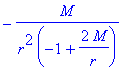
Such particles and signals will be expelled
from the cause-effect chain of universe. Therefore an imaginary surface
r = ![R[g]](images/astro363.gif) is named " event horizon
".
is named " event horizon
".
The absence of true physical singularity for
r =
can be illustrated in the following way. The invariant
of Riemann tensor ![R[alpha,beta,gamma,delta]*R^(alpha, beta, gamma, de...](images/astro455.gif) is
is
> schinv := invert( sch, 'detg'
):
D2sch := d2metric( D1sch, coord ):
Cf1 := Christoffel1 ( D1sch ):
RMN := Riemann( schinv, D2sch, Cf1 ):
raise(schinv,RMN,1):#raise of indexes in Riemann tensor
raise(schinv,%,2):
raise(schinv,%,3):
RMNinv := raise(schinv,%,4):
prod(RMN,RMNinv,[1,1],[2,2],[3,3],[4,4]);
![TABLE([compts = 48*M^2/(r^6), index_char = []])](images/astro456.gif)
and has no singularity on horizon. This is only coordinate singularity and its sense is the lack of rigid coordinates inside horizon. True physical singularity is r =0 and has the character of the so-called space-like singularity (the inavitable singularity for the observer crossing horizon).
Now try to embed the instant equator section of curved space into flat space (see above):
> z(r)[1] = int(sqrt(2*r*M-4*M^2)/(-r+2*M),r);
z(r)[2] = int(-sqrt(2*r*M-4*M^2)/(-r+2*M),r);
![z(r)[1] = -2*sqrt(2*M*r-4*M^2)](images/astro457.gif)
![z(r)[2] = 2*sqrt(2*M*r-4*M^2)](images/astro458.gif)
> plot3d({subs({M=1,r=sqrt(x^2+y^2)},rhs(%%)),subs({M=1,r=sqrt(x^2+y^2)},rhs(%))},x=-10..10,y=-10..10,axes=boxed,style=PATCHCONTOUR,grid=[100,100],title=`Schwarzschild black hole`);
![[Maple Plot]](images/astro459.gif)
This is the black hole, which looks as a neck of battle (Einstein-Rosen bridge): the inside way to horizon and the outside way to horizon are the ways between different but identically asymptotically flat universes ("wormhole" through 2-dimensional sphere with minimal radius 2 M ). But since the static geometry is not valid upon horizon (note, that here t-->t+dt is not time translation), this scheme is not stable.
Let's try to exclude the above-mentioned coordinate
singularity on the horizon by means of coordinate change. For example, we consider
the null geodesics (  =0) in Schwarzschild space-time corresponding to radial
motion of photons:
=0) in Schwarzschild space-time corresponding to radial
motion of photons:  =
= ![dr^2/((1-R[g]/r)^2)](images/astro462.gif) . Hence (see above considered expression for
. Hence (see above considered expression for ![r[0]](images/astro359.gif) ):
):
> t = combine( int(-1/(1-R[g]/r),r) );
![t = -r-R[g]*ln(r-R[g])](images/astro464.gif)
Then if v is the constant, which defines the radial coordinate for fixed t , we have
> t = -r - R[g]*ln( abs(-r/R[g]+1) ) + v;#module allows to extend the expression for r<R[g]
![t = -r-R[g]*ln(abs(r/R[g]-1))+v](images/astro465.gif)
Differentiation of this equation with subsequent
substitution of
in expression for interval in Schwarzschild metric produce
> defform(f=0,w1=1,w2=1,w3=1,v=1,R[g]=0,r=0,v=0);
d(t)^2 = expand( subs( d(R[g])=0,d( -r-R[g]*ln( r/R[g]-1 )+v ) )^2 );# differentials
in new coordinates
subs( d(t)^2=rhs(%),sch_compts[1,1]*d(t)^2 ) + sch_compts[2,2]*d(r)^2 + sch_compts[3,3]*d(theta)^2
+ sch_compts[4,4]*d(phi)^2:
collect( simplify( subs(R[g]=2*M,%) ),{d(r)^2,d(v)^2});#new metric
![d(t)^2 = r^2*d(r)^2/((r-R[g])^2)-2*r*d(r)*d(v)/(r-R...](images/astro467.gif)

So, we have a new linear element (in the so-called
Eddington-Finkelstein
coordinates )
= - ( ![1-R[g]/r](images/astro470.gif) )
)  + 2 dvdr +
 (
(  is the spherical part). The corresponding metric has the
regular character in all region of r
(except for r
=0). It should be noted, that the regularization was made
by transition to "light coordinate" v
therefore such coordinates can not be realized physically,
but formally we continued analytically the coordinates to all r
>0. We can see, that for future directed (i.e.
is the spherical part). The corresponding metric has the
regular character in all region of r
(except for r
=0). It should be noted, that the regularization was made
by transition to "light coordinate" v
therefore such coordinates can not be realized physically,
but formally we continued analytically the coordinates to all r
>0. We can see, that for future directed (i.e.
 >0)
null (
=0) or time like (
<0) worldlines dr
<0 for r <
that corresponds to above-mentioned conclusion about inevitable fall on singularity.
>0)
null (
=0) or time like (
<0) worldlines dr
<0 for r <
that corresponds to above-mentioned conclusion about inevitable fall on singularity.
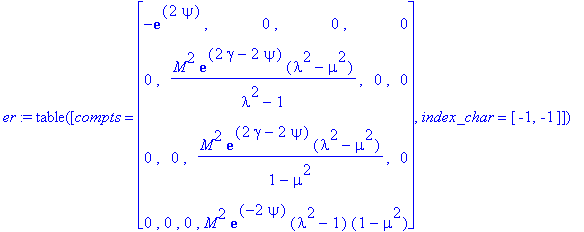
In the conclusion, we consider the problem of the deviation from spherical symmetry for static black hole. Such deviation can be described by the characteristic of quadrupole momentum q . Erez and Rosen found the corresponding static metric with axial symmetry:
> coord := [t, lambda, mu,
phi]:
er_compts := array(symmetric,sparse,1..4,1..4):# metric components
er_compts[1,1] := -exp(2*psi):# coefficient of d(t)^2 in interval
er_compts[2,2] := M^2*exp(2*gamma-2*psi)*(lambda^2-mu^2)/(lambda^2-1):# coefficient
of d(lambda)^2 in interval
er_compts[3,3] := M^2*exp(2*gamma-2*psi)*(lambda^2-mu^2)/(1-mu^2):# coefficient
of d(mu)^2 in interval
er_compts[4,4] := M^2*exp(-2*psi)*(lambda^2-1)*(1-mu^2):# coefficient of d(phi)^2
in interval
er := create([-1,-1], eval(er_compts));# axially symmetric metric
where
> f1 := psi = 1/2*( (1+q*(3*lambda^2-1)*(3*mu^2-1)/4)*ln((lambda-1)/(lambda+1))+3/2*q*lambda*(3*mu^2-1)
);
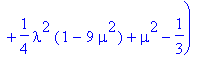
f2 := gamma = 1/2*(1+q+q^2)*ln((lambda^2-1)/(lambda^2-mu^2))-3/2*q*(1-mu^2)*(lambda*ln((lambda-1)/(lambda+1))+2)+9/4*q^2*(1-mu^2)*(
(lambda^2+mu^2-1-9*lambda^2*mu^2)*(lambda^2-1)/16*ln((lambda-1)/(lambda+1))^2+(lambda^2+7*mu^2-5/3-9*mu^2*lambda^2)*lambda*ln((lambda-1)/(lambda+1))/4+1/4*lambda^2*(1-9*mu^2)+(mu^2-1/3)
);
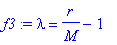
f3 := lambda = r/M-1;
f4 := mu = cos(theta);




In the case q =0 we have
> get_compts(er):
map2(subs,{psi=rhs(f1),gamma=rhs(f2)},%):
map2(subs,q=0,%):
map2(subs,{lambda=rhs(f3),mu=rhs(f4)},%):
map(simplify,%);
![matrix([[-(r-2*M)/r, 0, 0, 0], [0, r*M^2/(r-2*M), 0...](images/astro486.gif)
That is the Schwarzschild metric with regard to f3 and f4 .
Now let's find the horizon in the general case
of nonzero quadrupole momentum. For static field ( ![diff(g[alpha,beta],t)](images/astro487.gif) =0) the corresponding condition is
=0. Then
=0) the corresponding condition is
=0. Then
> map2(subs,psi=rhs(f1),er):
er2 := map2(subs,gamma=rhs(f2),%):
get_compts(er2)[1,1];

That is r =2 M ( l =1). But the result for invariant of curvature is:
> erinv := invert( er2, 'detg'
):
D1er := d1metric( er2, coord ):
D2er := d2metric( D1er, coord ):
Cf1 := Christoffel1 ( D1er ):
RMN := Riemann( erinv, D2er, Cf1 ):
raise(erinv,RMN,1):#raise of indexes in Riemann tensor
raise(erinv,%,2):
raise(erinv,%,3):
RMNinv := raise(erinv,%,4):
prod(RMN,RMNinv,[1,1],[2,2],[3,3],[4,4]):
get_compts(%):
series(%,q=0,2):#expansion on q
convert(%,polynom):
res := simplify(%):
In the spherical case the result corresponds to above obtained:
> factor( subs(q=0,res) ):#spherical
symmetry
subs(lambda=1,%);# this is 48*M^2/r^6

There is no singularity. But for nonzero q (let's choose m =0 for sake of simplification):
> subs(mu=0,res):
#L'Hospital's rule for calculation of limit
limit(diff(numer(%),lambda),lambda=1);
limit(diff(denom(%),lambda),lambda=1);


Hence, there is a true singularity on horizon that can be regarded as the demonstration of the impossibility of static axially symmetric black hole with nonzero quadrupole momentum. Such momentum will be "taken away" by the gravitational waves in the process of the black hole formation.
Reissner-Nordstrom black hole (charged black hole)
The generalization of Schwarzschild metric on the case of spherically symmetric vacuum solution of bounded Einstein-Maxwell equations results in
> coord := [t, r, theta, phi]:
rn_compts := array(symmetric,sparse,1..4,1..4):# metric components
rn_compts[1,1] := -(1-2*M/r+Q^2/r^2):# coefficient of d(t)^2 in interval
rn_compts[2,2] := 1/(1-2*M/r+Q^2/r^2):# coefficient of d(r)^2 in interval
rn_compts[3,3]:=g_matrix[3,3]:# coefficient of d(theta)^2 in interval
rn_compts[4,4]:=g_matrix[4,4]:# coefficient of d(phi)^2 in interval
rn := create([-1,-1], eval(rn_compts));# Reissner-Nordstrom (RN) metric
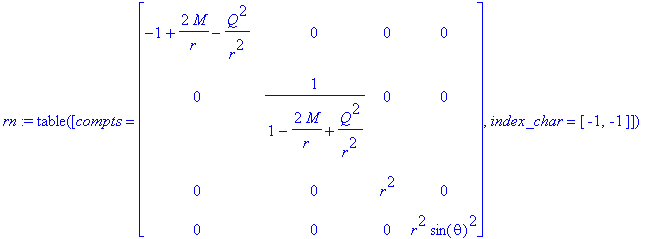
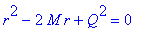
Here Q is the electric charge. The metric has three singularities: r =0 and
> denom(get_compts(rn)[2,2])
= 0;
r_p := solve(%, r)[1];
r_n := solve(%%, r)[2];


Let's calculate the invariant of curvature:
> rninv := invert( rn, 'detg'
):
D1rn := d1metric( rn, coord ):
D2rn := d2metric( D1rn, coord ):
Cf1 := Christoffel1 ( D1rn ):
RMN := Riemann( rninv, D2rn, Cf1 ):
raise(rninv,RMN,1):#raise of indexes in Riemann tensor
raise(rninv,%,2):
raise(rninv,%,3):
RMNinv := raise(rninv,%,4):
prod(RMN,RMNinv,[1,1],[2,2],[3,3],[4,4]);

> solve(get_compts(%),r);#nonphysical roots for numerator with nonzero Q
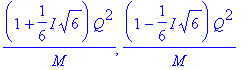
That is the situation like to one in Schwarzschild metric and two last singularities have a coordinate character. Now let us plot the signs of two first terms in linear element (we plot inverse value for second term in order to escape the divergence due to coordinate singularities).
> plot({subs({M=1,Q=1/2},get_compts(rn)[1,1]),\
subs({M=1,Q=1/2},1/get_compts(rn)[2,2])},\
r=0.1..2, title=`signs of first and second terms of linear element`);
![[Maple Plot]](images/astro501.gif)
One can see the radical difference from the
Schwarzschild black hole. The space and time terms exchange the roles in region
r_n <
r < r_p
(between so-called inner and outer horizons with
=0). But there are the usual signs in the vicinity of physical
singularity, i. e. it has a time-like
character and the falling observer can avoid this singularity.
Next difference is the lack of coordinate singularities
for  <
<  . In this case we have the so-called naked
singularity. One can demonstrate that there
is no such singularity as result of usual collapse of charged shell with mass
M and charge
Q . The total
energy (in Newtonian limit but with correction in framework of special relativity,
M_0 is the rest
mass) is
. In this case we have the so-called naked
singularity. One can demonstrate that there
is no such singularity as result of usual collapse of charged shell with mass
M and charge
Q . The total
energy (in Newtonian limit but with correction in framework of special relativity,
M_0 is the rest
mass) is
> en := M(r) = M_0 + Q^2/r
- M(r)^2/r;#we use the geometric units of charge so that the Coulomb low is
G*Q_1*Q_2/r^2
sol := solve(en,M(r));
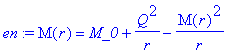

The choice of the solution is defined by the
correct asymptotic  = M_0 :
> if limit(sol[1],r=infinity)=M_0
then true_sol := sol[1] fi:
if limit(sol[2],r=infinity)=M_0 then true_sol := sol[2] fi:
true_sol;

> diff(true_sol,r):
subs(M_0=solve(en,M_0),%):
simplify(%,radical,symbolic);
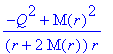
So,  =
= 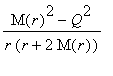 . The collapse is possible if M
decreases with decreasing
R (domination of gravity over the Coulomb interaction
in the process of collapse) that is possible, when
>
. It should be noted, that the limit
. The collapse is possible if M
decreases with decreasing
R (domination of gravity over the Coulomb interaction
in the process of collapse) that is possible, when
>
. It should be noted, that the limit
> limit(true_sol,r=0);

resolves the problem of the infinite proper energy of charged particle.
Now we will consider the pressure free collapse of charged sphere of dust by analogy with Schwarzschild metric.
> r := 'r':
E := 'E':
subs( r=r(t),get_compts(rn) ):
d(s)^2 = %[1,1]*d(t)^2 + %[2,2]*d(r)^2;#RN metric
-d(tau)^2 = collect(subs( d(r)=diff(r(t),t)*d(t),rhs(%) ),d(t));#tau is the
proper time for the observer on the surface of sphere
%/d(tau)^2;
subs({d(t)=E/(1-2*M/r(t)+Q^2/r^2),d(tau)=1},%);#we used d(t)/d(tau)=E/(1-2*M/r+Q^2/r^2)
pot_1 := factor( solve(%,(diff(r(t),t))^2) ):#"potential" for remote observer
pot_2 := simplify(pot_1*(E/(1-2*M/r(t)+Q^2/r^2))^2):#"potential for collapsing
observer" d/d(t)=(d/d(tau))*(1-2*M/r+Q^2/r^2)/E
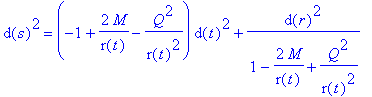
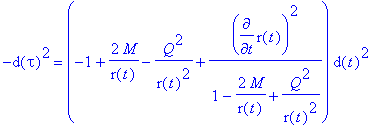
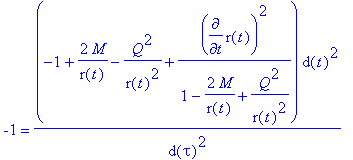
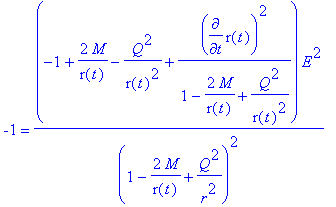
> plot({subs({E=0.5,M=1,Q=1/2,r(t)=r},pot_2),0*r},r=0.11..3,axes=boxed,title=`(dr/dtau)^2 vs r for collapsing observer`);
![[Maple Plot]](images/astro519.gif)
The difference from Schwarzschild collapse is obvious: the observer crosses the outer and inner horizons but does not reach the singularity because of the collapsar explodes as white hole due to repulsion with consequent recollapse and so on.
And at last, we consider the "extreme" case
=
.
> subs(Q^2=M^2, get_compts(rn));
factor(%[1,1]);
![matrix([[-1+2*M/r-M^2/(r^2), 0, 0, 0], [0, 1/(1-2*M...](images/astro522.gif)

So, we have one coordinate singularity in r = M . What happen with second horizon? Let's find the distance between horizons for fixed t and angular coordinates for RN-metric:
> get_compts(rn):
d(s)^2 = %[2,2]*d(r)^2;#RN metric
# or
d(s)^2 = d(r)^2/expand( (1-r_p/r)*(1-r_n/r) );#second representation of expression
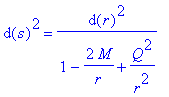
Hence, when r_p-->r_n
(  --> 0)
> r_p := 'r_p':
r_n := 'r_n':
s = Int(1/sqrt((1-r_p/r)*(1-r_n/r)),r=r_n..r_p) ;
simplify( value(rhs(%)),radical,symbolic );
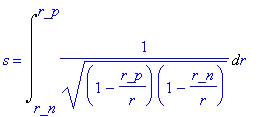

we have s-->
 .
So, there is the infinitely long Einstein-Rosen bridge (charged string) between
horizons that means a lack of wormhole between asymptotically flat universes.
This fact can be illustrated by means of embedding of equatorial section of
static RN space in flat Euclidian space (see above).
.
So, there is the infinitely long Einstein-Rosen bridge (charged string) between
horizons that means a lack of wormhole between asymptotically flat universes.
This fact can be illustrated by means of embedding of equatorial section of
static RN space in flat Euclidian space (see above).
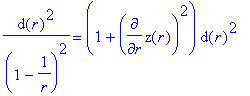
> d(r)^2/(1-1/r)^2 = (1+diff(z(r),r)^2)*d(r)^2;#equality
of radial elements of intervals, M=1
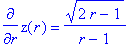
diff(z(r),r) = solve(%,diff(z(r),r))[1];
dsolve(%,z(r));# embedding

> plot3d(subs(r=sqrt(x^2+y^2),2*sqrt(2*r-1)+ln(sqrt(2*r-1)-1)-ln(sqrt(2*r-1)+1)),x=-10..10,y=-10..10,axes=boxed,style=PATCHCONTOUR,grid=[100,100],title=`extreme RN black hole`);#we expressed arctanh through ln
![[Maple Plot]](images/astro533.gif)
The asymptotic behavior of RN-metric as
r-->
is Minkowski. For investigation of the situation
r-->M let introduce
the new coordinate (see, for example, P.K.
Townsend, "Black Holes", arXiv: gr-gc/9707012):
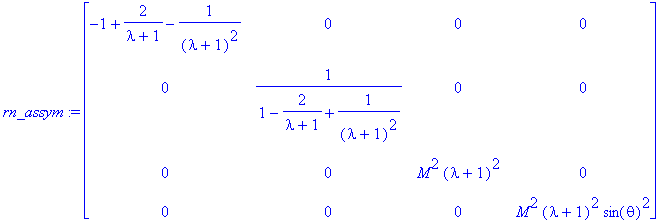
> rn_assym := subs( {r=M*(1+lambda),Q^2=M^2},get_compts(rn) );
> m1 := series(rn_assym[1,1],lambda=0,3);#
we keep only leading term in lambda
m2 := series(rn_assym[2,2],lambda=0,3);# we keep only leading term in lambda
d(s)^2 = convert(m1,polynom)*d(t)^2 +M^2*convert(m2,polynom)*d(lambda)^2 + M^2*d(Omega)^2;#d(Omega)
is spherical part

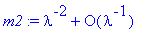
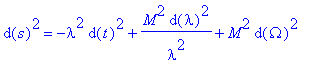
This is the Robinson-Bertotti metric . The last term describes two-dimensional sphere with radius M (these dimensions are compactified in the vicinity of horizon) and the first terms corresponds to anti-de Sitter space-time (see below) with constant negative curvature.
Kerr black hole (rotating black hole)
In the general form the stationary rotating black hole is described by so-called Kerr-Newman metric, which in the Boyer-Linquist coordinates can be presented as:
> coord := [t, r, theta, phi]:
kn_compts :=
array(sparse,1..4,1..4):# metric components, a=J/M, J is the angular momentum
kn_compts[1,1] :=
-(Delta-a^2*sin(theta)^2)/Sigma:# coefficient of d(t)^2
kn_compts[1,4] :=
-2*a*sin(theta)^2*(r^2+a^2-Delta)/Sigma:# coefficient of d(t)*dphi
kn_compts[2,2] :=
Sigma/Delta:# coefficient of d(r)^2
kn_compts[3,3] :=
Sigma:# coefficient of d(theta)^2
kn_compts[4,4] :=
(((r^2+a^2)^2-Delta*a^2*sin(theta)^2)/Sigma)*sin(theta)^2:# coefficient of d(phi)^2
kn := create([-1,-1], eval(kn_compts));# Kerr-Newman (KN) metric
#where
sub_1 := Sigma = r^2+a^2*cos(theta)^2;
sub_2 := Delta = r^2-2*M*r+a^2+sqrt(Q^2+P^2);# P is the magnetic (monopole)
charge
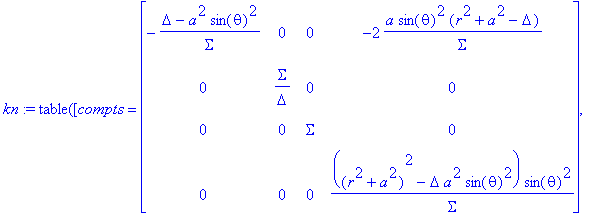




In the absence of charges, this results in Kerr metric. The obvious singularities are (except for an usual singularity of spherical coordinates q =0):
> r_p := solve( subs({Q=0,P=0},rhs(sub_2))=0,r
)[1];#outer horizon
r_n := solve( subs({Q=0,P=0},rhs(sub_2))=0,r )[2];#inner horizon
solve( subs({Q=0,P=0},rhs(sub_1))=0,theta );



The last produces r
=0, q =
 .
.
As it was in the case of charged static black
hole, there are three different situations:
<  ,
=
,
>
.
,
=
,
>
.
Let consider the signs of
, ![g[1,1]](images/astro557.gif) ,
, ![g[4,4]](images/astro558.gif) (
>
).
(
>
).
> plot3d(subs({M=1,a=1/2,P=0,Q=0},subs({Sigma=rhs(sub_1),Delta=rhs(sub_2)},get_compts(kn)[1,1])),\
r=0.1..4,theta=0..Pi,color=red):
plot3d(subs({M=1,a=1/2,P=0,Q=0,theta=2*Pi/3},subs({Sigma=rhs(sub_1),Delta=rhs(sub_2)},1/get_compts(kn)[2,2])),\
r=0.1..4,theta=0..Pi,color=green):
display(%,%%,title=`signs of first and second diagonal elements of metric`,axes=boxed);
plot3d(subs({M=1,a=1/2,P=0,Q=0},subs({Sigma=rhs(sub_1),Delta=rhs(sub_2)},get_compts(kn)[4,4])),\
r=-0.01..0.01,theta=Pi/2-0.01..Pi/2+0.01,color=blue,title=`four diagonal element
of metric in vicinity of singularity`,axes=boxed);
![[Maple Plot]](images/astro561.gif)
![[Maple Plot]](images/astro562.gif)
One can see, that the approach to r
=0 in the line, which differs from q
=
, corresponds to usual signs of diagonal elements of metric,
i.e. the observer crosses r =0
and comes into region r <0
without collision with singularity. But from the second picture we can see the
change of the ![g[3,3]](images/astro565.gif) -sign for r <0.
Now f is the time like
coordinate. But this coordinate has circle character and, as consequence, we
find oneself in the world with closed time lines. The approach to r
=0 in the line of q =
produces the change of
-sign, i.e. we find a true singularity in this direction.
These facts demonstrate that the singularity in Kerr black hole has a more complicated
character than in above considered black holes.
-sign for r <0.
Now f is the time like
coordinate. But this coordinate has circle character and, as consequence, we
find oneself in the world with closed time lines. The approach to r
=0 in the line of q =
produces the change of
-sign, i.e. we find a true singularity in this direction.
These facts demonstrate that the singularity in Kerr black hole has a more complicated
character than in above considered black holes.
The more careful consideration gives the following results:
1)
<
. There exists no horizon ( r_p
and r_n
are complex), but the singularity in r
=0, q =
keeps. To remove the coordinate singularity in q
=0 we introduce the Kerr-Schild
coordinates with linear element
> macro(ts=`t*`):
ks_le := d(s)^2 = -d(ts)^2 + d(x)^2 + d(y)^2 + d(z)^2 + (2*M*r^3/(r^4+a^2*z^2))*(
(r*(x*d(x)+y*d(y))-a*(x*d(y)-y*d(x)))/(r^2+a^2)+z*d(z)/r+d(ts) )^2;
x + I*y = (r + I*a)*sin(theta)*exp(I*(Int(1,phi)+Int(a/Delta,r)));
z = r*cos(theta);
ts = Int(1,t) + Int((r^2+a^2/Delta),r) - r;
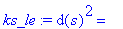

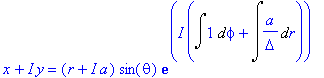

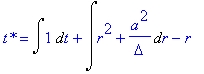
which is reduced to Minkowski metric by M--> 0.
> int(subs( {P=0,Q=0},subs(Delta=rhs(sub_2),a/Delta)
),r):
x+I*y=(r+I*a)*sin(theta)*exp(I*(phi+%));
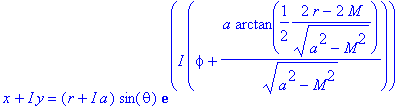
When r
=0, q =
the singularity is the ring  =
, z =
0.
=
, z =
0.
2)
>
. As before we have the ring singularity, but there are
the horizons r_p
and r_n . As a
additional feature of Kerr metric we note here the existence of coordinate singularity:
> get_compts(kn)[1,1]=0;
subs( Delta=rhs( sub_2 ),numer( lhs(%) ) ):
solve( subs({Q=0,P=0},%) = 0,r );
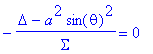

The crossing of ellipsoid r
_ 1 =
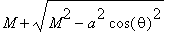 produces the change of
-sign. As it was for Schwarzschild black hole this fact
demonstrates the lack of static coordinates under this surface, which is called
"ergosphere "
and the region between r_p
and r_1 is the
ergoregion. The absence of singularity for
produces the change of
-sign. As it was for Schwarzschild black hole this fact
demonstrates the lack of static coordinates under this surface, which is called
"ergosphere "
and the region between r_p
and r_1 is the
ergoregion. The absence of singularity for ![r[r,r]](images/astro591.gif) suggests that the nonstatic behavior results from entrainment
of observer by black hole rotation, but not from fall on singularity, as it
takes place for observer under horizon in Schwarzschild black hole.
suggests that the nonstatic behavior results from entrainment
of observer by black hole rotation, but not from fall on singularity, as it
takes place for observer under horizon in Schwarzschild black hole.
Conclusion
So, the elementary analysis by means of basic Maple 6 functions allows to obtain the main results of black hole physics including conditions of collapsar formation, the space-time structure of static spherically symmetric charged and uncharged black holes and stationary axially symmetric black hole.