Introduction to relativistic astrophysics and cosmology through Maple
Vladimir L. Kalashnikov
,
Belarussian Polytechnical Academy,
[email protected]
www.geocities.com/optomaplev
Abstract:
The basics of the relativistic astrophysics including the celestial mechanics in weak field, black holes and cosmological models are illustrated and analyzed by means of Maple 6
Application Areas/Subjects:
Science, Astrophysics, General Relativity, Tensor Analysis, Differential geometry,
Differential equations
Relativistic celestial
mechanics in weak gravitational field
Introduction
The first results in the GR-theory were obtained without exact knowledge of the field equations (Einstein's equations for space-time geometry). The leading idea was the equivalence principle based on the equality of inertial and gravitational masses. We will demonstrate here that the natural consequences of this principle are the Schwarzschild metric and the basic experimental effects of GR-theory in weak gravitational field, i. e. planet's orbit precession and light ray deflection [see
Sommerfeld A. Lectures on theoretical physics, v. 3, Academic Press, NY, 313-315 (1952)
].
Schwarzschild metric
Let us consider the centrally symmetric gravitational
field, which is produced by mass M
. The small cell ![K[infinity]](images/astro1.gif) falls along x
-axis on the central mass. In the agreement with the equivalence
principle, the uniformly accelerated motion locally compensates the gravitational
force hence there is no a gravitational field in the free falling system
. This results in the locally Lorenzian metric with linear
element ( c is
the velocity of light):
falls along x
-axis on the central mass. In the agreement with the equivalence
principle, the uniformly accelerated motion locally compensates the gravitational
force hence there is no a gravitational field in the free falling system
. This results in the locally Lorenzian metric with linear
element ( c is
the velocity of light):
d  = d
= d ![x[infinity]^2](images/astro4.gif) + d
+ d ![y[infinity]^2](images/astro5.gif) + d
+ d ![z[infinity]^2](images/astro6.gif) -
-  d
d ![t[infinity]^2](images/astro8.gif)
The velocity v
and radial coordinate r
are measured in the spherical system K,
which are connected with central mass. It is natural, the observer in this motionless
system "feels" the gravitational field. Since the first system moves relatively
second one there are the following relations between coordinates:
d ![x[infinity]](images/astro9.gif) =
=  (b
=
(b
=  )
)
d ![t[infinity]](images/astro13.gif) =
=  dt
dt
d ![y[infinity]](images/astro15.gif) =rdq
=rdq
d ![z[infinity]](images/astro17.gif) =r
=r  df
df
The first and second relations are the Lorentzian
length shortening and time slowing down in the moving system. As result,
from K
looks as:
d
= 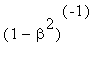 d
d  +
( d
+
( d  +
+  d
d  ) -
) -  ( 1 -
( 1 -
 ) d
) d 
The sense of the additional terms in metric
has to connect with the characteristics of gravitational field. What is the
energy of
in K ?
If the mass of
is m ,
and ![m[0]](images/astro33.gif) is the rest mass, the sum of kinetic and potential energies
is:
is the rest mass, the sum of kinetic and potential energies
is:
>
restart:
with(plots):
(m - m0)*c^2 - G*M*m/r=0;# energy conservation law (we suppose that the Newtonian law of gravitation is correct in the first approximation), G is the gravitational constant
%/(m*c^2):
subs( m=m0/sqrt(1-beta^2),% ):# relativistic mass
expand(%);
solve( %,sqrt(1-beta^2) ):
sqrt(1-beta^2) = expand(%);
1-beta^2 = taylor((1-subs(op(2,%)=alpha/r,rhs(%)))^2,alpha=0,2);# alpha=G*M/c^2, we use the first-order approximation on alpha
Warning, the name changecoords has been redefined
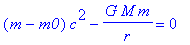
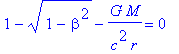
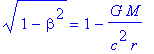
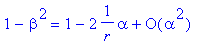
The last results in:
d
=  +
( d
+
d
) -
(1 -
+
( d
+
d
) -
(1 -
 ) d
) d
This linear element describes the so-called
Schwarzschild metric
. In the first-order approximation:
>
taylor( d(r)^2/(1-2*alpha/r)+r^2*(d(theta)^2+sin(theta)^2*d(phi)^2)-c^2*(1-2*alpha/r)*d(t)^2, alpha=0, 2 ):
convert( % , polynom ):
metric := d(s)^2 = collect( % , {d(r)^2, d(t)^2} );

Equations of motion
Let us consider a motion of the small unit
mass in Newtonian gravitational potential F
= -  . Lagrangian
describing the motion in centrally symmetric field is:
. Lagrangian
describing the motion in centrally symmetric field is:
>
L := (diff(r(t),t)^2 + r(t)^2*diff(theta(t),t)^2)/2 + G*M/r(t);

The transition to Schwarzschild metric transforms the time and radial differentials of coordinates (see, for example, [
Kai-Chia Cheng. A simple calculation of the perihelion Mercury from the principle of equivalence. Nature (Lond.), v. 155, 574 (1945); N.T. Roseveare, Mercury's perihelion from Le Verrier to Einstein, Clarendon Press - Oxford, 1982
]):
dr -->
(1 +  ) dr
and dt -->
) dr
and dt -->
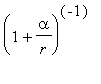 dt (it
should be noted, that the replacement will be performed for differentials, not
coordinates, and we use the weak field approximation for square-rooting):
dt (it
should be noted, that the replacement will be performed for differentials, not
coordinates, and we use the weak field approximation for square-rooting):
>
L_n := collect(\
expand(\
subs(\
{diff(r(t),t)=gamma(r(t))^2*diff(r(t),t),\ diff(theta(t),t)=gamma(r(t))*diff(theta(t),t)}, L ) ),\
{diff(r(t),t)^2, diff(theta(t),t)^2});# modified Lagrangian, gamma(r) = 1+alpha/r(t)

Next step for the obtaining of the equations
of motion from Lagrangian is the calculation of the force  and the momentum
  ,
where y =
,
where y =
 :
:
>
e1 := Diff(Lagrangian(r, Diff(r,t)), r) = diff(subs(r(t) = r, L_n),r);# first component of force
e2 := Diff(Lagrangian(r, Diff(r,t)), Diff(r,t)) = subs( x=diff(r(t),t), diff(subs(diff(r(t),t)=x, L_n), x));# first component of momentum
e3 := Diff(Lagrangian(theta, Diff(theta,t)), theta) = diff(subs(theta(t) = theta, L_n), theta);# second component of force
e4 := Diff(Lagrangian(theta, Diff(theta,t)), Diff(theta,t)) = subs(y=diff(theta(t),t), diff(subs(diff(theta(t),t)=y, L_n), y));# second component of momentum
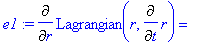




The equations of motion are the so-called
Euler-Lagrange equations
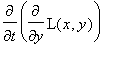 -
= 0 (in fact, these equations are the second Newton's law
and result from the law of least action). Now let us write the equations of
motion in angular coordinates. Since e3 = 0
due to an equality to zero of the mixed derivative, we
have from e4 the
equation of motion
-
= 0 (in fact, these equations are the second Newton's law
and result from the law of least action). Now let us write the equations of
motion in angular coordinates. Since e3 = 0
due to an equality to zero of the mixed derivative, we
have from e4 the
equation of motion ![diff(diff(L(r,theta,y[1],y[2]),y[2]),t)](images/astro64.gif) -
- ![diff(L(r,theta,y[1],y[2]),theta)](images/astro65.gif) = 0 (
= 0 ( ![y[1]](images/astro66.gif) =
=  ,
, ![y[2]](images/astro68.gif) =
=  ) in the form:
>
Eu_Lagr_1 := Diff(rhs(e4),t) = 0;

Hence
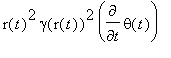 = H
= const
= H
= const
>
sol_1 := Diff(theta(t),t) = solve( gamma^2*diff(theta(t),t)/u(theta)^2 = H, diff(theta(t),t) );# u=1/r is the new variable
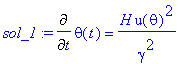
The introduced replacement u=
 leads to the next relations:
>
Diff(r(t), t) = diff(1/u(t),t);
Diff(r(t), t) = diff(1/u(theta),theta)*diff(theta(t),t);# change of variables
sol_2 := Diff(r(t), t) = subs(diff(theta(t),t) = rhs(sol_1), rhs(%));# the result of substitution of above obtained Euler-Lagrange equation
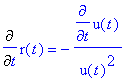
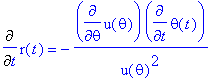
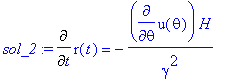
The last result will be used for the manipulations
with second Euler-Lagrange equation ![diff(diff(L(r,theta,y[1],y[2]),y[1]),t)](images/astro77.gif) -
- ![diff(L(r,theta,y[1],y[2]),r)](images/astro78.gif) = 0. We have for the right-hand side of e2:
= 0. We have for the right-hand side of e2:
>
Diff( subs( {diff(r(t),t)=rhs(%),gamma(r(t))=gamma}, rhs(e2)), t );
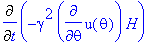
and can rewrite this expression:
>
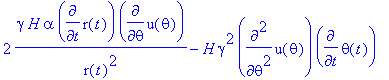
-2*gamma*H*diff(1+alpha/r(t),t)*diff(u(theta),theta) - H*gamma^2*diff(u(theta),theta$2)*diff(theta(t),t);# from the previous expression, definition of gamma and definition of derivative of product
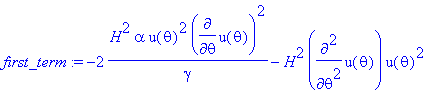
first_term := subs({r(t)=1/u(theta), diff(theta(t),t)=rhs(sol_1)},\
subs(diff(r(t),t) = rhs(sol_2),%));# this is a first term in second Euler-Lagrange equation
e1
results in:
>
2*gamma(r)^3*diff(r(t),t)^2*diff(gamma(r),r) + \
r*gamma(r)^2*diff(theta(t),t)^2 + \
r^2*gamma(r)*diff(theta(t),t)^2*diff(gamma(r),r) - \
G*M/(r^2);# This is e1
subs(\
{diff(r(t),t) = rhs(sol_2), diff(gamma(r),r) = diff(1+alpha/r,r), diff(theta(t),t) = rhs(sol_1)},\
%):# we used the expressions for diff(r(t),t), gamma(r) and the first equation of motion
subs(gamma(r) = gamma, %):
second_term := subs(r = 1/u(theta), %);


And finally:
>
Eu_Lagr_2 := expand( simplify(first_term - second_term)/u(theta)^2/H^2);

In the first-order approximation:
>
gamma^n = taylor((1+alpha*u)^n, alpha=0,2);

So
>
taylor( subs(gamma = 1+alpha*u(theta),Eu_Lagr_2), alpha=0,2 ):
basic_equation := convert(%, polynom) = 0;

Light ray deflection
In the beginning the obtained equation will
be used for the search of the light ray deflection in the vicinity of a star.
The fundamental consideration has to be based on the condition of null geodesic
line d
=0 for light, but we simplify a problem and consider the
trajectory of the particle moving from the infinity. In this case H=
 .
.
>
eq_def := subs(G*M/(H^2)=0,basic_equation);
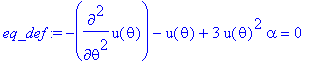
The free propagation ( a=0)
results in:
>
subs(alpha=0, lhs(eq_def)) = 0;
sol := dsolve({%, u(0) = 1/R, D(u)(0) = 0}, u(theta));# theta is measured from perihelion, where r = R
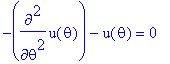
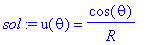
That is r=
 . The last expression corresponds to the straight ray passing
through point q=0,
r = R
. To find the corrected solution in the gravitational field
let substitute the obtained solution into eliminated term in eq_def
:
. The last expression corresponds to the straight ray passing
through point q=0,
r = R
. To find the corrected solution in the gravitational field
let substitute the obtained solution into eliminated term in eq_def
:
>
-op(1,lhs(eq_def)) - op(2,lhs(eq_def)) = subs(u(theta)=rhs(sol),op(3,lhs(eq_def)));
sol := dsolve({%, u(0) = 1/R, D(u)(0) = 0}, u(theta));#corrected solution in the presence of field
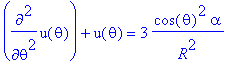
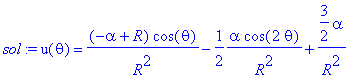
The equation for asymptote 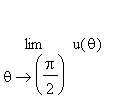 describes the observed ray. Then angle of ray deflection
is
describes the observed ray. Then angle of ray deflection
is  (symmetrical deflection before and after perihelion). Hence
>
simplify( 2*subs({theta=Pi/2, alpha=G*M/c^2},rhs(sol))*R );

This is correct expression for the light ray deflection in the gravitational field. For sun we have:
>
subs({kappa=0.74e-28, M=2e33, R=6.96e10},4*kappa*M/R/4.848e-6);
# in ["],where kappa = G/c^2 [cm/g], 4.848e-6 rad corresponds to 1"

The ray trajectory within Pluto's orbit distance is presented below:
>
K := (theta, alpha, R) -> 1 / (-(alpha-R)*cos(theta)/(R^2)-1/2*alpha*cos(2*theta)/(R^2)+3/2*alpha/(R^2)):
S := theta -> K(theta, 2.125e-6, 1):#deflected ray
SS := theta -> 1/cos(theta):#ray without deflection
p1 := polarplot([S,theta->theta,Pi/2..-Pi/2],axes=boxed):
p2 := polarplot([SS,theta->theta,Pi/2..-Pi/2],axes=boxed,color=black):
display(p1,p2,view=-10700..10700,title=`deflection of light ray`);#distance of propagation corresponds to 100 AU=1.5e10 km, distance is normalyzed to Sun radius
![[Maple Plot]](images/astro101.gif)
Planet's perihelion motion
Now we return to basic_equation
. Without relativistic correction to the metric (
a =0) the solution is
>
sol := dsolve({subs({G*M/(H^2)=k,alpha=0},basic_equation),u(0)=1/R,D(u)(0)=0},u(theta));

This equation describes an elliptical orbit:
u=k
( 1 + e  ),
),
where e =
(  - 1) is the eccentricity.
For Mercury k =
0.01, e = 0.2056,
R = 83.3
- 1) is the eccentricity.
For Mercury k =
0.01, e = 0.2056,
R = 83.3
>
K := (theta, k, R) -> 1/(k-(k*R-1)*cos(theta)/R):
S := theta -> K(theta, .01, 83.3):
polarplot([S,theta->theta,0..2*Pi],title=`Orbit of Mercury`);
![[Maple Plot]](images/astro106.gif)
The correction to this expression results from the substitution of obtained solution in
basic_equation
.
>
subs({G*M/(H^2)=k,3*u(theta)^2*alpha=3*alpha*(k*(1+e*cos(theta)))^2},\
basic_equation);
dsolve({%,u(0)=1/R,D(u)(0)=0},u(theta));



Now it is possible to plot the corrected orbit (we choose the exaggerated parameters for demonstration of orbit rotation):
>
K := (theta, k, R, alpha, e) -> 1 / (3*alpha*k^2*e*cos(theta)+3*sin(theta)*alpha*k^2*e*theta+3/2*alpha*k^2*e^2-1/2*alpha*k^2*e^2*cos(2*theta)+k+3*alpha*k^2-(3*alpha*k^2*e*R+alpha*k^2*e^2*R+k*R+3*alpha*k^2*R-1)*cos(theta)/R):
S := theta -> K(theta, .42, 1.5, 0.01, 0.6):
polarplot([S,theta->theta,0..4.8*Pi],title=`rotation of orbit`);
![[Maple Plot]](images/astro110.gif)
Now we try to estimate the perihelion shift
due to orbit rotation. Let's suppose that the searched solution of basic_equation
differs from one in the plane space-time only due to ellipse
rotation. The parameter describing this rotation is w:
u ( q
) = k (1
+ e  ).
).
>
subs({G*M/(H^2)=k,u(theta)=k*(1+e*cos(theta-omega*theta))},\
basic_equation):#substitution of approximate solution
simplify(%):
lhs(%):
collect(%, cos(-theta+omega*theta)):
coeff(%, cos(-theta+omega*theta)):#the coefficient before this term gives algebraic equation for omega
subs(omega^2=0,%):#omega is the small value and we don't consider the quadratic term
solve(% = 0, omega):
subs({alpha = G*M/c^2, k = 1/R/(1+e)},2*Pi*%);#result is expressed through the minimal distance R between planet and sun; 2*Pi corresponds to the transition to circle frequency of rotation
subs(R=a*(1-e),%);#result expressed through larger semiaxis a of an ellipse
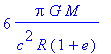
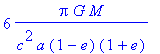
Hence for Mercury we have the perihelion shift during 100 years:
>
subs({kappa=0.74e-28,M=2e33,a=57.9e11,e=0.2056},\
6*Pi*kappa*M/a/(1-e^2)*(100*365.26/87.97)/4.848e-6):#here we took into account the periods of Earth's and Mercury's rotations
evalf(%);#["]

Now we will consider the
basic_equation
in detail [
J. L. Synge, Relativity: the general theory, Amsterdam (1960)
]. The implicit solutions of this equation are:
>
dsolve( subs(G*M/H^2=k, basic_equation), u(theta));
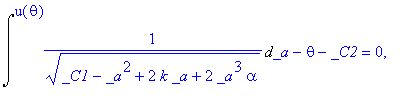
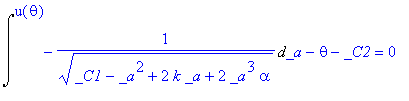
Hence, these implicit solutions result from
the following equation (b
is the constant depending on the initial conditions):
>
diff( u(theta), theta)^2 = 2*M*u(theta)^3 - u(theta)^2 + 2*u(theta)*M/H^2 + beta;# we use the units, where c=1, G=1 (see definition of the geometrical units in the next part)
f := rhs(%):
f = 2*M*( u(theta) - u1 )*( u(theta) - u2 )*( u(theta) - u3 );
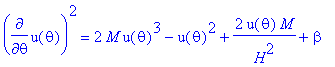

Here
u1
,
u2
,
u3
are the roots of cubic equation, which describes the "potential" defining the orbital motion:
>
fun := rhs(%);

The dependence of this function on
u
leads to the different types of motion. The confined motion corresponds to an elliptical orbit
>
plot(subs({u3=2, u2=1, u1=0.5, M=1/2},fun),u=0.4..1.1, title=`elliptical motion`, axes=boxed, view=0..0.08);
![[Maple Plot]](images/astro123.gif)
The next situation with u--
>0 ( r-- >
) corresponds to an infinite motion:
>
plot(subs({u3=2, u2=1, u1=-0.1, M=1/2},fun),u=0..1.1, title=`hyperbolical motion`, axes=boxed, view=0..0.6);
![[Maple Plot]](images/astro125.gif)
Now we return to the right-hand side of the modified basic equation.
>
f;
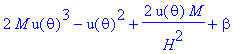
In this expression, one can eliminate the second
term by the substitution u (q
)= y (
q ) 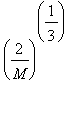 +
+  :
:
>
collect( subs(u(theta) = (2/M)^(1/3)*y(theta) + 1/(6*M), f),y(theta) );
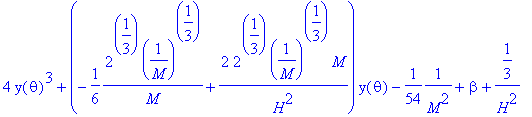
This substitution reduced our equation to canonical
form for the Weierstrass P function
[ E. T. Whittaker, G. N.
Watson, A course of modern analysis, Cambridge (1927) ]:
>
g2 = simplify(coeff(%, y(theta)));
g3 = -simplify(coeff(%%, y(theta), 0));
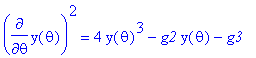
diff( y(theta), theta)^2 = 4*y(theta)^3 - g2*y(theta) - g3;
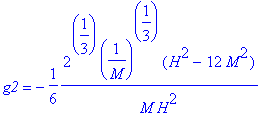
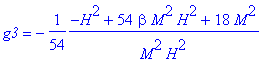
that results in:
>
y(theta) = WeierstrassP(theta, g2, g3);

In the general case, the potential in the form
of three-order polynomial produces the solution in the form of Jacobi
sn-function:
>
Orbit := proc(f, x)
print(`Equation in the form: u'(theta)^2 = a[0]*u^3+a[1]*u^2+a[2]*u+a[3]`):
degree(f,x):
if(% = 3) then
a[0] := coeff(f, x^3):# coefficients of polynomial
a[1] := coeff(f, x^2):
a[2] := coeff(f, x):
a[3] := coeff(f, x, 0):
sol := solve(f = 0, x):
print(`Roots of polynomial u[1] < u[2] < u[3]:`):
print(sol[1], sol[2], sol[3]):
solution := u[1] + (u[2]-u[1])*JacobiSN(theta*sqrt( 2*M*(u[3]-u[1]) )/2 + delta,sqrt((u[2]-u[1])/(u[3]-u[1])))^2:
print(`Result through Jacobi sn - function`):
print(u(theta) = solution):
else
print(`The polynomial degree is not 3`)
fi
end:
>
Orbit(subs(u(theta)=x,f),x);
![`Equation in the form: u'(theta)^2 = a[0]*u^3+a[1]*...](images/astro136.gif)
![`Roots of polynomial u[1] < u[2] < u[3]:`](images/astro137.gif)


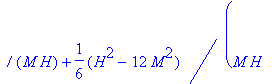



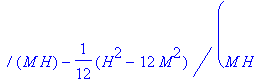

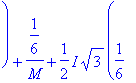

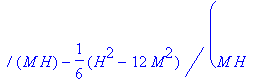



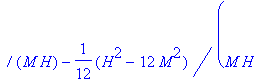

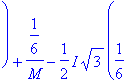

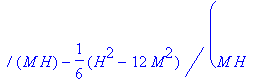



![u(theta) = u[1]+(u[2]-u[1])*JacobiSN(1/2*theta*sqrt...](images/astro160.gif)
As ![u[1]](images/astro161.gif) =
= ![1/r[1]](images/astro162.gif) and
and ![u[2]](images/astro163.gif) =
= ![1/r[2]](images/astro164.gif) are the small values for the planets (
are the small values for the planets ( ![r[1]](images/astro165.gif) and
and ![r[2]](images/astro166.gif) are the perihelion and aphelion points) and
+
+
are the perihelion and aphelion points) and
+
+ ![u[3]](images/astro169.gif) =
=  , we have 2 M
=1 and
, we have 2 M
=1 and
>
u(theta) - u[1] = (u[2] - u[1])*JacobiSN(1/2*theta+delta,0)^2;
![u(theta)-u[1] = (u[2]-u[1])*sin(1/2*theta+delta)^2](images/astro172.gif)
that is the equation of orbital motion (see
above) with e =
![(u[2]-u[1])/(u[2]+u[1])](images/astro173.gif) .
> 0 corresponds to the elliptical motion,
< 0 corresponds to hyperbolical motion. The period of
the orbital motion in the general case:
.
> 0 corresponds to the elliptical motion,
< 0 corresponds to hyperbolical motion. The period of
the orbital motion in the general case:
>
(u[2]-u[1])/(u[3]-u[1]):
kernel := 2/sqrt((1-t^2)*(1-t^2*%)):#2 in the numerator corresponds to sn^2-period
int(kernel, t=0..1);
![2*EllipticK(sqrt(-(-u[2]+u[1])/(u[3]-u[1])))](images/astro176.gif)
and can be found approximately for small
and
as result of expansion:
>
series(2*EllipticK(x), x=0,4):
convert(%,polynom):
subs(x = sqrt( 2*M*(u[2]-u[1]) ), %);
![Pi+1/2*Pi*M*(u[2]-u[1])](images/astro179.gif)
From the expression for u
( q )
and obtained expression for the period of  we have the change of angular coordinate over period:
>
%/(1/2*sqrt( 2*M*(u[3]-u[1]) )):
simplify(%);
![-1/2*Pi*(-2-M*u[2]+M*u[1])*sqrt(2)/(sqrt(M*(u[3]-u[...](images/astro182.gif)
But ![sqrt(2*M*(u[3]-u[1]))](images/astro183.gif) =
= ![sqrt(1-2*M*(u[1]-u[2]-u[1]))](images/astro184.gif) ~ 1 +
~ 1 + ![M*(2*u[1]+u[2])](images/astro185.gif) . And the result is
. And the result is
>
2*Pi*(1 + M*(u[2]-u[1])/2)*(1 + M*(2*u[1]+u[2])):
series(%, u[1]=0,2):
convert(%,polynom):
series(%, u[2]=0,2):
convert(%,polynom):
expand(%):
expand(%-op(4,%)):
factor(%);
![Pi*(2+3*M*u[1]+3*M*u[2])](images/astro186.gif)
The deviation of the period from 2p
causes the shift of the perihelion over one rotation of
the planet around massive star.
>
simplify(%-2*Pi):
subs({u[1]=1/r[1], u[2]=1/r[2]}, %):
subs({r[1]=a*(1+e), r[2]=a*(1-e)},G*%/c^2):# we returned the constants G and c
simplify(%);
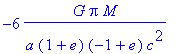
This result coincides with the expression, which was obtained on the basis of approximate solution of
basic_equation.
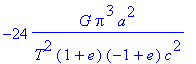
From the Kepler's low we can express this result through orbital period:
>
subs(M=4*Pi^2*a^3/T^2, %):# T is the orbital period
simplify(%);
Conclusion
So, we found the expression for the Schwarzschild metric from the equivalence principle without introducing of the Einstein's equations. On this basis and from Euler-Lagrange equations we obtained the main experimental consequences of GR-theory: the light ray deflection and planet's perihelion motion.