| Professional societies I am a student member of the following professional societies: Association for the Study of Animal Behaviour (ASAB), Ornithological Society of New Zealand (OSNZ), International Society for Behavioural Ecology (ISBE), and the Royal Society of New Zealand (RSNZ) (Canterbury Branch). |
| I recently completed a Ph.D. in behavioural ecology at Newcastle University in the United Kingdom which focussed on the role of physiological state on the foraging behaviour of birds. The majority of this research focussed on the energy/toxin trade-off involved in the predation of chemically defended prey. However, I also examined the possible role of energetic state on two other aspects of foraging behaviour. First, I examined the possible role of energy reserves on the foraging preferences that European starlings (Sturnus vulgaris) in a laboratory study. I found that the starlings did not display breaches in rationality irrespective of their levels of energy reserves. However, I found that some of the assumptions that I made regarding the payoffs and costs associated with the different foraging options might have been flawed. Second, I examined the risk-sensitive foraging behaviour of rufous hummingbirds (Selasphorus rufus) in free-living birds in Alberta, Canada. I was interested if there would be changes in the risk-sensitive foraging strategy of birds could be related to changes in the ambient temperatures. I found that the birds were indifferent to risk despite large temporal fluctuations in temperature. For the major part of my thesis research, I conducted a number of experiments on the energy toxin trade-off that has recently been formalised in stochastic dynamic programming (SDP) models. Through careful manipulation of the body mass, I unequivocally confirmed the energy/toxin trade-off under a number of conditions. I also made a number of other interesting findings which I am currently preparing for publication in scientific journals. For example, it is assumed that if the frequency of a chemically undefended mimetic species is increased, then this will increase the predation of the defended model which the mimic resembles. However, I found that this was not the case when the frequency of mimics was increased and in fact the models survivorship was enhanced at higher mimic frequencies. I am presenty working on many manuscripts from this research which I hope to publish in the next year or two. Please contact me if you would like further details of my Ph.D. research. I am presently at Illinois State University working as a post-doctoral fellow on the levels of reproductive investment made by female house wrens in reference to her mate's attractiveness. I am working in the lab of Professor Scott Sakaluk in collaboration with Professor Charlie Thompson. |
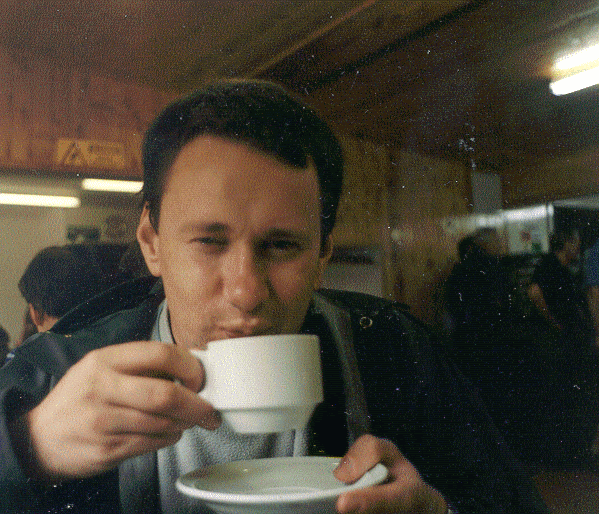 |
| Publications Barnett, C.A., Bateson, M., Rowe, C. The effect of mimic frequency and food availability on predation in a Batesian mimicry system. (Submitted to Proceedings of the National Academy of Sciences of the USA). Barnett, C.A., Briskie, J.V. 2007. Energetic state and the performance of dawn chorus in silvereyes. Behavioural Ecology & Sociobiology 61: 579-587. Barnett, C.A., Bateson, M., Rowe, C. 2007. State-dependent decision making: educated predators strategically trade-off the costs and benefits of consuming aposematic prey. Behavioral Ecology 18: 645-651. Barnett, C.A. 2007. The effect of physiological state on the foraging decisions of birds. Unpublished Ph.D. Thesis, Newcastle University. UK (c) Craig Barnett Link Barnett, C.A. 2004. Behavioral Plasticity. In Bekoff, M. (Ed.). Encyclopedia of Animal Behavior. Westport, CT: Greenwood Publishing Group. Pp. 117-120. Other Publications |
| Page last updated Sept 2007 |
| Dr Craig Barnett |