| Norma |
 |
 |
| Sound Samples for Real or Windows Conductor: Vittorio Gui / Maria Callas, Joan Sutherland, et al. / Label: Emi Classics |
| Though he adhered to the formal structure of the Bel Canto period by composing his numbers in the scena � cantabile � tempo di mezzo � cabaletta variety, he made several interesting departures, which were a bit radical for their day. Though not the first to do so, Bellini opens Act i with a soloist rather than the traditional ensemble introduzione. Then, instead of concluding the act with a grand scene involving all the chorus and principals frozen in utter stupefaction, he focuses on the love triangle of the three principals. He opens Act ii, not with an aria for Norma as she contemplates killing her sons, but more of a dramatic, declamatory scena as she agonizes over her choices. The opera has only two real arias, one for Norma and another for Pollione � Adalgisa is given a mere preghiera, a prayer sandwiched between two sections of recitative, and Oroveso's sortita is accompanied by chorus. And finally, to end Act ii, rather than having the soprano singing a rousing cabaletta or rond� with chorus, the opera comes to an abrupt end as Norma and Pollione solemnly progress to their immolation. (Full article-Norma: Background Notes) |
| In the first act aria "Costa Diva" ("Chaste Goddess"), in which Norma sings a hymn to the goddess of the moon, there is poetic imagery "about the moon shining on her face and asking that the moon shine, unclouded and unveiled, upon her and her people," Reveles said.
"The melodic line twists and turns, as if the composer is almost drawing a picture of her prayer rising into the sky," he added. "The climactic note in the first eight phrases is over the word which describes the moon's face: Bellini underlines the word 'face' by placing that particular word at the climax of the first verse. He is creating a phonic environment, so the audience can really believe the text, really believe that she is singing to the moon and treating it like a goddess." Full article-Norma raises questions of bel canto versus kol isha) |
| Of all his operas, Norma is often regarded as 'the most beautiful rose in the garland'. It was written at breakneck speed between September and December 1831 and premiered to rapturous acclaim on Boxing Day at La Scala with the ink still wet on the page. It was not, however, all plain sailing. In a letter to his friend Vincenzo Ferlito, written on 28th December, Bellini wrote:
In spite of a formidable cabal against it, worked up by one powerful and one very rich person, my Norma astounded the public even more last night, at the second performance, than the first. The powerful person acts thus because she is an enemy of Mme Pasta [sic: improbable but true] and the wealthy one because she is Pacini's mistress and therefore my enemy; yet the opera was even more appreciated last night and the theatre was crammed full, a real sign of an opera's success ...(Article) |
| When Bellini wrote this opera, the idea was to highlight the prima donna�s intense dramatic powers. The leading roles in Norma are extremely demanding - the title role being probably the most difficult in the entire operatic repertoire, since it requires the rarest voice of soprano drammatico d�agilit�, something more usually called "dramatic coloratura" today. It requires everything of a singer - an enormous range, complete control of coloratura, dynamics and of declamation and also a powerful voice. (Commented Discography-Norma) |
 |
| Ology |
 |
 |
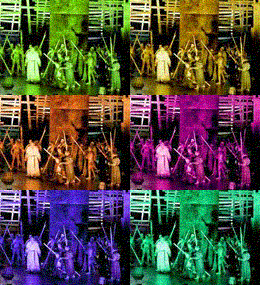 |
| Set against a entangled forest primeval, this Canadian Opera Production is a Norma far from the "a tree here, a rock there," concept of set design, and yet not all that far from the real forest experience. This forest is mystic and metaphoric. It bristles with the tension that Norma herself creates as she tries to be loyal to her love, her community, her children and ultimately to herself. |
 |
 |
 |
|
| This site and all related sites are for entertainment and reserch and contains information that anyone can get by using a search engine, such as Google./ This site is a sub-site of SF ART World // Creative Commons Attribution-Noncommercial-No Derivative Works 3.0 Licens |
| Roles Norma, daughter of Oroveso, High-priestess of the Celts soprano Adalgisa, priestess in the grove of the Irminsul statue soprano or mezzo soprano Pollione, Roman proconsul in Gaul tenor Oroveso, chief of the Druids bass Clotilde, Norma�s friend soprano Flavio, Pollione�s companion tenor |