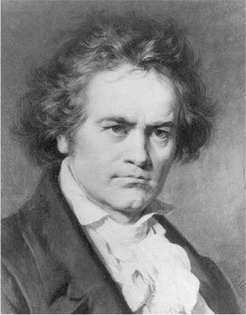
| Ludwig von Beethoven |
| Influential German composer of the late 18th and early 19th centuries, whose individual musical style successfully combined elements of the traditional, the innovative and a new personal expression. Beethoven pushed classical music to its limits and heralded the Romantic era. (BBC-Artis Profile) |
 |
| He only did one opera - Fidelio Main article: Beethoven's musical style and innovations Beethoven is viewed as a transitional figure between the Classical and Romantic eras of musical history. He built formally on the principles of sonata form and motivic development that he had inherited from Haydn and Mozart, but expanded their scope, writing longer and more ambitious movements. The work of Beethoven's middle period is celebrated for its frequently heroic form of expression, and the works of his late period for their intellectual depth. Personal beliefs and their musical influence Beethoven was much taken by the ideals of the Enlightenment and by the growing Romanticism in Europe. He initially dedicated his third symphony, the Eroica, to Napoleon in the belief that the general would sustain the democratic and republican ideals of the French Revolution, but in 1804 crossed out the dedication as Napoleon's imperial ambitions became clear, replacing it with "to the memory of a great man". The fourth movement of his Ninth Symphony is a setting of Schiller's ode An die Freude ("To Joy"), an optimistic hymn championing the brotherhood of humanity. The Middle period began shortly after Beethoven's personal crisis centering around deafness, and is noted for large-scale works expressing heroism and struggle; these include many of the most famous works of classical music. The Middle period works include Symphonies Nos. 3-8, the last three piano concertos and Violin Concerto, the string quartets #7-11, many piano sonatas (including the "Moonlight", "Waldstein", and "Appassionata"), and the opera Fidelio. Beethoven as fictional character Beethoven's larger-than-life persona has led many authors and filmmakers to incorporate him into works of fictionalized biography, among them Beethoven Lives Upstairs by Barbara Nichol and Scott Cameron and the popular 1994 film Immortal Beloved. Beethoven was the title character in the Trans-Siberian Orchestra's concept album, Beethoven's Last Night. In it, he makes a deal with the Devil to ease the suffering of a child sitting outside his door. (Source) |
 |
 |
|
| 1770-1827 |
 |
| SF Symphony
Keeping Score. Watch a Trailer Episode 1: Beethoven�s Eroica |
| This site is is for entertainment and reserch and contains information that anyone can get by using a search engine, such as Google./ This site is a sub-site of SF ART World // Creative Commons Attribution-Noncommercial-No Derivative Works 3.0 License. |