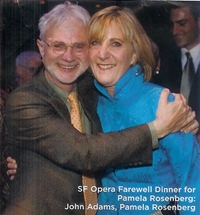
If you call John Adams a minimalist composer, be sure to emphasize the word "composer." Adams, born 1947, uses minimalist techniques to more compelling ends than any of his more famous American counterparts.
"Shaker Loops," a 1978 work for string septet (later arranged for string orchestra), admits a great deal of change within short periods. Adams shows even in this early piece that he is unafraid to write a long melodic line now and then.
/ YouTube
"Phrygian Gates," a 25-minute piano work predating "Shaker Loops" by just a few months, is a musical arch built of rough-hewn blocks. Here Adams abandons gradual change and embraces sudden, lurching shifts, a technique he still often employs.
In 1980, Adams created an orchestral piece titled "Common Tones in Simple Time," 20 minutes of beautiful, shimmering sound in search of a melody. Except for its bright splashes of orchestral color, this is one of Adams' duller efforts.
"Harmonium," for 275 singers and instrumentalists, is Adams' 1981 break through score. It is often lush, theatrical and gripping, but sometimes long-winded and even barren. Melody is still little more than "an aspect of the music's texture," in Adams' words. But despite its defects, "Harmonium's" many histrionic key changes create an emotional intensity unsurpassed in contemporary tonal music.
The grandiose conceits of "Harmonium" are parodied in Adams' 1982 "Grand Pianola Music" for winds, percussion, sopranos and two pianos. The rollicking last movement, particularly, mingles gospel-like tunes, bravura passagework on the keyboards and thumping Fourth of July percussion.
/ YouTube
I was Looking at the Ceiling and then I Saw the Sky.
/ YouTube
Adams invests nearly every measure with excitement, humor, nostalgia, the fullness of life. Consider the opening choral scene in which the Chinese await Nixon's arrival and chant lines from the writings of Mao, followed by a thrilling crescendo marking the landing of Air Force One, then Nixon's first aria, a breathless minimalist stutter not too different from the cadences revealed in the Watergate tapes. Listen to this 20-minute scene, and hear a master of music drama at work. Adams' second opera was "The Death of Klinghoffer,"
/ YouTube about the hijacking of the cruise ship Achille Lauro and the murder of one of its passengers. To some extent, it follows a stylistic line tautened in 1989's "The Wound Dresser," a bleak, moving, non-repetitive Walt Whitman setting for baritone and chamber orchestra.ded him the Enrico Fermi Award as a gesture of rehabilitation. (Source)
Nixon in China
/ YouTube |