WAR REPORT
Archives
September 11, 2001 News to 9-11-2002
TRIBUTE
TO 9/11
Courage
In a
Perfect World
Slavery
Reparations
Islam Has Proven
to be Our Historical Enemy
The Serenity
Prayer for Trauma Survivors
PUBLIC
SERVICE 101
P.O.W.
Pledge of Allegiance
I Will
Not Forget
Red Skelton's
Pledge of Allegiance
I AM the NATION---Updated
for 2002
COL. JOHN FINN
USMC, Ret. Humilated by United Airlines
CIA Operative
1st KIA
United States
Marine
Tribute to
Marines
Chronology
Military Action
What's Taking So
Long
October 11th Update
I
October 11th Update
II
No Fear
Numerology
Pashtun
Can of Whoop Ass
Football Game
Patriotic Dog
I CORPS VIETNAM
TAORS
I
Corps VietNam Map
Shoot
Bin Laden I
Bin
Laden's Liquors Episode I
Bin
Laden's Liquors Episode II
Courage
Courage, said the Romans, is
not the only virtue,
but it is the single virtue
without which all the other
virtues are meaningless.
The hell with politics...the
terroists must be
treated with extreme prejudice.
The only choice as I see it...is
between a free society
based on law and compassion
and a rampant
barbarism in the service of
brute force and tyranny.
Confusion and vacillation facilitated
the rise of terroism.
Clarity and courage will ensure
it's defeat.
Today the terroists have the
will to destroy us,
but not the power.
Today we have the power to destroy
them.
Now we must summon the will.
There is nothing stronger than
the will
of a free nation of people uniting
to
protect it's life and it's liberty.
Semper fidelis
Squez

Slavery
Reparations
The following is a rather elegant essay, by Mr. Reed, regarding the failings
of a system and a culture. Please note that he elegantly describes the
mood
of many white Americans and does so without predjudice.
Slavery Reparations ........by Fred Reed
On the Web I find that Henry Louis Gates Jr., the chairman of Afro-American
Studies at Harvard, is demanding that whites pay reparations to blacks.
It's
because of slavery, see. He is joined in this endeavor by a gaggle of other
professional blacks.
I guess he'll send me a bill, huh? I feel like saying, Let me get this
straight, Hank. I'm slow. Be patient. You want free money because of
slavery, right?
I don't blame you. I'd like free money too. Tell you what. I believe in
justice. I'll give you a million dollars for every slave I own, and another
million for every year you were a slave. Fair enough?
But tell me, how many slaves do you suppose I have? In round numbers, I
mean. Say to the nearest dozen. And how long were you a slave?
Oh.
In other words, I owe you reparations for something that I didn't do and
didn't happen to you. That makes sense. Like lug nuts on a birthday cake.
Personally, I think you owe me reparations for things you didn't do and
never happened to me. I've never been coated in Dutch chocolate and thrown
from the Eiffel Tower. I'll bet you've never done it to anyone.
I want reparations.
Kinda silly, isn't it?
But if we're going to talk about reparations, that's a street that runs
in
two directions. You want money from me for what some other whites did to
some other blacks in another century. How about you guys paying whites
reparations for current expenses caused by blacks? Not long ago blacks
burned down half of Los Angeles, a city in my country. Cities are expensive,
Hank. Build one sometime and you'll see what I mean. Whites had to pay
taxes
to repair Los Angeles for you.
You can send me a check.
Now, yes, I know you burned LA because you didn't like the verdict in the
trial of those police officers. Well, I didn't like the verdict in the
Simpson trial. But I didn't burn my house and loot Korean grocers.
Over the years blacks have burned a lot of American cities: Newark, Detroit,
Watts, on and on. Now add in the fantastic cost over the years of welfare
in
all its forms, of large police forces and jails and security systems in
department stores. I can't live in the capital city of my own country
because of crime committed by blacks. Toss in the cultural cost of lowering
standards in everything for the benefit of blacks.
See what I mean?
Now, I'd view things differently if you said, "Fred, blacks can't get
anywhere in a modern country without education. We know that. We need better
schools, smarter teachers, harder courses, books with smaller pictures
and
bigger words. Can you help us?"
I'd say, "Hallelujah! Hoo-ahh! Not just yes, but hell yes. Let's sell an
aircraft carrier and get these folks some real schools and get them into
the
economic mainstream." I'd say it partly because it would be the right thing
to do, and partly, because I'd like to add you guys to the tax base.
The current custodial state is expensive. I'd just love for blacks to study
and learn to compete and stop burning places.
But is it going to happen?
You may not believe it, but I, and most whites, don't like seeing blacks
as
miserable and screwed up as they are. I spend a fair amount of time in
the
projects. Those places are ugly. It's no fun watching perfectly good kids
turn into semi-literate dope dealers who barely speak English. It just
plain
ain't right. But, Hank, what am I supposed to do about it? I can't
do your
children's homework. At some point, people have to do things for themselves,
or they don't get done.
Maybe it's time.
I'll tell you what I see out in the world, Hank. I think blacks are too
accustomed to getting anything they want by just demanding it. True, it
has
worked for over half a century. Get a few hundred people in the street,
implicitly threaten to loot and burn, holler about slavery, and the Great
White Cash Spigot turns on.
Thing is, whites don't much buy it any longer. Most recognize that what
once
was a civil-rights movement has become a shake-down game. Few people still
feel responsible for the failings and inadequacies of blacks. Political
correctness keeps the lid on -- but everyone knows the score.
Which scares me, Hank. On one hand, blacks hate whites and incline toward
looting and burning. (The whites you hate are the ones who marched in the
civil-rights movement. Ever think about that?)
On the other hand, whites quietly grow wearier and wearier of it.
Not good.
On the third hand (allow me three hands, for rhetorical convenience), blacks
keep demanding things.
As I write, you demand reparations for slavery. Blacks in Oklahoma (I think
it was) want money for some ancient race riot. Other blacks reject the
Declaration of Independence, blacks in New York hint broadly at burning
and
looting over a trial, yet more demand the elimination of the Confederate
flag, and the federal equal opportunity apparatus, which means blacks,
wants
to sue Silicon Valley for not hiring nonexistent black engineers.
That's a lot of demanding for one month, Hank. What happens if whites ever
say, "No"?
Now, how about you? You've got a cushy job up there at Harvard, and you
can
hoot and holler about what swine and bandits whites are. I guess it's lots
of fun, and you get a salary for it. But don't you think you might do blacks
more good if you told them to complain less and study more?
For example, if you want blacks to work in Silicon Gulch, the best approach
might be to find some really smart black guys, and get them to study digital
design, not Black Studies.
That's how everybody else does it. It works. Then blacks wouldn't feel
left
out, and racial tension would decline.
Sound like a plan?
Just out of curiosity, how many hours a week do professors of Afro-American
Studies spend in the projects, encouraging poor black kids to study real
subjects, Hank?
Republic:
a state in which the supreme
power rests in
the body of citizens entitled
to vote and
is exercised by represetatives
chosen
directly or indirectly
by the people.
democracy:
government by the people;
a form of government in which
the supreme
power is (is) vested in the
people and
exercised by them or by their
elected
agents under a free electoral
system.
*Note: (in a restricted
sense)
a state in which the supreme
power is
vested in the people
and exercised directly by
them rather than by elected
representatives.
conservative:
disposed to preserve existing
conditions,
institutions, etc.
Liberal:
favorable to progress or reform,
as in
religious or political affairs.
independent:
not influenced by others in
matters of
opinion, conduct, etc.;
thinking or acting
for oneself.
ignorant:
destitute of knowledge; unlearned.
stupid:
lacking ordinary activity and
keeness of mind; dull.
idiot:
an utterly foolish or
senseless person.
one hopelessly deficient.
in the ordinary mental powers;
one
lacking the capacity to develop
beyond the
mental level of three years.
Right wing:
members of a conservative or
reactionary
political party,
or those opposing extensive
political
reform.
Left wing:
members of a socialistic or
radical
political party,
or those favoring extensive
political
reform.
aeaeae:
magic. the only all-vowel
six-letter word known.
The derivation is from Aeaeae,
which was a surname of the
lengendary pig-fancier circe
and the name of a small island
off the
coast of italy, said to be her
place of abode.
Useful for unscrupulous players
of parlor
word-games.
if taken to task for using it
in
such circumstances, you say:
"well, yes, strictly speaking
it
is foreign, i suppose---at least
in origin---but, surely, it's
a word everyone
knows, isn't it?"
I
PLEDGE ALLEGIANCE TO THE FLAG...
I am and American, I was a Prisoner
Of War, I have served my country.
I need no one to tell me what
allegiance I owe
to my flag to my country to
my home.
OF THE UNITED STATES OF AMERICA.
This is my country, I have fought
for it I have been
imprisoned for it and died for
it.
AND TO THE REPUBLIC FOR WHICH
IT STANDS.
This flag stands for me, for
love of my country.
My love for my family my love
for my friends.
I did not forsake it when I
was starved, when I was beaten,
when I was killed.
ONE NATION UNDER GOD, INDIVISABLE.
I am one man, I have one country
America, I worship one God.
Under God I was captured, under
God I was saved,
under God I have no fear.
WITH LIBERTY AND JUSTICE FOR
ALL.
My allegiance is to Liberty,
to Justice.
My flag represents the best of myself, my effort, my home my country.
I will pledge allegiance to
the flag.
I will pledge under the love
of God.
It is my right my privilege,
my duty, I have earned it.
I am an Ex-Prisoner Of War.
Take nothing more from me.
I PLEDGE ALLEGIANCE TO THE FLAG
OF MY COUNTRY.
I Will
Not Forget
I sat in a movie theater watching
"Schindler's List," asked myself,
"Why didn't the Jews fight back?"
Now I know why.
I sat in a movie theater, watching
"Pearl Harbor and asked myself,
"Why weren't we prepared?"
Now I know why.
Civilized people cannot fathom,
much less predict, the actions of
evil people.
On September 11, dozens of capable
airplane passengers allowed
themselves to be overpowered
by a handful of poorly armed terrorists
because they did not comprehend
the depth of hatred that motivated their captors.
On September 11, thousands of
innocent
people were murdered because
too many Americans naively reject
the reality that some nations are
dedicated to the dominance of
others. Many political pundits, pacifists
and media personnel want us
to forget the carnage. They say we must
focus on the bravery of the
rescuers and ignore the cowardice of the
killers. They implore us to
understand the motivation of the
perpetrators. Major television
stations have announced they will assist
the healing process by not replaying
devastating footage of the planes
crashing into the Twin Towers.
I will not be manipulated.
I will not pretend to understand.
I will not forget.
I will not forget the liberal
media who abused freedom
of the press to kick our country
when it was vulnerable and hurting.
I will not forget that CBS anchor
Dan Rather preceded President
Bush's address to the nation
with the snide remark, "No matter how you
feel about him, he is still
our president."
I will not forget that ABC TV
anchor Peter Jennings questioned
President Bush's motives for
not returning immediately to Washington,
DCand commented, "We're all
pretty skeptical and cynical about
Washington."
And I will not forget that ABC's
Mark Halperin warned if reporters
weren't informed of every little
detail of this war, they aren't likely
- nor should they be expected
to show deference."
I will not isolate myself from
my fellow Americans by pretending an
attack on the USS Cole in Yemen
was not an attack on the United States
of America.
I will not be appeased with pointless,
quick retaliatory strikes
like those perfected by the
previous administration.
I will not be comforted by "feel-good,
do nothing" regulations like
the silly "Have your bags been
under your control?" question at the
airport.
I will not be influenced by so
called, "antiwar demonstrators" who
exploit the right of statement
to chant anti-American obscenities.
I will not forget the moral victory
handed the North Vietnamese by
American war protesters who
reviled and spat upon the returning
soldiers, airmen, sailors and
Marines.
I will not be softened by the
wishful thinking of pacifists who
chose reassurance over reality.
I will embrace the wise words
of Prime Minister Tony Blair who told
Labor Party conference, "They
have no moral inhibition on the slaughter
of the innocent. If they could
have murdered not 7,000 but 70,000,
does anyone doubt they would
have done so and rejoiced in it?
There is no compromise possible
with such people, no meeting of minds,
no point of understanding with
such terror. Just a choice: defeat it or
be defeated by it. And defeat
it we must!"
I will force myself to: -hear
the weeping -feel the
helplessness -imagine the terror
-sense the panic -smell the<
burning flesh -experience the
loss -remember the hatred.
I sat in a movie theater, watching
"Private Ryan" and asked myself,
"Where did they find the courage?"
Now I know.
We have no choice. Living without
liberty is not living.
Red Skelton's
Pledge of Allegiance
Red Skelton, one of America's
best loved Comedians and star of Motion Pictures,
Radio and Television, was also
a true Patriot.
A man who loved his Country,
its Flag and the Freedom America stood for.
On January 14, 1969, Red touched
the hearts
of millions of Americans with
his "Pledge Of Allegiance", in which he explained the meaning of each and
every word.
Red's "Pledge" was twice read
into the Congressional Record of the United States
and received numerous awards.
In this time of National sorrow,
when America
is again united against an enemy
whose intent
is to destroy Democracy, Red
Skelton, if he
were here, would want to share
once again
this tribute to our Flag, "Old
Glory".
It is in his memory and for
the good of all Americans that it is being presented here.
I - me, an individual, a committee
of one.
Pledge - dedicate all my worldly
goods to
give without self-pity.
Allegiance - My love and my
devotion.
To the Flag - our standard,
Old Glory,
a symbol of freedom.
Wherever she waves, there is
respect because your loyalty has given her a dignity that shouts freedom
is everybody's job.
Of the United - that means that
we have
all come together.
States - individual communities
that have
united into 48 great states.
48 individual communities with
pride and
dignity and purpose, all divided
with imaginary boundaries, yet united to a common purpose,
and that's love for country.
Of America .
And to the Republic - a state
in which sovereign power is invested in representatives chosen by the people
to govern.
And government is the people
and it's from
the people to the leaders, not
from the leaders
to the people. For which is
stands .
One nation - meaning, so blessed
by God. Indivisible - incapable of being divided.
With Liberty - which is freedom
and the right
of power to live one's own life
without threats
or fear or some sort of retaliation.
And Justice - The principle
or quality of
dealing fairly with others.
For all - which means it's as
much your
country as it is mine."
"Since I was a small boy, two
states have
been added to our country and
two words
have been added to the Pledge
Of Allegiance - "under God".
Wouldn't it be a pity if someone
said,
"That's a prayer" and that would
be eliminated from schools too?"
COL. JOHN
FINN USMC, Ret. Humilated by United Airlines
All,
I just received this from Colonel
Wesley L. Fox, USMC, Retired (The only surviving Medal of Honor Recipient
from the 1st Battalion, 9th Marines in Vietnam):
Greetings, I am both saddened and
outraged to pass along the following:
Last week John Finn, at age 93 (he'll
be 94 on July 24th) was returning from a reunion of the USS Hancock in
New Orleans. His escorts were unable to continue with him beyond security,
and were not aware until the following day that John was:
1) Accused of having a potential
weapon in his pocket; a five pointed object with "sharp" edges ... security
AGAIN could not differentiate between the Navy Medal Of Honor and a martial
arts throwing "star" ...
2) Held in a security area and forced
to remove his boots. John, despite his bad knees and advanced age, has
trouble even getting his boots on or off, but in the style that is uniquely
John's, he wears them everywhere he goes.
3) Denied any personal help, up
to - and including - a wheel chair, and held despite a bad case of diarrhea
until he was most sadly humiliated and had to change his clothing.
4) Told that his United Airlines
ticket would not be honored unless he could produce the credit card that
bought it. ("... For all we know, this ticket was purchased with a stolen
credit card," he was told.) Since the ticket had been purchased by the
president of the USS Hancock Association, John was unable to produce the
demanded credit card, and therefore had to write a personal check in order
to obtain another ticket to get back home.
FRANKLY, I am outraged, especially
after the Joe Foss incident a few months ago and the coverage it received.
Despite that, these airport employees STILL can't recognize our Nation's
highest award for military heroism. For this to happen to John Finn, or
any Medal Of Honor recipient for that matter, is an extreme tragedy and
shame.
The President of the United Statesin
the name of The Congress
takes pleasure in presenting the
Medal of Honor to
FINN, JOHN WILLIAM
Rank and organization: Lieutenant,
U.S. Navy. Place and date: Naval Air Station, Kaneohe Bay, Territory of
Hawaii, 7 December 1941. Entered service at: California. Born: 23 July
1909, Los Angeles, Calif.
Citation:
For extraordinary heroism distinguished
service,
and devotion above and beyond the
call of duty.
During the first attack by Japanese
airplanes on the Naval Air Station, Kaneohe Bay, on 7 December 1941, Lt.
Finn promptly secured and manned a .50-caliber machinegun mounted on an
instruction stand in a completely exposed section of the parking ramp,
which was under heavy enemy machinegun strafing fire. Although painfully
wounded many times, he continued to man
this gun and to return the enemy's
fire vigorously and with telling effect throughout the enemy strafing and
bombing attacks and with complete disregard for his own personal safety.
It was only by specific orders
that he was persuaded to leave
his post to seek medical attention.
Following first aid treatment, although obviously suffering much pain and
moving with great difficulty, he returned to the squadron area and actively
supervised the rearming of returning
planes.
His extraordinary heroism and conduct
in this action were in keeping with the highest traditions of the U.S.
Naval Service.
CIA Operative's
Death 1st of Combat
By JOHN J. LUMPKIN
WASHINGTON (AP) - Rioting prisoners
killed CIA officer Johnny ``Mike'' Spann at Mazar-e-Sharif in northern
Afghanistan, the agency said Wednesday. He was the first American killed
in action inside the country since U.S. bombing began seven weeks earlier.
Officials recovered his body from
a prison compound only after northern alliance rebels backed by U.S. airstrikes
and special forces quelled an uprising by Taliban and al-Qaida prisoners.
Spann, at the compound to interrogate
prisoners, was caught inside when the riot began and had been missing since
Sunday. The CIA provided few details of the circumstances of his death.
CIA Director George J. Tenet addressed
agency employees Wednesday morning, saying Spann was an American hero and
calling on fellow officers to``continue the mission that Mike Spann held
sacred.''
``And so we will continue our battle
against evil with renewed strength and spirit,'' Tenet said, according
to a statement provided by the agency.
The flag outside CIA headquarters
in McLean, Va., flew at half-staff.
Spann was a paramilitary trooper
within the CIA's Directorate of Operations, the agency's spy service.
``Quiet, serious and absolutely
unflappable, Mike's stoicism concealed a dry sense of humor and a heart
of gold,'' Tenet said. ``His brand of leadership was founded not on words,
but on deeds - deeds performed in conditions of hazard and hardship.''
Spann, 32, leaves a wife, two daughters
and an infant son.
Originally from Winfield, Ala.,
he served in the Marine Corps as an artillery specialist, reaching the
rank of captain before joining the CIA in June 1999.
``He wanted to be in the FBI or
CIA. That's what he always wanted to do,'' said Billy Mack Spann, a distant
relative in Alabama. ``He got in the service and went from there.''
``This week has really brought home
the war to Winfield,'' said family friend Tracy Estes.
Four other Americans, all military
personnel, have been killed in connection with the fighting in Afghanistan.
All died in accidents outside the country, two in a helicopter crash in
Pakistan.
The CIA has been running covert
operations in Afghanistan alongside the more public military effort. CIA
officers are believed to have been providing weapons, money and intelligence
to rebel groups opposing the Taliban and al-Qaida, as well as interrogating
prisoners captured during the fighting.
The prison riot began Sunday when
hundreds of Arabs, Pakistanis and other non-Afghan prisoners captured after
the fall of Kunduz, the Taliban's last stronghold in the north, stormed
an armory for weapons.
Thousands of northern alliance fighters,
aided by U.S. commandos and airstrikes, assaulted the compound, but the
prisoners held out for days.
Five U.S. soldiers were seriously
wounded Monday when a U.S. bomb went astray. They were evacuated to a U.S.
military hospital in Germany, where one remained in intensive care and
the other four were in good condition.
The alliance had recaptured most
of the fortress prison by Wednesday. Hundreds of prisoners and dozens of
alliance fighters were dead.
``This is a dangerous period of
time,'' President Bush had said Monday. `America must be prepared for loss
of life.''
The CIA often keeps the death of
one of its own secret, usually to protect a clandestine operation or the
identities of foreign agents working with the officer. Neither was the
case with Spann's death.
Two CIA officers died in the line
of duty in 1998. No information has been released about their identities
or the circumstances.
Since the agency's creation, 78
CIA officers and employees have died or have been killed in the line of
duty, agency spokesman Mark Mansfield said. Each has a star on the wall
in the lobby of the agency's main building.
Slightly more than half of the stars
include names. The identities of the rest are secret.
Some of the better-known include
Robert Ames, who died in the 1983 bombing of the U.S. Embassy in Beirut,
and William Buckley, who was killed in 1985 after being kidnapped the previous
year in Lebanon.
"Tribute
to Marines"
A Taliban Army platoon was on patrol
when the commander noticed
alone US Marine standing on a hilltop
in their area. The commander told two
of his soldiers to go take out
the Marine, so they dropped their packs and
promptly ran as fast as they could
toward him.
Just before they got to the
top, the Marine ran over the other side
of the hill. The two soldiers followed.
For the next few minutes there were
bloody screams and dust flying
in the air. Then as quick as it had started,
it stopped and the Marine came
up on the hilltop. He brushed off his
cammies, straightened his cover,
crossed his arms and stood there looking at
the Taliban soldiers.
The infuriated commander called
for a squad to go get the Marine.
They promptly ran as fast as they
could toward him. Just before they got to
the top, the Marine ran over the
other side of the hill. The squad followed,
and for the next few minutes there
were bloody screams and dust flying in
the air. Then as quick as it had
started, it stopped and the Marine came up
on the hilltop, brushed off his
cammies, straightened his cover, crossed his
arms and stood there looking at
the Taliban soldiers once again.
The commander was really hot now.
He ordered the rest of his platoon
to attack the Marine. Determined
that Taliban soldiers were far superior
to one lone Marine, they had blood
in their eyes as they ran up the hill.
Just before they got to the top,
the Marine ran over the other side
of the hill. The bloodthirsty soldiers
followed. For many minutes there were
horrific screams and dust flying
in the air. It continued and continued.
Finally, one lone soldier came crawling
back to the commander, all
bloody and beat about the head
and shoulders. His uniform was torn, cuts
were all over his body. The commander
asked for a report. The lone soldier,
trying to catch his breath, replied
in a forceful and trembling voice:
"Sir,...run,...it's a trick. There
are TWO of them!!"
SEMPER FI
SEPTEMBER 11,
2001
8:45 a.m. (all times are EDT): A
hijacked passenger jet, American Airlines Flight
11 out of Boston, Massachusetts,
crashes into the north tower of the World Trade
Center, tearing a gaping hole in
the building and setting it afire.
2nd Plane hits WTC.
9:03 a.m.: A second hijacked airliner,
United Airlines Flight 175 from Boston,
crashes into the south tower of
the World Trade Center and explodes. Both
buildings are burning.
9:17 a.m.: The Federal Aviation
Administration shuts down all New York City
area airports.
9:21 a.m.: The Port Authority of
New York and New Jersey orders all bridges
and tunnels in the New York area
closed.
9:30 a.m.: President Bush, speaking
in Sarasota, Florida, says the country has
suffered an "apparent terrorist
attack."
9:40 a.m.: The FAA halts all flight
operations at U.S. airports, the first time in
U.S. history that air traffic nationwide
has been halted.
9:43 a.m.: American Airlines Flight
77 crashes into the Pentagon, sending up a
huge plume of smoke. Evacuation
begins immediately.
9:45 a.m.: The White House evacuates.
9:57 a.m.: Bush departs from Florida.
10:05 a.m.: The south tower of the
World Trade Center collapses, plummeting
into the streets below. A massive
cloud of dust and debris forms and slowly
drifts away from the building.
Pentagon burns.
10:08 a.m.: Secret Service agents
armed with automatic rifles are deployed into
Lafayette Park across from the
White House.
10:10 a.m.: A portion of the Pentagon
collapses.
10:10 a.m.: United Airlines Flight
93, also hijacked, crashes in Somerset
County, Pennsylvania, southeast
of Pittsburgh.
10:13 a.m.: The United Nations building
evacuates, including 4,700 people from
the headquarters building and 7,000
total from UNICEF and U.N. development
programs.
10:22 a.m.: In Washington, the State
and Justice departments are evacuated,
along with the World Bank.
10:24 a.m.: The FAA reports that
all inbound transatlantic aircraft flying into
the United States are being diverted
to Canada.
Pennsylvania crash scene
10:28 a.m.: The World Trade Center's
north tower collapses from the top down
as if it were being peeled apart,
releasing a tremendous cloud of debris and
smoke.
10:45 a.m.: All federal office buildings
in Washington are evacuated.
10.46 a.m.: U.S. Secretary of State
Colin Powell cuts short his trip to Latin
America to return to the United
States.
First tower falls.
10.48 a.m.: Police confirm the plane
crash in Pennsylvania.
10:53 a.m.: New York's primary elections,
scheduled for Tuesday, are
postponed.
10:54 a.m.: Israel evacuates all
diplomatic missions.
10:57 a.m.: New York Gov. George
Pataki says all state government offices are
closed.
11:02 a.m.: New York City Mayor
Rudolph Giuliani urges New Yorkers to stay
at home and orders an evacuation
of the area south of Canal Street.
11:16 a.m.: CNN reports that the
Centers for Disease Control and Prevention is
preparing emergency-response teams
in a precautionary move.
11:18 a.m.: American Airlines reports
it has lost two aircraft. American Flight
11, a Boeing 767 flying from Boston
to Los Angeles, had 81 passengers and 11
crew aboard. Flight 77, a Boeing
757 en route from Washington's Dulles
International Airport to Los Angeles,
had 58 passengers and six crew members
aboard. Flight 11 slammed into
the north tower of the World Trade Center.
Flight 77 hit the Pentagon.
11:26 a.m.: United Airlines reports
that United Flight 93, en route from
Newark, New Jersey, to San Francisco,
California, has crashed in Pennsylvania.
The airline also says that it is
"deeply concerned" about United Flight 175.
11:59 a.m.: United Airlines confirms
that Flight 175, from Boston to Los
Angeles, has crashed with 56 passengers
and nine crew members aboard. It hit
the World Trade Center's south
tower.
12:04 p.m.: Los Angeles International
Airport, the destination of three of the
crashed airplanes, is evacuated.
12:15 p.m: San Francisco International
Airport is evacuated and shut down.
The airport was the destination
of United Airlines Flight 93, which crashed in
Pennsylvania.
Second tower falls.
12:15 p.m.: The Immigration and
Naturalization Service says U.S. borders with
Canada and Mexico are on the highest
state of alert, but no decision has been
made about closing borders.
12:30 p.m.: The FAA says 50 flights
are in U.S. airspace, but none are reporting
any problems.
1:04 p.m.: Bush, speaking from Barksdale
Air Force Base in Louisiana, says
that all appropriate security measures
are being taken, including putting the
U.S. military on high alert worldwide.
He asks for prayers for those killed or
wounded in the attacks and says,
"Make no mistake, the United States will
hunt down and punish those responsible
for these cowardly acts."
1:27 p.m.: A state of emergency
is declared by the city of Washington.
1:44 p.m.: The Pentagon says five
warships and two aircraft carriers will leave
the U.S. Naval Station in Norfolk,
Virginia, to protect the East Coast from
further attack and to reduce the
number of ships in port. The two carriers, the
USS George Washington and the USS
John F. Kennedy, are headed for the
New York coast. The other ships
headed to sea are frigates and guided missile
destroyers capable of shooting
down aircraft.
1:48 p.m.: Bush leaves Barksdale
Air Force Base aboard Air Force One and
flies to an Air Force base in Nebraska.
Bush: "Attacks cowardly."
2 p.m.: Senior FBI sources tell
CNN they are working on the assumption that
the four airplanes that crashed
were hijacked as part of a terrorist attack.
2:30 p.m.: The FAA announces there
will be no U.S. commercial air traffic until
noon EDT Wednesday at the earliest.
2:49 p.m.: At a news conference,
Giuliani says that subway and bus service are
partially restored in New York
City. Asked about the number of people killed,
Giuliani says, "I don't think we
want to speculate about that -- more than any
of us can bear."
3:55 p.m.: Karen Hughes, a White
House counselor, says the president is at an
undisclosed location, later revealed
to be Offutt Air Force Base in Nebraska,
and is conducting a National Security
Council meeting by phone. Vice
President Dick Cheney and National
Security Adviser Condoleezza Rice are in
a secure facility at the White
House. Defense Secretary Donald Rumsfeld is at
the Pentagon.
3:55 p.m.: Giuliani now says the
number of critically injured in New York City
is up to 200 with 2,100 total injuries
reported.
4 p.m: CNN National Security Correspondent
David Ensor reports that U.S.
officials say there are "good indications"
that Saudi militant Osama bin Laden,
suspected of coordinating the bombings
of two U.S. embassies in 1998, is
involved in the attacks, based
on "new and specific" information developed
since the attacks.
4:06 p.m.: California Gov. Gray
Davis dispatches urban search-and-rescue
teams to New York.
4:10 p.m.: Building 7 of the World
Trade Center complex is reported on fire.
New York Mayor Giuliani speaks to
the Nation.
4:20 p.m.: U.S. Sen. Bob Graham,
D-Florida, chairman of the Senate
Intelligence Committee, says he
was "not surprised there was an attack (but)
was surprised at the specificity."
He says he was "shocked at what actually
happened -- the extent of it."
4:25 p.m.: The American Stock Exchange,
the Nasdaq and the New York Stock
Exchange say they will remain closed
Wednesday.
4:30 p.m.: The president leaves
Offutt Air Force Base in Nebraska aboard Air
Force One to return to Washington.
Soot-covered man
5:15 p.m.: CNN Military Affairs
Correspondent Jamie McIntyre reports fires
are still burning in part of the
Pentagon. No death figures have been released
yet.
5:20 p.m.: The 47-story Building
7 of the World Trade Center complex
collapses. The evacuated building
is damaged when the twin towers across the
street collapse earlier in the
day. Other nearby buildings in the area remain
ablaze.
5:30 p.m.: CNN Senior White House
Correspondent John King reports that
U.S. officials say the plane that
crashed in Pennsylvania could have been
headed for one of three possible
targets: Camp David, the White House or the
U.S. Capitol building.
6 p.m.: Explosions are heard in
Kabul, Afghanistan, hours after terrorist
attacks targeted financial and
military centers in the United States. The attacks
occurred at 2:30 a.m. local time.
Afghanistan is believed to be where bin Laden,
who U.S. officials say is possibly
behind Tuesday's deadly attacks, is located.
U.S. officials say later that the
United States had no involvement in the incident
whatsoever. The attack is credited
to the Northern Alliance, a group fighting
the Taliban in the country's ongoing
civil war.
6:10 p.m.:Giuliani urges New Yorkers
to stay home Wednesday if they can.
Stunned onlookers
6:40 p.m.: Rumsfeld, the U.S. defense
secretary, holds a news conference in the
Pentagon, noting the building is
operational. "It will be in business tomorrow,"
he says.
6:54 p.m.: Bush arrives back at
the White House aboard Marine One and is
scheduled to address the nation
at 8:30 p.m. The president earlier landed at
Andrews Air Force Base in Maryland
with a three-fighter jet escort. CNN's
King reports Laura Bush arrived
earlier by motorcade from a "secure
location."
7:17 p.m.: U.S. Attorney General
John Ashcroft says the FBI is setting up a
Web site for tips on the attacks:
www.ifccfbi.gov. He also says family and
friends of possible victims can
leave contact information at 800-331-0075.
7:02 p.m.: CNN's Paula Zahn reports
the Marriott Hotel near the World Trade
Center is on the verge of collapse
and says some New York bridges are now
open to outbound traffic.
WTC devastation
7:45 p.m.: The New York Police Department
says that at least 78 officers are
missing. The city also says that
as many as half of the first 400 firefighters on
the scene were killed.
8:30 p.m.: President Bush addresses
the nation, saying "thousands of lives were
suddenly ended by evil" and asks
for prayers for the families and friends of
Tuesday's victims. "These acts
shattered steel, but they cannot dent the steel of
American resolve," he says. The
president says the U.S. government will make
no distinction between the terrorists
who committed the acts and those who
harbor them. He adds that government
offices in Washington are reopening for
essential personnel Tuesday night
and for all workers Wednesday.
9:22 p.m.: CNN's McIntyre reports
the fire at the Pentagon is still burning and
is considered contained but not
under control.
9:57 p.m.: Giuliani says New York
City schools will be closed Wednesday and
no more volunteers are needed for
Tuesday evening's rescue efforts. He says
there is hope that there are still
people alive in rubble. He also says that power
is out on the westside of Manhattan
and that health department tests show
there are no airborne chemical
agents about which to worry.
10:49 p.m.: CNN Congressional Correspondent
Jonathan Karl reports that
Attorney General Ashcroft told
members of Congress that there were three to
five hijackers on each plane armed
only with knives.
10:56 p.m: CNN's Zahn reports that
New York City police believe there are
people alive in buildings near
the World Trade Center.
11:54 p.m.: CNN Washington Bureau
Chief Frank Sesno reports that a
government official told him there
was an open microphone on one of the
hijacked planes and that sounds
of discussion and "duress" were heard. Sesno
also reports a source says law
enforcement has "credible" information and
leads and is confident about the
investigation.
While not technically a "special
operations force," the Marines advertise their Expeditionary Units as "special
operations capable." These units -- at least two of which are in the Indian
Ocean -- are capable of quick, compact, multi-faceted military campaigns.
These units generally have more equipment, logistical and technical support,
weaponry and marines than their conventional counterparts, giving them
more firepower. Their purpose is to provide the commander-in-chief an operational
maneuver capability from the sea.
Commanded by a colonel, one Marine Expeditionary Unit typically includes
about 2,200 personnel. The infantry battalion uses amphibious assault and
light-armored vehicles, and the aviation unit employs helicopters and fixed-wing
aircraft such as "Harrier" jets.
Military Action:
With U.S. warplanes now free to
roam over Afghanistan, the stage is set for powerful satellites and reconnaissance
aircraft to pursue Usama bin Laden in a high-tech manhunt from the skies.
Day four of the air campaign over
Afghanistan has been met with more anti-aircraft fire. Taliban gunners
have opened fire from at least three positions in Kabul but most of it
appears to come from western areas where Usama bin Laden is believed to
have training camps.
Senior defense officials said U.S.
war planners are moving toward a new set of weaponry, including 5,000-pound
laser-guided bombs to penetrate underground bunkers used by Taliban leaders.
The Afghan envoy to Pakistan is
disputing U.S. claims that the airstrikes have destroyed the Taliban's
defense capability. He said the U.S. planes are flying very high and are
simply not in the range of the Afghan defense system.
The United States is preparing to
use troop-carrying and army attack helicopters in Afghanistan to hunt down
guerrillas allied with Saudi-born militant Usama bin Laden, U.S. defense
officials said.
Pakistani officials said their soldiers
fought a two-hour gun battle with about 30 Taliban fighters who tried to
flee into Pakistan to escape U.S. bombing. The officials said it was the
second time Taliban forces have tried to move into Pakistan since the bombing
began Sunday.
Two American C-17 cargo jets returned
to the Ramstein Air Base in Germany after dropping food aid in the north
of Afghanistan, varying their destination in a third straight night of
airdrops, an Air Force spokesman said.
International:
Afghan opposition leader Burhanuddin
Rabbani, whose exiled government is recognized by the United Nations, said
that all tribes should be represented in any post-Taliban government, as
long as they have no blood on their hands.
Taliban rulers said they were still
capable of defending the country despite attacks on their home city of
Kandahar and U.S. claims of air supremacy.
Palestinian schools reopened in
the Gaza Strip and foreign journalists were allowed back in as Palestinian
police eased security measures two days after a violent protest against
U.S. airstrikes.
Taliban leaders said they have lifted
restrictions on Usama bid Laden. Now that the United States has begun air
strikes on Afghanistan, he's free to wage holy war on America.
Germany has ruled out the possibility
of shooting down hijacked passenger planes even if they appeared to threaten
buildings with suicide attacks, the interior minister said on Wednesday.
Pakistan said any Afghan refugees
in the country becoming involved in political agitation would be sent back
home.
In a rare meeting, American envoys
told Iraqi President Saddam Hussein not to conduct military campaigns in
the region while air strikes against Afghanistan were under way or there
would be a "heavy price to pay."
What's taking
so long?
Much of the U.S. public and the
international community has been waiting for almost a month for the Bush
administration to strike back at Usama bin Laden, his Al Qaeda network
and the Taliban regime in Afghanistan that supports them both. Yet
we still haven't seen anything like the videos of sleek, exploding cruise
missiles that became staples of military press briefings ever since the
Persian Gulf War.
"That's what I call 'feel-good bombing,'"
said Donald Snow, a political-science professor specializing in national
security at the University of Alabama, in Tuscaloosa. "It makes you
feel good but it doesn't accomplish much of anything." Snow is the
author of the recently published book When America Fights, about potential
U.S. military engagements at the beginning of the 21st century. In
fact, according to Stratfor.com global security expert Victor Gubareff,
an immediate strike, while viscerally satisfying to Americans, would
probably do more harm to U.S. interests than good.
"You might get some the air defenses
or military bases, but you're certainly not going to get Usama bin Laden
or major military infrastructure," he said. He noted that other cruise-missile
strikes against bin Laden, if anything, increased the alleged terrorist
mastermind's stature in the world without even slowing him or his Al Qaeda
network down.
Officials have already warned against
instant gratification by saying repeatedly this will be a very different
type of military operation. Defense Secretary Donald Rumsfeld indicated
as much Thursday during his trip to the Middle East and Central Asia, when
he said the coming battle may involve less use of military forces than
is commonly assumed. "It undoubtedly will prove to be a lot more like a
cold war than a hot war,'' Rumsfeld said in an interview from his Cairo
hotel room. "In the Cold War it took 50 years, plus or minus. It did not
involve major battles. "It involved continuous pressure."
Hitting back at bin Laden certainly
won't take that long. But setting up the forces that will be used
will take weeks if not months, Rumsfeld and other officials have suggested.
There are an estimated 30,000 troops in or on their way to the region,
including three aircraft carrier battle groups, thousands of Marines, hundreds
of aircraft and an unspecified number of special operations forces.
But the first and most pressing
problem in any operation is to identify the target. And that hasn't
been easy in this case. U.S. military planners freely admit they don't
know the location of their prime target “bin Laden himself" or any number
of his hideaways.
The U.S. government's boasts about
having identified some two dozen terrorist camps in the country are empty,
Gubareff said.
"All these camps are surely abandoned,"
he said. "They're not going to stay around. They're not stupid."
In fact, Gubareff and Snow said,
the U.S. has close to no intelligence in the country, meaning that any
action it takes would be blind.
"Prior to Sept. 11, we probably
had no contingency plans to attack anything in Afghanistan and could barely
find it on a map," Snow said. "So now we have to start from zero.
Once the targets are identified, military planners will still have to decide
where to base their operations, and how they would be staged and reinforced.
That would be an easier question to answer in Europe or the Persian Gulf,
where the United States could rely on NATO bases or modern facilities established
during the Gulf War a decade ago. For this operation, the U.S. had to instead
approach a host of semi-friendly countries that have offered less-than-ideal
political and military climates for American forces.
Those countries included Pakistan,
which was under sanctions by the West when the crisis began, and the former
Soviet republics of Uzbekistan and Tajikistan.
Pakistan, full of Taliban sympathizers,
could be pushed over the edge into political chaos if American troops are
stationed there and that's not a welcome prospect for anyone, because Pakistan
has nuclear weapons.
And it's not clear exactly what
leeway the U.S. military has in that other prime location for a ground
assault, Uzbekistan.
Depending on what home base is chosen,
operations will have to take into account factors like the fact that planes
aren't allowed to fly over Iran, making a western approach exceedingly
inconvenient.
Ideally, the U.S. would work with
opposition groups inside Afghanistan as well. But Afghan Northern Alliance
politics is a tangle of mixed loyalties, old grudges and constant betrayal.
The assassination of charismastic alliance leader Ahmad Shah Massoud shortly
before the Sept. 11 attacks may have set U.S. plans back even further.
And once the matter of allies and
allied bases is settled, there's still the problem that has befuddled would-be
attackers for centuries: Afghanistan is among the most daunting landscapes
that soldiers have ever had to face.
"As history will demonstrate, there
is no good place from which to attack Afghanistan," Snow said. "Everybody
who's tried to conquer that place has found out. It's one of the most godforsaken
places on the earth." Mountainous, barren and tortured by extremes of weather,
the Central Asian crossroads nation could be a set from "Star Trek. "The
terrain is so treacherous it can take a man a week to traverse 20 miles.
Some parts are completely inaccessible to motorized vehicles, as the Soviets
discovered before shifting the focus of their operations to helicopter
gunships.
But the Soviets then learned that
even their modern helicopters were vulnerable to a single surefooted mujahideen
with a shoulder-mounted Stinger missile.
The cave-riddled badlands might
even prove to be impervious to the strategies favored by people like former
defense secretary Casper Weinberger. He said that "when we have identified
the targets … we have to destroy them," as the U.S.
did with a 200-plane raid on Libya after the bombing of a Berlin discotheque.
"You could bomb them for months
and you wouldn't get them," former British Special Air Services soldier
and mujahideen trainer Tom Carew said on Fox News Channel. "You can't bomb
them out of their caves. "The terrain is just about the toughest in the
world in which to fight."
The American military simply may
not be ready for such a battleground. The Taliban can draw on former mujahideen
used to climbing and fighting on 10,000-foot heights bathed in blood since
Alexander the Great invaded in 329 B.C. The Army's only high-altitude
unit, the 10th Mountain Division out of Ft. Drum, trains in the Catskill
Mountains, an area known mostly as a summer resort for middle-class New
Yorkers.
And then there's the murderous Afghan
winter. "I'm sure the Americans have looked at the calendar, but
I hope they realize winter in Afghanistan is just a few weeks away," one
retired Pakistani military officer said. "I don't know how well those special
forces have trained, but they'd better be darn well prepared if they're
going into those hills in December and January."
Military experts here noted the
winters are sometimes even too tough for the Taliban and their enemies,
the Northern Alliance.
Many forces on both sides of the
conflict simply go home for the winter and resume their battle in the spring,
the retired officer said.
To put it simply, Gubareff said,
the United States may soon be in a fight in the most dangerous place in
the world.
KABUL, Afghanistan
(Oct. 11)
In the biggest attack so far against
Kabul, U.S. jets pounded the Afghan capital Wednesday night and early Thursday,
and explosions thundered around a Taliban military academy, artillery units
and suspected terrorist training camps.
Meanwhile, U.S. personnel arrived
in Pakistan as part of the ongoing confrontation over Osama bin Laden,
Pakistani government officials said Thursday. Government spokesman Anwar
Mehmood said the personnel, whose numbers he did not provide, were not
combat forces.
A Pakistani official, speaking on
condition of anonymity, confirmed that the United States would be allowed
to use Pakistani air bases including Jacobabad, about 300 miles northeast
of Karachi, to carry out recovery operations.
With the United States claiming
air supremacy in its campaign to root out bin Laden's terrorist network,
American jets roamed the skies over Kabul for more than two hours Wednesday,
seeking out targets on the fringes of this war-ruined city of 1 million.
U.S. aircraft returned to the skies
over this city early Thursday pounding sites near the airport. In two sorties,
jets fired at least 11 heavy-detonation projectiles. They lit up the night
sky. Flames surged skyward. Taliban gunners returned fire with anti-aircraft
weapons. Thick clouds of black smoke rose from the direction of the airport.
New airstrikes hit the southern
city of Kandahar on Thursday morning, the Taliban said in Kabul. At the
border with Pakistan, refugees reported the strikes on that Taliban stronghold
city were escalating. Ekhtiar Mohammed, a brickworker who arrived in the
border town of Chaman on Thursday, said he had seen at least 10 people
killed and 30 injured in Kandahar over the past four days.
The private Afghan Islamic Press
in Pakistan said U.S. jets and missiles attacked a Taliban military base
at Shamshaad, about four miles from the Pakistani border.
A U.S. official in Washington, meanwhile,
said two adult male relatives of Taliban leader Mullah Mohammad Omar were
killed in bombing strikes Sunday on the leader's home in Kandahar in the
south of the country. The official, speaking on the condition of anonymity,
also said a senior Taliban officer was reported killed in strikes near
Mazar-e-Sharif in the north.
Before the latest bombardment began
after sunset, the United Nations reported that Taliban loyalists have been
beating up Afghans working with U.N.-affiliated aid agencies, apparently
taking aim at one of the only Western symbols remaining in the country.
The barrage on Kabul on Wednesday
night appeared to be the longest and biggest yet in the 4-day-old U.S.-led
air campaign. Warplanes fired missiles in rapid succession while Taliban
gunners unleashed furious, but futile barrages of anti-aircraft fire at
the jets flying beyond their range. Taliban mobile air defense units cruised
through the city, firing at the planes.
Powerful explosions could be heard
around Kabul airport in the north of the city and to the west in the direction
of Rishkore and Kargah - both areas where bin Laden is believed to have
terrorist training camps. Blinding flashes lit up the night sky toward
the Taliban military academy and an area with artillery garrisons. Jets
could be heard heading northward toward the front line between the Taliban
and the opposition northern alliance.
Most of the attack took place after
the 9 p.m. curfew, and it was impossible to determine the extent of damage.
There were no reports from Taliban radio, which has been off the air for
two days following attacks on communications towers.
Although there appeared to be no
impacts in central Kabul, buildings shook and windows rattled in residential
areas in the heart of the capital.
For many Afghans, the nightly air
raids were becoming difficult to bear, even in a war-hardened country.
Sardar Mohammed, a Kabul diesel-and-gasoline
merchant, said he and his family eat dinner early, then before nightfall
move everyone into a room with only one window, which is blocked up with
bedding.
''To stop the shrapnel,'' he said.
''We learned this during the civil war.''
Omar, the Taliban leader, appealed
to Muslims worldwide to back Afghanistan's fight against the United States,
according to reports carried Wednesday on Web sites of the British Broadcasting
Corp. and the Voice of America.
''Every Muslim, having a strong
faith, should resolutely act against the egoistic power,'' Omar said in
a statement published on the BBC Web site. The VOA carried a similar report
on its site but did not use the quotation.
Hours earlier, White House officials
urged U.S. media networks to be cautious in broadcasting prerecorded communications
from bin Laden and associates in case they contained coded instructions
for fresh strikes.
In other developments Wednesday:
- In Washington, President Bush
unveiled a list of the United States' 22 most-wanted terrorists, including
bin Laden and several associates.
- U.S. water system operators asked
for $5 billion from Congress to protect drinking water and wastewater plants
from terrorism.
The United States has claimed air
supremacy in the campaign against the poorly equipped Taliban, the hard-line
Islamic militia that rules most of Afghanistan. The Americans now plan
to use 5,000-pound laser-guided bombs against the underground bunkers of
Taliban leaders and bin Laden's al-Qaida terror network.
U.S. officials said U.S. warplanes
also would begin dropping cluster munitions - bombs that dispense smaller
bomblets - for use against moving and stationary land targets such as armored
vehicles and troop convoys.
Bush launched the bombing campaign
after weeks of fruitless efforts to get the Taliban to hand over bin Laden,
chief suspect in the attacks against the World Trade Center and the Pentagon.
The United States has coupled the
air assaults with a humanitarian effort, dropping packets of food aid into
Afghanistan from planes. The Taliban announced Wednesday that angry Afghans
were destroying the packets rather than eating the food.
Abdul Salam Zaeef, the Taliban ambassador
to Pakistan, called the aid an attempt to ''dishonor'' the Afghan people
by repaying their shed blood with offerings of food.
Zaeef also insisted that the Taliban
militia was not defenseless.
''American planes are flying very
high, and the defense system that we have, they are not in the range of
what we have,'' said Zaeef. ''As we know, we do not have that sophisticated
and modern defense system. But that they have destroyed our defense capability
is not true.''
He said bin Laden was still alive,
as was Taliban supreme leader Mullah Mohammed Omar. Warplanes have repeatedly
targeted Mullah Omar's compound outside Kandahar, though he is said to
have fled it Sunday. Wednesday morning, the compound and Kandahar's airport
again came under fire again.
The United Nations said assaults
against its Afghan staffers have taken place in recent days in cities that
have been prime targets for U.S. warplanes since the airstrikes began Sunday
- Kabul, Kandahar and the eastern city of Jalalabad.
U.N. spokeswoman Stephanie Bunker
said in Islamabad that U.N. vehicles, including ambulances and mine-clearing
vehicles, have also been seized - part of what seemed to be a stepped-up
campaign of harassment. ''It seems to be intensifying,'' she said.
The United Nations withdrew its
international staff from Afghanistan two days after Sept. 11 terrorist
attacks in the United States because of security fears. Hundreds of Afghan
employees remained behind, trying to continue delivering food and other
humanitarian aid.
On Monday night, four security guards
at a U.N.-affiliated mine-clearing operation were killed during an American
air raid on Kabul. The building where they worked was only a few hundred
yards from one of the night's targets, a transmission tower.
Along rugged stretches of the Pakistan-Afghanistan
border, Pakistani troops have been fending off Taliban fighters apparently
seeking to flee the bombing campaign.
Pakistani defense and intelligence
officials said Wednesday that Pakistani soldiers fought a two-hour gunbattle
a day earlier with about 30 Taliban soldiers who were trying to cross over
- the second such incident in two days.
On Monday, Taliban pilots flew five
helicopters across the border, where they were detained by Pakistani authorities,
the officials said, speaking on condition of anonymity.
Meanwhile, rebels in Afghanistan's
north said the American-led air campaign was helping their cause. Waisaddin
Salik, a spokesman for the northern opposition alliance contacted by telephone
from Pakistan, said U.S. jets had bombed Taliban positions in the district
of Shakardara on Tuesday night.
The district, 15 miles north of
Kabul, is along the battle line where the alliance has been facing off
against Taliban troops. It was the first reported bombing of such a front-line
position by U.S. forces.
The Taliban, for their part, said
they had repelled a rebel assault in northern Ghor province. Taliban spokesman
Abdul Hanan Himat said 35 opposition fighters were killed.
The claims could not be independently
verified.
KABUL, Afghanistan
(Oct. 11) - 2001
Heavy explosions rocked the Kabul
airport Thursday afternoon in the first daylight raids on the capital,
and bursts of Taliban anti-aircraft fire rang out during the fifth day
of U.S. airstrikes on Afghanistan.
In neighboring Pakistan, government
officials acknowledged for the first time that U.S. personnel were on the
ground, military planes were arriving and the Americans had been granted
use of two key air bases.
In the southern Afghan city of Kandahar,
raids earlier Thursday targeted a compound where followers of Osama bin
Laden had lived. Also hit was a munitions dump, and the resulting huge
explosions sent many of the city's residents racing for the Pakistani border.
''People ran without looking back,''
said Abdul Gharrar, arriving at the Chaman border crossing.
Afghanistan's ruling Taliban militia
said at least 115 people had been killed nationwide in overnight strikes
late Wednesday and early Thursday, including 100 who died around Jalalabad
and another 15 who were killed when a missile struck a mosque in that northeastern
city.
The claims could not be independently
confirmed.
In London, the head of the British
armed forces, Admiral Sir Michael Boyce, said U.S.-led military action
in Afghanistan could go on as long as until next summer, unless the Taliban
surrenders bin Laden to face trial in connection with the terror attacks
on the United States one month ago. If the Taliban hand over bin Laden
and stop sheltering terror networks, the offensive could end quickly, he
said.
''It could be a very short haul
... (or) we must expect to go through the winter and into next summer at
the very least,'' Boyce said.
The Kabul strike Thursday afternoon
caught many by surprise. In the previous four nights of bombing,
people had become accustomed to raids that began well after dark.
When the bombing began about 5:30
p.m., people were in the streets, going about their daily routines under
a cloudless sky,
many of them shopping for their
evening meal. Once the attack began, panicked civilians fled by any means
of transport
they could find, some jumping onto
the backs of bicycles of people riding away.
International aid workers in Afghanistan
once again ran into trouble with the Taliban. The World Food Program said
in Islamabad that a convoy of relief supplies from Pakistan to the western
Afghan city Herat, near the Iranian border,
was stopped on the road by Taliban
demanding a large ''road tax.''
''We refused,'' spokesman Francesco
Luna said. The standoff remained unresolved Thursday afternoon.
A day earlier, the United Nations
reported that some Afghan nationals working for U.N. agencies had been
beaten up in recent days by Taliban loyalists in several cities.
Pakistani government officials said
U.S. military personnel have arrived in the \country and the Americans
have been granted use of several Pakistani air bases. More than 15 U.S.
military aircraft, including C-130 transport planes, arrived over
the past two days at a base at
Jacobabad, 300 miles northeast of the port city of Karachi and about 150
miles from the Afghan border.
Government spokesman Anwar Mehmood
said the personnel were not combat forces and would not use Pakistani territory
for launching any attack on Afghanistan. A Pakistani official, speaking
on condition of anonymity, said U.S. forces would be allowed to use air
bases - including Jacobabad and a base at Pasani, west of Karachi - to
carry out recovery operations.
The Taliban ambassador to Pakistan,
Abdul Salam Zaeef, when asked about the reports of arriving U.S. personnel,
replied:
''When the Americans enter Afghanistan,
here will start the real war - not now. '' Zaeef reported the Taliban's
latest casualty claims.
Meanwhile, the rebels fighting to
topple the Taliban claimed Thursday they had taken the key central province
of Gur after heavy fighting with Taliban forces during the night.
Mohammed Abil, a spokesman for the
northern alliance of opposition groups, said by telephone from Pakistan
that the province and its capital, Chaghcharan, fell shortly after midnight
Thursday. Heavy fighting continued into the morning in several areas,
Abil said.
The claim could not be independently
verified. Gur borders four provinces that the opposition considers
crucial to efforts to unseat the Taliban.
The morning attacks on Kandahar,
the Taliban's home base, appeared to target the airport and its surrounding
area, where a sprawling two-story housing complex was built in 1996 by
bin Laden's followers. However, it is believed that most of the people
living there fled soon after the Sept. 11 assault on the World Trade Center
and the Pentagon.
Wednesday night saw the heaviest
bombardment yet of Kabul. U.S. jets pounded the capital late Wednesday
and early Thursday, and explosions thundered around a Taliban military
academy, artillery units and suspected terrorist training camps.
At the border crossing into Pakistan
closest to Kandahar, refugees reported the strikes were escalating.
Ekhtiar Mohammed, a brickworker who arrived in the border town of Chaman
on Thursday, said he had seen at least 10 people killed and 30 injured
in Kandahar over the past four days.
Another arriving refugee said some
bombs in recent days had been hitting populated areas, despite U.S. promises
that civilians wouldn't be targeted.
''It's not true that the Americans
have only been bombing military targets. Many of the bombs are dropping
on residential neighborhoods,'' said Naseebullah Khan, who works at a factory
near Kandahar's airport, a repeated U.S. target.
British Defense Secretary Geoff
Hoon claimed that some Taliban supporters have deserted since the offensive
began, but gave few details. ''Some are clearly defecting,'' he told
a press briefing in London, though he cautioned that there was not yet
''a clear indication of the collapse of the regime.''
Mullah Mohammed Omar, the Taliban
supreme leader, appealed to Muslims worldwide to back Afghanistan's fight
against the United States, according to reports carried Wednesday on the
Web sites of the British Broadcasting Corp. and the Voice of America.
''Every Muslim, having a strong
faith, should resolutely act against the egoistic power,'' Omar said in
a statement published on the BBC Web site.
Pentagon officials in Washington
refused comment Thursday on the topic of U.S. personnel in Pakistan.
Secretary of Defense Donald H. Rumsfeld said earlier he was considering
more airstrikes, use of special forces commando raids and coordinated missions
with rebel forces already fighting the Taliban.
Pakistan's support to the United
States is an extremely delicate issue politically for Pakistan's president.
In recent weeks, at least five people have died in anti-American, pro-Taliban
protests in Pakistan. Pakistan is providing logistical and intelligence
help to the Americans, spokesman Mehmood said.
Militant Islamic political leaders
have called for holy war on the United States and condemned President Gen.
Pervez Musharraf for his support of the U.S.-led coalition against terrorism.
In other developments:
- British Foreign Secretary Jack
Straw said Thursday that Britain and the United States agree there are
no immediate plans for a wider war outside of Afghanistan.
-An Air Force sergeant, Evander
Earl Andrews, was killed in a heavy equipment accident in the northern
Arabian Peninsula, becoming the first death in Operation Enduring Freedom,
military officials said. Also, an unidentified U.S. Army soldier
stationed in Turkey suffered critical injuries after becoming trapped between
two trucks.
- Officials said U.S. warplanes
would begin dropping cluster munitions - anti-personnel bombs that dispense
smaller bomblets - on mobile targets such as armored vehicles and troop
convoys.
- The head of the Afghan government
opposed to the Taliban said his small forces remain the key to defeating
the Afghan rulers. Burhanuddin Rabbani, whom most foreign governments recognize
as Afghanistan's legitimate president, said that U.S.-led airstrikes had
not changed his forces' fundamental strategy in fighting the Taliban.
- Afghanistan's former king is pushing
ahead with plans for a gathering of tribal leaders to select a new head
of state and now wants to hold the meeting in a demilitarized Kabul, a
senior aide said. No date has been set for the meeting, or loya jirga,
but former King Mohammad Zaher
Shah is working to convene the assembly in the Afghan capital if a cease-fire
is secured, Yusuf Nuristani said.
QUANG NAI
Duc Pho
Mo Duc
Hai Mon
Nui Dang
Phu Thanh Valley
Qui Nhon
Hwy QL19 & QL1
Chu Lai
TAOR and AO
An Tan Bridge
Hwy 1 - Chu Lai
Ly Tin
Binh Son
Hill 43
Hill 69
Chu Lai Binh An Noi
Chu Lai Phuoc Hoa
Chu Lai Long Phu
Chu Lai Nam Binh
Chu Lai Tien Dao
Ky Phu
My Lai Sontag Village Quang Ngai
Nui Tien An Buddah Hill Quang
Ngai
Tam Ky
Vinh Loc
Son Ha
Da Nang
TAOR and AO
Hill 10 FSB Dai Loc
Hill 22
Hill 25 Dineen Hill Dai Loc
Hill 34 Da Nang
Hill 37
Hill 41
Hill 51 LZ Ross Hiep Duc
Hill 52 FSB Dai Loc
Hill 55 Dai Loc
Hill 63 LZ Baldy Hoi An
Hill 65 FSB Dai Loc
Hill 70
Hill 90
Hill 119
Hill 185 Nui Loc Son Observation
Post Hiep Duc
Hill 190
Hill 190
Hill 214 FSB Thuong Duc
Hill 270
Hill 310
Hill 327 Freedom Hill 1st Mar. Div.
HQ Da Nang
Hill 375 Ben Giang
Hill 381
Hill 425
Hill 435 FSB Ben Giang
Hill 445 FSB-LZ Hiep Duc
Hill 502 FSB Dai Loc
Hill 508 FSB Ben Giang
Hill 510
Hill 558 FSB Ben Giang
Hill 575 FSB Hiep Duc
Hill 579 FSB Hiep Duc
Hill 749 FSB Thuong Duc
Hill 845 LZ Vulture
Hill 875
Hill 1062
Hill 1235 Thuong Duc
An Hoa
Cam Le Bridge
Cobb Bridge
Dai Lai Pass
Dai Loc
Elephant Valley
FSB Ross
Fort Apache
Golden Gate Bridge
Hill 55 Dai Loc
Phong Le Bridge
Hai Van Pass
Hoi An
LZ Baldy
Liberty Bridge
Song Thu Bon Dai Loc
Nam O Bridge
Song Cu De - Hwy 1 Da Nang
Que Son
Thuong Duc
Hue - Phu Bai
TAOR and AO
Phu Loc
Thon Dong An
Thon Trung Kien
Truoi Bridge
North of Hue City
Phu Vang
Hue City
Hue
Phu Bai
A Shau Valley
North of A Shau
Ap Lai Bang
Northwest of A Shau
A Luoi
Hill 937 Hamburger Hill
North of Khe Sanh
Camp Carrol
Cam Lo
Con Tien
Nui Cay Tre Mutter Ridge
Thon Khe Rockpile
Hill 861
Huong Hua
Hill 881 N
Hill 881 S
Khe Sanh Combat Base
Khe Sanh Village
Lang Vei
Dai Do
Quang Tri
Dong Ha
Gio Linh
NO FEAR
By now everyone has been hearing
the death toll rise and reports of the destruction from the terrorist attacks
on the US. These were deplorable acts that we will never forget.
But now is a time to look at the
other side of the numbers coming out of New York, Washington and Pennsylvania.
The sad but somewhat uplifting side that the mainstream media has not reported
yet - the SURVIVAL rates and some positive news about the attacks.
THE BUILDINGS
The World Trade Center The twin
towers of the World Trade Center were places of employment for some 50,000
people.
With the missing list of just over
5,000 people, that means 90% of the people targeted survived the attack.
A 90% on a test is an "A"'.
THE PENTAGON
Some 23,000 people were the target
of a third plane aimed at the Pentagon. The latest count shows that only
123 lost their lives. That is an amazing 99.5% survival rate. In
addition, the plane seems to have come in too low, too early to affect
a large
portion of the building.
On top of that, the section that
was hit was the first of five sections to undergo renovations that would
help protect the Pentagon from terrorist attacks.
It had recently completed straightening
and blast proofing, saving untold lives. This attack was sad, but
a statistical failure.
THE PLANES
American Airlines Flight 77
This Boeing 757 that was flown into
the outside of the Pentagon could have carried up to 289 people, yet only
64 were aboard. Luckily 78% of the seats were empty.
American Airlines Flight 11
This Boeing 767 could have had up
to 351 people aboard, but only carried 92. Thankfully 74% of the
seats were unfilled.
United Airlines Flight 175
Another Boeing 767 that could have
sat 351 people only had 65 people on board. Fortunately it was 81% empty.
United Airlines Flight 93
This Boeing 757 was one of the most
uplifting stories yet. The smallest flight to be hijacked with only 45
people aboard out of a possible 289 had 84% of its capacity unused.
Yet these people stood up to the
attackers and thwarted a fourth attempted destruction of a national landmark,
saving untold numbers of lives in the process.
IN SUMMARY
Out of potentially 74,280 + Americans
directly targeted by these inept cowards, 93% survived or avoided the attacks.
Don't fear these terrorists. The
odds are against them.
Sf
Numerology
Revisited
The date of the attack: 9/11 - 9
+ 1 + 1 = 11
September 11th is the 254th day
of the
year: 2 + 5 + 4= 11
After September 11th there are
111 days left to the
end of the year.
119 is the area code to Iraq/Iran.
1 + 1 + 9 = 11
Twin Towers -
standing side by side, looks like
the number 11
The first plane to hit the towers
was Flight 11
State of New York - The 11th State
added to the Union.
New York City - 11 Letters
Afghanistan - 11 Letters
The Pentagon - 11 Letters
Ramzi Yousef - 11 Letters
Flight 11 - 92 on board - 9 + 2
= 11
Flight 77 - 65 on board - 6 + 5
= 11
How worried should I be?
There are 11 letters in the name
"Raul Vasquez."
HHHHMMMMMMMMMMMMMMM..................
"YOU CAN'T HIDE" also has 11 letters!
What am I gonna do?
Help me!!!
The terrorists are after me!
ME!
I can't believe it!
Oh crap, there must be someplace
on the
planet Earth I could hide!
But no... "PLANET EARTH" has 11
letters, too! Maybe Nostradamus can help
me.
But dare I trust him?
There are 11 letters in"NOSTRADAMUS."
I know, the Red Cross can help.
No, they can't... 11 letters in
"THE RED CROSS."
I would rely on self defense, but
"SELF DEFENSE" has 11 letters in it, too!
"SEND ME EMAIL" has 11 letters....
Will this never end?
I'm going insane! "GOIN INSANE???"
Eleven letters!! Nooooooooooo!!!!!!
I guess I'll die alone,
even though "I'LL DIE ALONE" has
11 letters.
Oh my God, I just realized that
America is doomed! Our Independence Day
isJuly 4th ... 7/4 ... 7+4=11
PS. "IT'S BULLSHIT" has 11 letters
also.
Sf
The Pashtun
have their own tribal laws reaching back thousands of years to govern a
people
who consider themselves Pashtun
first and Pakistani or Afghan second. It is why the border
with Pakistan drawn by a British
general a century ago is still considered just a line on paper,
and why Pashtun in Pakistan are
enraged at the United States bombing.
To the Pashtun, the bombs might
as well be falling on the old men who trail behind water
buffalo tending sugar cane outside
Peshawar. This is a tribe that anthropologists consider one
of the oldest on earth, bound by
a common language, but also by millenniums of marriage, and
by blood.
As Islamic militants use religion
as a rallying cry all around the Muslim world, here on the border
it is ethnicity as much as Islam
that ties Pakistanis to their Afghan cousins — even those
in the
Taliban.
A proud, almost arrogant people
who fought Alexander the Great, they have fought among
themselves for centuries, as families
do.
Their lighter skins hint at Aryan
blood. "Handsome, well built, powerful and strong," intoned Raj
Wali Shah Khattak, a professor
of Pashtun studies at Pashtun Academy in Peshawar and a
Pashtun himself. "They will rise
as brothers against an outsider."
That code and kinship explain much
of what is happening in this conflict, such as why the
Taliban are reluctant to evict
their guest, Osama bin Laden, who has asked them for a
sanctuary they are honor-bound
to give, and why even those Pakistanis who are not religious
militants have joined in heated
protests.
"The first thing the male baby hears
is that sound of a bullet," Mr. Khattak said. "The second
thing he hears is the name of God,
from the mullah. And the third thing he hears is the voice of
his mother speaking as she gives
him a lesson of humanity. She sings a song and recites the
deeds of his forefathers, and the
values of his clan."
Among these values are certain iron-bound
laws, called the Pashtu Wali, or Code of Life. One
is badal, which obligates members
of a tribe to exact revenge for a wrongdoing — like the
American attack on other members
of the tribe. Another is milmasthia, which binds tribe
members to serve a guest. That
includes giving sanctuary to anyone who asks for it, even an
enemy.
That is why, say tribal elders,
the Taliban cannot give in to demands to hand over Mr. bin Laden.
"We are very hospitable people,"
said Sufaid Gul, 65, as he worked in an irrigation ditch in a
wheat field in the village of Zakhi
Charbagh.
But there is also a part of that
code that gives the host leeway to evict a guest if he creates
trouble for the family while he
is in the home a tenet of the tribal law that the Taliban has
apparently chosen to ignore, said
elders here. Pashtun law, like many a law, has loopholes one
can drive a camel through.
Pashtun here seem to regard the
Taliban as wayward cousins who racked by so much war
and suffering had nothing left
but their religion.
Mr. Khattak said the Pashtun, historically,
have not even included mullahs in tribal councils.
They are farmers, shepherds and
warriors. "A pure life," Mr. Gul said.
The mullah is a hired preacher,
paid from the largesse of the village, usually not even a
Pashtun.
But as Pashtun in Pakistan left
their rural villages over the decades to find skilled work in a
variety of jobs, the Pashtun in
Afghanistan had almost nothing except their history of endless
war. The mullahs, the older Pashtun
say, filled that void with an oppressive religion that elevated
the fighter clans to holy warriors.
With so much death, they made death glorious.
"They took power in the name of
religion, not as Pashtuns," Mr. Taizi said.
The Pashtun in Pakistan —
many of them, anyway — do not want oppressive government,
do
not want to further subjugate their
women, do not want Taliban-like lives. They love music —
musicians, like mullahs, are hired
from outside the clan — and women can choose to go
unveiled. They dance. Their children
run through the dusty fields outside the village, flying kites.
All that — the singing,
dancing, even the kite-flying — has been banned by the Taliban.
But in the dusty fields and in the
narrow alleys of brown-brick villages, Pashtun in Pakistan said
they condemn the United States.
Some have said, like the Islamic militants have, that they will
honor the code of badal and fight.
They do not scream it, the way the
militant Muslims often do. They do not see it as a holy war
so much as a simple duty. They
ask not to be identified — young men, most of them —
because they have jobs they do
not want to risk.
"You people in America say that
human life is sacred," said Mr. Khattak. "Here, life is nothing
without honor."
Outsiders have, over the centuries,
sometimes developed a lower opinion. The Pashtun have
been described by other tribes
as fierce killers and as skilled and ruthless kidnappers. A British
officer once advised his superiors
not to waste bullets on the Pashtun. Buy them, he said.
But the modern-day Pashtun are as
diverse as other societies, a people of small mud huts and
city apartments, donkey carts and
Suzukis, field hands and university professors. In Peshawar,
the guns are in closets.
In the wild tribal areas, near the
border, every man carries an automatic rifle. These are the
Pashtun who will more likely answer
the call for badal — as they did against the British and
Russians.
Others, too old, will watch from
the sidelines. But even some of the most educated believe that
the United States is wrong to bomb
an emaciated country. "Five billion dollars," Mr. Taizi
scoffed, "to bomb a $10 tent."
But even as some Pashtun have waited
for the ground assault by Americans so they can carry
out their code of warfare, others
have been planning for the post-war government.
The Pashtun demand that, in a post-Taliban
Afghanistan, the new government should be
multiethnic — but
one that gives a leading role to the Pashtun. "They have to be given fair
representation," Mr. Taizi said.
Some experts place the Pashtun at
40 percent of the population in Afghanistan, but the Pashtun
claim to be 60 percent or more
of the 25 million people. In a country that has never had a
census, it is hard to tell who
is right.
To the Pashtun, the Northern Alliance
— which has fought the Taliban for years — represents
Tajik, Uzbek, Hazara and other
minorities.
The Pashtun do not consider those
groups as their equals, and they do not recognize Pashtun
members of the alliance, or even
the fact that they are there.
If the Northern Alliance tries to
rule, it will be only the beginning of another war for the Pashtun,
said elders and historians here.
And war is just one more tradition.
There is, in Pashtun law, an alternative
to war. If one village or clan wrongs another by killing
one of its members, the village
of the killer can offer to the wronged village a girl, to be take as a
wife by one of the villagers.
But the woman, Mr. Taizi said, is
mistreated all her life. She is never regarded as an equal.
"She is persecuted," he said. It
is tradition.
"We are trying to move on from that
one," he said.
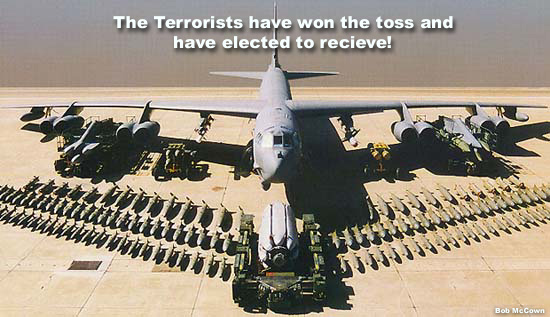
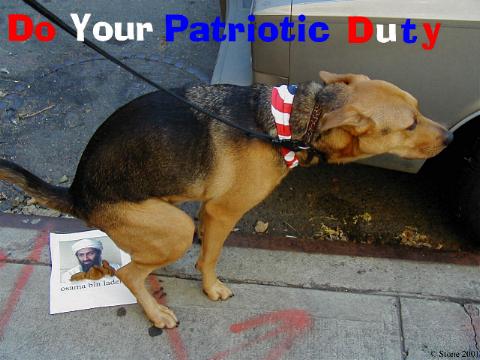
I AM the
NATION---Updated for 2002
I was born July 4, 1776, and
the Declaration
of Independence was my birth
certificate.
The blood lines of the world
run trough
my veins because I offered freedom
to the oppressed.
I am many things to many people.
I am the nation, over 281 million
living souls
and the ghosts of millions who
lived and died
for me.
I am Nathan Hale and Paul Revere
and Crispus Attucks.
I stood at Lexington and fired
the shot heard 'round the world.
I am Washington, Jefferson and
Patrick Henry.
I am John Paul Jones and Davy
Crockett.
My adopted sons include Lafayette
and Casmir Pulaski.
I am Lee, Grant and Abe Lincoln.
I remember the Alamo, the Maine,
the Merrimac and Pearl Harbor.
When freedom called, I answered
and stayed until it was over, over there.
I left my heroic dead on Flanders
Field,
the rock of Corregidor, on the
bleak slopes
of Korea and the steaming jungles
of Vietnam and in the sands of Desert Storm and the war on terrorism.
I am big and sprawl from the
Atlantic to the Pacific, with my arms reaching out to embrace Hawaii and
Alaska.
I am forest and field and mountains
and desert.
I am quiet villages and cities
that never sleep. You can look at me and see Benjamin Franklin on
the streets of Pilidelphia with a loaf of bread under his arm.
And you can see Betsy Ross with
her needle. You can see the lights of Christmas and hear ' Auld Lang
Syne' as the calendar turns.
I am Babe Ruth, Hank Aaron,
Jack Dempsey and Ted Williams.
I am more than 30,000 churches,
where my people worship as they think best.
I am a ballot dropped into a
box, the roar of the crowd at the Super Bowl, the NBA Finals
and the World Series.
YES, I AM the NATION and these
are the things I am.
I was conceived in liberty and,
God willing,
in freedom I will spend the
rest of my days to remain a citadel of freedom and a beacon of hope.
This is my wish on July 4, 2002,
226 years
after I was born.
The
Serenity Prayer for Trauma Survivors
Grant me the serenity to accept
the things I cannot change:
the past, what happened to me,
that what happened was traumatic
no matter how effectively I
have stuffed it.
Courage to change the things
I can:
my attitude towards my symptoms
-
help me to accept them as a
normal response to trauma
and evidence that I need to
take care of myself
by talking about this and getting
help;
my actions -
I no longer have to drug or
deny my symptoms.
I can just accept them.
My reactions -
instead of freaking out,
I can focus on the symptom,
feel what I feel,
go through and deal with the
pain and learn whatever it is that
my Higher Power wants me to
know and share
about the effects of trauma
on people.
Finally I can change how I see
these symptoms -
as normal and helpful to me
in my recovery
even if they are painful.
Eventually I will be able to
help other people
who share a history of trauma.
And the wisdom to know the difference:
I can change my actions and
reactions.
Help me to be willing, teachable
and to learn
about myself and what I have
survived,
even if it is frightening.
Islam Has Proven
to be Our Historical Enemy
By Patrick Hayes
Nearly a year after we went to war against
terrorism, leaders in the West appear still unwilling, if not afraid, to
name the actual enemy that we face - much less refocus the war against
that threat.
Many Westerners have called this conflict a
new "cold war" against "radical Islam" reminiscent of our "long twilight
struggle" against communism during the Cold War. Other observers argue
and believe that the current war in this new age of Islamic terrorism is
being fought solely in and against specific groups in limited geographical
areas such as the ousted Taliban regime in Afghanistan, the Abu Sayyaf
guerrillas in the Philippines, or the Muslim extremists in Chechnya.
The implication is that there is a larger Islamic
world indifferent or neutral to the West, with only a narrow, hostile faction
composed of extremists who wish to oust all Western influences from their
societies, or want to wage war on American soil in the name of jihad.
It is time to correct that misimpression. It
is time to end that illusion. As scholar Samuel P. Huntington has written,
the struggle is indeed taking place in a much wider context. Huntington
has accurately called it a "clash of civilizations" rather than merely
a war between the United States and its allies on one side, and a conspiracy
of sub-national terrorist groups on the other. Other experts agree.
If we are indeed committed to victory against
the al Qaeda terrorists and their sponsors, we need to heed experts such
as Huntington who say it is misleading and mistaken to identify the threat
as stemming only from the homicidal and suicidal tendencies of "radical
Muslims."
In other words, we have to face up to the ugly
prospect that the enemy is Islam and its inherent hatred of the West and
all the West stands for.
"Some westerners, including President Bill
Clinton, have argued that the West does not have a problem with Islam but
only with violent Islamist extremists," Huntington wrote in The Clash of
Civilizations - Remaking of World Order (Touchstone, New York, 1997). "Fourteen
hundred years of history demonstrate otherwise," he added.
This is not only because the acts of Muslim
terrorism are worldwide, as is the war itself, which includes the search
for Muslim terrorist cells within the United States and over 50 other countries.
It is also because the roots of the current conflict span nearly 10 centuries
of human history.
The assumption that al Qaeda is our only foe
and that Afghanistan is the sole target of U.S. anti-terrorism efforts
fails to recognize the tension that has existed between the Muslim world
(with its archaic, 12th-century beliefs and traditions), and the modern
Western world (which Muslims abhor for its computer gaming, high fashion
and education for women, and fast foods). That conflict existed long before
Sept. 11, 2001.
The mutual animosities between Islam and the
West go back before the time of the First Crusades, to 711 A.D., when Muslim
hordes overran a good portion of Europe, beginning with Spain. In 732,
the Muslim Arab and Berber armies were defeated at the Battle of Tours,
France, by the Frankish (German tribe) King, Charles Martel - a defeat
that effectively halted the Islamic advance into Europe.
In their march west, the Muslim armies spread
Islam where they could. The non-Arabs were called mawali, Arabic for "clients."
Although the mawali were converts to Islam, they were considered second-class
to their Arab masters. Much as they do today with their imported workers,
the Arabs used the mawali as their servants and, in some cases, soldiers.
By the 8th century, in addition to conquering
Persia (Iran), Central Asia and much of Eastern Europe (which is why the
West is currently dealing with the problem of Muslim terrorists in the
Balkans), the Islamic armies had conquered North Africa, the eastern Mediterranean
and much of Spain, and had even established bases in Italy. Islam, in effect,
still posed a serious threat to the rest of Europe.
By the 11th century, the balance of power was
shifting back to the West and trade flourished. The Church became stronger
and more centralized, doing away with the practice of allowing kings to
appoint regional church leaders. Therefore, the Popes were able to unify
popular support. With increased wealth and power, and the need to expand
trade, in 1095, Pope Urban II called for the raising of Christian armies
to free the Holy City of Jerusalem and the Holy Land itself from the Muslims.
The actual Crusades lasted from 1096 into the 13th century.
Over the years, tensions between the West and
Islam have continued to ebb and flow, but have never been far from the
surface. The 18th century again saw the rise of Islamic fundamentalism
in opposition to what was then perceived by the Muslim extremists of the
day as the decadence of the Ottoman (Muslim) Empire.
In the 19th century, when the Jews began to
move back to what is now Israel, tensions again grew between Arabs and
Jews - a conflict that continues to this day with no reasonable end in
sight.
During World War I, the Muslim Ottoman Empire
sided with Germany against the western powers. During World War II, many
Muslims sided with the Nazis because of their mutual hatred for the Jews.
The Muslims in Central Asia were quieted for a while during the reign of
communism, when the Muslim region became part of the Soviet Empire. Since
the fall of the Soviet Union, several of the former Soviet Republics, including
Russia itself in Chechnya, are facing their own war against Muslim terrorists.
To say that the current war against Islamic
fundamentalism and terrorism is not religious in nature - at least as perceived
by Muslim fanatics themselves - is to miss the point of history as addressed
by Huntington.
Islam is currently at war with the modern world
as much as it was with the West and Christianity in the 8th century. The
Saudi princes, who today publicly voice distain and concern about the murderous
acts of Muslim terror, continue to provide financial support to the Muslim
terrorists who perpetrate those acts.
In 1998, Osama bin Laden told his followers,
"The call to wage war against America was made because America has spearheaded
the crusade against the Islamic nation, sending tens of thousands of its
troops to the land of the two holy mosques over and above its meddling
in its affairs and its politics and its support of the oppressive, corrupt
and tyrannical regime that is in control."
Ranting though his statements may be, there
is no denying the message bin Laden is sending, not only to the al Qaeda
and other Muslim terrorists, but to all Muslims worldwide. (Of course bin
Laden, the Saudi princes and the mullahs in Iran discreetly ignore the
facts, because facts may muddle the minds of Muslim fanatics and true believers.)
Besides its obvious support of Israel, the
United States has also intervened around the globe and placed American
lives at risk in defense of Muslims. These operations include going to
war against Iraq after that country invaded Kuwait. In Somalia, the Bush
I and Clinton administrations' mission was to help feed a hungry Muslim
nation. That Clinton turned tail and ran at the first sight of American
bloodshed obscured the fact that the intervention itself was aimed at saving
Muslim lives. And American troops today remain in the Balkans, where Clinton
twice intervened against the Christian Serbs on behalf of Muslims who faced
ethnic cleansing and mass murder. However, American soldiers there must
now deal with the threat of attack by Muslim terrorists.
But those facts carry little weight in a conflict
defined by its radical organizers as a religious struggle. A recent article
by Andrew Sullivan on the war against terrorism, which appeared in The
New York Times Magazine noted, "The religious dimension to this conflict
is central to its being." Sullivan added, "The words of Osama bin Laden
are saturated with religious argument and theological language. Whatever
else the Taliban regime is in Afghanistan, it is fanatically religious."
As bin Laden himself has said, the American
"crusade" is not against the Arabs, per se, but "against the Islamic nation."
This is a semantic distinction that few Americans appreciate: Those words
were used to incite the involvement of every Muslim around the globe because
there is, strictly speaking, no "Islamic nation." The message in bin Laden's
own words, and the lesson the West needs to learn, is that the primary
loyalty of any Muslim is to his religion and not to any one nation-state.
Given the official concern about Muslim terrorist
cells within the United States, this issue of loyalty should cause those
in Washington and around the country serious concern, given the number
of Muslims of all races currently residing in the United States as well
as the number of others still flowing into the country with visas of all
types, or through the back doors of Mexico and Canada.
British author Salman Rushdie is another expert
who fully understands what is at stake here. He is a Westerner who since
1989 has been living with a fatwah, or edict of death, on his head, decreed
by the Ayatollah Khomeini in Iran.
In a recent commentary in The New York Times,
Rushdie wrote, "If this isn't about Islam, why the worldwide Muslim demonstrations
in support of Osama bin Laden and al Qaeda? Why did those 10,000 men armed
with swords and axes mass on the Pakistan-Afghanistan frontier, answering
some mullah's call to jihad? Why are the war's first British casualties
three Muslim men who died fighting on the Taliban side?
Why the routine anti-Semitism of the much-repeated
Islamic slander that "the Jews" arranged the hits on the World Trade Center
and the Pentagon, with the oddly self-deprecating explanation offered by
the Taliban leadership, among others, that Muslims could not have the technological
know-how or organizational sophistication to pull off such a feat?"
Daniel Pipes, Director of the Middle East Forum,
wrote in a New York Post article last Oct. 19, "To me, every fundamentalist
Muslim, no matter how peaceable in his own behavior, is part of a murderous
movement and is thus, in some fashion, a foot soldier in the war that bin
Laden has launched against civilization. By way of comparison, I
would say precisely the same about Nazis and Leninists; however non-violently
they might conduct their own lives, the fact that they back a barbaric
force means they too are barbarians and must be treated as such."
Although many in the West clearly recognize
the growing the threat of fundamentalist Muslim terror, a disturbing number
of apologists in this country and in Europe continue to argue restraint
in the war against Muslim terrorism. They argue that Islam is a "peaceful"
religion, open and tolerant of all others.
Yet the Koran beseeches the faithful to kill
the unbeliever: "And when the sacred months are passed, kill those who
join other gods with God wherever ye shall find them; and seize them, besiege
them, and lay wait for them with every kind of ambush."
As much as bin Laden and other Muslim fanatics
argue to the contrary, the West in general and Christianity in particular
have no reason to attack Islam. The simple fact is that most western countries,
including the United States, tolerate Muslims and their mosques within
their midst, even though, as an example, the Muslims in England in particular
are becoming a serious threat to the stability of that country. (As Rushdie
points out, it was British Muslims who were among the first volunteers
to go fight with al Qaeda and the Taliban.)
History provides a stern warning: The United
States and its allies have no choice but to take aggressive action against
an enemy that shows no willingness to negotiate. And unless specific evidence
to the contrary appears - a movement within Islam itself to disavow and
condemn the acts of al Qaeda and other terrorist organizations - we should
abandon the false distinction between the terrorists and the global religion
that by all intelligence continues to support them.
Patrick Hayes is a contributing editor to DefenseWatch.
He can be reached at [email protected].