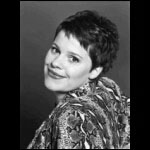
| Camilla Tilling soprano |
| In SFS 2006-2007 Season Stravinsky Orpheus / Mozart Mass in C minor |
| She feels just as much at home on the opera stage as in concerts and song recitals. She has developed a large concert repertoire ranging from Mozart's Exsultate, Jubilate, Bach's B minor Mass and Handel's Messiah to Ravel's Sh�h�razade(Source) |
 |
| Camilla Tilling dazzled New York City Opera audiences in September 1999, when her Corinna, Rossini's "celebre improvvisatrice romana," stole the show in James Robinson's witty production of II Viaggio a Reims. Who could have guessed from Tilling's lithe, bold stride and the confident radiance of her singing (especially her serene, spun-silver traversal of Corinna's final improvviso, "All'ombra amena") that NYCO's Viaggio was not only the soprano's New York debut but her international opera house debut -- and her first: Rossini role on any stage? As the native of Linkoping, Sweden, admits, "You could say, I suppose, that making this beginning here in this big way was a risk. But life has these charms, at times, and I was very, very, very lucky. It worked!" (Opera News) |
| In Swedish soprano Camilla Tilling, Zander has found a superb singer for the Fourth Movement Finale. Tilling sings the part without the stage-voice that other sopranos (Schwarzkopf, for example, in her recorded performances with Walter and Klemperer) bring to it; she uses, instead, a "Liederstimmung" with an endearingly girlish quality. Zander's lecture by itself would be worth the tariff on this set: it really elucidates the inner-workings of this remarkable symphony. Strongly recommended.(Review Mahler: Symphony No. 4) |
 |
| CAST A Figaro Performance Dates Sat 6/10, Tue 6/13, Sat 6/17, Tue 6/20, Sat 6/24, Tue 6/27 Thr 6/29 |
 |
 |
| THIS IS |
| OPERA |
 |
| In SFO 2005-2006 Season Susanna* - Le Nozze Di Figaro |
| and a rather tough audience at that � she added to our appreciation of the songs and performers that could win her attention.
Even more effective was the way Susanna's busy, distracted character shaped her relationship with the more affectionate and expansive Figaro. It helped explain his distrust of her and his fear that their love is one-sided. The only problem with this interpretation came in Act IV, where Tilling missed several opportunities to balance Susanna's bustling with tenderness. Her Deh vieni, non tardar seemed rushed and rather cool, not a sufficiently rhapsodic contrast to the rest of her role. The blocking and acting in this scene did not quite convey Susanna's intention of expressing true love for Figaro, albeit in the context of an elaborate ruse to provoke his jealousy. Even more unfortunately, their magical moment of reconciliation shortly thereafter (Pace, pace mio dolce tesoro) was marred by their falling seriously out of sync with the conductor./ 06 SFCV |
| The petite and sweet-voiced Camilla Tilling, making her company debut as Susanna, was in constant motion through the first three acts. She not only sang but also ironed, sewed, swept, made the Countess' bed, ran errands, and took dictation. The stage business gave a vivid reality to her servant role and brought out the distance between her and the other characters, with their apparently endless leisure for gossip, intrigue, and seduction. There were two subtler benefits to this busy representation of Susanna. The first was that, especially in the first two acts, she had to be drawn into paying attention to other characters' utterances. For example, Cherubino's Act I aria Non so pi� became even more effective as we watched its effect on Susanna, who was sewing when Cherubino began to sing but was gradually drawn in by the emotion of his song. Similarly, it took a while for Susanna to put down her broom and join in with Figaro's antics during Non pi� andrai. Susanna became a stand-in for the audience, |
| Susanna in motion |
| Anyone can Google and collect this information placed here for the entertainment and education of any opera fan that passes by. |