REVIEW
REVIEW
|
By Elizabeth Maupin
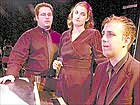
There's a scene at the end of Merrily We Roll Along, the Stephen Sondheim-George Furth musical, where you're supposed to feel what this show is all about -- the starry-eyed optimism of young people facing life and the bittersweet recognition that some of them will get what they want and some will not. But in Opening Doors Theatre Company's production of this remarkable little show, those feelings may take hold of you from the very beginning, when nearly two dozen talented young actors take the stage with such intensity of purpose that they can bring tears to your eyes. Performed by theater students and recent graduates of the University of Central Florida, Rollins College and several other schools, Merrily We Roll Along is that happy example of a perfect match of performers and show. This 1981 musical is notorious among Broadway theater fans for never quite working the way its writers intended, and the Orlando production has a few minor rough spots. Yet the show is a joy, and it does its young producers proud. The story of a trio of friends who want to make it in show business, this musical unfolds in a most unusual way -- backward, so that we meet the characters in middle age and watch them get younger and more innocent as the tale unfolds. Franklin Shepard and Charles Kringas are songwriters who want to succeed on the Broadway stage; Mary Flynn is their novelist friend who is more than a little in love with Frank. At the beginning of the show, Frank and Charley haven't spoken for years, and as the show takes you backward in time you find out why. That's a challenging device and one that's hard to carry out: Frank starts out unlikable, and Charley and Mary are forced from the first to come on awfully strong. Chances are most companies would bypass Merrily We Roll Along but for one factor -- songs such as "Not A Day Goes By" "Old Friends" and "Good Thing Going," which are among the most achingly beautiful and most accessible songs the famously difficult Sondheim ever wrote. Co-directors Todd M. Eskin and Robert Miller Jr., both products of UCF, seem to have struck pay dirt with almost every decision they made on the show -- a co-production of Opening Doors and the Civic School of Theatre Arts -- from the intelligent casting to the useful minimalist set to the well-thought-out costumes, which are mostly black when the characters are middle-aged and jaded but change with the times as the characters themselves do. Produced in the Civic's intimate little Tupperware Theatre, the production benefits from the audience's nearness to the stage, and the novice directors move the large cast in and out as if the pair has been doing it for years. What's remarkable about the performances is the way the actors seem to wear their roles offhandedly, as if they had been born to them: Even those in the ensemble parts play them with conviction. Those in the leads benefit from being just the right ages for the characters at the end of the show, but they're also credible as those characters in their late 40s, and that feat takes much more than luck. As Frank, Marcos A.G. Stafne seems deliberately low-key and restrained: His warmth as an actor and his lovely voice help him out, so that his Frank can be a nice guy and a cad at the same time. Co-director Eskin makes a brittle, acerbic Charley, who mellows into jolliness as the character grows younger, and he manages Charley's musically complex solo, "Franklin Shepard, Inc.," with aplomb. Stacy Renuart pushes hard as Mary, and she pushes her voice hard as well. But she still finds both the cynicism and later the vulnerability the character needs. Some of the supporting characters are equally good, especially Clark Mims' wonderfully over-the-top Gussie, the actress who is Frank's second wife, and Monica VanderWyde's graceful, elegant Beth, the singer who was his first. Craig Phillips finds a little hurt amid the fatuousness of producer Joe Josephson, and the ensemble moves smoothly with the flow. Not everything works as well as the performances. A couple of quick musical snippets are confusing, and the electronic keyboard drowns out some solo lines (and buzzed badly at one performance last weekend), and a Columbia student like Charley would know how to pronounce the name of Columbia's sister college, Barnard. Still, these young performers know what they're doing, and their skill
and confidence show. Most of all, they know that to hold back a little
on their emotions makes the show all the more moving for their audience.
When Frank says, at the end of the show, "We've got to be the luckiest
people alive," no one is reaching for easy sentiment. And when, at the
very beginning, the cast sings the title song, they do it with an underplayed
fervor that communicates exactly what it should. If these folks are just
starting out, who knows where they'll be able to go.
|
MAIN PAGE - CAST - CREW - DIRECTOR'S LETTERS - MUSICAL NUMBERS
-  -
-  -
-  -
-  -
-
-  -
-  -
-