|
The
Thailand education system is classified into 3 types, formal
education, non-formal education, and informal education. We will
only discuss formal education here since it is more relevant to
yo
For formal education, there
are 2 levels: basic education and higher education. Basic
education is provided before higher education. It covers
pre-primary or kindergarten, 6 years of primary education
(grades 1-6), 3 years of lower secondary education (grades 7-9)
and 3 years of upper secondary education (grades 10-12).
Compulsory education is 12 years.
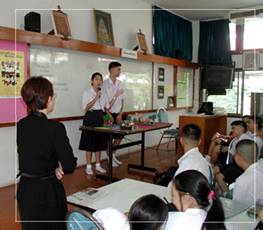
Students
are more and more taking centre-stage in the Thai classroom with
the teacher in the role of a consultant. Bodindecha is one of 36
Bangkok-area schools piloting the new national curriculum in
preparation for nationwide implementation next year.
Students can go to vocational
colleges if they finish lower secondary education. In thess
vocational colleges the students can do two years studying and
get a school certificate. They can also continue studying at
the college for two more years and get a diploma. Some
universities accept these students for another two year for a
Bachelor’s degree.
After completing
basic education, students can continue their study at a
university. They study for about 4-6 years to get a bachelor’s
degree depending on their major.
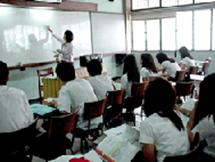
A classroom at
Srinakarinwirote University in Bangkok
(www.swu.ac.th/en/content/genedu.asp)
Visit this URL (http://www.thaistudents.com/)
and learn more about
1. Day at
school
2. Culture at school
3. Buddhism at school
4. Festival at schools
5. Video
clips
|