|

Thai
culture is quite different from western culture. A lot of our
culture is connected with Buddhism. The following are some
aspects of Thai culture and beliefs that visitors should know.
1. Wai
When
you set foot in Thailand, you will see Thai people “wai”
and hear the expression “sa-watdii ka” or “sa-watdii
krap” very often. This is the Thais’ daily life.
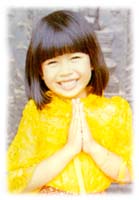
Look at the pictures of Thai people “wai” below
 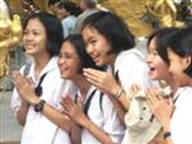
Reasons for “wai”
- “Wai” is used for several reasons; the most popular
being to express “welcome” or “hello.” The second reason to
“wai” is to show respect. For example, you would normally “wai”
a monk or an elder person. Thais do not “wai” to the person who
is younger or has a lower status than the greeter. On the other
hand, you may use a “wai” for farewell.
How to “Wai”-
A “Wai” is very easy to do.
This is how you can do it:
1. Clasp
your palms at chest level.
2. Lower
your head, and say “Sa-wat-dee” with a smile. (You can say “Sa-wat-dee” for
greeting and farewell)
The wai is a
delicate, graceful gesture when Thais do it. It may look funny
when you do it, but the attempt will still be most appreciated.
It might take you some time to perfect your technique, but this
charming greeting will become second nature in no time at all!
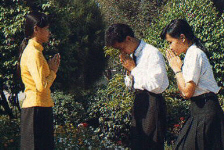
2. “To respect the
elderly”: As the
elderly were born before us, Thais think that the elderly have
more wisdom, at least the wisdom for living. To be polite, don’t
sit with your head higher than the senior person, and never
point your feet at anyone. If the senior is sitting, you should
bend your body while walking past the
3. Dos and Don’ts –
Here are some quick tips for you to understand Thai culture
|
3.1 |
|
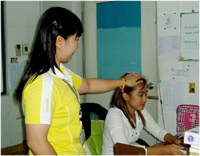
Head:
Don’t touch anyone’s head for any reason. The head is the most
important part of the entire body. It should never be touched.
However, you may touch the head of the person who is younger or
has lower status than you in order to show kindnes
|
|
|
|
|
|
3.2 |
|
Hats and shoes:
We believe that a hat placed on the head, merits respect. Shoes,
associated with feet, have a much lower status. So, hats and
shoes should not touch each other. |
|
|
|
|
|
3.3 |
|
Hands:
Do use the right hand for giving or receiving things and putting
things into the mouth. The left hand is regarded as “lowly”
because we use the left for cleaning downstairs after toilet
duty. |
|
|
|
|
|
3.4 |
|
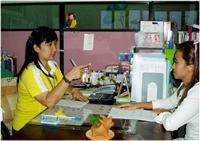
Fingers:
Do not point at anyone with the forefinger. If you are not older
or have higher status than that person, you should not point at
him with the forefinger and order him to do this or do that. In
the past, this gesture could be used with a person who had lower
status such as servants, slaves, or laborers.
|
|
|
|
|
|
3.5 |
|
Feet:
The feet are the lowest section of the body. They are regarded
as lowly too. Do not use them for pointing at anyone or
anything. In addition, do not place your feet on something such
as Buddha’s picture or money because there is his majesty the
king’s picture on the money |
|
|
|
|
|
3.6 |
|
Person:
Don’t step over any part of another person. You should not step
over a person’s feet if he/she is sitting up, or any part of the
body if he/she is lying down. Do say ‘excuse me’ and tell
him/her that you want to pass. |
|
|
|
|
|
3.7 |
|
Gestures:
Do speak quietly and gesture softly. Loud voices, calling
attention to yourself, throwing things, and making big hand
gestures, all seem graceless to the Thai sensibility. |
|
|
|
|
|
3.8 |
|
Be polite: Losing your temper, especially in public,
will more than likely get you nowhere. We think such displays
denote poor manners, and you are more apt to get what you want
by keeping a cool head and concealing your emotions. |
|
|
|
|
|
3.9 |
|
Your name:
Do not be surprised if you are addressed by your first name; for
instance, Mr. Peter or Miss Ann instead of by your surname. This
is because Thais refer to one another in this manner, usually
with the title "Khun" (Mr., Mrs., or Miss) in front. |
|
|
|
|
|
3.10 |
|
Female body: Don’t
touch a local female, friend or otherwise, on any part of her
body, not even her hand. |
|