THE SPECIAL TITLE : THE BUDDHA SPEAKS OF
AMITABHA
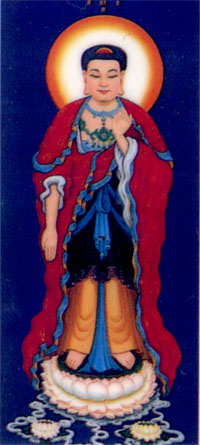 |
Who is BUDDHA ? The Buddha is
the Greatly Enlightened One. His great enlightment is an
awakening to all things, without a particle of confusion.
A true Buddha has ended karma and transcended emotions.
He is without karmic obstacles and devoid of emotional
responses. On the other hand we find living beings, who
are attached to emotions and worldly love. Common men with
heavy karma and confused emotions are simply living beings. The Buddha's enlightenment may be said to be of
three kinds : 1. Basic
enlightenment, enlightenment at the
root source.
2. Beginning enlightenment, the initial stages of enlightenment,
and
3. Ultimate
enlightenment, complete
enlightenment.
You can
also say that he is
1.
Self-enlightened, that he
2. Enlightens
others, and that he is
3. Complete in
enlightenment and practice.
|
Self-enlightenment. Common men are unenlightened. They think
themselves intelligent when they are actually quite dull. They
gamble thinking that they will win--who would have guessed that
they'd lose ? Why are they so confused ? It's because they do
things which they clearly know are wrong. The more confused they
are, the deeper they sink into confusion; the deeper they sink,
the more confused they become.
Every one should become enlightenment. The Buddha is a part of
all living beings and is one of them himself, but because he is
enlightenment instead of confused, he is said to be
self-enlightened and not like common men. "Sravakas",
the disciples of the Small Vehicle, are "independents";
they are self-enlightenment, but they do not enlighten others.
Bodhisattvas enlighten others, unlike the "Sravakas"
who thinks only of themselves. Bodhisattvas choose to benefit all
beings and ask for nothing in return. Using their own methods of
self-enlightenment, they convert all beings causing them to
realize the doctrine of enlightenment and non-confusion. This is
the practice of the Bodhisattva conduct.
"Sravakas", "sound-hearers", awaken to the
way upon hearing the sound of the Buddha's voice. They cultivate
the Four Holy Truths,
1. suffering,
2. origination,
3. extinction, and
4. the Way. |
 |
They also cultivate the Twelve Causes and Conditions :
01. ignorance, which conditions...
02. action, action which conditions...
03. consciousness, consciousness which conditions...
04. name and form, name and form which conditions...
05. the six sense organs, the six sense organs which
conditions...
06. contact, contact which conditions...
07. feeling, feeling which conditions...
08. craving, craving which conditions...
09. grasping, grasping which conditions...
10. becoming, becoming which conditions...
11. birth, and birth which conditions...
12. old age and death.
The
twelve all arise from ignorance, and ignorance is merely a lack
of undrstanding. Without ignorance, the Twelve Causes and
Conditions cease to operate. But if you flounder in ignotance,
you are caught in the remaining causes. Those of the Small
Vehicle cultivate the Dhama, but Bodhisattvas transcend all
successive stages, cultivating the Six Perfections and the
Ten-thousand conducts. The Six Perfections are :
1. Giving. giving
transform those who are stingy. Greedy people who can't give
should pratice
giving, for if they do not learn to give they will never get rid
of their stinginess.
2. Morality. The
precepts are guides to perfect conduct and eliminate offenses,
transgressions, and
evil deeds. Keep the precepts.
3. Patience.
Patience transforms those who are hateful. If you have an
unreasonable temper, cultivate being patient and bearing with
things. Don't be an asura, a fighter who gets
angry all day and is not speaking terms with anyone unless it;s
to speak while glaring with fierce, angry eyes. be patient
instead.
4. Vigor. Vigor
transform those who are lazy. If you're lazy, laern to be
vigorous.
5. Dhyana
meditation. Shyana meditation transform those who are scattered
and confused.
6. Wisdom. Prajna
wisdom transform those who are stupid; the bright light of wisdom disperses the
darkness of
stupity.
The Buddha has Three Bodies, Four Wisdoms, Five Eyes, and Six
Spiritual Penetration. You may be a Buddha, but you are still an
unrealized Buddha, for you do not have these powers. The Buddha
cultivated from the stage of a common person to Buddhahood, and
has all the attribures of Buddhahood.
Some who haven't become Buddhas claim to be Buddhas. This is the
height of stupidity; claiming to be what they are not, they cheat
themselves and cheat others. Isn't this to be a "Greatly
Stupid One ?". Everyone can become a Buddha, but
cultivation is necessary. If one has the Three Bodies and the
Four Wisdoms one may call oneself a Buddha. If one has just the
Five Eyes, or a bit of spiritual penetration, one may not.
The Three Bodies
are :
1.
The Dharma body,
2.
the Reward body,
3.
the Transformation body.
The Four Wisdoms
are :
1.
the Great Perfect Mirror Wisdoms,
2.
the Wonderful Observing Wisdoms,
3.
the Wisdom of Accomplishing What is Done, and
4.
the Equality Wisdom.
The six Spiritual
Penetration are :
1.
The Heavenly Eye. The Heavenly Eye can see the gods and watch all
their activities.
2. The Heavenly
Ear. The Heavenly Ear can hear the speech and sound of the gods.
3. The Knowledge of
Others' Thoughts. Thoughts in the minds of others which they have
not yet
spoken
are already known. This refers to the present.
4. The Knowledge of
Past Lives. With this penetration one can also know the
past.
5. The Extinction
of Outflows. To be without outflows is to have no thoughts of
greed, hate,
stupidity, or
sexual desire. In general, once one gets rid of all one's bad
habits and faults, one has no outflows.
Outflows are like water running through a leaky bottle; at
the stage of no outflows that leaks have been stopped
up.
6. The Complete
Spirit. Also called the Penetration of the Spiritual Realm, this
is an
inconceivably wonderful state.
The Five Eyes are :
1.
the Heavenly Eye,
2.
the Buddha Eye,
3.
the Wisdoms Eye,
4.
the Dharma Eye, and
5.
the Flesh Eye.
A verse about the
Five Eyes says,
The
Heavenly Eye Penetrates without obstruction.
The
Flesh Eye sees obstacles but does not penetrate.
The
Wisdom Eye understands True Emptiness.
The
Buddha Eye shines like a thousand suns.
Although the illuminations differ,
their substance is one.