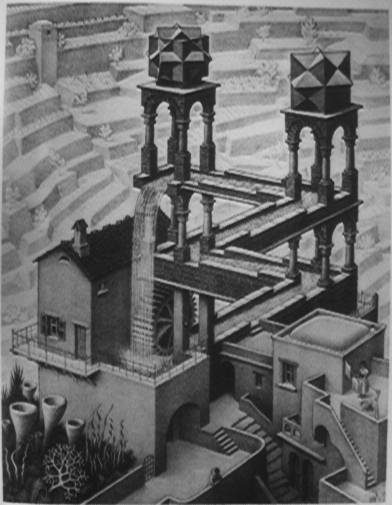
Senior year thesis project for Science Research. Accompanied by two hour lecture. Advisors: Chris Mayer and Robert Sauer
Monday, June 5, 2000 AD
Portland, Oregon
Many discoveries that humanity has made over time seem simple to modern man; this is because we have the benefit of education and hindsight. We are raised not to wonder, but simply to know that Earth is a sphere, and that we revolve around the Sun even as you read this page. They are facts we accept, even though our senses may challenge them. What we see is not always the reality. It has been my experience while researching this work, that what one believes and what is true are almost always different. The question that begs to be asked now is, why should perception of the world today be any less stagnant? To answer this, we must return to the beginnings of society, when illusion was ruler.
Early civilization was generally polytheistic. In humanity�s infancy, we tried to explain the world around us by means of divine powers. Greek and Roman culture has its creation myth, as well as society steeped in polytheism and heavy symbolism. Mount Olympus, a minotuar, and wax wings. The newly developing arts and architecture were almost always religious in nature. The grand pantheon in Athens is dedicated to Nike, goddess of victory. Misfortune, as well as a streak of luck, was attributed to the gods.
It is here in Greece that one can find the seeds for an incredible shift. Three men, each with his own connection to a stream of consciousness, have captured the thoughts of what would become ancient philosophical wisdom.
Plato, Socrates, and Aristotle were all contemporaries of each other. These thinkers were some of the first to try and define the world around them. With much of the physical world still undiscovered, Plato and Socrates focused on their more immediate environments. Government, politics, and society were the subject of many of the two�s writings. It is interesting to see that one of Plato�s most fine works, the Allegory of the Cave, is buried within a political text.
Of the three, it seems as though Plato provides the most advanced hypothesis for reality here. In Allegory of the Cave, humanity is seen as a group of chained savages, roaming a lair filled with illusion. The truth, what really exists is above the cave, symbolically represented by the sun. A small beam of light is reflected into the cave, so that people only see a partial truth. Plato writes that if someone were to escape the cave, and see reality for what it was, that it would be too much for their minds to comprehend, and if they tried to explain the vision to the remaining cave dwellers, the enlightened one would be killed.
Can you imagine the response people have when someone tells them that what they perceive is not quite what is real? To Greek society, Plato�s thoughts were slightly more accepted, perhaps because they could not fully comprehend the ramifications of his words. Socrates, on the other hand, created quite a stir within the system.
Socrates was put on trial for his beliefs, an ancient heretic for his ideas about a soul, and of monotheism. Though accused of many things, the one that attracts my attention the most is probably �corruption of youth�. According to the council that condemned him, Socrates had infected young Athenians with his strange thoughts. His perception of reality had changed, as had Plato�s. When Socrates was finally sentenced to die, Plato came to visit him in his cell, where he transcribed much of the philosopher�s last words to paper. Some scholars believe that Plato used Socratic ideas as a platform for his own seemingly irrational ideas about the self.
Aristotle was different only in the subject matter he dealt with. This last of the three more influential thinkers is responsible for creating a basic system of logic. However advanced, it has its flaws.
Working within the confines of early science, Aristotle combined mythology and his own thoughts to escape his immediate surroundings and develop a theory as to what Earth looked like. Greek-centered only in its myths, Aristotle envisioned a half sphere, with the heavens above, and the underworld below. The sun and moon moved around the Earth in this model, for even though Aristotle had seen beyond his social environment, he lacked the mathematics and observations to discount his eyes. Despite Allegory Of The Cave, science would create a view of reality that is still, somewhat foolishly in my mind, upheld today: what you see is what you get.
During the Middle Ages, after the intellectual prosperity of the Greeks had been forgotten, and Roman ingenuity displaced, little was done to forward western society�s view of the world. The Church, still geocentric, was firmly positioned as an authority. In a way, the Medieval period can be viewed as �the deaf leading the blind�. The Western world had been stagnant for too long, and a period of great change loomed ominously. The Sun still orbited the Earth, and only an overwhelming amount of evidence would prove otherwise.
Copernicus was born in Germany. He studied the sciences and mathematics, and he would be the first to capture an incredible idea: heliocentric model of the solar system. In the year 1543, the thinker released his ground breaking work, de Revolutionibus. Copernicus, somewhat luckily, died the day it came into print. He was also one of the last scientists to use what is referred to as �pure� geometry. With Gutenburg�s printing press now dominating publishing, the geometric figures defining Copernicus� theory were anathema to typeset composing rooms. Geometry had been embraced by the bored scribe. With the Renaissance, and the Arabic influenced algebra, both were dying.
The Church, and some progressives, after decades of prodding, would finally attempt to accept some of what Copernicus had said. His published work however, was edited to suggest that Copernicus was making assumptions rather than accretions. The model used an ideal: perfect spheres to represent orbital paths. This fact would make it easier on the authorities to ponder. A perfect being like God would place Earth in the center of the universe, but if this isn�t true, then at least the orbits were perfect spheres, all contained within a tremendous crystal orb.
Now as modern scholars, most students know that the planets and other exotic space objects don�t travel in circles, but rather elongated circles called ellipses. Copernicus knew of Johannas Kepler�s developments of this thought, but even he was blinded by his perception�s inclination, and would not see the truth.
Kepler left his home in Prague, and traveled to Austria to begin working with Tycho Brahe. Brahe, along with his assistants had collected enormous amounts of astronomical data, which Kepler would later inherit.
Kepler refused to take Brahe�s observations as stand alone data. He struggled with his thoughts to try and discover some kind of relationship. Within Brahe�s numbers, Kepler was able to revise Copernicus� world to include elliptical orbits. Kepler�s findings, known to physics students as Kepler�s Laws would help accurately illustrate planetary motion. Many scientists, both of Kepler�s time and ours, applaud his devotion to �making sense of it all�. Kepler is even known to have toyed with more esoteric thought to draw connections, including early realms of mysticism.
Galileo, by far the most courageous of the three great astronomers, was much like Socrates in his defiance of the norm. The great evidence needed to sway Renaissance thinkers had finally arrived in the form of undeniable proof. In 1630, shortly after the death of Johannas Kepler, Galileo published his most controversial work, Dialogue Concerning The Two Chief World Systems, which expanded on the research of Copernicus and Kepler. The work was sent to censors and reviews of the Spanish Inquisition. Declaring Galileo�s work heretical, further printing of the text was prohibited, and Galileo was put on trial by the Inquisition. Imprisoned, Galileo falsely admitted his �error� to the Church and continued to write manuscripts while in prison. His work was then smuggled out of Italy to be published. In 1642, after spending the last years of his life in pain and blind, Galileo died. His legacy would take the form of an incredible gauntlet thrown down as a challenge to those who wished to redefine the physical world. The Catholic Church was quieted, and the heliocentric model was accepted as a new fundamental truth. The second trio of thought hunters had found a way to explicate their universe.
In research, there is always something left untouched. For Galileo, it was his experiments dealing with gravity, inclined planes, and slight forays into projectiles. In his lifetime, he lacked the vocabulary necessary to communicate his thoughts. The eternal question can be posed here: which drives which, mathematics or science? It is here that the quest for thought is resumed, by a youthful Isaac Newton.
Isaac Newton was born the same year that Galileo died. His family was poor, and he was sent to Cambridge to study theology. Newton was forced to leave due to an outbreak of the plague, and it was during his time away from formal academia, that he made his most notable discoveries. Unlike his predecessors, he did not immediately publish his findings. Newton was extraordinarily paranoid and fearful of someone, namely his contemporary Hooke, taking credit for his hypothesis. Newton suffered a mental breakdown in 1675 and was still recovering through 1679. Like other thinkers before him, Newton often looked to the occult, as well as mathematics for an explanation.
It was finally the astronomer Halley, who convinced Newton to expand and publish his calculations. Newton devoted the period from August 1684 to spring 1686 to this task, and the result became one of the most important and influential works on physics of all times, Principia Mathematica. In the text, Newton presents his most famous laws of motion and the theory of universal gravitation. Much to the dismay of high school students everywhere, Newton is also responsible for creating new mathematical vocabulary: the binomial theorem and calculus. In both cases, unfortunately, Newton delayed publishing to the point of others making the same observations, and often temporarily beating him to the credit. In the latter portion of his life, Newton devoted much of his time to alchemical researches and trying to date events in the Bible. Isaac Newton finally died, most likely of mercury poisoning, in 1721.
Newton had taken Galileo�s work and forwarded it to a new extreme. Newtonian theory caused a massive shift in thought. Suddenly, using a newer form of math, it was possible to make more accurate predictions regarding motion. In a philosophical instant, existence could be defined in terms of variables. F=ma.
At this point in the history of Western thought, reality is very concrete. Newton, and those who came before him had accomplished two major tasks: defining their immediate surroundings, and removing themselves from their environment to explain mankind�s position in the universe. However, even with the advancements of Newton, humanities still believed in unrealistic myths and religions across Europe upheld one final wall: creationism
Charles Darwin was born in 1809 in England. He, like Newton was sent to Cambridge to study theology. Darwin quickly rejected this idea in favor of botany and etymology. After he received his doctorate degree, Darwin began his research on the Galapagos islands, via the H. M. S. Beagle. He published several journals, and his most influential works The Origin Of Species. In this work, Darwin details a more believable theory of evolution than Lamark. Also included is Darwin�s revolutionary ideas regarding natural selection. The Decent of Man would come later, dealing with natural selection in relation to sex. Darwin lived out a quiet life of research and writing, until 1882 when he died.
Darwin caused western religion to take an almost fatal blow. In the book of Genesis, Moses clearly writes that God created man, not God created primates and watched them evolve. This caused a stir within the intellectual communities of Europe, and the controversy Darwin�s work created would help fuel the intense period of romanticism in literature. The educated class, by Darwin�s time was ready and willing to apply his theory of natural selection to socioeconomic situations. The Church, arguing against overwhelming amounts of proof, could only provide the answer �because the Bible says so.� It was not good enough for some romantic and Victorian intellectuals.
The late 1800�s was a period of great scientific and human arrogance. Many people speculated that physics, aside from some polishing and finishing touches, was a finished science. A foolish assumption to make considering that Earth had not been fully explored (and still isn�t) and mankind�s dreams of space were decades away.
In 1905, Max Planck received a submission to the scientific journal Annals Of Physics, for which he was the leading editor. It had been written by a quiet twenty-six year old, who worked as a patent office clerk in Switzerland. Albert Einstein.
Einstein�s problem, one he had been pondering since his teens, was this: what would happen if you were to chase a beam of light at light speed? Newtonian relativity would suggest that eventually you would catch up with the end of the light beam/waves so that it appears stationary. This reasoning flies in the face of James Maxwell�s theory, because there is simply no such thing as stationary light. It�s almost an oxymoron, hence Einstein�s issue. Many other physicists the world over were struggling to solve this same thought experiment, often leading themselves down unexplored mental paths which they kept to themselves.
Einstein�s more known work, special relativity, deals with the problems that occur in space-time when the velocity of an object approaches light speed. Length contraction and time dilation, both of which can be proved, were catalysts for some of the greatest new discoveries in physics. In Einstein�s Twin Paradox Theory, he addresses time dilation by taking a set of twins and placing one in a space ship, leaving the other on Earth. The twin in the rocket, when in space, is in a non-inertial frame. When traveling at even small fractions of light speed, the twin in the rocket will experience time differently than the twin on Earth. In fact, the twin remaining home will have aged more than his brother in the ship.
However, as successful as Einstein�s thought-catching was, the basic premise of special relativity, and the foundation of another critical branch of physics, quantum mechanics, disagree with each other to a critical point. They cannot both be correct in certain situations.
Quantum mechanics deals with the very small of the universe; atoms and elements that they are composed of. Relativity explains the very large; the mass of galaxies, and high velocity. Yet both of these theories cannot be simultaneously applied to the most promising an intriguing situations the universe has to offer. Black holes are massive, but matter within a black hole is compacted into a minute area. The universe is said to have originated from an incomprehensible space-the immense emerging from the incredibly small. It is here that superstring theory enters the equation, or rather, lack thereof.
Superstring theory, or string theory, is an avenue which many theoretical physicists believe will lead humanity to a �theory of everything�, henceforth referred to as a TOE. Strings of matter have recently been theorized to be a smaller division of matter. An apple is made up of many atoms, which are broken down into protons, neutrons and electrons. The elements which make up the nucleus of an atom can be further subdivided into quarks. Electrons and quarks, according to theory, can then be broken down into individual pieces of oscillating, single dimensional �matter string,� which our current technology cannot measure.
The concept of a TOE in physics may seem frightening; humanity may return to its previous rather counterproductive egotism, in which mankind knows everything. This is simply untrue. Many believers in the possibility of a TOE, including my own physics professor, see a final theory as a basis for further work, a solid foundation if you will, on which more research- more explanation may be built.
As I study physics, I have come to see that much of the science has to do with perception. The most recent theory to attempt to explain reality, while at the same time bringing justification to experiences physical law cannot discount-hypnosis, clairvoyance, and general metaphysics-is holographic theory.
Holographic theory can be traced back to Plato�s Allegory of the Cave, because it deals with the difference between reality and human perception of reality. As we have discussed, the two are almost never alike. This theory is based on the idea that the mind is like a giant sheet of holographic film. Practical holograms have every bit of data to compose the entire picture stored in every part of the film. This would explain why during car accidents, people don�t forget half their family-it�s all or nothing. Holographics ties in with psychology well, because it suggests that memory and the ability to learn are distributed throughout the brain. Many proponents of this theory believe that humans perceive a certain percentage of reality correctly, and the rest is made up of �filler�. This is why people occasionally don�t catch spelling errors in papers, or on road signs, because the brain automatically assumes what the word should be, and fixes it without our knowledge. Think of how when under hypnosis or dreaming, the brain perfectly re-creates a reality, to the point where many of us believe the dreamscape is real. How do you know you aren�t dreaming now?
Much like Plato�s work, holographic theory has been the subject of growing controversy, since Michael Talbot published The Holographic Universe in 1991. With western society now completely hardwired into a collective-the Internet, it would take an amazing feat to direct humanity�s attention to the very real possibility that we are projecting our reality, and that physical laws are a learned habit. Western society was in need of an easily accessible package for this thought-something to make us consider.
In 1999, Larry and Andy Wachowski wrote and directed The Matrix. It was released and remained in theaters for over a year. The plot is almost a mirror of holographics- AI has taken over Earth, and is exploiting energy the human body produces over a lifetime. The reality that people in the matrix believe in is actually a computer projection, like a dream. In one sequence, Morpheus shows Neo that the laws of physics can be broken. Talbot�s research, though not to the extreme shown in The Matrix, follows these lines. Mind over matter really does work. Exotic rituals throughout the world involve such tasks as drinking molten lead, firewalking, or impaling the body with blunt objects, only to have the subject survive and show no signs of the experience. Most cases of telekinesis are linked to young children, who for a period exist in a kind of timelessness, and have no concept of Newtonian physics. All they-all we must do to experience this is believe. Sadly, this is often the hardest task of all, for it takes a different kind of will to discount the senses. If this model is true, the potential for humanity�s growth is infinite. We should not spend precious time arguing over the facts when we have them. Thought-hunting has been put aside in favor of more frivolous ideals, and another Renaissance is upon us. An awakening, if you will.
closing notes
I can understand some people's irritation at the fact that I don't really give justice to the individuals I cited in this work. Literally thousands of pages could be devoted to Plato (and they have), as well as those thinkers I omitted, like Nietzche. Or religious perspectives I haven't included. Much Eastern thought passivly knew about holographics, and the concept that 'life is a dream' centuries before the west. In order to preserve simplicity, I had to restrict my research to western philisophical thought and science. Not out of ignorance, but out of respect for my weakening sanity. I hope my readers will understand.
I enjoy letters, please send me some if you find and error, or if you like what I've done. Maybe you hate it, but I'll never know unless you tell me.... (c) 1997, 1998, 1999, 2000, 2001 by A.S. Galvan, unless otherwise noted or painfully obvious. All M.C. Escher works (c) Cordon Art-Baarn-the Netherlands. Like I could ever draw that well.