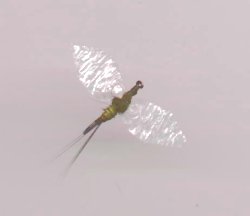
Tying Instructions:
1. Start thread at mid shank and wrap to beginning of bend. Wrap 2 -3 times on last wrap,
creating a "thread bump."
2. Tie in the tail fibers immediately in front of the thread bump, and wrap your thread back
over the fibers, toward the bump. When you press the fibers against the bump, they should
flare.
3. Tie in quill, wrap thread forward to 1/3 from hook eye.
4. Wrap quill forward, tie off.
5. Find a thin, translucent foam sheet, like electronics packaging foam.
6. Cut spinner wing shapes out of the foam. Tie in wings with figure 8 wraps.
8. Using the finest dry fly dubbing you have, dub the thinnest and tightest dubbing
rope you can. The diameter of the dubbing rope should be no more than twice the diameter
of the thread.
9. Build a "dubbing dam" around the wings by taking 5 or 6 turns of dubbing immediately behind
and in front of the wings.
10. When you begin figure 8 wrapping the thin dubbing rope to complete the thorax be sure to
place each turn of dubbing behind the rear dam and in front of the front dam. No turn of
the figure-8 process should touch either wing.
11. Dub forward to the eye, tie off and finish.
Notes: This pattern is based on A.K. Best's Red Quill Spinner. Mr. Best keeps a few things
secret, such as how to keep hen neck feathers (the original wing material) from absorbing water.
If you read LaFontaine's "Proven Trout Patterns," then you've heard about how translucent foam
makes the AirHead a powerful attractor. I am hoping that the realistic silhouette, combined with
the translucent wings, will both imitate and attract. The resulting fly is still an experiment,
but one I feel very excited about. Please let me know if you have success with this pattern.
|