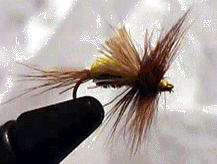
Tying Instructions:
1. Using a bobbin, cover the hook shank with a layer of thread, starting from behind
the hook eye and finishing at the rear of the shank.
2. Tie in a small clump of deer hair for the tail. I like the tail to be as long as
the hook shank. After tying it down, I like to lightly cover the tied in part with
"Hard-as-Nails". It helps keep the foam (applied next) from slipping on the finished fly.
3. Tie the 8" slice of thin yellow foam on top of the hook so that it creates a foam
underbody over the rearmost 1/2 of the shank only. Use your left forefinger and thumb to
hold down and bend the foam over the hook as you tie it down. The foam will essentially
surround the shank. When this is done, the loose end of the foam strip will be pointing
to the left, away from the hook eye. Your bobbin should be hanging at the rear of the
shank because this will be the tie-in point for the peacock herl (or substitute).
4. Using the same technique as is used for tying in the floss on a traditional humpy pattern:
Tie in 3-4 strands of peacock herl at the rear of the foam underbody. Move your thread
and bobbin up the mid-point of the hook (where the foam underbody ends). I cover the foam
underbody with a little Hard as Nails, twist the peacock herl to make a rope, and wrap the
rope over and around the foam underbody, palmering it up to the midpoint of the hook. Tie
it down there and cut off the extra herl.
5. Now make the hump by folding the foam forward and over the underbody and herl. Tie it
down at the midpoint of the shank. Cut off the excess and tie down the rough end. Run your thread
up to the eye and back to the mid point a few times to make a smooth platform of thread over
the front half of the hook. (If it is not smooth, when you tie in hackle it will not wrap
properly.)
6. Tie in a clump of deer hair by the tips to create the downwing. I like to put a drop of
CA glue on the tips after the first few wraps of thread, then wrap a few more to finish tying
it down. Since the tips are thinner than the butts, it should be easy to tie them down without
adding too much bulk. Again wrap your thread up to the eye and back to the tie in point a few
times to create a smooth thread platform over the front of the hook for the last step, which is
tying in the hackle. (Oh, you should at this point trim the downwing to the desired length.
It makes a very good visual aid.)
7. Tie in two hackles. I hold one on top of the other and tie them in together, butt first
on the near side of the hook, with the tips facing to the rear of the hook. Wrap the top (the
one closest to you) hackle first and tie off at the front. Wrap the second hackle through the
first. Sometimes you need to wiggle it a little so that it will go through the barbules of the
first hackle without bending them over. Tie off the second hackle.
8. I have a hard time whip finishing when there is a bunch of thick hackling near the front of
the hook. I use a half hitch tool and make several half hitches before cutting the thread.
|