

by Jen Ruhl
I'd like to start off by saying that I'm not Jewish, so hopefully I don't have tons of information wrong in this article. However, I do have some JTEs and students who have asked questions about the Jewish celebration Chanukah, which usually falls around the same time as Christmas. So, if you are also a non-Jew who would like to be a little more informed (in case you're called upon to be the expert on all things foreign), read on. If you're Jewish and find that I have made some egregious errors, please help me correct them!
For some basic history, I recommend these websites: The Jewish Times, KidsDomain, and Chanuka.com.
In generic terms, the story goes that the ancient Jews were ordered by their Greek conquerors to stop following their faith. A group of them refused, and worked to clean the Holy Temple in Jerusalem of the Greek symbols that had been painted there. They had only a small amount of oil to light their candles for the job, but by a miracle, this oil stretched for 8 nights. This is why the menorah, the symbol of Chanukah, has 9 candles - 4 on either side of the "lighter" candle. One of the 8 side candles is lit on each night of the holiday.
Chanukah will be from December 7-15 this year. Here are some Chanukah traditions, as well as some vocabulary to help you understand your own explanation!
Chanukah Traditions
Lighting the menorah. The menorah is lit in a small ceremony with all family members present. There are rules about when each candle should be lit, what prayers should be offered when lighting, what the menorah should be made of, and how tall the candles should be. The candles are lit after sunset on each night of Chanukah. One the first night, only one candle and the shamash are lit, on the second night, 2 candles and the shamash, etc. The first candles to be lit are on the right side, but candles should always be lit from left to right during the ceremony. See this website for a clearer explanation.
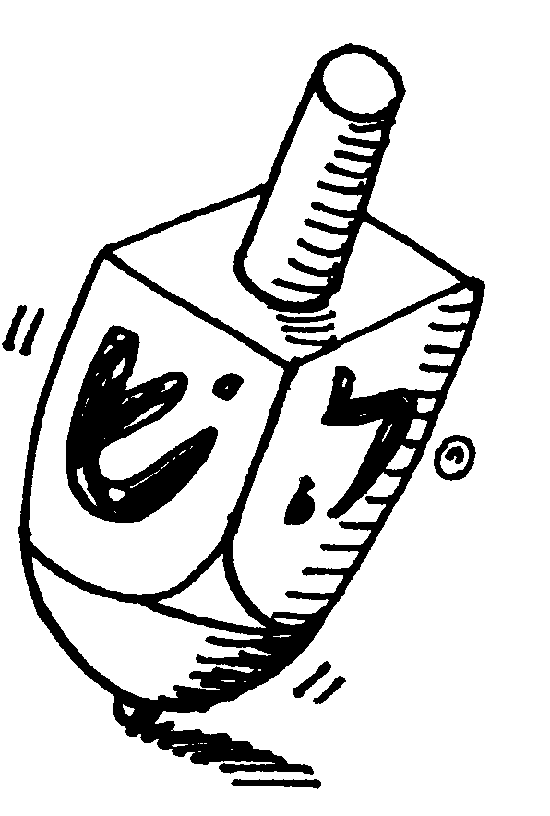
Spinning the dreidel. The dreidel is a kind of 4-sided top. The story is that the Jews who were secretly studying the Torah together would quickly begin playing with the dreidel whenever soldiers came by. This game comes from an ancient German gambling game. For the rules of the game, and for a pattern to make your own dreidels with your students, see this page.
Eating latkes. This is a sort of potato pancake that is made with a lot of oil. Oil has special significance during Chanukah! For a recipe and some hints for making latke, go here.
Giving gifts. This is only practiced in places where Jewish people are in close contact with Christians! It is not an original Chanukah tradition!
Chanukah Vocabulary
Chanukah/Hanukkah - rededication
Rabbi - a Jewish priest
Torah - the Jewish Holy Book, generally the first 5 books of the Old Testament
Talmud - collection of oral interpretations of the Torah, which is supposed to teach the Jews how to apply the Laws of the Torah
Kislev - the Jewish month when Chanukah occurs
Maccabees - a group of Jews who refused to obey the Greeks
Mitzvot - the Jewish commandments. See them here
Mitzvah - a commandment of Jewish Law, or the fulfillment of one of the commandments
Hallel - a combination of Psalms that are said in praise of God on important Jewish holidays
Berakhot - blessings
Menorah - a kind of candlestick that holds 9 candles (1 "lighter" plus 1 for each day of Chanukah)
Shamash - the center candle of the menorah that is used to light the other candles
Dreidel - a 4-sided top that is traditionally played at Chanukah
Latke - an oily potato-based food, often compared to a pancake or fritter, which is traditionally eaten during Chanukah
Sufganiyot - a kind of jelly donut that is a popular Chanukah treat