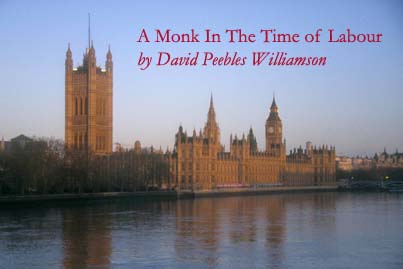
"Sure, we all need something to believe in," said the monk at the traffic-lights to me last Thursday, "but don't we all also need someone to believe in us?"
I didn't know who this monk was. I don't know any monks. The green man flashed and the monk crossed the street, walking away from the Houses of Parliament.
Monks are fun. They're like clowns, but they don't take the make-up off when they go home. But a monk walking down the street is not a man dressed up as a monk walking the street. He is a monk walking down the street.
And that's reassuring, because these days I live in costume. For the first time in my life, I'm regularly wearing a suit. Every day, I walk through the gates that lead into the British parliament.
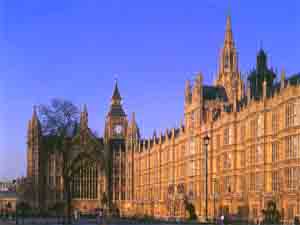
To get there, I have to make my way along a narrow footpath that's crowded with tourists -- no matter what the weather is. In the rain there will be just as many people posing for photographs as in the sun.
This could be frustrating, but I still find it kind of fun. I've only been a researcher for a few months, and I have more in common with the tourists than with the many men who wear suits.
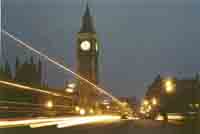
The other day, a line of crazy-haired Europeans stood on a wall with Big Ben in the background and posed for a photograph.
Their thumbs shot up skywards and their faces grinned the grin of mountain climbers. Their walking this spot constituted an achievement, the end of a journey.
They recognised the wonder of being at the this precise place in the world and celebrated. I wanted to be on the wall, too. What's the etiquette for walking through this crowd of photographers?
You can slow up, and try to avoid entering the camera shot, but this is impractical. It halts the flow of humans, breeds frustration in those behind you, and makes the self-conscious photographer snap a bad picture.
The compromise involves revelling in the possibility of being in a hundred thousand holiday photograph albums around the globe.
Don't stop walking, but look into the lens and smile. Become part of the picture; a picture that will be developed in Geneva, Cairo or Uzbekistan.
Who knows, maybe it'll be seen by an industrialist who'll be struck at some core level by this image of the positive Britisher; perhaps they'll invest in the United Kingdom and some worker in Sheffield won't lose their job; then their children will be able to go to university, get an MBA, get rich and invest in, well, Geneva, Cairo or Uzbekistan.
"Don't we all also need someone to believe in us?"
Maybe the monk was talking to someone else? Someone beside me? Someone behind me? But no, he made eye-contact.
Eye-contact! The most important act of any salesman. It isn't something we really do naturally. Eyes wander in conversation between friends; and yet, here's this monk staring straight at me.
The gall! But maybe the monk was a salesman in his earlier life, when the only orders he entered were into docket books.
Yes, he had a slight American lilt in his voice; Billy Graham used to sell vacuum cleaners door-to-door across the USA.
He said it was good practice for evangelism. Maybe this monk, locked up in a world of Aquinas and Hippo, looks back with wanderlust at treading along the highways of Idaho.
Think what he could have been selling in the name of the pursuit of happiness. That's it.
The house in Nebrasksa Avenue is sheer Edward Hopper. White timber frames hold up the blue slate roof. The monk wears a suit the same colour.
He opens the white gate attached to the obligatory white picket fence and steps into the garden in which perfect green grass gleams around his brown brogues. I can see it now.
The monk walks up to the front door. A black man answers it. The year's 1971. Memories of MLK are fresh in the air. The monk tries to sell vitamin tablets to the black man's family.
"They'll boost your daughter's IQ," the monk says, "and help you get through your working day." A bottle of Vitamin C tablets changes hands for cash. The monk goes on his way. Into the neighbouring state.
This could of swung any man into a monastery. The headlines! Scores of children drop dead in the ballparks and the playgrounds the morning after popping the pills that promised so very, very much.
A trial follows. The monk is not culpable for the tragic mistake. His employer goes bankrupt, but the monk was going to quit anyway.
Yes, he now looks for something to atone for his sins; something he can put faith in; something he can preach with confidence.
"Excuse me," I say to the elderly man in the bow-tie who sits at the desk in Central Lobby, the round chamber that divides the Palace of Westminster between the House of Commons and the House of Lords. "Was there anything going on here today that involved monks?"
There's the pause as blue folders are opened and lists of engagements are studied.
"There's nothing obviously religious," the old man says. "But I guess a monk could be invited to anything he had a particular interest in."
"Thanks." I don't even know if the monk had actually been in Westminster, but I can't get him out of my head.
It's 2:30 and the House of Commons is about to begin its business for the day. Before the public can be admitted into Stranger's Gallery, the Speaker has to make his procession into the chamber.
Crowds of schoolchildren and tourists fill Central Lobby waiting for him. There's the cry from somewhere deeper in the building of "Speaker!" and a line of men dressed in black appear.
The Speaker, a former steel-presser and trade unionist from Glasgow is wearing black breeches and a cape that is carried, bridesmaid-style, by one of his attendants. Behind them, the golden Mace -- the symbol of the Queen's authority -- is held on the shoulder of a grey-haired and wiry character with a bushy white moustache.
Then there's the public's rush up the half-dozen flights of stairs into the Stranger's Gallery. From here, we can see the Conservative Members of Parliament sitting to the Speaker's left (our right), facing the Labour MPs.
It's tough being in opposition in 2001.
The Labour government has a majority of 179. They can pass any piece of legislation they dream up. Britain doesn't have the checks-and-balances that make American democracy so lugubrious
.
The Prime Minister, Tony Blair, could make it illegal to wear a mobile phone on your belt if he wanted to. I wish he would. There's something about the sight of someone with a phone clipped onto their side that looks so utterly nerdish, but not in a way that evokes the possibility of the discovery of alchemy. It's a brandishing of gadgetry in a way that smacks of… No way!
Sitting in the same gallery aisle as myself, with his head ever so slightly nodding, is the monk.
The monk! The monk! The monk!
I cannot fail to make contact with this person who has so captivated my morning. "Who do you believe believes in you?" I want to ask, but we're watched with glares by men in black breeches and tails.
Their jackets are pinned together by a gold portcullis brooch. Anyone who insists on pointing at MPs, whispering loudly, or applauding is ejected as if from a nightclub by these bouncer-gruff cohorts.
The monk rises to his feet. I spin to look at him with fear and thrill humming in the air. You are not supposed to do this. Standing up is out of order.
Has no-one told him? It's -- he's untying his cassock! What's the name of the rope that binds monks robes on?
Woah, it flies over the gallery's parapet, falling in front of a drowsy Liberal Democrat. From beneath his cassock he unfurls, and I can't help but giggle, an Iraqi flag. It's huge; its satin fabric unfolds and billows like a conjurers table cloth.
My monk skips down the couple of rows of pews in front of him and leans over the dark oak edge of the gallery.
The Portcullis-buttoned men in their black uniforms are moving at the monk already. They order the spectators in the front pew to step out so as to let them in. They oblige. Oh, why be so obsequies?
I want to applaud. This is rock and roll. This is Dylan plugging in his guitar at the Newport Folk Festival. This is Norman Mailer marching on the Pentagon. This is the Beatles smoking a joint in Buckingham Palace.
This is a monk waving an Iraqi flag in the House of Commons!
The Environment Minister, Michael Meacher, is speaking at the Dispatch Box next to the Mace. He doesn't look up.
Backbench MPs continue to field questions about the Rural White Paper. Not one of the elected representatives will look up at the shouting monk, let alone make eye-contact. They're used to this type of thing. Prepped for it. It's normal.
The flag falls.
Snatched by a steward on its way down, it never stands a chance of hitting the carpet. The monk is now held by both arms and is being frog-marched up out of the gallery. He's still shouting something about sanctions, violation of United Nations mandates, international law and an abuse of Article 7.
Before he disappears into a corridor that leads to a room full of policemen, he turns his shining head and cries: "Democracy, justice, development -- what do you believe in?"
Parliamentary proceedings continue. It's going to be a long debate. You can expect the House to sit until at least three in the morning. When the Members finally retire to their apartments in Pimlico and Kensington, then the Monk will move from the holding-cell in the bowels of the palace.
He'll have been offered a meal from the House of Commons menu, but will have to have provided payment from his own purse. This has been the routine for years. Back at my desk in nearby Whitehall I'd wondered about tracking down a policeman and trying to buy the monk a meal.
I didn't do it.
Nor did I do what I really wish I'd done.
Back when his face had filled with royal purple, when his vocal cords had made a louder noise that they'd probably had to project in who-knows-how-many years of Matins and Vespers, back when he'd had his cassock flapping like a superhero's cape, back when the Queen's Men were scrambling along the green leather of the gallery aisles, I should have jumped beside him, gripped his side and screamed.
I'd have yodelled a response to his question that morning on the corner of Waterloo bridge. Yes, I'd probably lose my security clearance. That badge that swings around neck would have been the first thing the police confiscated.
Gone would be any future in the Civil Service. And there would be no hope of lucrative media notoriety.
There seems to be a tacit agreement that gallery shoutings go unreported. We don't wish to encourage such behaviour…
But I know what I would have hollered, because I've rehearsed the moment all afternoon, evening and night. Standing by the side of the man of faith, my favourite monk -- the one who stripped for Iraq in the Palace of Westminster -- I'd have shouted the most obvious words that one could articulate: "I believe in you."
Then I would know who I was. I wouldn't be a man in a suit. Definitely not a bureaucrat. I'd be a man who applauded and made obvious gestures and raised my voice. Who knows?
Perhaps there would be tourists in the gallery who I'd smiled at when they took photographs earlier in the afternoon? Back in Beijing (or wherever!) they'd point at me and say, "That's the man who…"
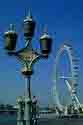
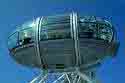
No, the next day's newspapers don't carry a single word about the monk in the chamber. But the front pages of three of the nationals are full of another monk story. What's the word for a collection of monks? A herd? Flock? Shoal? Posse? Whatever. Twelve of them clustered into a capsule in the world's biggest fairground wheel, the pride of millennium London.
Located right opposite the Houses of Parliament, next to the giant County Hall that was shut down during the Thatcher government, it takes 45 minutes to do one revolution. Thousands ride it each day. Three million a year. Do the math. Lots.
Monks are the right type of tourists to have in a capsule. They're not going to spray-paint the windows. They won't harass other passengers during what British Airways, the corporate sponsor of the attraction, term a "flight". They'll enjoy the spectacular view of the metropolis, point at the unprecedented view of Queen Elizabeth II's back garden, and comment on how much space a railway station takes up.
They might even pray. I don't know what the monks did during their first revolution, but when 360 degrees had been circled, they refused to get out.
When ordered to leave the capsule, they presented the attendants with a sealed envelope. Inside was a letter complete with the logo of their Order.
It detailed how US and UK led sanctions against were starving the nation's poorest and cementing support for Saddam Hussein. The monks enjoyed a further flight.
This time, they attached giant flags to the windows and chanted in Latin. BBC, CNN, SKY, MSNBC arrived, and the world caught a glimpse of civil disobedience on a day in which London's skies were paint-palette blue. That night I walked home whistling.