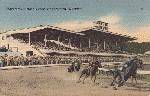
The Track
Curves
Tracks tend to be from 1/2 mile to 1 mile in length. In Thoroughbred racing, where 5 furlongs, or 5/8 of a mile, is usually the minimum distance, curves of the track are something that has to be dealt with.
   The centripetal force of the self-imposed motion of the horse brings the horse to swing out wide over the turns. F=m((v^2)/r). A large mass and a large velocity lends itself to a large force that is pulling the horse away from the rail.
   A horse good at handling turns would be able to slip onto the rail and save themselves the extra distance.
www.horse-races.net
Impulse
The effects of the impulse on horse legs sometimes break a horse down after a long career. The horse is so massive and is thrusting his feet onto the track so hard that the impulse is rather large.
  The impulse is given by J=delta P. The momentum (P), is m*v. The velocity of the horse's leg and the mass of it gives it a big momentum, which changes to the opposite direction when the horse's leg pounds the track.
Static Friction
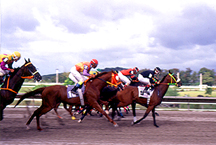
Static friction is what is important in this situation. There must be enough friction between the hooves and the surface of the track to keep the horse from sliding.
Track Surface
  A good track surface has a nice compromise between a good friction surface, enough padding for the horse's joints, and not being so deep as to bog the horse down.
   The track condition is measured by fast, fair, muddy, or sloppy.
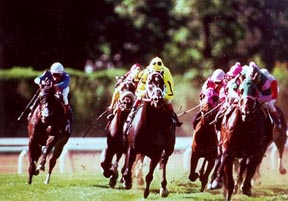
  Turf racing, racing on grass, is most popular in Europe, but their is its own niche for it here as well.. It has a totally different feel to it, in the cushioning and static friction of the track, so some horse's take to it better than others.
www.castillotours.com
www.batchellermansioninn.com
Hosted by www.Geocities.ws

1