 |
|
|
|
|
|
|
|
|
|
|
|
|
|
|
|
|
|
|
|
|
|
|
|
|
|
|
Handicapping and Weights |
|
|
|
 |
|
|
|
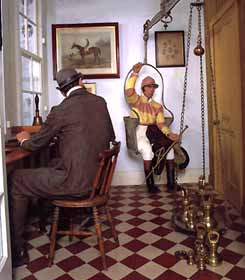
More mass requires more force to get the same amount of acceleration, as proven by F=ma. Most races have a designated amount of weight for each horse to carry so that no horse will have an advantage by havinh a lighter jockey. Each jockey is weighed with their saddle before the race, and if it is less than the required weight to carry, the difference is put into the horse's saddle pad in lead. No horse is allowed to carry more than three pounds of their designated weight. |
|
|
 |
|
|
|
|
|
|
This is also apparent in KE=1/2mv^2. The more massive a horse and jockey system is, the more energy will be required to maintain that speed. |
|
|
|
|
users.moose.co.uk |
|
|
|
|
|
|
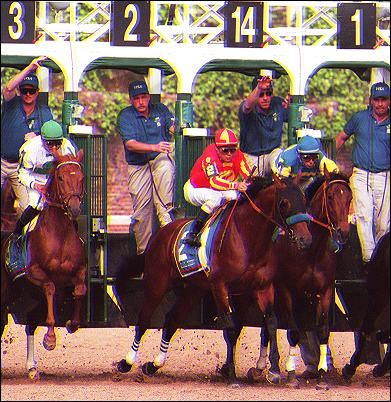
Handicap races are among the most exciting of all races as knowledgable horsemen weigh a horse's ability through past performances, breeding and experience and assign each horse an individual weight to carry. The point is to give all horse's an equal chance to win, even those who are not as fast as toher horses in the race. Again, F=ma comes into play. If a horse is forced to carry more mass and is only able to give out a finite amount or force, the acceleration will be slowed to compensate. This will allow a horse carrying less mass and that usually gives out less force to have an acceleration more similar to the faster horse than they would have otherwise. |
|
|
|
 |
|
|
|
|
|
www.courierjournal |
|
|
|
|
|
 |
|
|
|
The mass will affect all aspects of the race. Breaking from the gate requires a huge acceleration, and moving up in the pack will require an acceleration as well, afterthe horse has already spent some energy. Staying on the pace and not falling behind in the pack is also affected, and could win or lose a race. |
|
|
|
|
www.finishlynx.com |
|
|
|
|