(collected from various sources including Scott Cunningham’s book "The Magical Household")
The broom has long been associated with magick due to its shape, use in purification rituals and its kinship with magical wands and staffs. The common household tool is so sacred that in some parts of the world, broom deities exist.
In China, the broom goddess is Sao Ch’ing Niang or Sao Ch’ing Niang-Niang. Known as the Lady with the Broom, she lives on the Broom Star, and presides over good weather. When rain continues too long, threatening crops, farmers cut out paper images of brooms and paste them on their doors and fences to bring clear weather and sunshine.
In pre-Colombian Mexico, the Aztecs worshiped the Witch-Goddess Tiazolteotl, who was usually depicted carrying or riding a broom. In her rites, priests burned black incense and laid brooms made from rushes across the fire. Owls, snakes, and the Moon were also dedicated to her. She was invoked to sweep away worshipers’ transgressions.
In the old days several different types of brooms were specially prepared for magic. For other than normal sweeping spells, you should have one broom in your house reserved for magic that isn’t used for anything else.
There are many associations made between brooms and witches, some of them off-color and and confused. Witches didn’t fly on their broomsticks (too bad!) but like their accusers, they did use them to clean their cottages. Reports that witches galloped around on broomsticks during their ritual dances may hold some truth, as they were blessing the fertility of their crops. Even today, the jumping of the broom is still performed at some weddings!
BROOM MAGIC
When using a broom for the first time, make a wish and it will come true.
Anyone who desires to be married merely has to jump over a broom nine times; within a year, he or she will be married.
Placing a broom across a doorway allows your departed friends and family to speak to you if they so choose. As long as the broom remains, they can communicate freely.
To bring rain, stand outside and swing a broom in the air over your head. If lightening blows your way put a broom on your porch to act as a lightening rod. Electricity and lightening are thought to be attracted to brooms. Another way to safeguard a house against lightning strikes is to cross a spade and a broom outside the main entrance.
Placing a small broom beneath the pillows was thought to keep evil far from the person’s slumbers.
Two brooms crossed and hung on a wall or nailed to a door guard the house, as does a broom placed on the ground before the main door.
Take 2 needles and make an equal-armed cross with them and place the cross into a broom. Stand the broom behind a door, and it will guard your home. (When standing a broom, place the bristles up, handle to the floor. This not only insures that the bristles last longer, it is good luck.)
It is unlucky to buy a broom in the month of August.
Moving an old broom into a new house is bad luck. This doesn’t pertain to brooms used exclusively for magical use, only those used for sweeping floors.
If nightmares are a problem, let a broom sweep them away. Hang one on the bedroom door, and place garlic beneath your pillow. You should sleep peacefully.
When making a broom for normal household sweeping, carve on the handle (the words running from the tip to the bristles on one side): "I sweep in money and luck." On the other side with the words travelling away from the bristles), carve "I sweep out evil and poverty." When the broom is used, it will do just that.
To protect yourself in bed, lay a broom beneath the bed. Sprinkle a circle of salt around the bed (while inside the circle’s perimeter), and you shall be guarded until morning. Sweep up the salt with the broom when you rise.
It isn’t wise to leave a bed empty for too long. If you must travel, tuck a broom into the bed, laying the bristles on the pillow. This will guard the bed against evil until you return.
If you have nightmares, you can put a broom under the bed to sweep away the bad dreams.
When sweeping remember to go towards the fireplace, if you have one. If not sweep in any direction except towards the front door. Do it this way so that you will not sweep your good luck out the door.
To end tiresome visits from company that stays too long, place a broom upside down behind their door.
If a broom drops across a doorway, you’ll soon go on a journey. However, make sure to pick it up quickly; don’t step over it.
BESOM SONG
Besom, besom long & lithe
Made from ash and willow with
Tied with thongs of willow bark
In running stream at moonset dark
With a pentagram indighted
As the ritual fire is lighted
Sweep ye circle, deosil
Sweep out evil, sweep out ill
Make the round of the ground
Where we do the Lady’s will
Besom, besom, lady’s broom
Sweep out darkness, sweep out doom
Rid ye lady’s hallowed ground
Of demons, imps and Hell’s red hound
Then set ye down on Her green earth
By running stream or Mistress’ hearth
Till called once more on Sabbath night
To cleanse once more the dancing site
FOLKLORE
In folklore, witches use brooms or besoms (brooms made of bundled twigs) to fly through the air at high speed. In Renaissance and medieval times, "the belief that witches traveled by broom was more prevalent on the European continent than in the British Isles." Only once are brooms mentioned in English witch trials. Nonetheless, the image of a witch riding a broomstick has become a popular cultural stereotype. Several theories explain this association of brooms with witches:4."The association between witches and brooms goes back to ancient times, when pagans performed fertility rites to induce their crops to grow high." These people mounted pitchforks, poles, and brooms, and rode them like horses in the fields, leaping high into the air and dancing.1.Brooms are "a symbol of female domesticity, a tool of every woman, and most witches were women." Centuries ago, a woman would push her broom up the chimney or prop it outside the door to show to callers and neighbors that she was out of the house. "From there, it was an easy step to believe that witches, who purportedly could fly, would use their most common tool and soar up the chimney on it."
2.Many flying potions contained hallucinogenic ingredients. If a broomstick was rubbed with such potions and used for masturbatory purposes, a sensation of flight would result.
3.The benandanti used stalks of sorghum in their battles against evil witches. Sorghum is a type of millet identified with brooms.
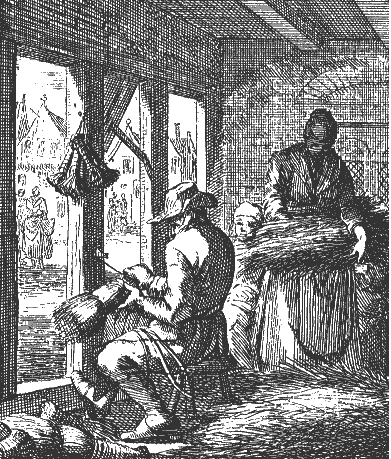
The correlation between brooms and witches is not noticeable until the late 16th and early 17th centuries. Before then, witches were depicted astride shovels, sticks, forks, hurdles, and demon-animals. Eventually, witches were shown more on either demons in the forms of animals or on brooms.
At first, the brush end of a broom (or faggot) was pointed downwards so the witch could "sweep her tracks from the sky." This is the stereotypical image we still see on the verge of the 21st century. Nevertheless, by the end of the 17th century, the reverse was true. Witches often rode with the faggot-end up, with a candle in the faggot to light the way.
In some lore, the devil dispensed brooms and flying ointment to weak witches who needed help. In other tales, all newly initiated witches were presented with the broom and ointment. The ointment typically consisted of toxic/hallucinogenic ingredients. If the witch was inside a house, she theoretically rose through the chimney, although in court, few witches ever acknowledged doing such a thing. Sorcerers flew on brooms as well as witches, but men were more often shown riding pitchforks.
According to lore, witches flew their brooms to the sabbats, sometimes carrying along demons or their familiars in the shapes of animals. They also rode their brooms to fly out to sea in order to raise up storms. Legend had it that novices sometimes fell off. On witch festival nights such as Walpurgisnacht, townspeople laid out hooks and scythes to kill any witches who fell off their brooms. The also rang church bells, which had the power to ground broomsticks and knock witches off them.
A famous Scottish witch of the 17th century claimed to have used her broom for an atypical reason. Instead of using it for travelling, she used it to deceive her husband. Before going to a sabbat, Isobel substituted her broom for herself in bed. She said he never knew the difference, which might have been more of a comment on their marriage than a confession of witchcraft.
Brooms were also used in weather magic. "In Hamburg, sailors, after long toiling against a contrary wind, on meeting another ship sailing in an opposite direction, throw an old broom before the vessel, believing thereby to reverse the wind."