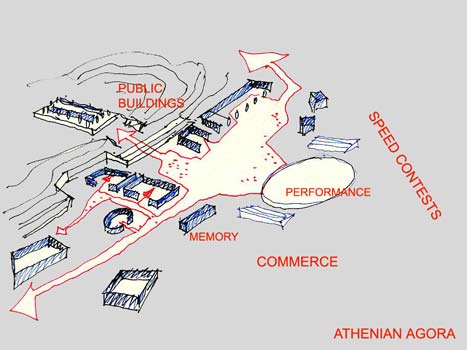
"The most certain difference is between the Agora, as public space and space of public life (a space that is realized by the public exchange and the dialogue) and the motorway or the hyper-stores as non-places that are realized through the lonely consumptive wandering". M. Auge.
A comparative comparison of the Agora and the
contemporary non-places is interesting not in order to show through it models
of ideal functions of space, but as a cause for search of new significations
in programmatic functions and phenomena that creates our era. These phenomena
are necessary to be mapped and be understood.
The Agora that historically moved in parallel with the activities of the public
life, added in the movement something more than its functional value, constructed
the value of street, constituted the street as a historic vehicle of public
life of the city. We can see that the special cultural attributes of a period
rendered the meaning that the movement and the street of the city had that
certain period.
Mapping the contemporary cultural attributes and the forces that today produce
the movement, the transportation, the communication, is the way that will
lead us to the understanding of the contemporary space of movement. A type
of space with many particularities but also with special interest for the
research of space.
To begin with, we have to look for the characteristics of movement space today. In this search, help can be given by the Auge's argument about the non-places, the physiognomy of contemporary spaces of ephemeral exchange:
"The multiplication of "non-places" is a characteristic of contemporary world. Traffic spaces (motorways, airports), consumption spaces (multistores, hypermarkets) and communication spaces (telephone, television, nets) occupy even more and more space all over the world. These are spaces where people co-exist or co-habit without living together". M. Auge.
Auge observes the procedures of contemporary life through anthropology and offers to us an interesting interpretation of the situation that he calls "super-modern".
The "super-modern" situation, according to Auge, is dominated by the following characteristics:
1. A hyperplentitude of events. Excessive information and excessive production of meaning.
2. A hyperplentitude of space. Excessive production
of space.
The production of space covers specialized needs of transportation, information,
consumption. The needs, most of the times, don't coincide and don't coexist,
are functionally separated and are strictly programmed, excluding the unexpected.
3. The references.
Contemporary activities produce non-collective references and representations.
Create correlations that deprive the collective use of space, negotiation
and coition.
Auge's observations have one more very important interest for the research:
They are referring to procedures that regard to the production, use and meaning
of space. This way, they become very useful data for the interdisciplinary
field of spatial research. Something that is interesting to the architects
and furthermore influences the work and the tools that architects use nowadays.
We can, according to the foresaid, investigate
some characteristics of the contemporary movement and to state its contemporary
programmatic function in the space. It's also interesting to state the opposition
that started by imprinting the physiognomy of the Agora and the contemporary
motorway, in the comparison between contemporary and traditional programmatic
functions of space. Either to move forward to the comparison between the way
with which space is produced nowadays and was traditionally produced in the
past or between the way that the movement administers or administered in the
past, the concept of earth.
1) The two types of programmatic function of space.
a. Programs that restore a collectively produced "symbolic order" and organize identities, relations, memories.
b. Programs with multiple meanings where space
symbolism isn't subject of negotiation but is imposed either as a functional
need or as a need for the satisfaction of desire.
Furthermore, "schizoid" programs where the production of meaning
is an uncontinual procedure. Where memories and identities are not constructed,
limits are not defined, the relations are not the same. The most interesting
in these types of programs is that users experience the space in a "constant"
today. These spaces that Auge calls "non-places" are existing in
order to be left behind. They are dominated by the present, the present moment.
The programs of case a) belongs to a traditional perception for the use of space. When the local society administered and gave meaning to space. When the meaning was produced and reproduced through a continuous and repeated use of space. Nowadays the meaning is produced by the rules of globalization and with the logic of market, the consumable needs and services. We can nowadays say that the programmatic prototypes are corresponding to case b).
The unusual experience of time that we have in
these spaces define and our experience of space too. The activity is ephemeral,
doesn't create relations, doesn't produce memories, doesn't construct identities.
2) The consumption of space.
Space is enrolled in the consumptive procedure.
It's a good that it is consumed.
Through space some basic consumptive functions like transportations and communications
are satisfied.
Road is becoming the conductor of transportations and communications in a
network of uses that defines our everyday life. So, the road, the space of
movement, is becoming the space of transition, the medium in order people,
information, goods and services to be transported between the programmatically
defined places of consumption.
The transition is not lived as an experience but as an obligatory waste of
time. The movement doesn't constitute procedure that offers knowledge, brings
in touch and creates relationships, but is a stage in the procedure of consumption.
The movement is a quantity and is judged quantitatively. Doesn't create alterations
of the meaning, the meaning in the movement is unvaryingly registered. Today
a movement without any sign of local character, with a common universal meaning,
constitutes the ideal. A motorway that doesn't differentiate the experience
of being in New York, Hong Kong or Athens.
3) The artificial ground of movement.
Transportation is traditionally imprinted as
a sign, as a copy of a procedure of appropriation and recognition of space.
The heritage of the movement's separation as autonomous function from the
period of modernism, to the period of hyper-modernism, is reflected in the
advanced production of artificial ground. The spaces of transportation are
becoming complicated hubs, infrastructures and megastructures that are asserted
to landscape, produce themselves landscape.
These megastructures and their role in the production of urban landscape is
something that we experience in everyday life. These infrastructures appear
in our city even more intensively during the last years but haven't occupied
us as a phenomenon yet. These megastructures are urban infrastructures, important
investments for the city, which are dedicated to an exclusively programmatic
function, the transportation. Spaces which produce these structures can reserve
to a city different functions unforeseen and not arranged.
The unexpected and non-scheduled functions can
be a subject of experimentation for the architect.
In the example that we present here, it is in our interests to implement programs
of public functions, cultural, athletic activities, activities of political
dialogue and memory of a local community, in spaces that are not initially
scheduled to receive these kind of functions. A similar occasion of space
is the infrastructure of motorway and especially in hubs and crossroads.
The crossroad historically represents the place
of meeting, the place of power coincidence and the place where the unexpected
happens. The crossroad for this reason always carries intensive symbolism:
Hermes, for greek civilization, protects the transportations and the commerce,
the Agora and the crossroads.
Today, the public life can not be symbolized by the crossroad. The market
is not anymore a place of meeting, doesn't protect the exchange nor the negotiation.
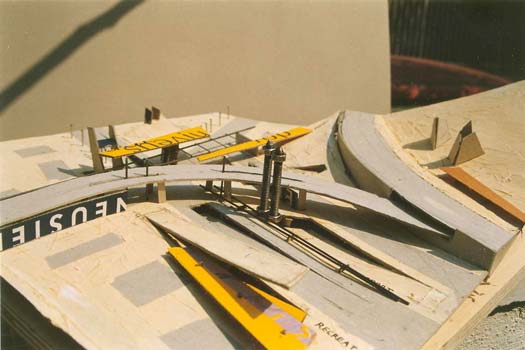
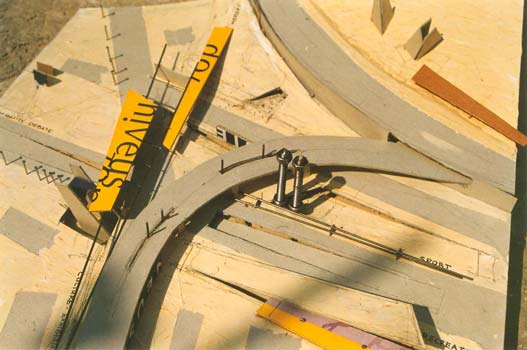
So, it would be very interesting to use a contemporary crossroad, a hub, in order to investigate the type of space, which it produces, its special characteristics but also the meaning with which it supplies the urban space. The case of Stavros' hub (Agia Paraskevi / Athens) is useful to us as a field of experimentation. It functions as a field where an interlacing of design in a phenomenon can be displayed, in a way that invades in the life of a city (the new motorways). And at the same time, alters the physiognomy of the city in general, but also of the local communities and its public life.
Using a paradigm of design interlacing, we set
the question of how such an infrastructure can be appropriate, how it can
include hospitable functions for a local community.
Furthermore, we set the question of what can be the meaning of a contemporary
crossroad. How can it supply and characterize the public life of a local community
and also to create a network of communication of parts from the broader city.
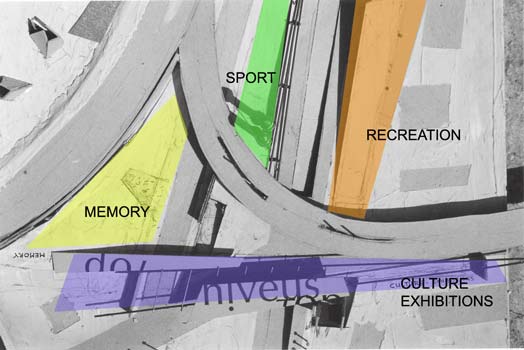
In this site we place a program of public functions:
athletic activities, spaces of exhibition and gathering, space of dialogue
and communication of citizens, spaces of memory and environmental awareness,
space of cultural activities.
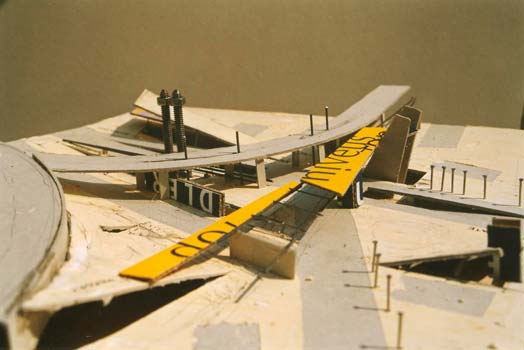
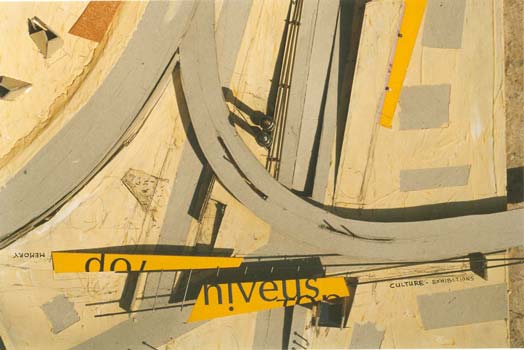
In the designing, the intensive shape of ground is a dominant parameter. The
ground is used as a surface, which in combination with the megastructure of
a hub tries to transform the place into an interesting "artificial ground"
with possibilities for combined movements (parallel and vertical, underground
or superterrestrial).
The compound creates a place that can take advantage of the continuous movements
of the motorway and the endless opportunities for communication or exchange
that can offer. From the locality's point of view, it can be a point of reference
and an interesting first substance. On the other hand, from the travelers'
point of view, it offers particularity and meaning in the place from where
they pass and gives cause for stop and participation.