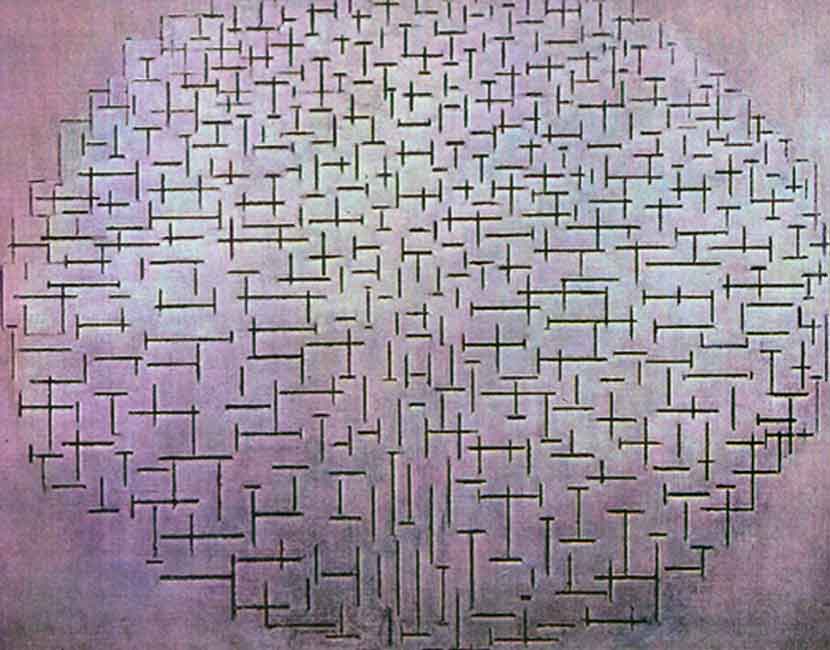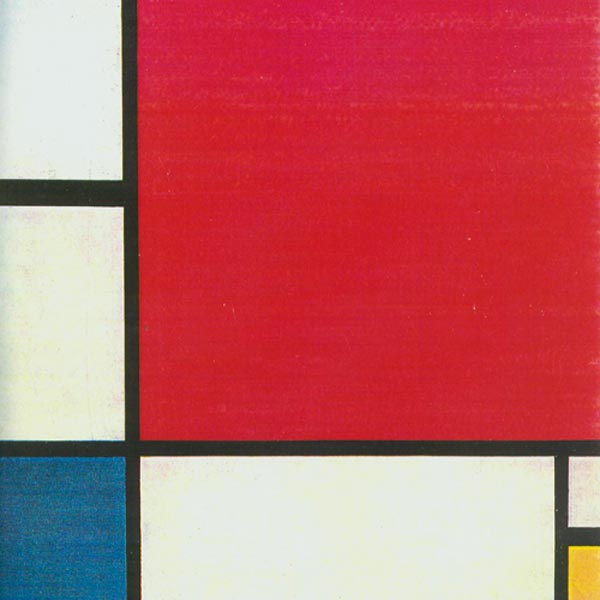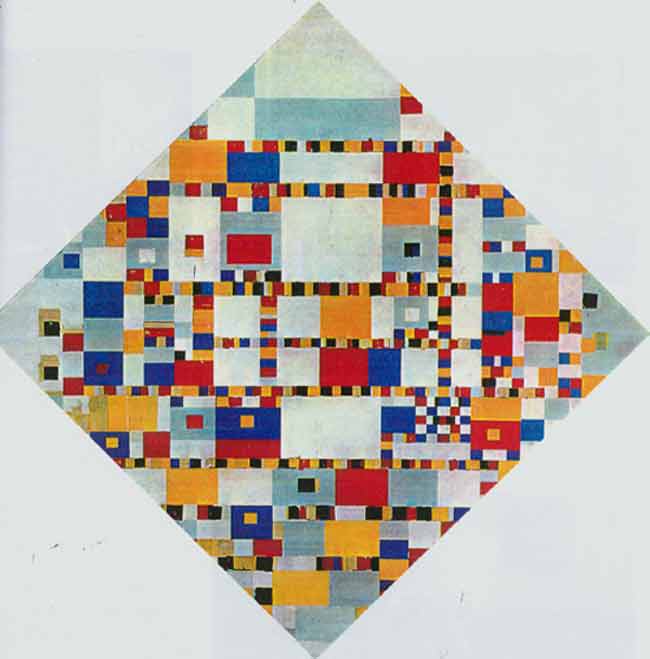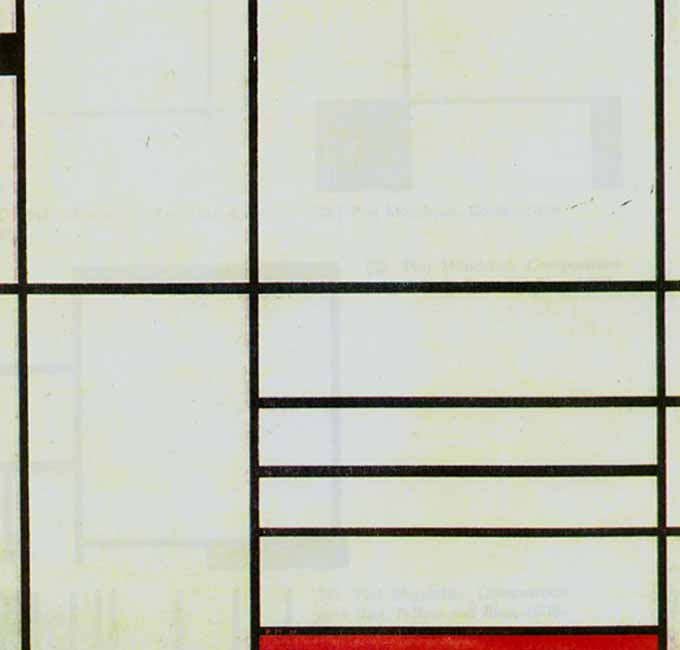
The schematization in the work of Mondrian.
Subject of this essay is the definition of the contents of the schematization
in the work of Mondrian. The question that is set is first of all if the notion
of schematization includes only the compositional and expressive media of
Mondrian (and which are they) or if included in it are also the ideological,
social, political, cultural and psychological frames that support it (and
in which way it happens). In a second level, we should look out if this schematization
(the general frame I mean) is capable to define and express exactly the content
and the substance of his works. I will state that we have to move forward,
towards a more detailed schematization, that means towards the enlistment
of his particular, in every period of his work, theoretical frame and his
special way of using his media. We have to proceed to a second schematization
that comes from the first, contains the essential elements of Mondrian's philosophy
and also conforms to the occasional transitions of his work, something very
important to be stated. The aim is to approach as much as possible, the content
of Mondrian's work and not to be satisfied with a general, abstract shape
that has nothing to do with the reality and which will not express it.
We have in this moment to make a point. We are not theorists of art and we
don't have this kind of ambition. Maybe in this essay are recorded some errors
or methodological mistakes that a theorist of art would have avoided. We continue
to be architects and for that reason we adopt an architectural view. Our intention
is, studying the work of Mondrian, to enlist his own way of forming his ideas
and his vision and to study the possible correlations of this confrontation
in the architecture. Our aim is, gathering elements, to return to architecture
and to schematization in general.
Observing the progress of Mondrian and his total work (from the moment that
he had decided in which frames would like to move) a researcher could define
in which directions the schematization "moves" that he gives to
his art. With the word "schematization" we don't refer to the media
and the way that he uses but to the ideological, social, political and cultural
shape that he adopts and projects to his work. It is ascertained already in
the scientific community of the art theorists that Mondrian was deeply influenced
by Theosofism and had founded neoplastisism (his personal theory we could
call it to Theosofism and to other philosophical steams that were famous that
period. Furthermore, he had defined and organized his expressive media with
such a distinctness (some theorists speak about an extreme way) that someone
can easily refer to them.
In conclusion, through this study of the Mondrian's work (something that we
can generalize to all forms of creation) we can realize that a group of values
(ideological and political-social) and some compositional and expressive media
that constitute the so-called first schematization (the general frame) can't
analytically describe the substance of his work. I would like to state that
we have, studying the content of Mondrian's compositions, to formulate in
every period a second, more detailed schematization that can express the special
theoretical frame that supports him that specific time and the particular
expressive and compositional media that he uses that period. In parallel,
in this essay we have to show forth the importance of the ideological, social,
political, cultural and psychological-personal elements that exist in every
type of schematization. Their roles are important and significant because,
in a great scale, these elements are the ones that define the character of
the compositional and expressive media.
Nektarios Kefalogiannis