Research
subject for this project was the abstract model and all these it contains
and to what it refers. I am interested in studying this kind of models as
a perception subject and as representation of the (architectural) space and
also as a mean that give notion to it. Especially the last one, since this
kind of model that I will refer to intends to express a notion, to transfer
an idea, to express a will. The subject of the project is referring to the
abstract architectural models, however the references that are done ( for
pointing out, non-logical references etc) can be expanded (and this is willingly
happening) in general in the concept of the model (digital, materialized,
2 dimensional etc).
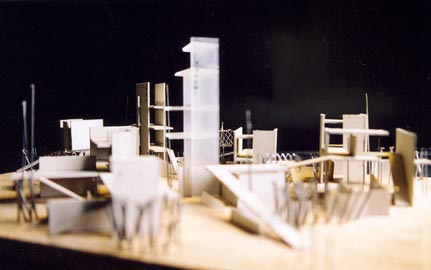
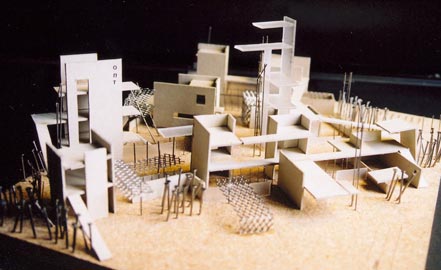
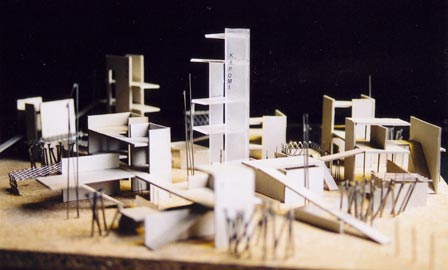
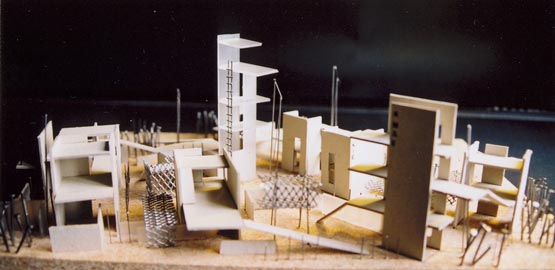
I will initial try to "show"
in what exactly I am referring to under the definition of the abstract model,
providing some examples and incorporating them in the broad variety of models
that we have in our disposal. I say to "show" because I will support
with this text that it is very difficult to become clear talking about (and
describing) abstract models, whereas using the pointing mechanism, in other
words, showing and presenting examples, is far easier to express what we
want and cannot be described with words. Besides this is the power of the
model… Thus, in this project pictures play an important role, equally important
with the words. The pictures in other words do not have a secondary importance
as they do in the majority of the theoretical texts.
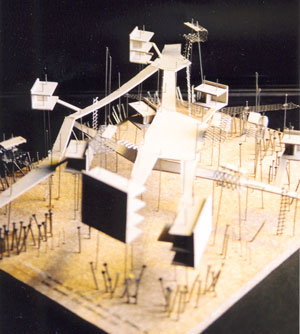
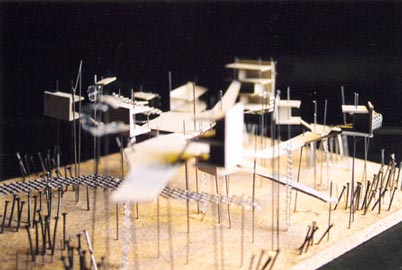
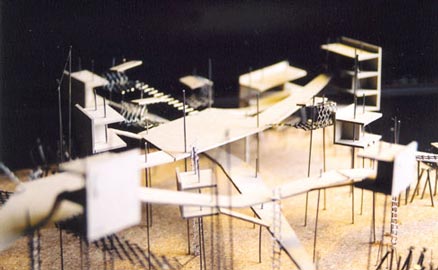
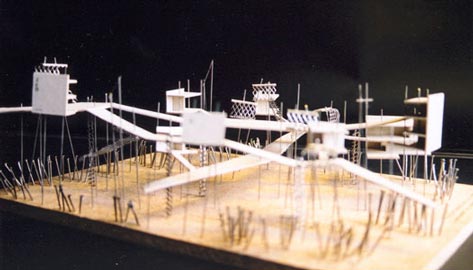
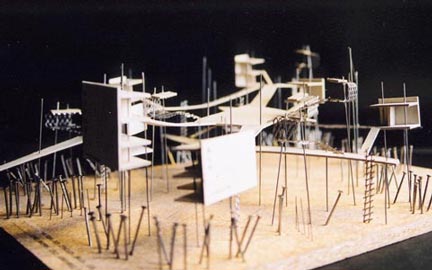
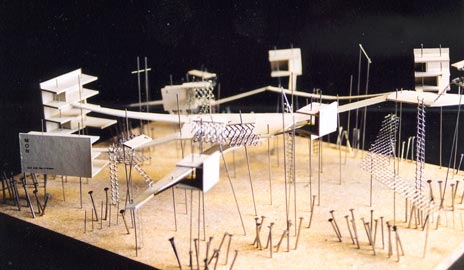
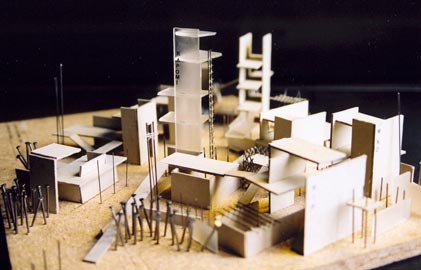
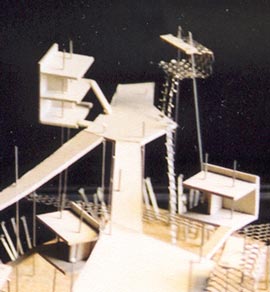
In order to satisfy this initial
objective I resorted in the production, specifically for this work, of abstractive
models in order to express, through the space and the notional relations
that this composes, in what I am precisely referring, in order to present
all these particular elements that are contained in the model and are not
recorded with words. I used literary text as base, not only in order to
have an initial material in order to support myself, but also in order that
this material can be communicated and become comprehensible from the others.
I used two of the Invisible Cities of Italo Calvino, the Zinovia and Zovaetha.
These should not be considered as a practical exercise that follows a theoretical
research. On the contrary, it is a practical work that at its duration it
troubled me on the content of abstractive models and on the mechanism of
relations that rule it. It mobilized me in order to decide what it interests
me and what not, to express in it things that I cannot record with the written
and oral speech. Mainly however, it shaped me a questioning with which I
read the theoretical texts and found in them equivalences and proportions.
It helped me to determine which texts and which approaches interest me in
this work and which not.

Having made a first effort to
determine the content and relations that this model expresses, I will try
to further approach more initial objective of (clarification that is to say)
through the work of Claude Levi - Strauss and the significances of consent
and resemblance of relations, I support that mainly characterize abstractive
model. Through the work of Levi - Strauss we will be led to the mechanism
of consent and to the way that it is presented in abstractive models. Claude
Levi-Strauss will help us to understand the mechanism of the human thought
in anthropologic terms. And I believe, with his help, we can understand that
the relations that rule and determine a creation are the same with the relations
that somebody constitutes in order to articulate his thought that (relations)
appear in the social frame in which it participates. The human creation is
a micrography of a hyperstructure, that is the human community. In other words,
Claude Levi-Strauss will try to understand the way people think, analyzing
the structural relations of a community with the glance of an anthropologist.
Levi-Strauss studying the various
castes, anthropologically, was led to the point to reject the logic of proportion
and to direct itself to the consent. [In order to become more comprehensible,
with the proportion I find way of transcription (e.g. of a significance) in
the "language" itself, with a visualistic way, with an imitating
intention. Basically, we are referring to a metaphor, in this case through
a structural resemblance. The consent is resemblance of relations (structural
consent), a equivalence 1:1, that is usually reported in another system, on
another "language". Is based on relation a/b = c/d.]
If the consent between the thoughts
of person and in social structures, in the classification or in human creations
is in effect, then we could claim that the mechanism of consent is also in
effect between the thoughts and the ideas of the architect and in the projects
in general, hence in the construction of abstractive model. We can realize
this mechanism also in the most abstractive models that have poetic mood.
We can see that the relation between ideas (that are found in the brain of
author or in a e.g. literary text that want to translate in the space) is
proportional to the relation of the materials between them, the parts of their
model or system. If we try to construct such a model, we will observe this
mechanism of consent (in combination with the inspiration) that it guides
and supports its construction.
We will understand that a lot
of things cannot be comprehended via only the mechanism of consent and we
will direct ourselves towards the "showing" and its problems. The
last proposal from the Tractatus of Wittgenstein has ghosted the human thought
(cf. Wittgenstein L.: Tractatus Logico-Philosophicus, Routledge and Kegan
Paul, London, 1961): "7. For those that someone cannot speak, for those
he should hush". Reaching this conclusion someone can understand that
many of the human activities such as art, action, activity, cannot be set
forth and expressed in all its range with the speech but it is necessary to
be shown, in other words they need a showing mechanism]. We will determine
the frame in which the showing is realised (as long as the abstractive model
is concerned), that is to say the abstractive approach of thought and art
and we will observe that only through acting, constructing abstractive models
we can conceive all the breadth of its content.
If has been stated with plenitude
the frame in which the showing is realized is realised, then its ambiguity
can have beneficial results. I am referring to all these additional thoughts
that the spectator of an abstractive model realizes, that did not exist in
the brain of its author and that function additive in its value. The ability
to conceive a territorial fact make the spectator increase the qualitative
charge of the model. A similar phenomenon with the work of art exists here.
In this (if we were specifically reported in abstractive art) the spectator
increases the value of artistic work with the interpretation that he produces.
Levi-Strauss in his text that is referring to art, speaks for the model and
its ability to create thoughts in the brain of the spectator that had not
been realized by the author or had been excluded from this. Basically, it
states an ability of the model to accept other interpretations, other extensions,
depending on the structure of thought of each observer and his perceiving
ability.
This effort of ours will lead
us to theoretical texts that are reffering to the significance of abstraction
in the architecture and in art more generally.
Nektarios Kefalogiannis
(Special thanks to Marios Kefalogiannis for
his contribution in further editing many of the english texts on this site.)