 |
 |
 |
 |
 |
 |
 |
 |
 |
 |
 |
 |
 |
| John West and Professor Robert Schoch of Boston University put in an application to the Egyptian authorities to resume their research in 1995 but their application was refused. According to Zahi Hawass, chief inspector of the Giza pyramid plateau, he is not playing favorites in the granting of licenses to explore for hidden chambers. According to "Venture Inward," (Nov-Dec, 1996), he said: "I am not stopping anyone from investigating in Egypt. They simply must meet [the condition] that requires that anyone wanting to do research in Egypt be connected with a recognized university or museum." But is there anything to be discovered under the front paws of the Sphinx? At the conference on "The Origins of the Egyptian State" at UCLA in November, 1995, Zahi Hawass and Mark Lehner showed slides of a core sampling done by the University of Pennsylvania. They found a ground anomaly below the paws of the Sphinx consisting of a lighter material (but solid) than the surrounding stone. This could be sediment deposited by flooding but the area has yet to be excavated. Or, if it has been excavated, results have not been made available to the public or the press. |
| 1996... More Rumors than News Currently, rumors abound about what is going on in, around, and underneath the Great Sphinx. Graham Hancock, who just published a new book entitled "The Message of the Sphinx," reported in handouts on his book tour as well as on radio talk shows like Art Bell, that Dr. Joseph Schor, head of the Schor Foundation, associated with the Edgar Cayce's Association for Research and Enlightenment (A.R.E.), and an alumnus of Florida State University was backing an excavation underneath the Sphinx for a news documentary on a major Network. Rumors indicated that everyone from the Egyptian's Supreme Council of Antiquities (S.C.A.) to A.R.E. to Florida State University to the Schor Foundation were conspiring to thwart other work. Was there a conspiracy? Hard evidence and solid news has been difficult to come by, but A.R.E., for one, claims it has not sided with Joseph Schor against such authors as Graham Hancock, Robert Bauval, and John Anthony West in the controversy surrounding the Sphinx. According to "Venture Inward," (Nov-Dec, 1996), John Van Auken, of the Association for Research and Enlightenment (A.R.E.) said: "The A.R.E is not taking sides. We even had Hancock and Bauval speaking at Virginia Beach this year. Our objective is to get to the truth, no matter who gets the credit." In April, 1996, Egypt's Supreme Council of Antiquities (S.C.A.) granted a one-year license to a team academically sponsored by Florida State University and financially sponsored by the Schor Foundation to conduct surveys around the Sphinx and the Giza necropolis using seismic equipment and ground-penetrating radar. Dr. Joseph Schor is quoted as saying: "We do not work for the Edgar Cayce Group.... The major purpose of the Schor Foundation and the Florida State University is to aid in the preservation and restoration of the Pyramids and Sphinx. In addition, we are surveying the underground of the Giza Plateau to find faults and chasms that might collapse. This will increase the safety of the plateau." Meanwhile, Graham Hancock, on the Art Bell radio show, stated that metal objects had been found in some of these newly-excavated cavities but nothing was confirmable in hard news reports. Reports also surfaced of a promotional film starring none other than Zahi Hawass, director of the Gizeh site. Florida State University denied involvement in the film after they were credited as participating without their knowledge or permission. Dr. Daniel Pullen wrote: "There are a number of rumors, reports, and queries on the Internet about current explorations around the Sphinx and elsewhere on the Giza Plateau, filming on the Plateau, and the role of the Florida State University. "A small team of three geologists and one archaeologist from the Florida State University went to Giza in early April 1996, at the invitation of Dr. Joseph Schor, an alumnus of FSU, and the Schor Foundation, in order to determine whether or not we might be able to address the current controversy over weathering, dating, and construction of the Sphinx and other monuments on the Giza Plateau. The Florida State team consisted of Dr. Alan Zindler, Chair of Geology and head of geochemistry at the National High Magnetic Field Laboratory, Dr. Leroy Odom, Professor of Geology and geochemist at the NHMFL, Dr. James Tull, Professor of Geology and structural geologist, and Dr. Daniel Pullen, Associate Professor of Classics and archaeologist. We spent five days at Giza exploring the monuments and geology so that we could gather sufficient on-site information to evaluate the prospect of any future project which address the three concerns of weathering, dating, and construction. If such a project does come about, we will announce it. |
 |
 |
| "While we were invited to consider participation in a film or video, the Florida State University and the FSU team declined. Unfortunately the promotional video used to invite our participation by including the name of the Florida State University in the credits was circulated without our authorization and the continued association of the Florida State University with this promotional video is incorrect." [from Daniel J. Pullen, Associate Professor, Department of Classics, Florida State University ([email protected]) in the Usenet newsgroup, sci.archaeology]. The film in question was reportedly financed by Dr. Schor and was a short promotional film. It begins with Dr. Zahi Hawass, chief inspector of the archaeological sites at Gizeh, scrambling into a tunnel leading under the Sphinx. When he reaches the bottom he turns to face the camera and says: "Even Indiana Jones will never dream to be here. Can you believe it? We are now inside the Sphinx in this tunnel. This tunnel has never been opened before. No one really knows what's inside this tunnel. But we are going to open it for the first time." The film's narrator then says... "Edgar Cayce, America's famous Sleeping Prophet, predicted that a chamber would be discovered beneath the Sphinx -- a chamber containing the recorded history of human civilisation. For the first time, we'll show you what lies beneath this great statue... a chamber which will be opened tonight, live for our television cameras." The excavations were supposed to have been put into a film to be shown in a television documentary in September or October, but, to this date, there has been no documentary... and even less news. |
 |
| This work was confirmed and incorporated into the film, "The Mystery of the Sphinx" made in 1992-1993 about author/Egyptologist, John Anthony West; Robert M. Schoch, Professor of Geology at Boston University; and geophysicist/seismologist, Thomas Dobecki from the Houston firm, McBride-Ratclif & Associates. Shown on NBC, the film was produced by Boris Said of Magical Eye, Inc., and Bill Cote of BCVideo; and, according to some reports, was partly financed by members of the Association for Research and Enlightenment (A.R.E.). Headquartered in Virginia Beach, Virginia, A.R.E. is the organization that promulgates the work of psychic, Edgar Cayce, the sleeping prophet. Cayce predicted it would be discovered that the Sphinx had been built in 10,500 B.C. by survivors from the break-up of the continent of Atlantis. In addition, concealed beneath it, a Hall of Records would be discovered that would contain all the collective wisdom from their lost civilization and the true history of the human race. Cayce predicted the Hall of Records would be found and opened by 1998. |
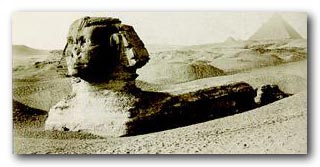
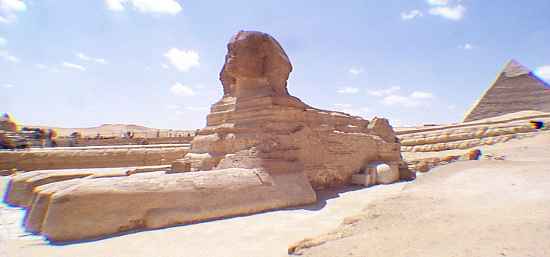
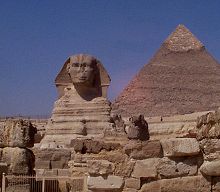
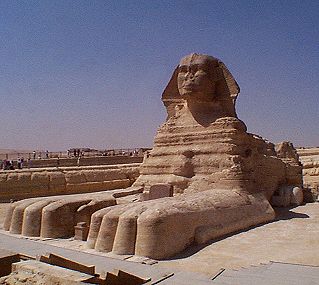
| The Valley Temple is at the end of one of the world's oldest paved canals, a 1600-foot causeway that leads to a Mortuary Temple in front of the Pyramid of Chephren (or Khafra, the middle pyramid) -- about 150 feet have been excavated so far. Ancient tunnels run under the Valley Temple, but researchers do not know what they were used for and have not begun excavating. Causeways also link the Khufu (or Cheops, the Great Pyramid, to the northeast) and Menkaura (or Mycerinus to the southwest) pyramids to their respective valley temples along the ancient course of the Nile. The Giza plateau has been called the Underground Galleries with good reason. However, additional seismographic evidence is accumulating that several cavities lie buried underneath the Sphinx. The Sphinx began its life as an outcrop of rock which was excavated from the limestone bedrock of the Gizeh plateau. The Sphinx Temple is in front of the Sphinx and adjacent to the Valley Temple to the south. Both temples were originally close to the Nile which has changed course over the centuries. Their huge, 70-ton, monolithic blocks -- as compared to those used in the pyramids (3.5 tons) -- are thought to have been quarried from the Sphinx enclosure. |
 |
 |
 |
 |
 |
| The Sphinx |
|
|
 |
 |
|
|
 |
 |
 |
 |