| It is also possible that she capitalized on the role of �god�s wife of Amun�, its economic holdings, and its connection to the family of Ahmose-Nefertari (possibly Hatshepsut�s own genealogical link, through her mother, Ahmose) in order to support her regency in a manner similar to her female precessors, Ahhotep and Ahmose-Nefertari. She also appears to have been preparing Nefrura for the same type of role. However, once Hatshepsut had given herself a throne name and begun to transform herself publicly into a king, she can have had only one certain earlier model to follow: Sobekkara Sobekneferu (1777-1773 BC), the woman who ruled at the end of the 12th Dynasty. Hatshepsut did not attempt to legitimize her reign by claiming to have ruled with or for her husband Thutmose II. Instead she emphasized her blood line, and in the period before she had taken a throne name the royal steward Senenmut left an inscription at Aswan (commemorating the quarrying of her first obelisks), naming her as: � king�s daughter, king�s sister, god�s wife, great royal wife Hatshepsut.� At Deir el-Bahri, scenes and texts of Hatshepsut claim that Thutmose I had proclaimed her as heir before his death, and that Ahmose had been chosen by Amun to bear the new divine ruler, Sobekneferu. The latter was never a queen: she was a king�s daughter, whose embodiment of the pure family line was apparently sufficient to maintain her rule as pharaoh. Hatshepsut must have felt she embodied the same aspects, and for nearly twenty years she was correct. Her only known offspring (by Thutmose II) was Nefrura, who was frequently described as � king�s daughter� and � god�s wife�, and also, more than once, � mistress of the two lands� and � lady of Upper and Lower Egypt� . The debate continues as to whether she was wife to Thutmose III during the co-regency period, but she did appear as � god�s wife� with him as late as the twenty-second or twenty-third year of his reign. At some time Thutmose III replaced her name with that of Sitiah, whom he married after his sole rule began. If Nefrura was ever � king�s great wife� to Thutmose III, the king must have ended the formal relationship soon after Hatshepsut�s disappearance in the twentieth or twenty-first year of his reign. Children born to Nefrura are not explicitly identified, although the prince Amenemhat has been suggested as her son on purely circumstantial grounds. As a ruler, Hatshepsut inaugurated building projects that far outstripped those of her precessors. The list of sites touched by Thutmose I and II was expanded in Upper Egypt, to include places that the Ahmosid rulers had favoured: Kom Ombo, Nekhen (Hierakonpolis), and Elkab in particular, but also Armant and Elephantine. However, no site received more attention from Hatshepsut than Thebes. The temple of Karnak grew once more under her supervision, with the construction work being directed by a number of officials, including Hapuseneb (her high priest of Amun), Djehuty (the overseer of the treasury) Puyemra (the second priest of Amun), and, of course, Senenmut (the royal steward). With the country evidently at peace during most of the twenty years of her reign, Hatshepsut was able to exploit the wealth of Egypt�s natural resources as well as those of Nubia. Gold flowed in from the eastern deserts and the south; the precious stone quarries were in operation, Gebel el-Silsila began to be worked in earnest for sandstone, cedar was imported from the Levant, and ebony came from Africa (by way of the land Punt, perhaps.) Clearly Hatshepsut was pleased with the amount and variety of luxury goods that she could acquire and donate in Amun�s honour; so much so that she had a scene carved at Deir el-Bahri to show the quantity of exotic goods brought from Punt. In Karnak central Hatshepsut had a palace built for her ritual activities, and she constructed a series of rooms around the central bark shrine where she had depicted her purification and acceptance by the gods. This shrine bears depictions of the processions associated with the Opet Festival (in which Amun of Karnak visited Luxor temple) and the Beautiful Feast of the Valley. During the latter festival, Amun left Karnak to travel westwards to Deir el-Bahri and the temples of other rulers. This festival became the most prized on on the Theban west bank during the New Kingdom. Hatshepsut had a tomb excavated in the Valley of the Kings for herself as ruler. Tomb KV 20 appears to be the earliest tomb in the valley, and Hatshepsut had it enlarged to accommodate both her own sarcophagus and a second that had been initially carved for herself but then recarved for her father Thutmose I. Both Hatshepsut and Thutmose I may have initially been laid to res there, but Thutmose III later removed Thutmose I�s body to KV38, which he had built for a similar purpose. The confusion of multiple tombs and sarcophagi for Hatshepsut is not entirely at an end, but research has contributed to a better understanding of early work in the Valley of Kings. The queen also built a temple to Amun at Medinet Habu at the southern end of Thebes. Completed by Thutmose III, this chapel housed an important cult of the god on the west, becoming part of the regular festival processional cycle which included Deir el-Bahri and Karnak, and later also involved Osiris. |
 |
 |
 |
 |
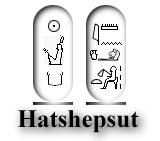
| Name: Hat-shep-sut [Maat-ka-re] Status: Pharaoh, female Origin: Human Lived: 1502 b.c. -1458 b.c. Ruled: 1473 b.c. - 1458 b.c. |
| H a t s h e p s u t |
| Height: |
| Weight: |
| Dynasty: 18th |
| Egypt worked for her, head bowed, the excellent seed of the god, who came forth from him��. Ahmose Pennekhbet�s inscription similarly refers to Hatshepsut�s regency in unbashed terms, not only describing her as god�s wife but also calling her Maatkara, which was her chosen throne name (prenomen). |
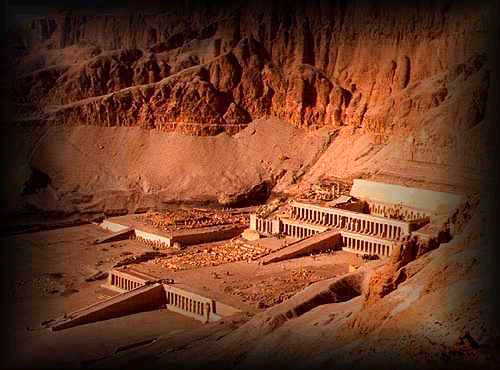
| The temple at Deir el-Bahri: A statement of Hatshepsut�s Reign The temple at Deir el-Bahri remains Hatshepsut�s most enduring monument. Built of limestone and designed in a series of terraces set against the cliff wall in a bay formed naturally by river and wind action, the temple called � Holy of Holies� (djeser djeseru) was Hatshepsut�s most complete statement in material form about her reign. The design of the temple followed a form known since the First Intermediate Period, and particularly inspired by the 11th Dunasty temple of Mantuhotep II (2055-2004 BC) just to the south. Terrace temples, however, had continued to be built in the Second Intermediate Period and, more recently, in the early 18th Dynasty (most particularly by Ahmose at Abydos). Hatshepsut borrowed forms developed by many of her royal ancestors; for example, colossal Osirid statues set in front of square pillars on her colonnades resemble closely statures of Senusret I. Hatshepsut�s inspiration may instead have been her father, Thutmose I, however, since his Osirid colossi at Karnak, although of sandstone, were similar to those at Deir el-Bahri. By the time of its completion, the temple contained scenes and inscriptions that carefully characterize a number of aspects of the life and rule of Hatshepsut. The most accessible areas, the lower and middle colonnades, showed, for example, a Nubian campaign, the transport of obelisks for Karnak temple, an expedition to Punt to bring back incense trees and African trade products, and the divine birth of the ruler. Officials associated with the work were mentioned by name, including the treasurer Nehesy, and Senenmut. The funerary inscriptions of Djehuty and Senenmut suggest that they were active in the building and embellishment of the � Holy of Holies� temple at Deir el-Bahri. On the south end of the middle terrace, a chapel was constructed for Hathor, goddess of the western cemetery, and it was fronted by a pillared court, whose capitals were fashioned as emblems of the cow-faced deity. Scenes of the king feeding the sacred cow flank the entrance to the chapel itself. On the upper terrace there was a central door into a peristyle court behind which was the main temple sanctuary. Scenes of the Beautiful Feast of the Valley procession decorated the north side of the court, while the Opet Festival appeared on the south. Another enclosed court to the north contained niche shrines to the gods, including Amun, and a large Egyptian alabaster open-air altar for the sun-god Ra-Horakhty. This sun-temple feature was a significant addition to the complex, recalling an old form seen as early as the 3rd Dynasty Step Pyramid at Saqqara. Its meaning for the royal cult was further underscored in rooms on the south of the central court, where the ruler�s desire to accompany the sun-god on his daily route through the heavens and the netherworld was expressed in scenes and texts. Hymns describing the deities who governed each hour of the day and night gave Hatshepsut power over time itself so that she could merge with the sun for eternity. On this terrace, too, were chapels for Hatshepsut herself and for her father, Thutmose I. An inscription accompanied a scene of the king declaring his daughter�s future reign. A set of phrases designed to communicate with the few who could read and who would actually see these private areas of the temple allude obliquely to the unusual nature of Hatshepsut�s ruel. Her high officials are twice warned: � he who shall do her homage shall live, he who shall speak evil in blasphemy of her Majesty shall die.� It is likely that this was the official court position of the time and that the inscription merely monumentalized a statement well known to the �elite circles of the time. Hatshepsut was very generous to those who supported her, judging from the sudden increase in large decorated private statues dedicatedin temples such as Karnak. The ruler appears to have forged a symbiotic relationship with her nobles, so that she became as important to them as they were to her. During this period, for the first time in Tehban private tombs, the enthroned ruler appears arrayed like the sun-god himself, acting as an eternal intermediary for the tomb-owner. The Theban tombs of the royal steward Amenhotep (TT73) and the royal butler Djehuty (TT 110) show Hatshepsut in this manner, and several tombs dating to the sole rule of Thutmose III continued the practice. Such loyalist representations recall the inscribed stelae of the Middle Kingdom elite that described how the 12th Dynasty kings acted for the good of Egypt. |
| The fifty-four year reign of Thutmose III began in his early childhood with Hatshepsut, his aunt and stepmother, acting as regent. According to Ineni, whose funerary � autobiography� ended just before Hatshepsut became ruler: � his [Thutmose II�s] son was set in his place as king of the Two Lands upon the throne of him who engendered him. His sister, the god�s wife Hatshepsut, executed the affairs of the Two Lands according to her counsels. |
| It has been argued that Hatshepsut saw herself as Thutmose I�s heir even before her father died, thus implying that the dating of Thutmose III�s rule may have applied to her own reign as much has to the child king�s. |