


Chitra
I want to express my sincere thanks to Krishnan and Padmaja Marar (Kanimangalam, Thrissur) for their valuable suggestions in several of the recipes including SarkkaruppEri and to Krishnan's brother Mr. Raghava Marar ( Pattambi) for the authentic style of serving on a plantain leaf. I want to express my sincere gratitude to the following regular contributors of Forum Hub: Hemantji, Seetha, Mini, SR, Ramya, Punnahai, SDeepak, Sush, CI, Meena, Ambika, and Lakshmi for their encouragement, valuable comments and corrections in my venture. I want to mention Mini�s name again for her assistance in setting up this webpage and helping me post my collection of Onam Recipes on this site.
All of the following recipes are intended for about six adults.
1. naarangngaa kaRi ( Lemon pickle curry)
2. maangngaa kaRi ( Mango pickle curry)
3. puLeenchi- Tamarind-ginger hot sauce
4. inchi thair- Ginger & Yogurt relish
5. achchingngaa thOran- saut�ed green beans
6. avial- cooked mixed vegetables and coconut curry.
7. Olan- Pumpkin and Beans in coconut milk gravy
8. kurukku kaaLan- Thickened yogurt curry
9. pachchaTi- Sliced fresh vegetables in a yogurt sauce
10. eriSSEri- Chickpeas green banana and coconut curry
11. uppEries- fried vegetables ( banana, yam, green beans, bitter gourd)
13. SarkaruppEri- (brown sugar banana chips)
14. parippu & neyyu � mashed lentil curry with clarified butter
15. saambaaR- Vegetable and Lentil curry
17. parippu prathhaman- Moong dhal pudding
18. paalaTa prathhaman-rice crepe and milk pudding
19. Rice-
20. Yogurt
Traditionally this is made with VaTukappuLi Naarangnga which is bigger than the usual Lemon and has a thicker skin with a strong bitter taste to it. If this is not available you can use the ordinary Lemon.
Lemon: 1 vaTukappuLi naarangnga or 3 Lemons
Green chili peppers (sliced thin) 2
Red chili powder 4 to 6 teaspoon
Turmeric a pinch
Asafetida powder � teaspoon
Roasted Fenugreek powder � teaspoon
Salt to taste
Sesame seed oil 2 tablespoon
Mustard seeds 1 teaspoon
Fenugreek seeds � teaspoon
Dried red chilies (broken to pieces) 1 or 2
Curry leaves 2 sprigs
Method:
Slice the lemons and cut them in to small � size cubes.
Add enough salt to the lemon pieces and keep it aside for a couple of hours.
Slice the green chili peppers in to thin circles.
In a pan pour � cup water and add a pinch of turmeric and heat it up until it
boils. Remove this from the stove and add to this the lemon pieces. Close the
container with a lid and let it stand for 30 minutes.
In a saucepan add 2 tablespoon sesame seed oil and heat it up. Add 1 teaspoon
mustard seeds to the oil and cover it with a dry lid to prevent splattering.
When the seeds start to splutter add fenugreek seeds, the broken pieces of dried
red chilies, and the curry leaves. To this add the sliced green chili pepper.
Remove the pan from the stove and let the oil cool down. If you add the chili
powder to the hot oil it will burn and the red color will be lost. Now to this
oil add the red chili powder, roasted fenugreek powder, asafetida powder and the
cut lemon pieces with the juice in it. Mix them together very well. Taste and
adjust the salt. Keep it in the pan for a couple of hours and mix the contents
occasionally. You can store this in a glass bottle when it is cold and keep it
in the refrigerator. Always use a dry spoon to serve this. This pickle will
remain fresh for a month in the refrigerator.
Note: The bitterness of this pickle is considered to enhance the taste. This is seldom served as the only pickle.
Raw green mangoes 2 (Medium size)
Green chili peppers 2
Red chili powder 1 to 2 tablespoon (you can adjust this to your taste)
Turmeric a pinch
Asafetida powder � to � teaspoon
Fenugreek powder � to � teaspoon
Salt to taste
For tempering:
Sesame seed oil 2 tablespoon
Mustard seeds 1 teaspoon
Fenugreek seeds � teaspoon
Dried Red chilies 2 (broken to pieces)
Curry leaves 2 or 3 sprigs.
Method:
Wash and dry the mangoes. When they are completely dry slice them lengthwise on
both sides up to its pit. Complete by cutting the other two pieces still
attached to the pit. Now cut them approximately to � inch cubes by cutting
length-wise and crosswise. Make sure to use a dry cutting board and knife.
(Presence of water at this stage shortens shelf life) Add enough salt to the
mango pieces and keep aside for 30 minutes. Wash, dry and then cut the green
chili peppers into round thin slices.
In a small container boil � cup water with a pinch of turmeric powder and let it
cool. This Turmeric water may be needed towards the end to adjust the
consistency of the Mango Pickle Curry.
Heat a saucepan (size depending upon the quantity of the Mango pieces) Add 2
tablespoon Sesame seed oil when it is hot and dry. Add mustard seeds to the oil
and cover the pan with a dry lid to prevent splattering. When they start to pop
add the fenugreek seeds, broken pieces of dried red chili, thinly sliced green
chili peppers and curry leaves. Stir the contents until the Fenugreek turns
golden brown and the aroma comes out. Turn off the stove and remove the saucepan
and let the contents cool down to the point that the chili powder to be added
would not burn. Add to this the chili powder, Fenugreek powder, Asafetida
powder and mix well with a dry wooden spoon. Add the salted Mango pieces to this
and stir the contents so that the pickle masala coats well to the Mango pieces.
Taste and adjust the salt. Let it stand in the pan for 4-5 hours, stirring it
frequently. This time is given for the water content of the Mango to create the
juice. If the consistency appears too thick you may add the previously prepared
Turmeric water to this a little bit at a time to make more liquid.
Store this in a dry glass bottle when it is completely cold and place this in the refrigerator.
Fresh ginger one (2 inch long piece)
Green chili peppers 3 or 4 according to your tolerance
Sesame seed oil 1 tablespoon
Tamarind paste 5 -6 teaspoon or Tamarind bar lemon-sized to make a thick syrup
in 2 cups of water
Water to dissolve the Tamarind paste 2 cups
Red chili powder � teaspoon
Brown sugar 1 to 2 tablespoon to suit your taste and pepper tolerance
Salt to taste
Powders (Parboiled rice and spices):
Parboiled rice 2 tablespoon (Dry roast to a golden brown color and grind to a fine powder)
Fenugreek seeds � teaspoon (Dry roast to a golden brown color and grind to a fine powder.)
Mustard seeds � teaspoon (Dry roast covered with a
lid until they pop and then powder it)
Cumin seeds � teaspoon (Dry roast until it turns brown and an aroma is
released. Powder the seeds finely)
Roast all the above ingredients separately. You may grind them all together except the rice. Powdered rice is added to thicken the puLeenchi to your liking. You may not need the whole amount. I use a coffee grinder to make fresh curry powders, including this because I don�t have the wet dry grinder available in India.
Seasoning:
Sesame seed oil 1 tablespoon
Mustard seeds 1 teaspoon
Dried red chilies 2 broken to small pieces
Curry leaves 2 to 3 sprigs
Method:
Remove the skin from the ginger and wash it. Divide it in
to 2 pieces. Thinly slice each piece longitudinally. Again slice longitudinally
each flat piece into thin strips. (About half the size of a match -stick) Wash
and slice the green chilies longitudinally into 4 or 6 pieces.
Dissolve the Tamarind paste in 2 cups of water and keep aside.
Heat up a heavy bottomed saucepan and pour one tablespoon
Sesame seed oil to the pan. When the oil is hot add about 3 tablespoon ginger
strips and saut� them for 2-3 minutes. Add the sliced green chilies and stir
them together for another 2 minutes. Pour the thick Tamarind water to the pan
along with brown sugar, chili powder and salt and let the contents slowly get
cooked. You may close the saucepan with a lid and stir the contents occasionally
until the raw smell of Tamarind disappears and the Ginger is fully cooked. Let
this simmer and thicken at medium-low heat for 10- 15 more minutes. Now add the
Fenugreek, Cumin, Mustard and I tablespoon rice powder and mix them all
together. Taste and adjust salt and brown sugar. Remove the pan from the stove.
Seasoning:
Heat up a small pan on the stovetop and when it is hot and
dry add 1 tablespoon Sesame seed oil to it. Add Mustard seeds to the oil and
cover the pan with a dry lid to prevent splattering. When the Mustard seeds
start popping, add the dry red chili pieces and curry leaves to the pan. Pour
this seasoned oil to the puLeenchi and cover it with a lid. Let this rest for an
hour and check the consistency. If you like this a little bit thicker you may
add left over rice powder and adjust the consistency. If you want this thinner,
adjust by adding boiled water. (I prefer to keep the consistency like that of
Tomato Ketchup or Barbecue sauce so that puLeenchi when served on a plantain
leaf wouldn�t run in to other items on the leaf.)
Store this in a dry glass container and keep in the refrigerator. This will stay
fresh for a month. Use a dry spoon to serve this.
Note: The taste of puLeenchi may vary, among other things, depending upon the
quality of the Tamarind we use.
Yogurt (Sour) 2 cups
Fresh Ginger one 1 inch long piece
Green Chili Peppers 2
Salt to taste
Method:
Remove the skin from the Ginger and wash it well. Wash the Green Chili Peppers.
Cut the Ginger and the Chilies to small pieces and crush them coarsely using a
mortar & pestle or blender. Add this and salt to the Yogurt. Whisk the yogurt
with the added ingredients to a smooth consistency. This is usually prepared
within a few hours of serving.
Note: There are a lot of regional variations to this very simple recipe.
Beans 3 cups when sliced
Turmeric � teaspoon
Salt to taste
Water � cup (enough
to cook the beans)
Fresh or frozen grated coconut � cup
Cumin seeds � teaspoon
Green chili pepper 1 or 2 according to your tolerance
Shallots 2
(Coarsely crush or grind grated coconut, Cumin seeds, Green Chili Peppers and
Shallots without adding water)
Seasoning:
Oil 1 tablespoon
Mustard seeds 1 teaspoon
Urud dhal 2 teaspoon
Dried red chili pepper broken to pieces 1
Curry leaves 2-3 sprigs
Method:
Wash the fresh green beans and cut them into thin round slices (1/8th inch thick). Place the beans in a saucepan and add Turmeric powder and salt and cook this in medium heat about 5 minutes. Do not over cook the beans. (make sure to remove the lid after 2 minutes and cook without lid for another 3 minutes to avoid over cooking and the beans getting mashed and losing its green color)
Heat up a saucepan and when it is hot and dry add the oil. When the oil is warm add Mustard seeds and cover the pan with a dry lid to prevent splattering. Let the seeds start to pop. Now add Urud dhal, dried chili pepper pieces and Curry leaves. When the Urud dhal attains a golden brown color add the cooked beans and mix well. Now add the crushed Coconut, Cumin seeds, Green chili pepper and Shallots to this and stir and heat up until the water content evaporates.
aviyal is an important dish served in Kerala for festive occasions. This is a dish with large variations in cooking in different parts of Kerala. Different types of vegetables can be used to make aviyal. For this reason in Malayalam the word aviyal is used figuratively to mean mixture.
In the part of Kerala I come from, we prepare Avial one way for festive
occasions and quite differently for ordinary meals. Vegetables with very high
water content such as Cucumbers, Ash Gourds, Eggplant (Brinjal) are seldom if
ever used for special Avial which is served �dry� (without gravy) as opposed to
ordinary Avial which usually has more gravy. In addition to the type of
vegetables used, in special Avial the sourness is imparted by yoghurt where as
in ordinary Avial you can add unripe Mango or even green or ripe Tamarind, and
vegetables are cooked to a much softer consistency. Another significant
difference is in the use of Turmeric powder. Although Turmeric powder is used in
teaspoon measures in ordinary Avial to impart color and flavor to vegetables and
gravy only a pinch is used for special Avial, making sure it does not impart
yellow color to the dish. Some �Avial experts� wouldn�t use even a pinch of
Turmeric to their Avial. Avial is one of those few dishes (another is Olan)
where Coconut oil and Curry leaves are a must, and their use is for flavor.
Green unripe Banana 1
Drumsticks 2
Beans 10
Carrot a small one
Yam (chEna) cut pieces 1 cup
Turmeric a pinch
Salt to taste
Some of these vegetables may not be available in all regions of the world. You can substitute other vegetables for these. I often use the tender stems of Broccoli. If you get snake gourd (paTavalangnga in Malayalam) you can use it too. I don�t use Bitter Gourd for festive Avial but I often use it in ordinary Avial.
Fresh or frozen grated Coconut 2 cups
Cumin seeds � teaspoon
Green Chili Peppers 2-3
Yoghurt 1 � cup
(Place the coconut, Cumin seeds and Green Chili Peppers in a blender and blend them to a coarse consistency. While blending I suggest that you should use yoghurt instead of water. Keep this aside.)
Coconut oil 2 tablespoons
Curry leaves 5 sprigs
Method:
Remove the ridge of the banana skin longitudinally and cut it in to 1 � inch long, � inch thick pieces. (Do not remove the entire banana skin) Peel the outer skin of Drumstick by making a slight slit at the top end and pulling the peel downwards. Continue this till you peel the whole surface. Cut them across in to 1 � inch long pieces. Cut the beans in to 1 � inch long pieces. Scrape the outer skin of the Carrot and cut in to 1 � inch long and � inch thick pieces. Remove the skin of the Yam and slice it and cut in to 1 � inch long, � inch thick pieces. Wash all the cut vegetables thoroughly. Since Drumsticks need more cooking time than the other vegetables, place them in a pot large enough to hold all the ingredients. Add a cup of water, a pinch of Turmeric and salt to this and cover the pot with a lid. Now heat up the pot. Check the contents occasionally and when they are half done, add all the other vegetables with � cup water and let it cook. Make sure that they are not over cooked and there is just enough water to cook the vegetables. Mix the contents in between by holding the pot with both hands and flipping the contents rather than stirring with a wooden spoon which may break the vegetables. Remove the lid and let the remaining water evaporate.
When the vegetables are cooked and all the water has dried
up add the coarsely blended coconut with cumin seeds, green chili peppers and
yoghurt. Gently fold this with a wooden spoon. Once this is added to the
vegetables, don�t let this boil. Heat it up for 2 minutes at low heat and remove
the pot from the stove top.
Immerse the Curry leaf sprigs into the Avial and add 2 tablespoons of Coconut
oil over it and immediately cover the pot with a lid. Let this rest for at least
an hour before serving. This is to ensure that the coconut oil and curry leaves
impart their flavor to the dish.
Dry beans � cup
[Black eyed peas dry � cup or Black eyed peas canned (precooked) can be substituted for beans. If you are using the canned cooked peas, place the peas in a colander and wash it with cold running water to remove the preservatives.)
Green Pumpkin 2 cups (sliced)
[Since I can�t get unripe pumpkin in this region, I use chayote squash] http://www.londonfruit.com/chayote.html
Green Chilies 2
Salt to taste
Fresh or frozen grated coconut 1 cup
Grind the grated coconut in a blender with water to make 1 � cup coconut milk.
[You can substitute canned coconut milk but it does not taste as good as freshly extracted coconut milk because of the added preservative.]
Curry leaves 3 sprigs
Coconut oil 2 teaspoon
Method:
Soak dried beans, over night in water, cook the beans and
set aside. If you are using precooked canned Black eyed peas, place them in a
colander and drain the liquid and wash them with cold running water.
Cut peeled Pumpkin in to 1 � inch wide and 1/8 inch thick
slices. Wash and place them in a pot with small quantity of water just to cover.
Add slit Green chilies, salt and cook the vegetables over medium flame. When the
pumpkin pieces are cooked, add the beans and coconut milk and simmer for 2-3
minutes.
Finally add the coconut oil and Curry leaves. Remove the pot from the stovetop
and keep it covered with a lid.
Green unripe banana [Eththaykka or nEnthrakkaya (Mal)] 1
Yam [chEna (Mal)] 1 cup pieces
Black pepper corn finely ground � teaspoon
Turmeric powder � teaspoon
Salt to taste
Sour curd 3 cups
Fresh or frozen grated coconut 1 cup
Green chili peppers 2-3 (according to tolerance)
Cumin seeds � teaspoon
(Blend the above 3 ingredients to a fine paste in a blender and keep aside.)
Oil 2 tablespoon
Mustard seeds 1 teaspoon
Fenugreek seeds � teaspoon
Dried red chilies broken to pieces 2
Curry leaves 3 sprigs
Method:
Peel the banana and slice it longitudinally through the center. Cut the two pieces in to � inch thick slices and wash them. Remove the skin from the Yam and slice it to � inch thick, 1 inch long pieces. Wash the Yam slices. (raw surface of the yam may cause itching; some people are allergic to yam and may not be able to eat! In such cases, avoid yam and use 2 Bananas instead). Place the cut vegetables in 3 cups of water in a saucepan. Add the Turmeric powder, powdered black pepper and salt and heat till the vegetables are cooked and water is evaporated. Make sure the vegetables are not overcooked and mushy. When it is �fork tender� (or �toothpick tender�) the vegetable is done.
Add the sour yogurt to the cooked vegetables and let it simmer until very little yogurt remains as liquid. Now add the coconut-cumin,-green chili paste to the above and stir. Keep it on a low heat for 2 minutes. Do not let it boil: remove it from the stove top.
In a heated dry pan, pour the oil. When the oil is hot, add mustard seeds and cover the pan with a dry lid to avoid splattering. When mustard seed pops, add Fenugreek seeds, dried Red chili peppers and Curry leaves. When the Fenugreek seeds turn golden brown and the aroma comes out, add this seasoned oil to the kaaLan and cover it with a lid.
When cold, if you transfer this Kurukku KaaLan to a China jar, and keep in a cool place, it will retain its taste and flavor for several days. You may keep it in the refrigerator but bring it to room temperature before serving.
Ingredients:
Fresh medium Tomato 1 (Diced into very small cubes)
Fresh ginger � inch piece 1
Fresh green chili pepper 1
Fresh grated coconut (best) or frozen 2 tablespoon
Mustard seeds a pinch
Curry leaves 2 sprigs
Yogurt 2 cups
Salt to taste
Method:
Grind the grated coconut, peeled Ginger, Mustard seeds and the green chili to a coarse paste. Use yogurt if you need liquid to grind. Pour the yogurt in a bowl and stir with a whisk until it becomes smooth. Add the ground coconut paste to the yogurt and mix well. Now mix in the diced tomato. Taste the pachchaTi and adjust the salt. Add the curry leaves.
Ingredients:
Chana dhal (kaTala parippu in Malayalam) � cup
Green unripe banana 1
Finely ground Black Pepper � teaspoon
Turmeric powder � teaspoon
Red chili powder � teaspoon
Salt to taste
Fresh or frozen grated coconut � cup
Cumin seeds a pinch
(Blend the coconut and cumin seeds to a fine paste using very little water)
Oil (Preferably Coconut oil) 2 tablespoon
Mustard seeds 1 teaspoon
Dried Red chili pepper (broken to pieces) 2
Curry leaves 5-6 sprigs
Grated coconut � cup
NOTE: Total amount of grated coconut for this recipe is 1 � cups. Half of which
is used to make a paste with cumin seeds and the rest for seasoning.
Method:
Clean and wash the Chana Dhal. Add the dhal to 2 cups of water in a cooking pot, cover it with a lid and cook over medium heat. Do not over cook to the point that the dhal is mashed.
Cut the peeled banana in to � inch cubes. Wash and place them in a cooking pot. Add 2 cups of water, black pepper, chili powder, Turmeric and salt. Cover with a lid and heat it up. Stir in between and see that the banana cubes are cooked. Now add the cooked dhal and mix well and boil for a few more minutes. If required add small quantities of hot water to prevent the contents from burning. Add the coconut-cumin paste to this and continue heating till it comes to a boil. Stir the contents occasionally for uniform cooking and to avoid burning.
Remove the pot from the stovetop.
Heat up a saucepan and when it is hot and dry add the oil.
Now add the Mustard seeds to the oil and cover the pan with a lid to prevent
splattering. Once the seeds start popping, add red chilies, curry leaves and �
cup grated coconut and stir with a wooden spoon. Continue until the grated
coconut turn golden brown in color and an aroma is released. Add this seasoning
to the prepared eriSSEri and mix very well. Cover with a lid.
This dish tastes better if served slightly warmer than the room temperature.
uppEri-
fried vegetables (banana, yam, beans and bitter gourd)
For Onassadya 4 types of deep fried vegetables are served. I have written the method of making Banana chips. The same method is followed to make Yam, Green Beans and Bitter Gourd fries.
Unripe bananas 4
Peanut oil 4 cups
Turmeric powder 1/4 teaspoon
Salt 1 teaspoon
Peel the bananas and wash them in water to which a pinch of Turmeric is added. The banana peel may stain your hands and fingers. To reduce the stain you can apply a little bit of oil on your hands before peeling the bananas. Take the bananas from the Turmeric water, dry them with a paper towel and keep them aside.
Take a small bowl and pour half a cup of water in it. To this add a little less
than � teaspoon of Turmeric and � teaspoon of salt. Mix this well and keep
aside.
The bananas need to be cut longitudinally at the center once and then cut again longitudinally at the center right angle to the first cut. This will divide the banana into four quarters. Now place the banana on a cutting board and slice into 1/8 inch thick pieces.
Now heat up a thick bottomed sauce pan and pour the Peanut oil in it. To test
whether the oil has reached the correct temperature, dip a wooden chop stick in
the oil and see whether the oil bubbles around it. If so the oil is ready to fry
the banana slices.
Carefully place the cut banana pieces in the hot oil. The amount to be placed in
the oil depends upon the size of the sauce pan. To get crispy chips do not over
crowd the oil. Now use a sieved stainless steel spoon and stir carefully the
chips inside the oil. When the chips get fried they will make a peculiar sound
like the sound produced by glass bangles hitting against each other. Now with
your hand scoop some Turmeric and salt water and sprinkle it onto the chips
inside the oil. This makes a noisy bubbly sound. If you want you can cover the
pan with a dry lid for a while till the bubbling sound settles down. Keep
stirring the contents inside the hot oil until the bubbles subside almost
completely. Now the chips are fried and you can scoop them out of the oil, and
place them on paper towel to drain the oil from it. Taste and see if it has
enough salt and if you want it more salty add a little bit more salt to the
Turmeric water. You can also adjust the color now by adding more Turmeric, or
reducing the color by adding more water to the Turmeric-salt water.
Repeat the whole process until all the bananas are fried.
Spread the fried chips on a sheet of brown paper or paper towel till they are
cold. When they are cold you can store them in a dry glass bottle and close the
lid tight. This will remain fresh and crispy for a couple of months. If you put
warm chips in a bottle they become soggy.
Yam fry (chEna in Malayalam)
Remove the skin from the Yam, wash and slice it into 1 � long, � inch wide thin
slices. Use gloves to prevent itching while cutting Yam. Deep fry the slices to
a very crispy consistency, sprinkling Turmeric-salt water for flavor and color.
Wash and cut beans in to 1 � inch long pieces and deep fry them to a crispy consistency. Sprinkle Turmeric-salt water while frying.
Bitter Gourd (kaippakka or paavayka in Malayalam)
Wash and cut the Bitter Gourd in to thin round slices. Mix them with Turmeric powder and salt and keep aside for 30 minutes. Squeeze and remove as much bitter water as possible without breaking the pieces. Deep fry the slices to a very crispy consistency, sprinkling turmeric-salt water if required.
Pappadam is made with Urud dhal (Uzhunnu in Malayalam)
flour. Pappadam is available as plain or spicy. For Onam and other celebrations,
plain Pappadams are served.
Pappadam is available in Indian stores. It is deep fried in oil until it becomes
crisp. Usually they are fried a few hours before the meal is served, but will
keep crisp if you store them in an air tight container, for a day or two.
Method:
Heat up 2 cups of oil in a wok or saucepan. If bubbles form around a wooden
chopstick dipped in the heated oil, it is ready to fry the Pappadams.
If the Pappadams are heavily coated with flour, dust it off. If fried with the
coated flour, the burnt flour may discolor them.
Dip the Pappadam in the hot oil one at a time, wait until it expands to almost double its size and becomes crisp. Turn it over once and take it out of the oil when ready. Use a slotted metallic ladle, tong or a skewer to remove the fried ones. Place it on a paper towel to drain the excess oil. Serve them fresh. Good brands of Pappadams will usually have large bubbles when fried.
SarkkaruppEri � (Brown sugar banana chips)
I am indebted to my friends Padmam and her husband Krishnan for this recipe. All my past attempts to make SarkkaruppEri (Brown sugar banana chips) had failed until I got a detailed recipe from Padmam & Krishnan. Till then the chips used to be soggy. When I followed their recipe to the letter, I could make crunchy and tasty chips with a long shelf-life when kept in airtight containers.
|
Unripe Bananas ( green and mature) |
4 |
|
*Peanut oil |
4 cups |
|
Dark brown sugar powder (or Pieces of Dark Brown Sugar Candies) |
3 cups (15 pieces) |
|
Water |
1 cup |
|
Dried Ginger Powder |
2 Table spoon |
|
Raw (Not roasted) Cumin seed powder |
2 Table Spoon |
|
Powdered Sugar |
1 Tablespoon |
* Peanut oil is the best for deep frying because of its
high smoking point and low risk of burning. It has a neutral flavor that does
not affect the taste of the fries adversely. The other alternatives are Corn oil
and Safflower oil.
Method of Preparation:
Peel the bananas and wash and dry them thoroughly with
paper towels. Slice each banana longitudinally in the center and cut the
resulting two pieces into � inch thick slices. Keep the slices aside.
Heat Peanut oil in a heavy bottomed saucepan on a medium flame. Dip a dry wooden
chop stick in the oil and if bubbles are forming around it, the oil is ready.
Carefully place the banana pieces in the oil, enough amount at a time for even
cooking (quantity varies with the pan size). Stir the pieces occasionally until
they are very crisp. This will take almost 30 minutes. This is a very important
step for proper crispiness and crunchiness. When the oil stops bubbling around
the banana slices and the color of the chip turns reddish brown they are done.
Now, scoop out the banana pieces from the oil with a
slotted or sieved stainless steel ladle, and drain the oil as much as you can
and place them on a paper towel, or brown paper for further blotting of oil.
Repeat the process until all the sliced pieces are evenly fried to the right
color and consistency. If they are well fried the pieces will not become soft as
they get cold. If by chance a few pieces are soft, put them back in the oil and
continue to fry them until they are crisp.
In another bigger saucepan, large enough to hold the entire fried banana slices,
place Brown sugar and add to this one cup of water. Heat it over low to medium
flame until it melts and starts to bubble. Stir the liquid often to prevent it
from sticking to the bottom of the saucepan. Put a drop of the above syrup in
cold water and see whether it forms a �pearl-drop�. If it forms a pearl drop
the syrup is of the right consistency. Now put the fried banana slices in the
syrup all at once and stir vigorously. Turn off the fire and add dry ginger and
raw cumin seed powder and mix well to coat all the pieces. Wait until it is
lukewarm to sprinkle and mix the powdered sugar on top of them. (If you sprinkle
the powdered sugar when the banana pieces are hot, the sugar will melt.)
Powdered sugar gives a better appearance to the SarkaruppEri. Let it cool
completely before you store it in an airtight glass bottle.
parippu and neyyu (Dhal and Ghee)
Ingredients:
Thoor dhal 1 cup
Turmeric powder 1/8 teaspoon
Red chili powder � teaspoon or less
Salt to taste
Fresh or frozen grated coconut � cup
Cumin seeds a pinch
Grind the grated coconut with Cumin seeds in a blender and set aside
Seasoning:
Oil or Ghee 2 teaspoon
Thinly sliced Onion 1 tablespoon
Curry leaves 2-3 sprigs
Method:
Wash Thoor dhal and cook with 3 cups of water, 1/8 teaspoon Turmeric powder, � teaspoon Red chili powder, and salt. You may use a pressure cooker to reduce the cooking time.
Add the ground coconut-cumin paste to the cooked dhal and let it simmer and come to a boil. Remove the pot from the stovetop once the contents are well mixed.
Seasoning:
Heat up a saucepan and add 2 teaspoon oil or ghee. When it
is hot add the sliced Onion and saut� till it turns golden brown. Now add the
curry leaves and pour this seasoned oil into the curry and keep it covered with
a lid for an hour.
NOTE: In some parts of Kerala, Green Gram dhal is used to
make this Parippu curry. Shelled Green gram is heated up in a pan until it turns
golden brown and an aroma is released. This roasted dhal is used to make the
curry.
For feast, Parippu curry is always served with Ghee.
Ghee: Best to make fresh Ghee rather than buy bottled one.
Ingredients:
Unsalted (Sweet) butter 1 pound (Grocery stores sell these as a packet of 4
bars, each weighing 4 ounce.)
Method:
Heat a heavy bottomed pan. When the pan is dry, add
unsalted butter to the pan and heat up at medium flame stirring occasionally. As
the butter melts and starts to bubble, reduce the flame to low and keep stirring
continuously. Gradually the residue turns to a golden brown color and gives out
a nice aroma. At this time, turn off the stove and remove the pot. Let it stand
for 20 minutes for the deposits to settle. Strain and remove the residue and
pour the clear liquid into a clean dry bottle. Close the bottle with a lid and
keep this in the refrigerator or outside. This will retain the freshness for a
couple of months.
saambaaR-vegetable and lentil curry
This is considered as a main curry in South Indian vegetarian cooking. In most households in Northeastern part of Kerala, Sambar is an essential lunch item. There are large variations in the preparation of this curry, even from house to house in the same neighborhood. The differences in preparation include in the types of vegetables used, the types and proportion of various ingredients in making the Sambar powder, and the use of coconut.
Some health conscious Keralites have stopped using coconut in all preparations, including Sambar for fear of its effect on cholesterol, while others question coconut�s role in high blood cholesterol! However, no Keralite will question the flavor coconut imparts to the preparation!
Ingredients:
Thoor dhal 1 cup
Turmeric powder � teaspoon
Asafetida powder � teaspoon
Oil 2 teaspoon
Grated coconut � cup
Coriander powder 2 teaspoon
(some prefer to use whole coriander seeds � 1 tablespoon- instead of powder for
freshness and flavor.)
Fenugreek seeds � teaspoon
Chili powder �- 1 teaspoon (according to pepper
tolerance)
(some prefer to use whole dried red chilies for their fresh taste- 4 to 6 chili
peppers)
Asafetida powder � teaspoon
Sliced onion 2 teaspoon
Curry leaves 1 sprig
Okra 4-6 if dwarf variety available in US; less if long Indian Lady�s Finger
Drumsticks 4
Onion (medium size) 1
Tomato 1
Green chilies 2
(Brinjal, Potatoes, Carrot and Ash gourd are other
vegetables that can be used.)
Turmeric powder a pinch
Asafetida � teaspoon
Tamarind paste 1-2 teaspoon
Salt to taste
Coriander leaves few sprigs.
Oil 2 teaspoon
Mustard seeds 1 teaspoon
Fenugreek seeds � teaspoon
Dried red chilies 2-3 broken to pieces
Asafetida powder a pinch
Curry leaves 4-5 sprigs
Method:
Add � teaspoon Turmeric and � teaspoon Asafetida powder to 3 cups of water in a cooking utensil. Add Thoor dhal to this and cook till it is mushy. Using a pressure cooker will shorten the cooking time. Set aside the cooked dhal.
Heat up a saucepan and add 2 teaspoon oil. Add the sliced onion and Fenugreek seeds and saut� until the Fenugreek turns golden brown. If you are using whole coriander seeds and dried red chilies add them now. Stir until the seeds turn light golden brown and release their aroma. Add the grated coconut and stir well until it turns golden brown. At this point add the curry leaves. Mix everything well and remove the pan from the stovetop.
If you are using powdered coriander and chili instead of
whole coriander seeds and red chilies, add them a minute or two after adding the
grated coconut as it begins to turn light brown. This is to make sure that the
coriander and chili powders which have a shorter saut� time, don�t burn.
Let the Sambar masala cool down before you grind it to a
fine paste in a blender using small quantities of water at a time.
Wash the Okra, cut and remove the stem ends. Cut them in to 1 � inch long pieces. Peel the Drumsticks, cut them into 1 � inch pieces, and then wash and drain. Peel the onion, wash and slice then into � inch wide pieces. Wash and slit the green chilies lengthwise.
Heat a cooking pot and pour 2 teaspoon oil. Add the okra and saut� until it
loses the slimy juice. It may take 3-4 minutes on a medium flame. Remove the
okra and set aside in a small container. To the cooking pot, add the rest of the
vegetables except Tomato and pour 3 cups of water, a pinch of Turmeric, �
teaspoon Asafetida and required salt. Heat up the pot in medium flame. When the
Drumsticks are half cooked add the saut�ed Okra and the cooked dhal. Wash and
cut the Tomato into chunks and add them to the curry. When this mixture starts
to boil add the Tamarind paste diluted in an ounce of water. Cook this for
another 5 minutes until the raw smell of Tamarind goes away. Now add the
previously made saambaaR-masala paste and stir well and let it boil once again.
To adjust the final consistency of the saambaaR, you may add more water at this
stage if required. Taste and adjust salt and tamarind. Add the Coriander leaves
and let this boil for 2-3 minutes to release its aroma... Turn off the flame.
Seasoning:
Heat a small sauce pan and add oil. When the oil gets heated, add the mustard seeds and cover with a lid to avoid splattering. When it starts popping, add the broken dried red chilies, fenugreek seeds, a pinch of Asafetida and the curry leaves. When the fenugreek turns light brown, add the seasoned oil to the saambaaR and cover it with a lid. Let it rest for 2 hrs to get its full flavor before serving. If you have refrigerated Sambar, please heat it on stove top or Microwave before serving.
The truth is no one can make Sambar taste the same way twice!
Ingredients:
Cooked Thoor dhal � cup
Peeled whole Tomatoes 1 can (14 oz)
Turmeric powder 1/8 teaspoon
Cumin seeds 1 teaspoon
Asafetida powder � teaspoon
Salt to taste
Garlic cloves 3-4 (Crushed)
Fresh Lemon or Lime 1 for juice
Coriander leaves 4-5 sprigs (chopped)
Rasam powder 2 teaspoon (store bought)
Oil 2 teaspoon
Mustard seeds 1 teaspoon
Cumin seeds a pinch
Asafetida a pinch
Dried red chili pepper 2-3 broken to pieces
Curry leaves 2-3 sprigs
Method:
Blend the cooked dhal and the Tomatoes and transfer to a cooking pot and pour about 7 cups of water to this. Add Turmeric powder, Cumin seeds, Asafetida powder, and salt and chopped Coriander leaves and heat this up on a medium flame. Once it starts to boil, add � teaspoon Tamarind paste and let it boil for another 5 minutes. Now add 2 teaspoon Rasam powder and 3-4 cloves of crushed Garlic and let it simmer and come to a boil. Remove the pot from the stovetop.
Seasoning:
Heat up a saucepan and when it is hot and dry add oil. When
the oil is warm add Mustard seeds and cover the pan with a dry lid to prevent
splattering. When the seeds start popping add the broken pieces of dried red
chilies, Cumin seeds, Asafetida powder and Curry leaves. Add this seasoned oil
to the Rasam and cover the pot with a lid.
NOTE: You may add Lemon or Lime juice to the Rasam for a tangier flavor.
parippu prathhaman (Moong dhal pudding)
Moong dhal (Shelled) 1 1/3 cups
Brown sugar (dark) � lb
Coconut milk 1can (13.5 Fl Oz)
Ghee 4 tablespoon
Cardamom powder 1 teaspoon
Dried Ginger powder � teaspoon
Salt a pinch
Dried coconut pieces (Copra) 1 tablespoon
Optional:
Raisins 1 tablespoon
Cashew nuts chopped 1 tablespoon
Method:
Heat up the Moong dhal in a heavy bottomed dry pan, to a
deep golden brown color. A nice aroma will be released at this point. Let it
cool. Wash this and heat it up in a cooking pot with 4 cups of water. Cook to a
soft consistency but still retaining shape, adding hot water if needed to
prevent the contents from burning. (Don�t allow it to get mushy.) You may use a
pressure cooker to shorten the cooking time. Grind � of the cooked dhal in a
blender and transfer this back to the pot. This is to thicken the consistency of
the Prathhaman.
Add 3 tablespoon Ghee and powdered brown sugar to the cooked dhal. Heat this at
a medium flame to melt the ghee and the brown sugar. Stir the contents as needed
to blend everything. Mix half the contents of the coconut milk with 6 cups of
water and add to the dhal. Heat the contents and let it come to a boil. Keep
stirring the contents to prevent it from sticking to the bottom of the pan and
burning. You may adjust the consistency if needed, by adding more water to the
pot.
When the contents are well mixed add the rest of the coconut milk and a pinch of
salt. Let this simmer for 5 more minutes and turn off the stove. Stir the
contents occasionally and let it cool. Keep the Prathhaman in the cooked pot for
a couple of hours. Finally add the Cardamom and Ginger powder and mix well.
Roast the Copra pieces in ghee and add to the prathhaman. Some prefer to use
similarly roasted Raisins and Cashews.
Ingredients:
aTa (available at Indian stores, 200 Gram
packets) 100 Grams (� packet)
Whole milk 8 cups (adjust the amount according to the consistency)
Sweetened Condensed milk (14 oz can) - � cup
Sugar 1-1 � cup
Cardamom powder 1 teaspoon
Ghee � cup
Raisins roasted in Ghee 1 tablespoon-Optional
Cashews broken and roasted in Ghee 1 tablespoon-Optional
Method:
Wash the Ata and add this to 4 cups of boiled water and turn off the stove.
Drain the water after 20 minutes.
Heat up a heavy bottomed pot and add 2 tablespoon ghee. Transfer the softened
Ata to the ghee and heat and stir for 3-5 minutes. Add milk and cook the Ata at
medium flame. Stir occasionally and bring it to a boil. Reduce the heat and
simmer this for about 45 minutes stirring to prevent the Ata sticking to the
bottom and burning. At this stage, add � cup condensed milk. Stir well. Add �
of the sugar and mix well. Taste and add the remaining sugar, to the desired
sweetness. Let it simmer, stirring constantly, for 10 more minutes. Turn off the
stove and let this stand in the cooked vessel for a couple of hours. Stir the
contents in between to prevent a creamy layer forming on top.
When the paayasam is cooled down, add the Cardamom powder and mix.
Optional: Raisins and broken Cashew nuts roasted in Ghee may be added to the
paayasam.
Most Keralites prefer long grain parboiled rice. Indian
stores in the US, sell long grain Parboiled rice with the brand names, Adolphus
and Lakshmi and it costs $8-10/25Lb bag.
Parboiled Rice of equally good quality is available in some supermarkets. Uncle
Ben's Long grain Enriched Parboiled Rice and Golden Canilla Long grain enriched
Parboiled rice (5lb plastic bags) are available in my city. They cost more than
the Indian Store products.
Cooking time for parboiled rice exceeds that of long grain rice. You can cook up
to 3 cups of parboiled rice using the Rice Cooker (5 cup capacity). For 3 cups
parboiled rice, you need to fill water between 4�- 5 line mark inside the cooker
depending up on the softness you desire for the cooked rice.
If you have more than 6 guests, it is better to cook rice on a conventional
stove top. I use a Steamer Insert with cover (8qrts). This consists of an inner
vessel with holes, and an outer container, and a lid with adjustable steam
vents. The Steamer Insert (with both containers in place,) is filled �th with
water and heated. Washed Parboiled Rice is then added to the inner container and
closed with the lid. When the rice is cooked, the Inner container is lifted, and
the rice-water is allowed to drain in to the outer container. The outer
container is then emptied of the rice- water, and the inner container with
cooked rice is placed back inside the outer container, and closed to keep it
warm for up to 3 hrs.
The left over rice can be refrigerated. You can re-warm it in Microwave oven and
use for several days. To warm in Microwave, the required rice is taken in a
Microwavable container. Sprinkle a handful of water, and cover with a wet paper
towel and microwave to the required temperature. The rice will taste just as
good as on day one.
The Steamer inserts are available in Departmental stores like Wal-Mart and
Target.
The following link will open a page for an image of Steamer Insert.
http://www.cooking.com/products/shprodde.asp?SKU=160453
I usually serve homemade curd. The following is the method I use to make it.
Boiled whole milk 6 cups
Starter Yoghurt 2 tablespoon
Pour the milk in a cooking vessel and boil it. Stir occasionally to prevent the milk from boiling over. Let it cool to 100-110 degree F. (I use a candy thermometer to measure this.)
In a cup take 2 tablespoon starter Yoghurt, and mix it well
with 2-3 tablespoon warm milk to a uniform consistency. Add this back to the
warm milk and stir and mix well. Cover this with a lid and keep in a warm place.
I cover the covered pot with a flannel cloth to maintain uniform temperature.
Depending upon the sourness you prefer, the length of fermentation may vary from
2-4 hours. Usually the milk solidifies after 2 hours with minimum acidity.
Ingredients:
Ripe bananas: 3 (Make sure they are not overripe)
Method:
Cut the ripe bananas into 1�-2� pieces. Place them in a
saucepan and pour enough water to submerge them. Heat up at medium flame and let
it come to a boil. Lower the heat and simmer them for a few more minutes, until
they are soft to touch but not mushy. Turn off the stove, and remove the pieces
from the cooked vessel. You may serve one or two pieces.
NOTE: To make it sweeter, you may add a few pieces of achuvellam (brown sugar candy) or powdered brown sugar, to the water before steaming boiling it.
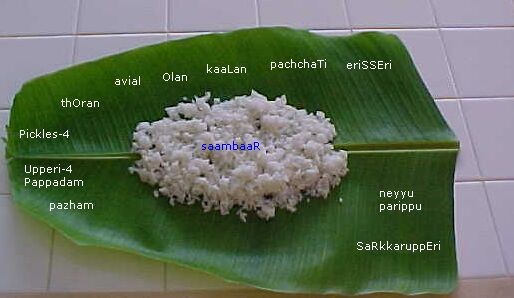
Cut the plantain leaf crosswise to include 20 inches
(50cms) of the pointed end of the leaf, the preferred one to use for festive
occasions. Place the washed and wiped leaf with its tip to the left of the
seated guest. With very few exceptions, most use a designated part of the leaf
for each item. The center of the leaf is reserved for rice. Once rice course is
finished, paayasam is served on the center, but limited to the lower half of the
leaf so that it does not spill over to the upper half.
Starting from the left upper corner, items are served clockwise around the area
designated for rice.
�
Upper half
(L> R)
1. Pickles (4 types)
2. thOran
3. avial
4. Olan
5. kaaLan
6. pachchaTi
7. eriSSEri
�
Center
8. Rice with saambaar at its crest. (later rice and rasam and finally rice and
curd.)
�
Lower half
(R> L)
9. Ghee & Parippu
10. SarkkaruppEri
11. uppEries (4 types)
12. Pappadam
13. Steamed ripe banana