Getting A Board And Seeds To Play With
If the reader is not a native Ugandan, a valid question arises of how one should acquire a board and seeds with which to play.
If you want to mail order a board…
Trainspotter’s guide to east africa mancala boards…
Where you can buy a "bao" board in uk…
-----------------------------------------------------------------------------------
If you want to mail order a board…
On our last trip to Uganda we managed to bring back several spare boards that we are selling (plus post and packing) - email us at

for information about boards and seeds for sale.
Alternatively, one can get started with some egg boxes sticky-taped together, using dried soya beans or dried peas in place of the 'empiki'…
Or, ask a carpenter to make one for you using this diagram as a specification:
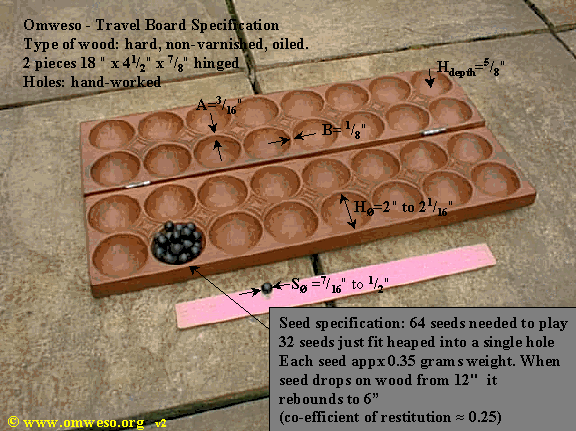
The easiest way (if you are in Kampala!) is to go to the craft market behind the National Theatre and browse the stalls there, which will have a selection of folding boards of the type now favoured in the city for 10,000/- to 15,000/-. In London, the Africa Centre in King Street off Covent Garden also has Ugandan boards for sale (but at a much higher price!).
Trainspotter’s Guide to East Africa Mancala Boards…
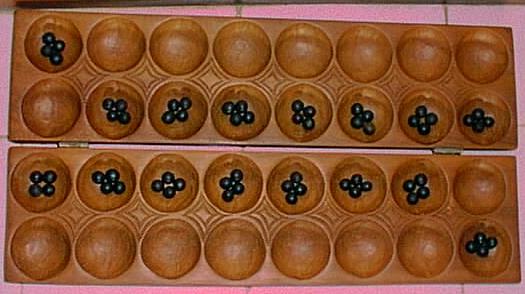
But the Ugandan ‘Omweso’ has all 32 holes the same size and shape:
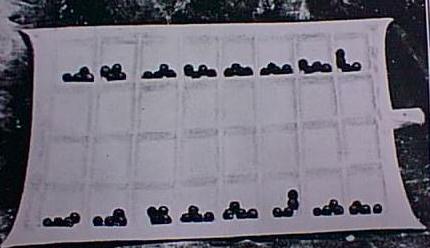
It is considerably harder to find the 'classic' shaped unhinged variety of boards nowadays, but the craft stall at the Kisubi tombs, on the outskirts of Kampala, has some in stock. These are made of a single piece of wood in the shape of a hide with rectangular holes and a hole in a handle at one end for wall-hanging when the board is not in play.
You will notice that the seeds (or 'Empiki' pron. Em-pee-chee) are very shiny and although they are light, they are very strong, hard, almost perfectly spherical and hence pleasant to play with.
These seeds come from the 'Omuyiki' tree (pron. Om-yoo-chee). On a recent weekend visit to Mpigi, I walked in Mpanga forest, and the forest guide took me to see a couple of fine examples of this tree at Kaligwa, just past Mpigi on the Mpigi-Masaka road. The reader may be familiar with the craft stalls specialising in drums which line the road just before it turns into a death trap for speeding motorists as it crosses the Nabukongole Swamp.
Once a year, in mid-November, just after the tree blossoms, the pods containing the seeds in the tree ripen and they fall to the ground. The pods form singly, or in pairs on the extremities of the upmost branches. They are orange when they fall, and as they dry they turn black
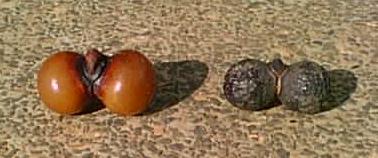
I was interested to see that the seeds were fully hardened within the ripe pods and ready for immediate play. The juices from the pod spurt out when the skin is broken making a very attractive fragrance that I could not place at first. Then I recognised it: it is exactly the smell of homemade English strawberry jam spread on buttered toast! The owner of the shamba in which I found the tree told me that the sap could be usefully used as an alternative to soap, so when I returned to Kampala I put his statement to the test at my bathroom washbasin, and found that he was correct! It was an extremely pleasant and effective hand cleanser and moisturiser!

His tree was mature and about 4m in height with a 30cm diameter trunk - I commend it to any resident of Uganda thinking of improving the ambience of his shamba. Apparently all one needs to do is plant the bare empiki seeds in some compost and wait for the seedling to emerge, and plant outdoors.
An alternative type of seed that you may also see at the National Theatre craft market is slightly larger in size and brown. This seems to have been used more in past days. These brown seeds are more irregular than the black empiki, and come from the 'Luiki' (pron. Loo-ee-chee) shrub (mesoneurum welwitschianum).
This is an unusual plant, and is quite distinctive as it has large (3-5cm) spikes resembling rhinoceros horns growing from its stems. I saw several examples of this shrub in Mpanga forest, on the Southern part of the 'Hornbill Trail' near Ndugu, but none were producing seeds at the time of my visit.
This drawing shows the pods, a piece of leaf and samples from the bark of the shrub. The pods contain the brown seeds in pairs.
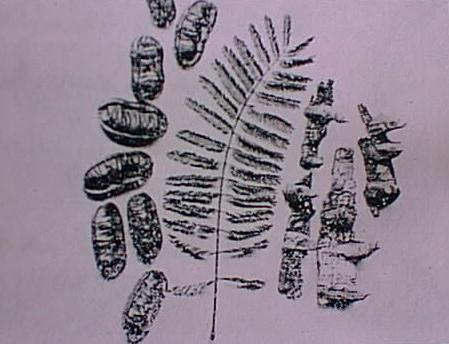
However, I cannot recommend this plant to the reader if he is a keen gardener: the spikes are sharp enough to gouge out the eyes of unwary children, and the plant grows by climbing up nearby trees to heights of 10m or more eventually strangling its hosts!
Where you can buy a "Bao" board in UK…
As I mentioned in the Basic Rules page on this website, an Omweso board appears similar to that of the Swahili/Zanzibarian game of Bao, but the rules are very different. A Bao board has round holes apart from the 5th hole on the inner row on each side which are square, representing the ‘house’ of each player. Genuine Tanzanian Bao boards are available from "Jangwani", 49 Piccadilly, Hanley, Stoke-On-Trent, UK Tel: +44 (0)1782 202600
Comments to the author by email to:
www.omweso.org Copyright Brian Wernham 2001. All rights reserved