THE INCREDIBLE HULK
by Jeremy Harker
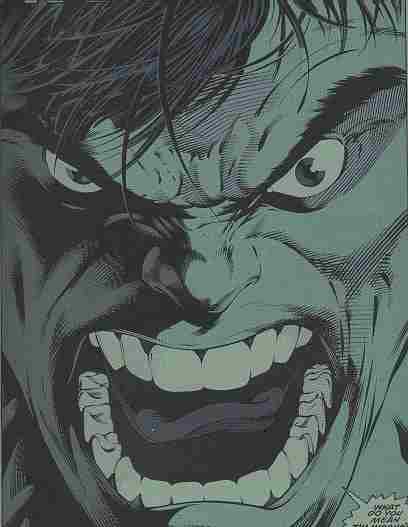
|
THE INCREDIBLE HULK
|
|
by Jeremy Harker
|
|
|
PART TWO
It had been an ideological betrayal of the highest order: humanity turning its back on what, to that point, had been its greatest strength. Something that had helped man survive in Earth's wild younger days, when steamy jungles and monstrous predators were plentiful. It wasn't so much a philosophy as it was an understanding--an acknowledgement of the often-denied fact that life was adversarial in nature. Heroes were those who could casually slaughter their enemies, victims were those who weren't savage enough to defend themselves. Whatever you did to protect your tribe or homeland was justified. But, as civilization developed, the tables were turned on the very mentality that had enabled everyone to make it this far. There were now more sophisticated means of establishing freedom and security. People who believed that might made right were referred to as dictators and tyrants. The idea of shared interests and a common good became popular, while isolationism and antagonism were not. If you were an instinctive, unhesitating killer, something was seriously wrong with you. However, cultural inertia had carried many of the old beliefs over. In this enlightened world, there was at least one disciple of the primal ways…albeit an unwilling one.
It had been an ideological betrayal of the highest order: humanity turning its back on what, to that point, had been its greatest strength. Something that had helped man survive in Earth's wild younger days, when steamy jungles and monstrous predators were plentiful. It wasn't so much a philosophy as it was an understanding--an acknowledgement of the often-denied fact that life was adversarial in nature. Heroes were those who could casually slaughter their enemies, victims were those who weren't savage enough to defend themselves. Whatever you did to protect your tribe or homeland was justified. But, as civilization developed, the tables were turned on the very mentality that had enabled everyone to make it this far. There were now more sophisticated means of establishing freedom and security. People who believed that might made right were referred to as dictators and tyrants. The idea of shared interests and a common good became popular, while isolationism and antagonism were not. If you were an instinctive, unhesitating killer, something was seriously wrong with you. However, cultural inertia had carried many of the old beliefs over. In this enlightened world, there was at least one disciple of the primal ways…albeit an unwilling one. There were beautiful deserts in the world--endless waves of untouched, golden sand, with strange flowers and the occasional oasis--and then there was a dead patch in Nevada, where dust constantly clogged the air and shrubs desperately clung to life. Exotic rock formations revealed that there were at least a million different shades of brown. The ground was hard and coarse, rather than soft and sandy. A cracked freeway wound through it like a black river, and if you followed it, you'd eventually stumble across little outposts of capitalism. It might have a fast-food restaurant or two, and a gas station with a convenience store. (All with gambling machines in the corner, of course.) A paved island in the middle of nowhere. At one such location, something shocking was happening…it was raining. Black clouds stretched as far as the eye could see, and relatively huge splotches of water were coming straight down.
A bus had parked in a lot that was shared by a McDonald's, a diner, and a quick-trip place that, thankfully, also did vehicle repair. The bus had gone over a bad bump about ten miles back, and the engine had been losing power ever since. They said it'd take at least two hours to fix, so all but one of the passengers had wandered towards the most recognizable corporate logo, in search of food. The odd man out headed for the diner, the third of only three buildings in a fifty-mile radius. He wore a green army jacket (with the hood up), bluejeans, and tan-and-black sneakers that looked like they were made for hiking. A black backpack was slung over his shoulder. Though it was only late afternoon, it was surprisingly dark. The diner's exterior was white and mostly made of windows. Upon making sure that there weren't any cop cars parked by the diner (just semis and a pickup), the man pushed the glass door open and went in.
Dr. Bruce Banner pulled his hood down, unzipping his jacket. His dark brown hair was messy, and he wore glasses--a completely-transparent oval over each eye. Bruce was painfully thin and not particularly tall. He stood on the plastic mat by the door, wiping off his feet and removing his jacket. (He had a long-sleeved black shirt, tucked in, underneath.) His clothes had a rumpled, ill-fitting look to them, like he'd just pulled them off some random clothesline. He didn't look well. Too pale, too worn-down. Science had been a good career choice for him, as he would have been a horrible actor: he had all of one facial expression, which indicated a surplus of thought and a lack of emotion.
As ever, no one noticed that he'd come in. There were some flannel-clad truckers at the counter, and a middle-aged Hispanic man was sitting in a booth, reading a newspaper, but Bruce didn't get so much as a single glance his way. No employees were visible. It was a rectangular room, with an L-shaped row of booths that was interrupted only by the door. He stepped onto white, bronze-flecked tiling, and looked around at all of the kitschy stuff covering the walls--ancient movie posters, paintings of James Dean and Marilyn Monroe, yellowed baseball scorecards, etc. An old dot-matrix computer printout, which was taped to the front counter, told him to "SIT YOURSELVE DOWN", so he did just that. Bruce was in the habit of always picking a seat in a corner and (preferably) away from the windows. He sat in a maroon-cushioned booth at the end of the diner, the only one in the entire place that had a price-list poster on the other side of its window, obscuring the view.
After reaching over the table and tossing his jacket and backpack in the other seat, he settled back down and flipped open a laminated menu. A woman's voice started out muffled and slowly became louder, as the lone waitress on duty stopped gabbing with the cook and came out to check on the truckers. She was in her twenties, with brown, blonde-streaked hair and maybe a little too much makeup. The company uniform (red, white and blue) looked surprisingly good on her. Though Bruce was no more than fifteen feet away, she didn't see him. He tended to have that effect on women; on people in general, really. His face was bland and forgettable, he rarely spoke, and he was simply the kind of person that didn't stand out. After clearing his throat several times, she finally looked over and realized that someone was sitting there.
She bustled over, little notepad in hand. "I'm sorry, I didn't see you come in. Can I get you something to drink?"
"Water's fine."
"Are you ready to order, or…?"
"I'll just have the biscuits."
"Do you want honey-butter with that, or jam?"
"Honey-butter sounds good."
"Okay, we'll have that right out."
After she was gone, he grabbed his backpack and pulled it across the table. A specialized laptop was extracted from it. He gave it a minute to boot up, and then selected a file called "Condition History". It was a large file, and it lagged before opening. Inside were ten years' worth of medical records on his least favorite subject--himself. A variety of line graphs climbed upwards, showing how his condition was intensifying. There were also charts full of numbers. All of the bases were covered: his brainwaves, his heart, his bloodwork, his respiratory and circulatory systems, his adrenaline level, his DNA, even his level of gamma radiation. Whenever Bruce got a spare moment, he liked to look for trends and patterns in all of this data, hoping to find a clue that might lead him to a cure.
It had been an interesting ten years. Of course, it had all started a little before that--his research involving gamma radiation had proven to be groundbreaking, and he'd been ready to start working on a million different applications for it, all of which could have changed the world as we know it. Then, he'd been contacted by the government. His work had apparently been deemed a matter of national security, and it had been confiscated and classified. They told him that they'd be perfectly happy to help him turn it into a power-source, a form of medical treatment, a stimulent for crops, and more--so long as he made it into a weapon for them, first. Like most Americans, Bruce had an instinctive suspicion of authority, but he reasoned that they'd never be crazy or desperate enough to use a weapon that powerful. (It made nuclear warheads pale in comparison.) Also, though he didn't like being forced to do something, he didn't want his ego to get in the way of the world getting this revolutionary new science. And, in all honesty, he didn't fight them as hard as he could have. In those days, the idea of making something with that kind of power was fascinating to him, and it was an excellent challenge, as well. He had faith that the bomb would never hurt anyone.
So, he found himself working for the military, under one General "Thunderbolt" Ross. Their project was a controversial one. Bruce was paid a lot of lip-service by the higher-ups, but most people at the base thought that he was creepy. What kind of person could let himself be talked into building a weapon that could kill tens of millions of people? It was clear that he enjoyed the problem-solving of it all, and the way he could refer to potential casualties like they were just numbers on a page…it scared them. As with all of his experiments, he wanted it to be as "effective" as possible, and he seemed to be able to divorce the science from the reality. Bruce's cold, distant nature didn't exactly endear himself to his coworkers. When it came time for them to test the bomb (it was a prototype that was purposely weak, as they'd be testing it within America), Bruce spotted a teenager out on the site…someone who'd snuck in on a dare. He tried to call it off, but they wouldn't let him. The ideal testing conditions came along very rarely--no wind, no known satellite overfly, and so on--and they didn't want to put it off for another few weeks. When Bruce raced out to throw him in a shielded trench, they let him go, and it wasn't hard to figure out why: they didn't need him, anymore, and it'd be a lot easier if he were out of the picture.
What happened next would be the subject of a hundred different inquiries and investigations. Careers would be ended, scandal-loving reporters were still taking about it, and a never-ending blame game would be kicked off within Washington, DC. The teenager (Rick Jones) was shoved into the trench, the bomb went off, and Bruce was hit. Miraculously, he survived. And soon after that, an individual that the military dubbed the Hulk began appearing throughout the southwest, destroying things and menacing people. Bruce managed to keep his condition secret for a couple of years. (He even kept working for the military.) After it was discovered that the Hulk was gamma-powered, the official theory was that a third man had wandered onto the testing site and been turned into the Hulk. Eventually, they discovered the truth, and Bruce had been on the run (off and on; he sometimes came to an understanding with the authorities, but they tended to be short-lived) ever since.
His waitress came back, plate in hand. "Here you go."
"Thanks."
"You come in off the bus?
"Yes."
"If you're in here on one of those little stretch-your-legs breaks and you need to hurry, I can bag that for you."
"There was a mechanical problem, something like that."
"Gotta wait for it to get fixed?"
"Exactly."
She hung around for about ten more seconds, apparently waiting for him to make small talk, or make eye-contact (he never had), or thank her for offering to bag his food, or even hit on her, but he just stared at his laptop and his food. Finally, she looked annoyed and walked off.
Bruce started eating. He also shut down the laptop and closed it, slipping it back into his backpack. Inside, there was a change of clothes (horribly wadded up), some fake IDs, a flashlight, and an empty nine-millimeter. The latter was a testament to Bruce's selfless, completely objective logic. In his mind, it was all quite clear. His wife, Betty, had died because of gamma radiation poisoning. (Normally, exposure to Bruce wasn't dangerous at all, and it had never hurt anyone else.) Also, though Bruce usually became the Hulk out of self-defense, the Hulk had a tendency to become overwhelmed by external stimuli and slip into savage-mode, where everyone and everything he came in contact with was a target. Likewise, even when the Hulk was lucid, it was all too easy for innocent bystanders to be killed in the crossfire of his battles. The Hulk could become very focused on who was threatening him, sometimes to the point of not realizing the consequences that his actions were having on uninvolved people nearby. And, finally, Bruce had seen futures where the Hulk had gone completely evil and taken over the world. Short of a cure, suicide was the best option for all involved.
Unfortunately, the Hulk had adapted. Things that should have killed Bruce Banner just weren't doing the trick. One night, he'd put the gun to his head and pulled the trigger. Surely, his brain would flatline before it'd have a chance to set off the Hulk--but that hadn't happened. The next morning, Bruce had found himself wandering around the desert, wearing nothing but a shredded pair of jeans. Another time, he'd planted a small explosive next to his body and heavily sedated himself, hoping that a lack of consciousness would prevent him from becoming angry or registering the pain it took to become the Hulk. That hadn't worked, either. When he came to, he was about a mile from where the bomb had gone off, and he was untouched. He'd tried a few other experiments--adrenal suppressants, poison, decapitation, having someone else kill him, building a disintegration field generator and jumping into it headfirst--but the Hulk survived it or prevented it every time. All of this had helped Bruce further understand the psychological triggers that created the Hulk, however: the three main ones were anger, frustration, and a need for survival.
Though he hadn't found a cure, it was possible to manage his condition. Essentially, he had to regulate both his internal and external stimuli. By staying calm and avoiding conflict and tense situations, he could keep the monster inside. But he could always feel the Hulk trying to claw his way out. In part, the Hulk had been created by Bruce's unhealthy repression and avoidance--and now, repression and avoidance were the only tools he had, to keep the Hulk in check. Though Bruce viewed himself as a victim in all this, he also knew that it was karma. His naive dalliance with destructive power had created his current situation…he'd thought that it was something that could be easily controlled and contained, and life had taught him a lesson about that. He often threw up, thinking about not only how his accident could have been prevented, but about the good that could have come from his research, if only he'd done things differently. On some level, he knew that this was his punishment.
A dropped tray of dishes clattered loudly, and everyone in the place jumped--except Bruce. He sat motionless in his booth, as tightly-controlled as ever. While he contemplated suicide, relived events that would have driven anyone else insane, and restrained one of the most dangerous beings on Earth using nothing but his own discipline and willpower, he looked frighteningly calm. Bruce halfheartedly ate his biscuits (there was no point in trying to starve himself, he'd found, his body seemed to be able to operate on nothing but gamma radiation), and didn't notice when a dark sedan pulled up clear on the other side of the shared parking lot.
High-tech binoculars were used. The driver got out and proceeded to run lightly through the rain, looking for a better angle. (If it was Banner, he was was smart: sitting up against a wall, in a booth with a covered window. Two of the four lines of sight had been cut off.) After confirming his identity, strangely, the driver just stood out in the rain, removing a cell phone and hitting two buttons.
"I found him. Yeah. Yeah, I'm just gonna get it over with."