




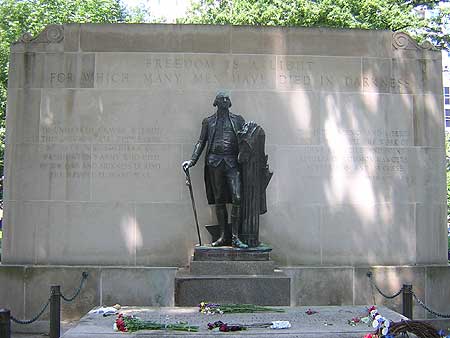
The Tomb of the Unknown Soldier lies within Washington Square, one of the five public parks drawn up by William Penn in his 1682 blueprint for Philadelphia. Shortly after the square was laid out, however, it was being used for a wholly other purpose � as a potter's field.
Burials in Washington Square, then known as Southeast Square, started in 1706 and continued for nearly nine decades. Initially located on Philadelphia's westernmost settled area, the square proved an out-of-the-way repository for the impecunious as well as a permanent residence for deceased "strangers" � those unknown visitors to Philadelphia whose stay proved to be longer than expected.
Others, too, were buried in the square on occasion. For example, the Joshua Carpenter family, a prominent Philadelphia clan, had maintained a private family burial ground in the square's center owing to the suicide of a family member � this kept her from being buried in a church cemetery. Amid this funerary setting grazing cows and at-play urchins would blithely go about their business.
The living and the dead have long commingled in the square. Over the years, the square has been used for as a fishing hole, cow pasture, hayfield, duck hunting spot and, appropriately enough, revival meeting grounds. 19th-century historian John Watson reports that slaves would be allowed to congregate in the square during holidays, sometimes numbering a thousand, holding dances and honoring the "sleeping dust below."
By 1776, that "sleeping dust" would be jolted by the first Revolutionary War casualties.