Great White Shark
| Shark Attacks | Diet | Reproduction | Habitat | Range |
|---|
|
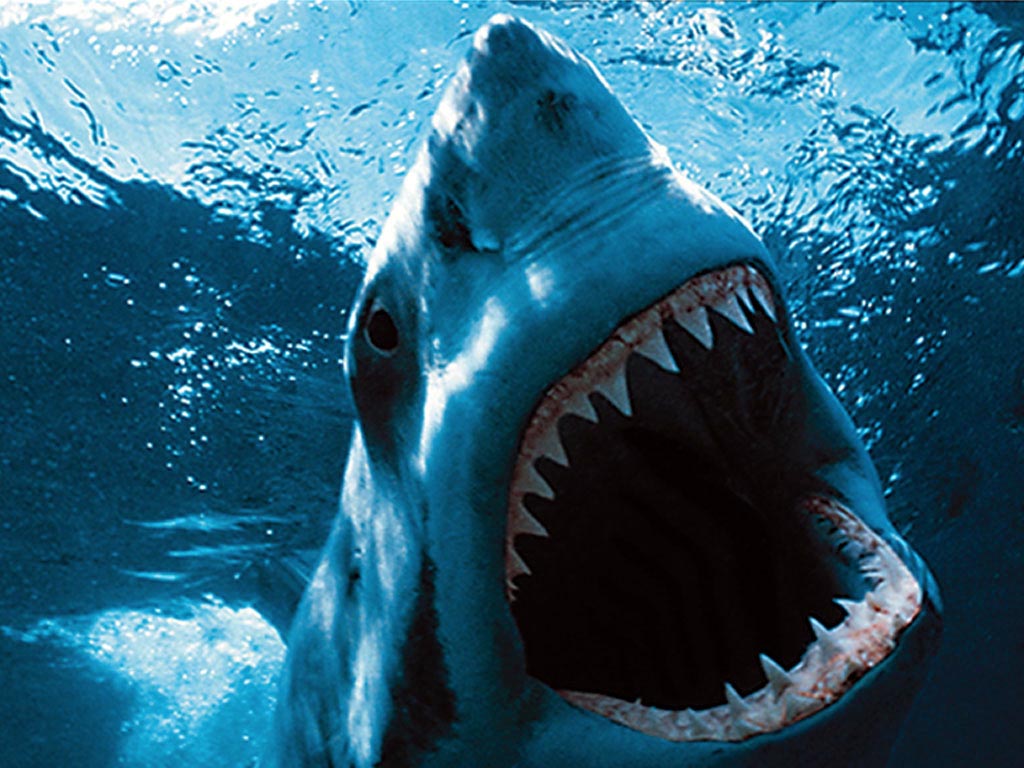
Australia has had its fair share of GW attacks. The most documented GW attack occurred in 1963 when Rodney Fox was attacked while competing in a spear fishing contest. He attempted to poke the eye of his attacker but only managed to stick his hand into the shark's mouth, slicing his arm open to the bone. The shark let go but attacked again with Fox grabbing its snout to avoid being bitten again. Weakened by loss of blood and running out of air, Fox let go and struggled to the surface. The shark attacked again but only grabbed the fish line clipped to his belt, pulling Fox down with it. The shark's teeth then severed the line and Fox finally made it into a waiting boat. Rushed to the hospital, Fox underwent emergency surgery, an operation that required 462 stitches to put him back together.
|
 |
|---|
|
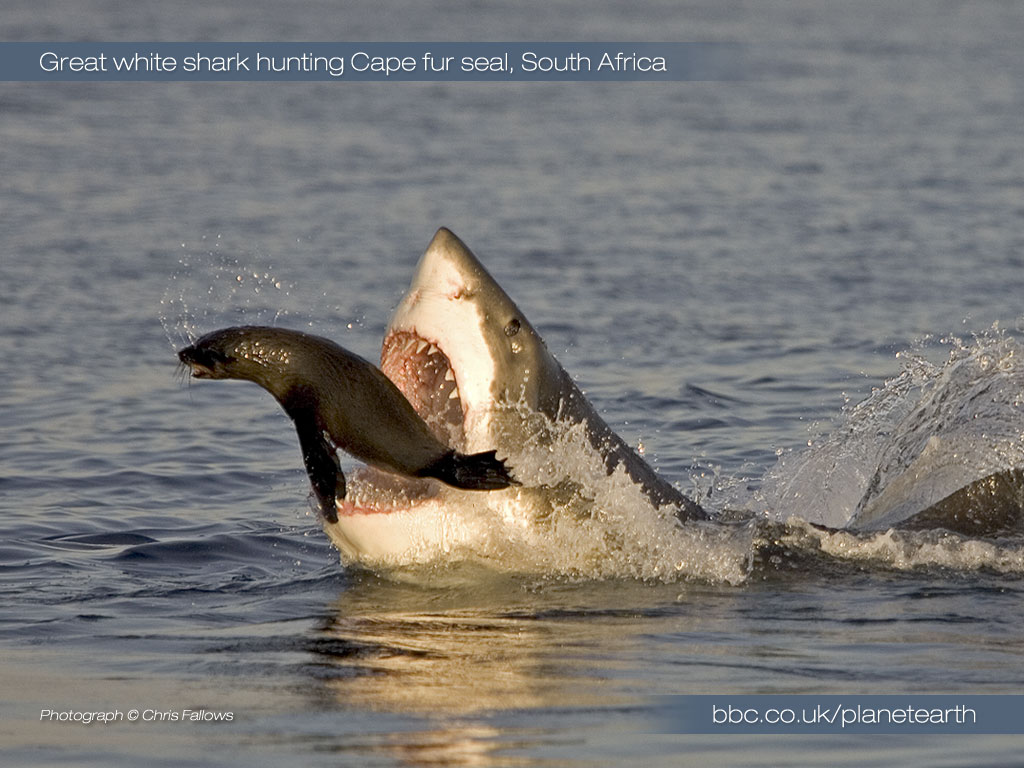
The white shark preys upon a variety of fishes and marine mammals. Fish such as salmon, hake, halibut, mackerel and tunas are common prey, as are marine mammals such as harbor porpoises and harbor seals. However whites also eat other sharks, sea turtles and seabirds. They may also feed upon blubber from dead whale carcasses. Examination of the stomach contents of one great white caught off Deer Island, New Brunswick revealed three porpoises within it. Great white sharks are carnivorous , and primarily eat fish (including rays and smaller sharks ), dolphins , porpoises , whale carcasses and pinnipeds such as earless seals , fur seals and sea lions . Sea otters and sea turtles are also taken at times. Great whites have also been known to eat objects that they are unable to digest. In great white sharks above 3.41 metres (11 ft, 2 in) a diet consisting of a higher proportion of mammals has been observed. [8] These sharks prefer prey with high contents of energy-rich fat. |
 |
|---|
|
Unlike most bony fish, shark's eggs are fertilized inside the female's body. The male shark has "claspers," extensions of the pelvic fins that are used to transfer sperm to the female and fertilize her eggs. Most sharks give birth to live young, but some release eggs that hatch later. The gestation period (the time the embryo spends inside the female, developing) can be up to almost two years long (the spiny dogfish shark may have the longest shark gestation period). Baby sharks (called pups) are born with a full set of teeth and are fully ready to take care of themselves. They quickly swim away, even from their mothers who might eat them. Litter size ranges from one or two pups (for a great white shark) to over 100 (for a large blue shark and the whale shark). |
 |
|---|
|
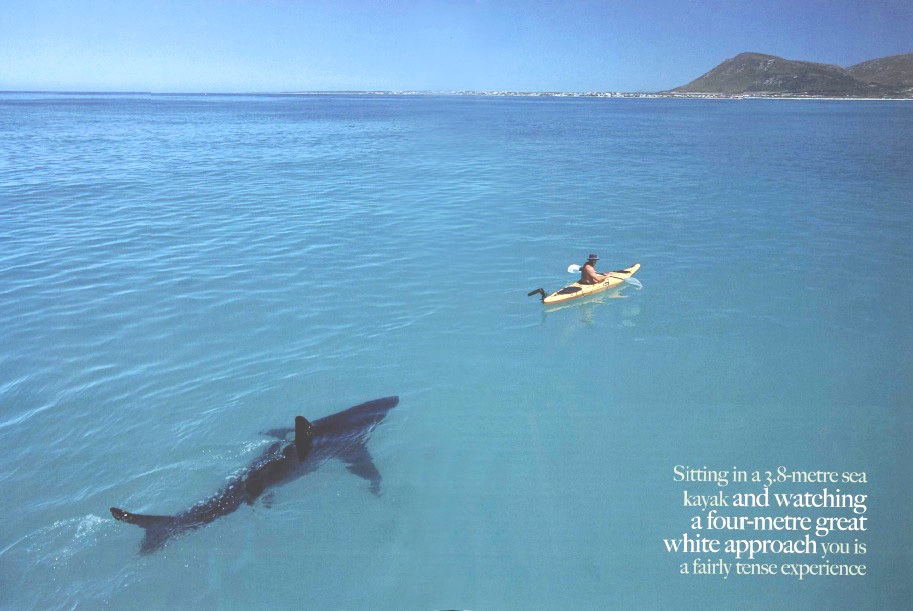
The white shark inhabits coastal and offshore waters of the continental shelf. Periodically it will wander into bays and harbours. This shark also inhabits waters around oceanic islands. The great white shark occurs in surface waters and down to a depth of 1280 meters (4,240 feet).Great white sharks live in almost all coastal and offshore waters which have a water temperature of between 12 and 24° C (54° to 75° F ), with greater concentrations off the southern coasts of Australia , off South Africa , California , Mexico 's Isla Guadalupe and to a degree in the Central Mediterranean and Adriatic Seas . There have also been unconfirmed reports as far north as the southern shores of the United Kingdom . [2] One of the densest known populations is found around Dyer Island, South Africa where much research on the shark is conducted. It can be also found in tropical waters like those of the Caribbean and has been recorded off Mauritius . [3] It is a pelagic fish, but recorded or observed mostly in coastal waters in the presence of rich game like fur seals , sealions , cetaceans , other sharks and large bony fish species. It is considered an open-ocean dweller and is recorded from the surface down to depths of 1,280 metres (4,200 ft), but is most often found close to the surface. |
 |
|---|
|
The white shark has a worldwide range along the continental margins of all temperate seas and part of the tropics. In Atlantic Canadian waters it is rare, but has been caught off Deer Island in the Bay of Fundy and off Campobello Island, New Brunswick. A 5-meter (17') white was caught off of PEI in 1983. Based on the growth bands in the vertebra, this shark appears to have been about 16 years old.
|
 |
|---|
Resources