A ScreamDesign Publication



|
|
|
|
|
||
| |
||
| Home | Advertise | ScreamDesign | Feedback | Contribute | ||
|
|
|
Radio Live in Boston
Microsoft Case Heads to Supreme Court Barnes
& Noble Offers MP3.com
Forms Retail
|
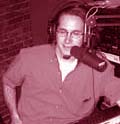
Radio Live in Boston Interview by Robert O'Malley An Interview with RadioBoston.com's Robert Swalley Robert Swalley sits in a 19th century building in Boston's BackBay. The building was once a church but is now the office of RadioBoston.com, an Internet radio station that carries the music of local Boston musicians to a global audience. The walls of Swalley's office are plastered with the promo photos and stickers of local bands. Computers line the tables. Before founding RadioBoston.com in 1999, Swalley studied electrical engineering at Ohio State University and graduated from the Berklee College of Music, where he studied music production engineering. ScreamZine recently recorded Swalley's story at the station's Boston office.
The idea of RadioBoston.com came to me in 1998. I was at the CMJ music conference promoting my independent record label Eastern Front records. While I was there I went to several panels on the Internet. And one idea that really struck me was the concept of Internet radio. When the idea came to me, it had a lightning bolt effect. Basically I'd been running this record label for about five years and was really running up against a brick wall trying to get music played on traditional radio. The stations were all becoming pre- programmed. There was a lot of consolidation going on. And when I went to this conference traditional radio panels pretty much confirmed that concept. Going to the Internet radio panels was very interesting . The Internet panels were talking about Triple A stations and commercial alternative stations. But why go to the Net for whatyou can tune in on your FM dial? You can get the same content there. So what's the point? My belief is that the real treasure of the Internet is unique content. This is what makes the Internet so incredibly cool and so useful. You can go to the Internet and find anything on really any topic you can imagine. And so brain cells started turning. I was sitting here in Boston with all this incredible music going on around me, which is like no other music in the entire world, and I'm looking at Internet radio and saying, wow! unique content. The Internet made sense and it was literally that whole lightning bolt thing. Boom! We got to do a radio station on the Internet for the music of Boston and New England. When I came up with the idea I basically rushed home from CMJ and started talking with Robert Curtis, a friend of mine from Web Primitives, who had been doing web sites for Eastern Front. I asked him what it would take to do an Internet radio station. He said, uh, that shouldn't be too hard. He liked the challenge. So we got to digging around. He got a copy of RealProducer and we put it on a machine in his kitchen and we hooked it up to his MediaOne connection, which is really meant to suck information down and not upload anything. He hooked it up to the cable modem connection and started doing a little broadcast. Just before Christmas I finally went to Jerry Potts from Eastern Front Records and said, hey Robert and I have been fiddling with this idea of Internet radio. We think it would be a really great thing, regional music to a global audience. He said, wow! That's great. We got to do it. We got to do it. So he jumped on board and through January, February, March we started putting this thing together, still keeping Eastern Front Records.as Jerry's and my primary business and creating this new business with Jerry, Robert, and myself. In April of '99 we moved into this building and we did our first real broadcast, which was the Kahlua Boston Music Awards live from the Orpheum Theater. Since then we've been broadcasting live 24/7. Live Encoding Now when I say "live" there's actually two aspects to this: there's live encoding and there's a live EJ spinning the tunes. We call them EJ's - live electronic jockies . The live element was crucial to creating the unique content. There are hundreds, thousands of Internet radio stations out there - or what they call Internet radio - that are jukeboxes in which some programmer has gone and recorded CDs and put them into a jukebox to do their thing. You know some of them have actually recorded a DJ's voice and put it between the songs. And that's okay - that's not a bad thing. I'm not going to totally dis on that. Here in town there's DiscJockey.com. So the idea of an Internet jukebox is a perfectly valid concept. But that wasn't what I wanted to do. I wanted to do something really unique. And to me the most unique thing is what is going on at this very instant in time . How often do you go back to a web site and it looks the same and sounds the same? Now granted our web site looks the same a lot. But if you go to our RealPlayer, you've got something new and fresh happening every time; there's a different EJ spinning different tunes and talking about today's events. It's live broadcasting. Now when I say we're live 24/7 I'm speaking of live encoding. Instead of recording shows to real audio files and uploading those and letting people click into those at will, we're actually continually encoding a live continuous stream. It's the live encoding that gives us the best sound quality on the map. One of the really early Internet radio stations did tons and tons of channels and recorded it all in Real Audio 5, which three years ago sounded amazing. But today, quite frankly, RealAudio 5 sounds like crap because the technology has improved so drastically in the past three years. It's even made some drastic improvements in the last six months. Six months ago we didn't sound nearly as good as we sound now. So if we record all of the music into a file the sound quality would be permanently recorded. Instead, we're live encoding, spinning tunes straight from the CDs and through a digital mixer with a real EJ talking about the tunes. The signal going to the Real Audio encoder is the highest possible quality - 96K stereo sound. It's really a function of how good is the Real Networks' product is, and at this point , it's very good, infinitely better than it was six months ago. In the best case scenario it takes 30 seconds for the stream to reach a user's computer, though sometimes it takes two or three minutes . You need a little bit of time to encode it , seconds actually . Then it pops up to our server in California, so there's a little bit of time required - seconds or fractions of a second - to get from here to there. From there it goes through what is called a push splitter which takes that signal, replicates it, and pushes it out to some 300 servers on - the buzzword for this is - "the edge" of the Internet. The edge of the Internet means as close to the listener as possible. The real time differential depends on the user's computer. Whether the user is dialed in on a 56K modem or on a corporate T1 will determine how much buffering goes on. Whenyou bump your CD player , it doesn't skip because the CD is recorded into a buffer three or four second ahead. When you bump that CD it's going to say hold on, something's wrong here, we have to rematch it up. And it does all that before it reaches you, the listener. The same thing happens with streaming on the Internet. When your screen says "buffering," it means it's recording 5, 10, 25, 30 seconds of music so that if there's a drop in the connection, it can still put the stream together and come out seamless to you, the user. How much buffering takes place depends on your computer's speed, your connection tot he Internet, the size of your hard drive, and your preferences . There are a lot of variables on that end. We could have two computers side by side in this room and have them log in at the same time but the audios won't come in at the same time, though it will be close enough to rock and roll because it's never more than two or three minutes off. We're using RealBroadcast Networks . They're considered to be the leader in the streaming media delivery but there are a lot of other players in the field offering bandwidth. Spinning the Tunes My concept was to create this as much like a traditional radio station as possible. The EJs would come in and do what they would typically do on a radio station. There's a stack of CD players, mini disc players, and dat machines wired to a digital board. The EJs are in there pulling CDs off the shelf, putting them in the CDplayer, and queuing them up. They've got microphones and headphones and are running it really just like a regular radio station. The only difference is we have a live video cam and a couple of static or still-image cameras for the lower bandwidth people. And they've got a computer sitting in front of them for uploading the song titles. To get the music from the CD to the RealAudio Server the EJ puts the CD in the CD player and that signal is routed down to the mixing board. From the mixing board it goes to a Windows NT box running NT4 Service Pac 6. We actually split that signal into three different audio cards: one for low bandwidth, one for medium bandwidth, and one for audio visual that is actually wrapped together in one high bandwidth stream. The stream is then transmitted over a T1 DSL to a server in California that essentially receives that signal and matches it up with other streams that we're sending at the same time. We send multiple streams of text and images; it matches all that up and then splits it out and sends it to those servers. In our broadcast booth it flows out of the mixing board and into a computer. On the video side it's actually one card. We use an Osprey 200 that takes the stereo audio and the video in one coded stream to California. On the camera side of things it's a little more complex but basically we've got a program taking pictures with two different cameras and those get FTP'd to another computer that does this flop thing between two images. Then that gets dumped into the encoder folder which then pipes it up. So basically all of the encoding happens on site and then goes to the server to be spread around. Remote Broadcasting We have six channels now. Channel 1 is a live EJ, like a traditional radio station. For Channel 2 we went ahead and did the jukebox thing, just because everyone else was doing it. We said: What the heck, it's not our cup of tea, but we did a jukebox. I think it's probably good for people listening at work because they don't have to worry about a loudmouth EJ. The jukebox is pre-programmed. We have a rotation made up of unknown and better-known regional musicians. Now we don't play Aerosmith and New Kids on the Block. We feel they don't really need our help. The average person in California will look at our playlist and say, it's all unknown to me. We certainly wouldn't have any top 40 artists on our play list. The EJs gets to play anything on our shelf. Our music director receives the music, and if we feel it meets our audio quality and musical content criteria and if we like it then it makes it onto the shelf. It's all regional. That is the one defining characteristic: it has got to be from this area. The musicians are sending their CDs to us. We can play MP3s too but we don't really play them that often. Everyone likes to say MP3 is digital and CD quality, but it's really not CD quality yet. It's digital because it's on the Internet; anything on the Internet is digital. We also do live broadcasts two or three nights a week. On Channel 3 we have remote broadcasts from various clubs. We use a traditional broadcast piece of gear that encodes and decodes the music , then sends it over regular phone lines to our broadcast booth. We then pipe it up to the Internet using the same method used for our other channels. When we broadcast from the clubs, we use a broadcast piece by Comrex called the Vector. It has a little mixing board. We take a line off the house mixing board and put a mike up in the room and put a camera up in the room to take still images. The still images are transmitted up here via wireless modem. The audio is sent over traditional phone lines back to our broadcast booth where it's encoded. Then it's all put together and shipped up to our server. Now due to the constraints of traditional phonelines and wireless modems the audio and visual quality of Channel 3 is going to be lower than the quality of our other channels. But you've got to consider the fact that we can do this from pretty much anywhere. Channels 4, 5, and 6 are live braodcasts from three clubs. All of the clubs have DSL connections. Channel 4 is the Kendall Café, Channel 5 is Club Passim, and Channel 6 is TT the Bear's. We broadcast live every single night from those clubs, provided the artists give us their approval. We're also piping up live video. We just started the live video this week. It's 96K stereo/audio and live video. Our systems are set up so that basically anybody with any bandwidth can get something. But the 96K stereo/ audio and live video is only for people with a cable modem or a T1 connection, something over 256K. If you're on a dial-up modem your going to get good-sounding mono audio with still images. The audio quality for the dialup is still going to be the best you're ever going to get from a dialup. But we are kicking out the really great audio and video for users with high bandwidth. Four years from now you're not going to want to be on a dialup modem. Nobody in their right mind will want to be on a dialup modem. 56K modems have been shipping in new computers probably close to two years now. If you have a 28.8 and 33.6 modems you've got to be sitting on a fairly old computer. As people begin getting broadband in their homes, a bunch of different manufacturers have started to create various components or Internet appliances that are designed to plug straight into your cable modem and hook you up to Internet radio or Internet television. Eventually the Internet is going to be very much like electricity or the telephone. You use electricity all the time but you never think about it. The Internet is definitely heading that way. Advertising My business partner is Jerimiah Potts, who privately funded the record label and to date has privately funded this venture. Now we're on the verge of a deal for future funding of this venture that I actually can't talk about. Our primary source of income will be advertising. That's really the model for the Internet. There are some companies out there that try to do subscription base, but it's a lot trickier to do subscription base for radio. The licensing becomes very different with ASCAP depending on whether it's pay-for-play or a subscription-fee service. Advertising is the most logical model for us and essentially it's pretty straight ahead figures as far as what advertising is worth . With the Real Player we have the ability to tell who's on and for how long. We don't know their name or address or anything like that, but we do have an idea of where they're coming from and how long they 're on; we know what they're listening to and when they come back and how many times they've been back. That information is actually very valuable to advertisers. We have advertising running along the bottom of the RealPlayer. They're standard 468x60 banner ads. They also run at the top of our home page. We're not going to make them suffer through audio ads.
|
|
||||