Return
to
home page
Water War over Olympic Dam Mine Expansion
Media Release
November 11, 2004
Friends of the Earth and the Campaign Against Nuclear Dumping (CAND)
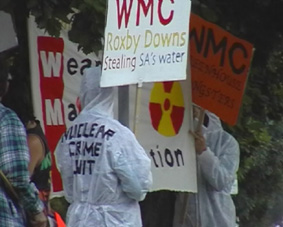
are this morning protesting outside WMC Resources' office on Greenhill
Rd against plans for a massive expansion of the uranium/copper mine at
Roxby Downs.
Currently the mine takes over 30 million litres of water daily from the
Great Artesian Basin - free of charge - threatening the precious and
fragile Mound Springs. WMC plans to more than double its water usage
for the planned expansion toward 80 million litres a day and is
exploring at least three options:
* doubling the water take from the Great Artesian Basin
* taking water from the ailing River Murray (from the Morgan-Whyalla
pipeline)
* taking water from the Spencer Gulf and building a desalination plant.
Dr Jim Green, national nuclear campaigner for FoE and a member of CAND,
said: "Which of SA's precious water resources is WMC targeting? Will
the company further endanger the unique Mound Springs, or add to the
pressures on the River Murray, or desalinate water taken from the
Spencer Gulf?"
"These options are being negotiated behind closed doors by WMC and the
Rann government. Their preferred option will then be presented as a
fait accompli to the public in the form of an Environmental Impact
Statement. This EIS process promises to be an expensive, undemocratic
farce.”
"The state government has totally failed in its duty to protect
groundwater at the Beverley acid leach uranium mine site. Will Mike
Rann also further sacrifice the Great Artesian Basin to uranium
mining?" said Dr Green.
Today's protest will include banners ('Stop the Roxby Mine Expansion',
'WMC: Water Thieves', 'WMC - Weapon of Mass Consumption'), placards,
Kelly the Mutant Three-headed Kangaroo and other props.
FoE and CAND are also challenging the legal privileges enjoyed by WMC.
The Roxby Indenture Act overrides key environmental legislation in SA
including the Environment Protection Act and the Water Resources Act.
As an example of the consequences of these legal privileges, uranium
mine wastes at Olympic Dam are not covered by the Environment
Protection Act.
Richard Ensor, a CAND member, said: "As the most environmentally
damaging development in the state, WMC's Olympic Dam ought to be
subject to the most stringent standards, but as things stand the mine
is subject to the weakest standards of any development in the state.
These outrageous and totally unjustifiable legal privileges must end."
WMC
Office, Adelaide, November 11, 2004.
WMC: Greenhouse Greenwash
Jim Green
Acronyms
AAC - Australian Aluminium Council
ABARE - Australian Bureau of Agricultural and Resource Economics
AGO - Australian Greenhouse Office
AIGN - Australian Industry Greenhouse Network
AMEEF - Australian Minerals & Energy Environment Foundation
BCA - Business Council of Australia
CEI - Competitive Enterprise Institute (US free-market think-tank)
FoF - Frontiers of Freedom (US free-market think-tank)
GCP - Greenhouse Challenge Program
GST - Goods and Services Tax
MCA - Minerals Council of Australia
UIC - Uranium Information Centre
WBCSD - World Business Council for Sustainable Development
WWF - World Wide Fund for Nature Australia
Summary
On June 10, 2002, Mr Hugh Matheson Morgan AO, then chief executive of
WMC Limited (formerly Western Mining Corporation), was awarded a
Companion of the Order of Australia for services to business. The
citation stressed his "leadership in the formation and evolution of
sustainable development policy". (<www.itsanhonour.gov.au>)
What a joke. Morgan and WMC have been tireless in their efforts to rail
against the overwhelming weight of scientific evidence on anthropogenic
climate change and to fight national and international initiatives to
reduce greenhouse gas emissions.
Even though WMC rejects the overwhelming weight of scientific opinion
on climate change, the company claims to be taking steps to reduce
greenhouse gas emissions - but its emissions almost doubled between
1994-95 and 2001.
When marketing its uranium from Roxby Downs in South Australia, WMC
adopts a more rational stance on climate change science - but leaps
from that premise to the dubious conclusion that only nuclear power
(and WMC's uranium) can save the day.
WMC employees have argued for the abolition of the Australian
Greenhouse Office - but WMC itself is involved in, and benefits from,
an AGO-run greenwashing scam called the Greenhouse Challenge Program.
WMC rails against politicians and bureaucrats and portrays them as
captives of environmentalists, but for years the company has been
working hand-in-glove with conservative politicians and bureaucrats to
fend off domestic and international pressure to reduce greenhouse gas
emissions.
WMC rails against environmentalists, but the company has also had some
success co-opting conservative environmentalists.
In short, WMC's approach to the climate change debate has been
hypocrisy writ large - all the more so because of the company's
insistence that it has adopted a consistent, science-driven approach to
the debate.
Killing Kyoto
WMC's activities span uranium, nickel, copper and gold mining, and the
production of phosphate fertiliser. WMC is also a 39.25% part-owner of
Alcoa World Alumina Australia, which operates two smelters in Victoria
and three refineries in Western Australia. WMC says its most
significant emissions of carbon dioxide, sulphur dioxide and nitrogen
oxides originate from electricity usage, fuel-burning equipment,
refineries, smelters, chemical processes, and the use of explosives.
As a large emitter of greenhouse gases, WMC takes the climate change
debate seriously - it has a Greenhouse Program Committee comprised of
senior executives and chaired by an executive general manager.
WMC was heavily involved in trying to undermine the Kyoto Protocol in
the lead-up to the December 1997 conference at which the Protocol was
established and opened for signature and ratification.
The company worked with free-market think-tanks and corporate front
groups in both Australia and the United States. WMC collaborated with
the Competitive Enterprise Institute (CEI), a US free-market
think-tank, in the organisation of a climate sceptics conference held
in Washington DC on July 15, 1997.
R.J. Smith, 'Senior Environmental Scholar' with the CEI, outlined the
game plan to Mining Monitor in 1997: "Early last winter, right after
Tim Wirth of the US State Department announced they were going to call
for mandatory controls in Kyoto, we said what do we do? How do we stop
this? Ray Evans [from WMC] was coming into town and so in November of
last year we met at CEI headquarters, with Ray, Fred Smith our
President, I think Dick Lawson the Executive Director of the National
Mining Association, Bill O'Keefe, the Executive Director of the
American Petroleum Institute and the senior world Vice-President for
Ford Motor to sort of start plotting some strategy." (Bob Burton,
"WMC's Campaign to Scuttle Binding Targets", Mining Monitor, Vol.2(4),
December 1997, p.1.)
The July 15 conference, titled 'The Costs of Kyoto', included, among
others, Paul O'Sullivan, a senior diplomat from the Australian Embassy
in Washington, and Brian Fisher from the Australian Bureau of
Agricultural and Resource Economics (ABARE). According to the CEI, the
"highlights" of the conference included O'Sullivan explaining why
"Australia is fighting against a treaty that imposes an undue burden
with minimal return". A transcript of O'Sullivan's speech was
circulated to the media by the CEI. (CEI Staff, 15/7/97, "Global
Warming Conference A Smashing Success",
<www.cei.org/gencon/003,02757.cfm>.)
On October 22, 1997, the CEI hosted ABARE's Brian Fisher at a luncheon
with the aim of winning over "economic attaches to embassies of
developing countries which might prefer differentiation to uniform
reduction targets". The CEI had "recognized the strategic importance of
Australia in the climate change gambit" according to CEI research
fellow (and Australian national) Hugh Morley. "If Australia sticks to
its guns", Morley said, "there might not be a Kyoto treaty after all."
(Hugh Morley, 1/11/97, "Australia Cool To Warming",
<www.cei.org/gencon/005,01305.cfm>.)
WMC was one of the sponsors of the August 1997 'Countdown to Kyoto'
conference held in Canberra. The conference was organised in
conjunction with Frontiers of Freedom (FoF), a US free-market
think-tank, the CEI and various other climate sceptics. FoF said:
"Members of Australia's government called the conference "absolutely
critical" in solidifying the government's opposition to a Kyoto treaty
even if it means defying Clinton Administration policy. At the same
time, Australia's opposition to a climate treaty means that opponents
in the U.S. Congress will not be facing unanimous world opinion in
favor of such a treaty." (FoF, The Freedom Report, Volume 1(4),
December 1997, <www.ff.org>).
Despite the boastings of the FoF, the Australian government didn't need
much convincing - it was already colluding with corporate climate
sceptics. O'Sullivan and Fisher spoke at the Washington conference, and
speakers at the Canberra conference included Deputy Prime Minister Tim
Fischer, environment minister Robert Hill, shadow environment minister
Duncan Kerr, as well as some US politicians.
FoF is, to be fair, consistent and even-handed: it opposes both
mandatory and voluntary reductions of greenhouse gas emissions.
Responding to the US government's 'plan' for voluntary reductions in
February 2002, FoF president George Landrith said: "This smells like
the first step in a mandatory program requiring emission reductions.
Have we given in to extremists who favor energy suppression across the
board? Give an inch to those who think energy is inherently evil and
they will take 100 miles." ("Frontiers Questions Wisdom in Bush
Administration Global Warming Plan",
<www.ff.org/press/021402-bushenviroplan.html>.)
That's just the sort of hyperbole that WMC contributes to the climate
change debate in Australia.
ABARE
WMC is a member of the Business Council of Australia (BCA), which was
one of the members of a Steering Committee which directed ABARE's work
on the economic impacts of the Kyoto Protocol. Alcoa Australia is a
member of the Australian Aluminium Council, which was also on the ABARE
Steering Committee.
Fisher presented the discredited MEGABARE model to the Washington
conference in July 1997. The Australian Department of Foreign Affairs
and Trade (DFAT) said there "has been no financial contributions made
to the work apart from those by DFAT and ABARE" - but failed to mention
corporate financial contributions to, and direct involvement in,
ABARE's modelling. (Bob Burton, "WMC's Campaign to Scuttle Binding
Targets", Mining Monitor, Vol.2(4), December 1997, p.1.)
US Under-Secretary for Global Affairs Timothy Wirth said in relation to
ABARE's grossly inflated estimates of the economic impacts of the Kyoto
Protocol that someone should "look at what those people are smoking".
In February 1998, the Commonwealth Ombudsman issued a report which
concluded that by limiting membership of the Steering Committee to
organisations willing and able to pay $50,000, ABARE had failed to
protect itself adequately from "allegations of undue influence by
vested interests". In the same month, ABARE received a a special public
service prize for its MEGABARE work from Prime Minister John Howard.
(Clive Hamilton, 2001, Running from the Storm, p.54-63.)
Lavoisier Group
WMC helped establish the Lavoisier Group in 2000 - an organisation
which, according to Professor John Quiggin, "is devoted to the
proposition that basic principles of physics ... cease to apply when
they come into conflict with the interests of the Australian coal
industry." ("Wishful thinking of Walsh's true believers", Australian
Financial Review, 11/4/01, <ecocomm.anu.edu.au/quiggin>)
To give a taste for the Lavoisier Group's greenhouse conspiracy
theories, it argued in a submission to the Joint Standing Committee on
Treaties that the Kyoto Protocol poses "the most serious challenge to
our sovereignty since the Japanese Fleet entered the Coral Sea on 3
May, 1942 " and that Kyoto proponents are scheming to impose "a new
imperial order". (<www.lavoisier.com.au>)
WMC is one of the corporate supporters of the Lavoisier Group. Ray
Evans and Ian Webber from WMC are on the board of the Lavoisier Group
and, as WMC notes on its website, Hugh Morgan has addressed a number of
Lavoisier Group functions. The Lavoisier Group shares the postal
address of the H.R. Nicholls Society. WMC's Ray Evans is secretary of
the Lavoisier Group (as at 2002) and president of the H.R. Nicholls
Society (as at 2002).
For all of WMC's bluster about 'command and control' regulation and
green-eyed politicians and bureaucrats, corporate polluters and
conservative governments had been working hand-in-glove for some years.
So it was no surprise that leaping to the defence of the Lavoisier
Group after an attack from John Quiggin was Liberal MP Andrew Thomson,
chair of the Joint Standing Committee on Treaties. Thomson said it was
"disappointing to see the pernicious techniques of political
correctness being used in an important debate such as this" and that
"at least Walsh [head of the Lavoisier Group, and former Labor finance
minister] had the guts to seek election to parliament" ... whatever
that means. (Andrew Thomson, letter, Australian Financial Review,
17/4/01.)
Some of the Lavoisier Group's conspiracy theories have been adopted as
government policy (Jim Green, "Greenhouse sceptics lose the plot",
Green Left Weekly, 11/10/00,
<www.geocities.com/jimgreen3/lavoisier.html>.)
* the Lavoisier Group talks openly about military invasion while Andrew
Thomson evokes frightening images of Richard Butler clones and people
from “hostile” developing countries carrying out inspections in
Australia.
* Andrew Thomson’s concern about bureaucrats “eager to secure budget
funding and authority and policy importance” has an echo in the
Lavoisier Group’s assertion that bureacrats have been “extremely
reluctant” to let ministers know that Australia can withdraw from the
treaties to which it has subscribed. And another echo in this spray
from Evans: "... the Howard Government supports, with $240 million of
hapless taxpayers' money each year, the Australian Greenhouse Office,
the energetic officials of which are, through a self-selection
recruitment process, committed to bringing Australia into the Kyoto
tent, regardless of our national interest." (Ray Evans, "The
Greenhouse-warming Debate is Hotting Up", The Canberra Times, 24/1/02,
<www.lavoisier.com.au/papers/articles/EvansCTimes.html>.)
* at a United Nations climate change conference in France in September
2000, an Australian delegate argued that countries should monitor their
own progress on greenhouse gas emissions rather than establishing an
international monitoring body. An Australian delegate objected to a
proposal to establish a consultative process to ensure continuity of
information exchange, to facilitate international cooperation, and to
contribute to the assessment of demonstrable progress. If such a body
was established, an Australian delegate argued, it should be prohibited
from responding to questions about a country’s performance except for
questions posed by the country in question. An Australian delegate also
opposed proposals for financial penalties, or any binding consequences
whatsoever, for countries failing to meet their self-imposed targets.
For more on the Lavoisier Group, see:
- Professor John Quiggin's website <ecocomm.anu.edu.au/quiggin>
- John Quiggin, "Right-wing sceptics on call", Australian Financial
Review, 19/7/01.
- John Quiggin, "Wishful thinking of Walsh's true believers",
Australian Financial Review, 11/4/01.
- Clive Hamilton, "Green conspiracy theory", Canberra Times, 10/01/02,
<canberra.yourguide.com.au>
- Clive Hamilton, 2001, Running from the Storm, pp.137-139.
Other fora for WMC's climate
scepticism
WMC is a member of the Minerals Council of Australia (MCA) and has used
the MCA as another forum to peddle greenhouse scepticism. Among other
activities, WMC, the MCA and other mining councils funded an
econometric modelling study on the regional impacts of an international
emissions trading scheme. The MCA also funded research by the Allen
Consulting Group which, according to Clive Hamilton, overestimates
marginal greenhouse gas abatement costs by an order of magnitude
(Running from the Storm, 2001, p.136.)
WMC is also a member of the Australian Industry Greenhouse Network,
which has worked tirelessly to undermine the Kyoto Protocol and climate
change abatement initiatives more generally (<www.aign.net>; AIGN
submission to the Joint Standing Committee on Treaties:
<www.aph.gov.au/house/committee/jsct/kyoto/sub98.pdf>). The AIGN
has provided industry advisers to Australian delegations to United
Nations Framework Convention on Climate Change meetings
(<www.aussiebiz.com/aign/members.htm>).
Another forum for WMC's climate scepticism has been the Institute of
Public Affairs, an Australian free-market think-tank. WMC has been
represented on the IPA's board (e.g. WMC's Gregory Travers was on the
IPA board as at May 2000).
Alcoa Australia is a member of the Australian Aluminium Council
(<www.aluminium.org.au/Members.html>). The AAC has worked to
undermine the Kyoto Protocol. It has also been active on other
greenhouse-related issues, such as successfully lobbying the federal
govt to defer legislation mandating a 2% increase in the proportion of
electricity produced from renewable sources by 2010, and then lobbying
to have the legislation watered down such that the increase will be
closer to 1% (Clive Hamilton, 2001, Running from the Storm, p.64). Some
AIGN members had threatened to boycott the renewable energy scheme.
David Coutts from the AAC said: "We certainly won't be co-operating
with it. The Government promised not to do anything that would hurt
Australian business. We think they should do nothing before the [Kyoto]
treaty is ratified." (Lenore Taylor, Australian Financial Review,
2-3/10/99.) Dick Wells from the MCA was also opposed: "Increasing
electricity prices will mean some new investments will be no longer
competitive. We are getting a far better understanding of the fact that
the Kyoto commitments are incompatible with the Government's aim of
high economic growth." (ibid.)
WMC has also been active in the Business Council of Australia, urging
the BCA to take the same sceptical position on climate change as WMC
itself. WMC has had some success in those efforts, particularly in the
mid to late 1990s. The BCA was on ABARE's Steering Committee. However,
the BCA now takes a more moderate position, still questioning the
science but also alert to commercial opportunities from climate change
abatement, and insisting that if measures to reduce greenhouse
emissions are to be introduced, they should be pursued in the least
costly manner possible. The BCA's 'Statement of Climate Change Policy
Principles' begins: "Although there are uncertainties in the science of
climate change there is sufficient reason to be concerned that
increasing levels of anthropogenic greenhouse gases lead to
interference with the world's climate system."
(<www.bca.com.au/default.asp?pnewsid=1073&psiteid=BCA&menu=true>)
The moderation of the BCA's position caused some division - or perhaps
just confusion - within WMC. WMC's group manager for environmental
affairs, Gordon Drake, said WMC had "signed on to those [BCA]
principles" in May 2000 (Bob Burton, "WMC Backs New Climate Sceptics
Group", Mining Monitor, Volume 5(2), July 2000, p.4). If so, no-one
told Morgan and Evans, who have never strayed from their hard-line
hyperbole, scare-mongering and conspiracy theories. (A collection of
their articles and speeches is at
<www.lavoisier.com.au/papers/lav-papers.html>.)
WMC is also a member of the World Business Council for Sustainable
Development (WBCSD), with Morgan serving on the Council's executive
committee. (WMC Limited, "Sustainability Report 2001",
<www.wmc.com.au>; <www.wbcsd.org/aboutus/exco.htm>.) Like
the BCA, the WBCSD largely accepts the weight of scientific opinion on
climate change, and the inevitability of international initiatives to
reduce greenhouse gas emissions, and it focuses its efforts on
minimising the costs to industry and profiting from whatever commercial
opportunities arise. The WBCSD says: "Business has a crucial role to
play in developing solutions to climate change and deploying them
globally. Realizing this potential will require an effective long-term
framework in which to operate. The Kyoto Protocol contains the seeds of
such a framework that can, and should, be built upon."
(<www.wbcsd.org/projects/climate/cop7-wbcsd-position.pdf>; see
also <www.wbcsd.org/projects/pr_climenergy.htm>.)
The main role of the WBCSD is to "reframe discussions" (WBCSD, "Energy
and Climate Why are we involved?",
<www.wbcsd.org/projects/pr_climenergy.htm>). In other words, the
WBCSD prefers greenwashing and co-option to WMC's brand of climate
scepticism and denial. The WBCSD aims to co-opt environmental debate
and constrain it within the parameters of free-market environmentalism:
"The WBCSD's business case emphasizes the role of markets because
sustainable development is best achieved through markets that are fair,
competitive, open, and global. Such markets encourage innovation and
eco-efficiency, both of which are essential for sustainable human
progress."
(<www.wbcsd.org/projects/climate/cop7-wbcsd-position.pdf>; for a
critique, see for example Corporate Europe Observer, October 1997,
"World Business Council for Sustainable Development",
<www.xs4all.nl/~ceo/observer0/wbcsd.html>.)
Alcoa (majority owner of Alcoa Australia) is a member of the Business
Environmental Leadership Council of the Pew Center on Global Climate
Change. A premise for inclusion on the Council is that members "accept
the views of most scientists that enough is known about the science and
environmental impacts of climate change for us to take actions to
address its consequences" (<www.pewclimate.org/belc/index.cfm>).
On the Pew website, Alcoa chief executive Alain Belda states:
"Aluminum, because of its superior strength to weight ratio,
durability, and recyclability will play a major role in reducing
greenhouse gas emissions over the full life cycle of products."
(<www.pewclimate.org/belc/alcoa_quote.cfm>; for a critique, see
Thea Picton, "Aluminium: "Green" Metal?", Mining Monitor, Vol.3(3),
October 1998, pp.5-6.)
So WMC rejects the overwhelming weight of scientific opinion on
anthropogenic climate change, but WMC/Alcoa belong to organisations
which accept the majority scientific view. WMC's endorsement of
contradictory positions sits uneasily with Morgan's holier-than-thou
comments at the May 2000 Lavoisier Group conference: "Our
democracy, our political institutions, rely upon truth, and a concern
for the truth, which parallels that of a church and its reliance on
doctrine. Once the institutions which underpin our national life become
indifferent to truth, then I do not believe that in the long term, they
can survive." (<www.lavoisier.com.au/papers/may2000/Morgan.html>)
Simultaneous endorsement of contradictory positions is one of the
contradictions discussed by US public relations spin-doctor Peter
Sandman (who has worked for WMC): "I do think there is a problem if the
company actively and enthusiastically pursues one policy position
individually and a different one within the trade association. If such
a company were my client, I would urge it to point out the
inconsistency each time it advocates its position: 'We think X, but our
trade association continues to urge Y; we're trying to change that but
we haven't succeeded yet.'" (Bob Burton, "Engage Critics, PR Man
Advises Miners", Mining Monitor, Vol. 3(3), October 1998, pp.7-9.)
Nuclear hypocrisy
WMC says on its website, "We have been consistent in our approach to
greenhouse issues" (<www.wmc.com.au/sustain/cer00/page27.htm> and
<.../page28.htm>). Consistently hypocritical. One of WMC's
ventures is the uranium mine at Roxby Downs in South Australia, and the
company also owns the Yeelirrie uranium deposit in Western Australia.
WMC was the third largest uranium producing company in 2000
(<www.world-nuclear.org>).
The South Australian Nuclear Information Centre noted in its August
1999 newsletter that senior employees from WMC profess deep concern
about climate change and insist that only the expansion of nuclear
power can save the day.
WMC is one of the corporate sponsors of the Uranium Information Centre,
which is endlessly talking up nuclear power as a greenhouse-friendly
energy source. One of the directors of the UIC - and its chairperson
from June 26, 2001 - is James Eric Eggins, the WMC representative
(<www.wmc.com.au/pubpres/pdfpres/coppuran010701.pdf>,
<www.uic.com.au/about.htm>).
WMC is an institutional member of (and most likely a financial
contributor to) the World Nuclear Association, which also runs the
argument that nuclear power is the solution to climate change.
(<www.world-nuclear.org>)
WMC is also one of the corporate sponsors of a school 'education'
program, run by the South Australian Chamber of Mines and Energy, which
runs the same argument - though not as shamelessly as the UIC.
(<www.uraniumsa.org>)
Uranium accounts for only a small percentage of the WMC's revenue -
less than 2%. (Paddy Manning, 6/5/01, "IOOF launches SRI fund", Ethical
Investor,
<www.ethicalinvestor.com.au/news/story.asp?Story_ID=164>.)
Consequently, WMC's concern about climate change extends no further
than its uranium marketing. By far the company's major concern is
avoiding any constraints on its operations or any cost increases as a
result of rising atmospheric greenhouse gas concentrations and global
warming.
(On the argument that nuclear power is the solution to climate change,
see <www.geocities.com/jimgreen3/nuclearclimate.html>.)
Creative accounting
WMC says "We acknowledge that our public position on greenhouse is
controversial. ... Some critics have questioned if our stance on
greenhouse is consistent with our pursuit of good environmental
performance and leadership in environmental reporting. However, our
call for greater community debate on greenhouse policy implications has
not stopped us from seeking to reduce our energy consumption and our
emissions of carbon dioxide per tonne of ore treated." (WMC, "Towards
Sustainable Development" (Community Environment Report 2000),
<www.wmc.com.au/sustain/cer00/page07.htm)
But WMC's greenhouse emissions almost doubled between 1994-95 and 2001:
WMC's Australian operations:
Year ending / Greenhouse gas emissions
June 95: 1.62 million tonnes carbon dioxide
June 96: 1.92
June 97: 1.90
June 98: 1.76
Dec 98: 1.89
Dec 99: 2.08
Dec 00: 2.79
Dec 01: 2.99
(Main source: WMC "Annual Progress Report 3",
<www.wmc.com.au/acrobat/greenhouse/greenhouseaug2001.pdf>. Dec 01
figure from WMC website <www.wmc.com.au>.)
The sharp increase in 2000 is attributed to "planned increases in
production at WMC's Queensland Fertilizer Operations and record
production levels at the company's copper uranium and nickel
operations".
(<www.wmc.com.au/acrobat/greenhouse/greenhouseaug2001.pdf>)
According to WMC: "Total greenhouse gas emissions during the calendar
year ending December 2000 has been estimated to be 2,785,300 tonnes of
CO2 representing a 25% reduction (or 917,100 tonnes of CO2) compared to
the 2000 no action case projection. Against a Business as Usual or no
action case, WMC's emissions could have been 3,702,400 tonnes of CO2 in
2000." <www.wmc.com.au/acrobat/greenhouse/greenhouseaug2001.pdf>
Morgan said in his opening address to the May 2000 Lavoisier Group
conference that, five years earlier, WMC set targets in its first
'Environment Progress Report' including a target of a 15% reduction in
energy use and carbon dioxide emissions per tonne of ore milled. Morgan
claimed that WMC reduced emissions of carbon dioxide by 499,000 tonnes
compared to a business-as-usual or no-action basis - that between
1994/95 and 1998, WMC's carbon dioxide emissions were reduced from 96
to 82 kg of carbon dioxide for tonne of ore milled, compared to a
no-action projection of 103 kg. Emissions reductions were achieved
through actions such as switching to gas fired power generation, other
fuel substitution activities and energy efficiency measures.
(<www.lavoisier.com.au/papers/may2000/Morgan.html>)
In 1998, WMC said that it had achieved its target for reduced carbon
dioxide emissions, and published a new target to be achieved by 2001.
However, in that period, carbon dioxide emissions increased from 80 kgs
per tonne of ore treated to 87 kgs during 2001 - an 8.8% increase
compared to the target of a 2.5% reduction. WMC said that 5.0% of the
8.8% increase was attributable to a change in the way the government
required WMC to calculate emissions. The other reason given for the
increase was "changes in mining practice". (WMC, "Sustainability Report
2001", <www.wmc.com.au/acrobat/sr2001/sustain2001fullt.pdf>.)
It's impossible to evaluate WMC's claims in the absence of detailed
data. If the claims are accurate there has been a modest reduction in
carbon dioxide emissions per tonne of ore milled and treated. The
reduction is even more modest (perhaps negated altogether) given that
economy-wide models typically assume energy efficiency gains of 1-1.5%
annually (Hamilton, 2001, Running from the Storm, p.45).
It's also worth noting that much of WMC's activity is of dubious value,
such as gold mining (a large percentage of which ends up in jewellery
or bank vaults) and uranium mining (which can only end up as high-level
radioactive waste or, worse still, nuclear weapons).
Corporate welfare meets greenwashing:
the Greenhouse Challenge Program
WMC evidently wants the Australian Greenhouse Office to be shut down.
Ray Evans described the AGO as a "threat to Australia's future as a
sovereign nation" in a typically hyperbolic and meaningless spray at a
September 2001 Lavoisier Group conference.
(<www.lavoisier.com.au/papers/lav-papers.html>; see also Ray
Evans, "The Greenhouse-warming Debate is Hotting Up", The Canberra
Times, 24/1/02,
<www.lavoisier.com.au/papers/articles/EvansCTimes.html>.)
Yet WMC benefits from an AGO-run greenwashing scam. The Greenhouse
Challenge Program was developed by the Keating Labor government in
1995, and to some extent accepted by big business, as a means of
heading off a carbon tax. Ostensibly the program involves voluntary
reductions in greenhouse gas emissions. In reality, participants
receive generous government-funded publicity for doing little if
anything to reduce greenhouse emissions. For corporate greenhouse
polluters, the GCP has the additional advantage that it is posited as a
preferable alternative to 'command-and-control' reductions mandated by
law.
The GCP was proving so successful - as a public relations, greenwashing
swindle - that the Coalition government allocated an extra $27 million
to the program in 1997 and aimed for a ten-fold increase in the number
of participating companies.
Agreements between corporations and the government are based on 'no
regrets' measures which have benefits other than greenhouse gas
reductions (usually increasing profits) and would in many cases have
proceeded regardless of the GCP. A July 1996 assessment of the program
by George Wilkenfeld and Associates and Economic and Energy Analysis
was critical of the 'frozen efficiency' assumption (ignoring the
likelihood of efficiencies being adopted under a business-as-usual
scenario), stating that it "is an entirely artificial concept and does
not reflect what would have been likely to occur even in the absence of
the GCP". GWA/EEA calculated that 83% of emissions reductions would
most likely be realised in a business-as-usual scenario - so the
benefits of the GCP had been overstated by a factor of about six. The
GWA/EEA report concluded that "Australia can meet its commitment under
the Kyoto Protocol, but only if far more vigorous and effective action
is taken than currently envisaged."
A later evaluation of the GCP - carried out by a panel stacked with
government bureaucrats and industry representatives (including a
representative from the Australian Industry Greenhouse Network, which
counts WMC among its members) - found that almost half the
participating companies acknowledged that the GCP did not stimulate any
greenhouse gas abatement actions whatsoever. The evaluation also
acknowledged that "some of the actions reported under the Greenhouse
Challenge Program would have occurred in any event" and that "precise
quantification of abatement against business as usual is problematic
due to data and methodological difficulties". (1999 Harris Report.)
The executive director of the GCP said in a Senate estimates hearing on
May 3, 2001 that only one in 10 companies had met their emission
reduction targets. (See also Report of the Senate Environment,
Communications, Information Technology and the Arts References
Committee, "The Heat Is On: Australia's Greenhouse Future", chapter 8.)
An OECD report argued that the GCP is costly to administer, difficult
to verify and unlikely to encourage companies to reduce emissions other
than on a no-regrets basis. (Lenore Taylor, "Report attacks local
greenhouse schemes", Australian Financial Review, 9/8/01.)
Since 1997, WMC has participated in the GCP. Details of the agreements
between companies participating in the GCP and the government remain
secret, so there's no way of testing WMC's "estimate" that it had
achieved a 25% reduction in carbon dioxide emissions against
business-as-usual projections between 1994-95 and 2000. (WMC, November
2001, Annual Progress Report 3,
<www.wmc.com.au/acrobat/greenhouse/greenhouseaug2001.pdf>.)
Following a review in 2000, the AGO's assertion in 2001 that
"examination of WMC Resources Ltd's Cooperative Agreement and 1998
Progress Report did not identify any material discrepancies" is small
comfort given the in-built biased assumptions (such as frozen
efficiency), the secrecy surrounding the program, and the fact that
only a sample of sites, emissions and abatement projects was tested.
(<www.greenhouse.gov.au/challenge/html/about/iv/code/appendx.htm>,
<www.greenhouse.gov.au/challenge/html/about/iv/wmc_resources.html>)
WMC is one of the corporations the AGO uses to promote the GCP. The AGO
website quotes Hugh Morgan: "The Greenhouse Challenge is a significant
joint Government and industry program contributing to the management of
greenhouse gas emissions in Australia. We are very pleased to be part
of this program ... Our involvement in the Challenge builds on and
extends our initiatives in environmental management."
(<www.greenhouse.gov.au/challenge/html/member-tools/company-tools/board_members.html>)
The AAC - which includes Alcoa Australia, part-owned by WMC - is
identified as a GCP "success story" on the AGO website for its
perfluorocarbon reductions
(<www.greenhouse.gov.au/challenge/html/achievements/success_stories/aac.html>).
Compare with Hamilton's assessment that the aluminium industry "... has
repeatedly managed to bully and bluff governments into giving it
special concessions and has consistently retarded progress towards
resolving the greenhouse issue. It has without question been the most
self-serving and uncompromising lobby group in the climate change
debate in Australia." (Running from the Storm, 2001, p.67.)
Pick and stick
WMC has been the recipient of any number of free-kicks from successive
governments, a number of which have significant greenhouse
implications.
Organisations to which WMC or Alcoa belong - such as the BCA, the MCA
and the AAC - lobbied for weaker federal environment laws in the late
1990s. The MCA led the charge - its environmental policy overseen by an
'Environment Committee' including Gordon Drake from WMC. (Bob Burton,
MCA Push to Weaken Environmental Laws, Mining Monitor, Vol.3(3),
October 1998, pp.1-4; see also Brendan Pearson, "Canberra reassures
business on environment legislation", Australian Financial Review,
2/7/99, pp.20-21.)
The absence of a greenhouse trigger in the resulting Environmental
Protection and Biodiversity Conservation Act 1999 was widely seen as
one of its greatest flaws. The government committed only to
consultations on the issue of a greenhouse trigger for environmental
assessments and approval under the EPBC Act. Even that vague commitment
was too much for Morgan, who said it "moved the Government in the
direction of unilateral commitment to the Kyoto targets." (Elisabeth
Sexton, "Money to burn", Sydney Morning Herald, 14/8/99, p.61, 65.)
In the three years from 1992-93 to 1995-96, WMC benefited by about $140
million under the Diesel Fuel Rebate Scheme. In a review of the scheme
in May 1996, the Australian National Audit Office said "the policy
objectives it serves have never been clearly stated" and that "the
objective of the scheme remains unclear ... this impedes any assessment
of how effective the annual expenditure of $1.25 billion is in
achieving the Government's policy aims". (Performance Audit: Diesel
fuel rebate scheme: Australian Customs Office, Audit Report No 20
1995-96, The Auditor-General, AGPS, 1996; Anon., "Diesel Dollars",
Mining Monitor 2(2), June 1997, p.12.)
The MCA succeeded in persuading the federal government to adopt many of
its proposals for tax reform in the late 1990s, including even greater
subsidies for diesel fuel. (Anon., "Minerals Council leads GST push",
Mining Monitor, October 1998, p.14; on the environmental implications
of the tax package, see also Clive Hamilton, 2001, Running from the
Storm, pp.112-117; Murray Hogarth, "Gasbagging", Sydney Morning Herald,
29/5/99.)
Hamilton said the diesel rebates included in the GST tax package
constituted a banned tax exemption under the terms of the Kyoto
Protocol. (Running from the Storm, 2001, p.113.)
An Australian Financial Review article noted that "The biggest
corporate winners from a GST and the associated reduction in diesel
fuel fuel excise will be diversified resource companies such as BHP,
Rio Tinto, North and Western Mining." (Ian Porter and Damon Kitney, "A
boost for mining and manufacturing sectors", Australian Financial
Review, 31/5/99.)
Hamilton argued in June 2002 that: "In the last budget, the government
sharply cut back on the greenhouse programs promised to the Democrats
to offset the stimulus to emissions caused by the diesel price cuts. It
has also reneged on important promises covering the energy credits
scheme ..." (Clive Hamilton, "Will Meg Lees become the new Mal
Colston?", Sydney Morning Herald, 27/6/02.)
No doubt WMC enjoys other hefty subsidies with adverse implications for
climate change, such as subsidised electricity to Alcoa.
The benevolence between the government and WMC isn't all one way. WMC
has been a generous donor to conservative political parties. It was one
of the largest donors according to electoral commission returns for
1995-96 (Anon., "Miners Donations", Mining Monitor 2(2), June 1997,
p.12). In addition to direct donations, Morgan was a director of the
the Cormack Foundation, which donated $1.5 million in 1995-96 (ibid.)
In 1999-2000, the Cormack Foundation was the largest donor to the
Liberal Party, donating $800,000. (Laura Tingle, Labor's election nest
egg turns to gold, Sydney Morning Herald 2/2/01.)
Kate Askew wrote in the Sydney Morning Herald: "All shareholders are
told in the WMC report is that the company "donates to political
parties having regard to policies that impact our company and
shareholders". ... But what the annual report doesn't tell shareholders
is that Morgan has had a long-time involvement in the Liberal Party and
has done a fair bit for the Cormack Foundation, a Libs fundraising
vehicle. We expect that Morgan would therefore be very adept at filling
in the board on why it should be donating to his chosen party." (Kate
Askew, 4/2/02, "WMC backs Libs - and why not?", Sydney Morning Herald,
<www.smh.com.au/news/0202/04/biztech/comment1.html>.)
WMC says in its Annual Report 2001 that its 2001 donations were:
$150,000 to the federal Liberal Party, $10,000 each to WA and SA
Liberals, and $10,000 to independent MP Mark Neville.
(<www.wmc.com.au>)
Co-option
Even while railing against environmentalists, WMC has also been a
market leader in terms of co-opting environmentalists for public
relations purposes. For example, two members of WMC's 'External
Advisory Group' are well-known environmental author and lobbyist
Professor Ian Lowe, and Tricia Caswell, former director of the
Australian Conservation Foundation.
On WMC's role in the climate change debate, the advisory group said in
WMC's Sustainability Report 2001: "We would like to see WMC assuring
the community that it ... is working hard to alleviate its contribution
to such environmental problems as global climate change. ... Finally,
we respect WMC's interest in stating its position on matters of public
policy ... in regard to greenhouse gas abatement. This does not mean
that members of the External Advisory Group agree with these opinions
or with each other on these issues, but we acknowledge WMC's right to
its opinions and to be part of the debate."
(<www.wmc.com.au/acrobat/sr2001/sustain2001fullt.pdf>)
Timid stuff given WMC's appalling record on climate change. Perhaps
Lowe, Caswell and other members of the advisory group have been more
forthright in their reports or comments to WMC, but all that is posted
on the WMC website are snippets such as the one above.
Lowe has certainly been a vocal public critic of the Coalition
government's handling of the climate change debate (see for example his
submission to the Joint Standing Committee on Treaties:
<www.aph.gov.au/house/committee/jsct/kyoto/sub137.pdf>).
As for Caswell, she thinks WMC, BHP Billiton and other corporate
polluters are "serious and brave" about sustainable development and
that: "Most of us are not so brave. Mining is leading the contemporary
search for sustainability in Australia and globally. No other industry
has collaborated globally around its contribution to sustainability.
The chemical industry had a go a decade plus ago but they now have to
catch up. No other industry has put its money where its mouth is,
millions of dollars, the 30 largest companies, an independent project
team, with the right to publish arms length research and
recommendations pulling no punches." ("Mining Industry Leads in
Sustainable Development", speech to Mining Minerals and Sustainable
Development conference, 7/5/02,
<www.ameef.com.au/mmsd/pdfs/mmsdrep/caswell.pdf>)
Punchy reports on WMC are few and far between, and they don't come from
company representatives or from co-opted, conservative
environmentalists. They come from such places as the Mineral Policy
Institute and Minewatch:
* Mineral Policy Institute, 1998, "Glossy reports, Grim reality",
<www.mpi.org.au/reports/wmc_report.html>. See also Mining Monitor
articles at the Mineral Policy Institute website <www.mpi.org.au>
* "The Gulliver File - Mines, people and land: a global battleground"
by Roger Moody, Minewatch, 1992,
<www.sea-us.org.au/roxby/wmc-gulliver.html>
Caswell also sat on an Australian Minerals & Energy Environment
Foundation (AMEEF) panel which nominated corporate polluters for
'environment excellence' awards, including Pasminco, Placer Dome, and
Normandy Mining. (Ethical Investor, 15/10/2000, "Mining environment
awards cause stir",
<www.ethicalinvestor.com.au/news/story.asp?Story_ID=29>.) WMC is
acontributor/sponsor to AMEEF
(<www.ameef.com.au/about/cont.html>).
Caswell is also on the MCA's External Advisory Group. (Bob Burton,
"Miners Unveil 'Independent' Audit Committee, Mining Monitor, March
2001, p.5.) As is the World Wide Fund for Nature's Michael Rae
(<www.ameef.com.au/about/board/mr.html>).
The notorious ex-Greenpeace ex-environmentalist Paul Gilding was
employed by WMC as a consultant in the mid- to late-1990s.
The World Wide Fund for Nature Australia (WWF) has been co-opted by
Alcoa Australia. Alcoa has been a "major corporate sponsor" of WWF
since 1992. Alcoa operates an extensive landcare program, it funded a
project to protect the Chudditch (western quoll), it "played a
significant role in providing seed funding and impetus for the
establishment of the WWF WA office", and it has made a "major financial
contribution" to WWF's Woodland Watch project.
(<www.wwf.org.au>). No mention on the WWF website of WMC/Alcoa's
contribution to global warming or their contribution to greenhouse
disinformation campaigns.
Academic Tim Doyle discussed WWF and WMC in his 2000 book Green Power.
In 1998, WWF provided a glowing endorsement of WMC's 'Environmental
Monitoring Report'. Partly on the strength of the WWF endorsement, WMC
later received an industry award for environmental protection. Doyle
wrote to the WWF asking how its endorsement could be reconciled with
the enormous environmental impact of WMC's copper and uranium mine at
Olympic Dam (a.k.a. Roxby Downs) in South Australia. WWF's response was
that it was only assessing the quality of corporate reporting, not
corporate practices!
"This is is simply greenwashing", Doyle writes. "WWF representatives,
and several other key environmentalists, who trade on the integrity of
their name for money and power, continue to be impressed with Western
Mining's efforts to look after the 'stick-nest rat' that is found in
the vicinity of Olympic Dam, while the largest expansion of the uranium
industry in this country's history continues unabated at Roxby Downs."
(On the protection of rats etc. - the so-called "Arid rECOvery Project"
- see "Current Project: On the Comeback Trail", Groundwork (magazine of
the Australian Minerals & Energy Environment Foundation),
<www.ameef.com.au/publicat/gw/grnd698/gcurproj.htm>.)
Return to
home page