|
 |
|
|
|
An Administrative Survey
of the Masai Social System
By H. A. Fosbrooke
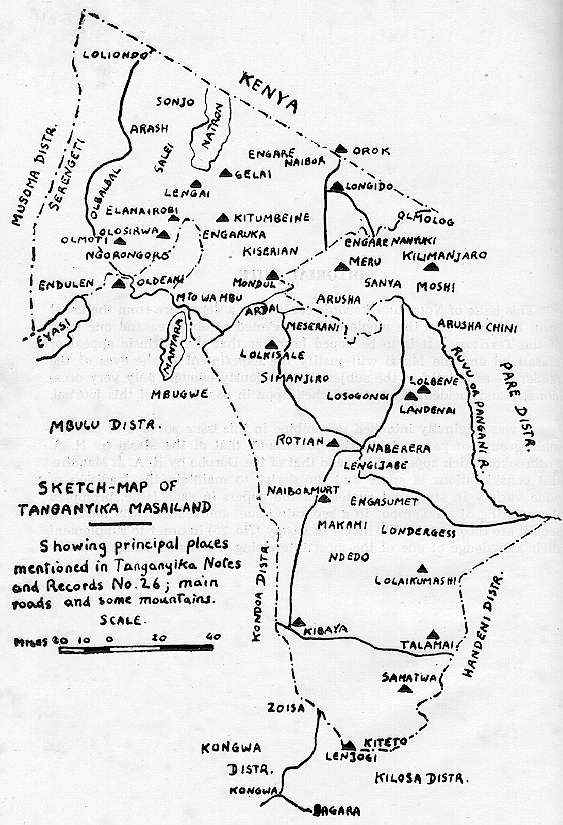
Figure 1 Sketch Map of Tanganyika Masailand
Contents *Table of Figures *PREFACE. *BIBLIOGRAPHY. *SECTION I. – HISTORY. *A. Early History: the Exodus – origin of the Laibonok – southward penetration – consolidation in Tanganyika under Subet – origin of the Lumbwa or Kwavi – limit of expansion – dispossessed tribes – archaeological evidence. *B. Sub-tribes and Sections: Sub-tribes – Sections – Kenya Sections – Sections common to Kenya and Tanganyika – Laitayok, clan or section? – Salei – Serenget – Engaruka – Kissongo – Kiteto – Moibo. *C. Recent History: Famine – civil war – German Policy. *SECTION 11. THE LAIBON *A. History – recent origins – development – the three types of Medicine man – rules of succession. *B. Pre European Functions of the Laibon: Raids and War – Age-grade ceremonies (with certain restrictions) – local ceremonies – tribute – supposed administrative actions. *C. Modern adaptation of the Laibonate – increase in local ceremonies – payment of fees – right to demand girls – extra-tribal contacts - attitude of Masai to Laibon and spiritual matters in general – conclusions. *SECTION III: THE AGE GRADE SYSTEM. *A. Basic importance of the system – an age-grade chart formation of a new age and its ceremonies – endungore – engibata – embolosat. *B. Junior Warriorhood. – circumcision – subdivisions of age – formation of Manyattas – relations between junior and senior warriors – promotion (Unoto). *C. Senior Warriorhood and the passage to elderhood – the Ngeherr ceremony – economic status of Warriors elderhood – the distribution of population between the ages – advantages and disadvantages of the system. *SECTION IV: ‘TRIBAL OFFICIALS. *A The Laigwanan and his Assistants – choice of Laigwanak – visits to the Laibon – installation – unpopularity of office – the head Laigwanan – relations between officials. *B. The duties of Laigwanak – in theory – and in practice – influence in raids and war – position in regard to individual disputes. *C. Other officials – the launon – magico-religious position – his duties – the ol buro engene – the losurutya. *SECTION V. CLAN AND FAMILY MATTERS *A. Clans – the clan chart – ownership of waters – areas peculiar to certain clans – clan responsibility. *B. Family matters – the boma system – the ‘gates’ – polygamy – marriage statistics – number of cattle to each gate – relations in law – travelling – adoption – economic. *CONCLUSION. *
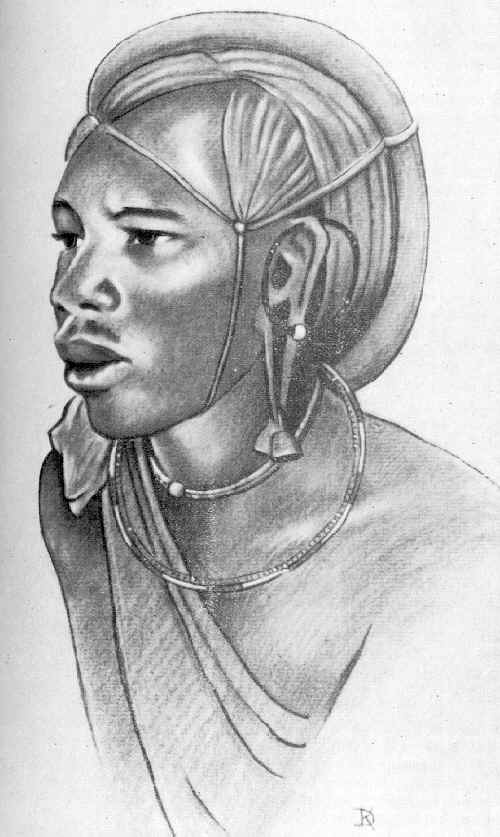
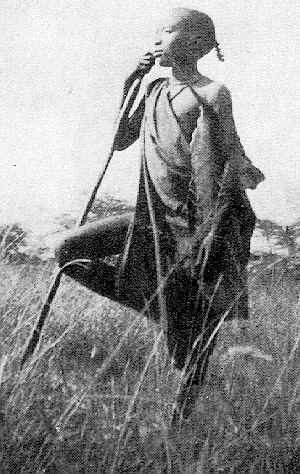
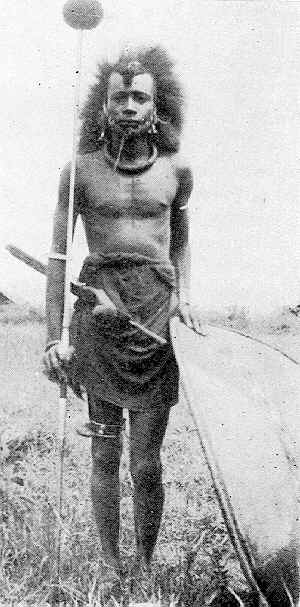
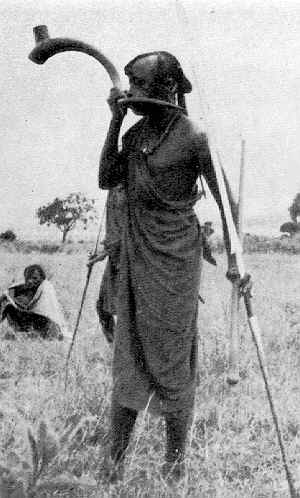
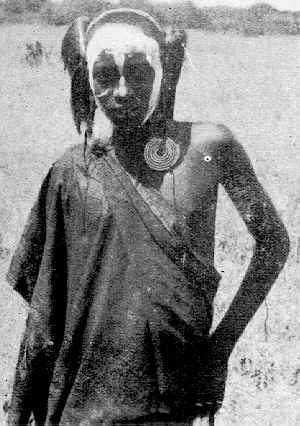
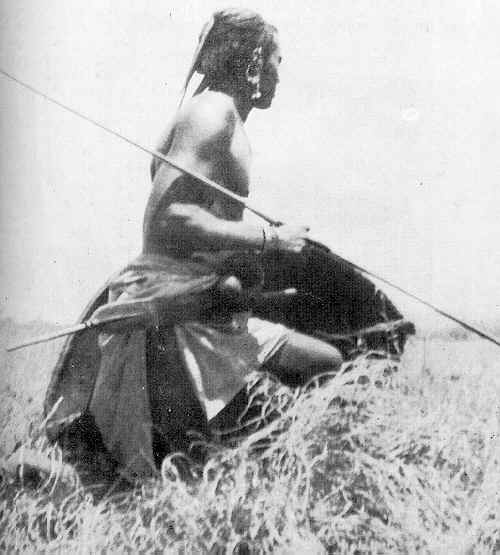
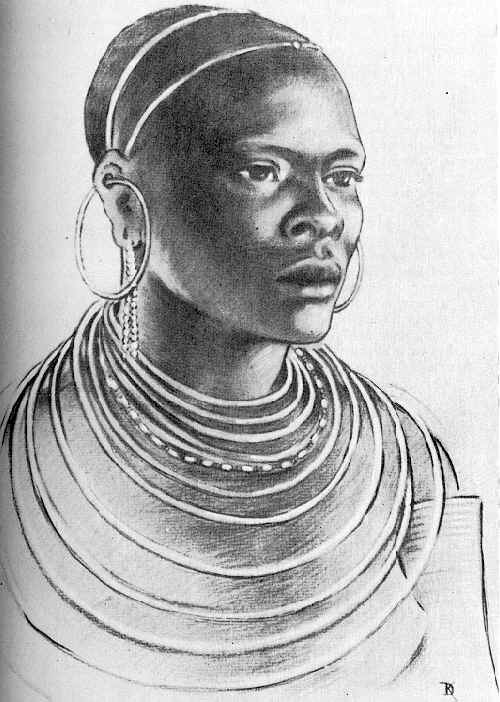
Figure 2 Masai Moran - From a drawing by Dorothy Kingdon. *Figure 3 Genealogy of the Laibon Family *Figure 4 On the Move - An Old Lady Loading Donkey *Figure 5Masai Herd Boy The one-leg stance characteristic of Hamitic peoples. *Figure 6Laibon Mbeiya (17) *Figure 7Warrior in Full Ceremonial Dress wearing lion-killer's headdress with ostrich plumes on spear as a sign of peace. *Figure 8 Warrior in Full Ceremonial Dress wearing lion-killer's headdress with ostrich plumes on spear as a sign of peace. *Figure 9 Senior Moran - blowing Kudu horn. *Figure 10 Newly Circumcised Youth. *Figure 11 Masai Warrior on the Alert. Note the knobkerry and sharp sword in its crimson sheath. *Figure 12 Masai maiden - from a drawing by Dorothy Kingdon. *Figure 13 A Prominent Laigwanan and Two of His Wives, Oltimbau ole Mesiaya of Ngorongoro area. *Figure 14 Laigwanan Oltimbau's 'Boma', Showing grouping of huts and cattle by 'gates'. *The accompanying notes do not presume to give a balanced picture the Masai social system. They were compiled in 1939 when the writer, after 4 years’ service in the Masai District of Tanganyika was seconded to study the political system and to submit proposals on administrative reorganisation. These latter are omitted from the present publication, but the chapters on History, the Laibon, the Age Grade System, the Tribal Officials, and Clan and Family matters are presented in that order and in practically the same form as when originally submitted, and consequently refer to the position as it existed in 1939. This introduction and the conclusion are being written in 1948. By reason of its origins this material has a heavy bias on the political side of the social organisation; the purely social – birth, marriage and death customs – and the socio-economic – the cattle culture, land usage, etc. – leave a large field of interesting material for future study. It is hoped that one result of the publication of these notes will be to stimulate those at present serving in Masailand in whatever capacity, in both Kenya and Tanganyika, to take up these untouched branches of study in addition to correcting, bringing up-to-date and noting local divergences in this and other published material. The Masai are known, by reputation or repute to the majority of those into whose hands the present publication will fall. Here it will suffice to say that they are a race of semi-nomadic pastoralists, of Nilo-Hamitic stock, occupying a large area of country on both sides of the Kenya-Tanganyika border. The census due to take place this month will reveal their true numbers, and perhaps the editor of Notes and Records will be in a position to quote an accurate figure before this appears in print. But the whole tribe probably does not exceed 25,000 adult males or 100,000 persons in all.* It has been frequently pointed out by its critics that the tribe occupied more land and has played a more important part in history than is justified by its numbers, but the same remarks apply to many strong-charactered and virile races. [*The Director of Statistics, E.A. High Commission, has kindly supplied the following preliminary estimate figures of the Census enumeration: Total number of Masai in the Masai districts of Kenya and Tanganyika – 107,309, of which 54,535 are males. – Ed.] To illustrate this paper some of the numerous photographs which I took during my sojourn in Masailand are reproduced, though they have perhaps suffered through time and inadequate storage; in addition those interested will find that the works marked in the bibliography with an asterisk give an adequate pictorial representation of Masai life. And finally 400 feet of 16 mm. cine film, kindly edited and ‘duped’ by the Colonial Film Unit, has been deposited with the Information Officer, Dar-es-Salaam, from whom it may be obtained on loan. Of particular interest are shots of ceremonial dances taken during the Jubilee Celebrations of King George V in 1935, and of water drawing from the deep pre-historic wells of Central Masailand. A word about Masai terms; throughout clarity rather than pedantic accuracy has been the aim. Thus the anglicised "Laibon" has been used for ol Oiboni, "Unoto" for e Unoto, "Laiser" for ‘lAiser, etc., the article has been retained or dropped as the occasion demands. Where the plural forms have become current in local administrative usage, eg. Laigwanak, they have been retained, but in other cases their employment would merely have led to confusion. When anglicised or in common use, these terms have been left in standard print: when italicised the word or phrase is, as far as known, grammatically correct. Finally, it was thought undesirable to burden the report with frequent references and footnotes. A list of the works consulted is appended. Travels, Researches, and Missionary Labours in East Africa. – Rev. Dr. J. Lewis Krapf. London, 1860. * Through Masailand - Joseph Thomson. London, 1885. * New Light on Dark Africa. – Karl Peters. English Edition 1891. * The Masai, their Language and Folklore. – A. C. Hollis. London, 1905. An Administrative and Political History of the Masai Reserve. – G. F. Sandford. London, 1919. Notes on Marriage Customs among the Masai. – D. Storrs-Fox. Journal of the East Africa and Uganda Natural History Society. Nos. 42-45, pp. 183-192. Masai Social Customs. – L. E. Whitehouse. Journal of the East Africa and Uganda Natural History Society, Nos. 47-48, p. 146. The Masai Penal Code. – R. A. Maguire. Journal of the Royal Africa Society, October, 1928, pp. 12-18. Some-Notes on the Masai of Kenya Colony. – L. S. B. Leakey. Journal of the Royal Anthropological Institute, Vol. LX, 1930, pp. 185-209. (A further paper by Mr. Storrs-Fox, published in a subsequent number of the J.R.A.I., amplifies Dr. Leakey’s paper). * A Day in the Life of the Masai. – H. A. Fosbrooke East African Annual, 1935-36, pp. 119 ff. * Masai Place Names. D. J. Fosbrooke. East African Annual, 1945-46, pp. 95 ff. Peasantry or Prosperity. – Colin Maher. East African Problems No. 3. [*Fully illustrated] The Masai are generally regarded as coming from Nilo-Hamitic stock. From the known history of other tribes, and a comparison of various cultures with that of the Masai, it is believed that, some four hundred years ago, the latter were located in the area lying to the north and vest of Lake Rudolph. The Masai themselves carry their history back to a time when they lived in a lowland called Kieru; this cannot be other than the desert region lying between Lake Rudolph and the Kenya Highlands. The following is the story of their exodus from that area. An elder, Maasinda, constructed a ladder or staircase up the scarp, which, till then, had prevented the Masai from moving south; on the plateau beyond he found good grazing and water. He consequently arranged to migrate, and he and his six sons, followed by the Laikipiak and the Kwavi, successfully negotiated the climb with all their cattle and possessions. The remaining Masai, who had previously been instructed o follow in an agreed order, then rushed the ladder, which broke under them. They were thus unable to follow. The scarp is named Endigirr oo Namuga (the scarp of the sandals) and the country at the top Olkeju lol dugha (the river of palms). At his latter place Maasinda met with the Laitayok, the Uasingishu and,Siria Masai, and the Kipsikis (Lumbwa). Maasinda has become the culture hero of the Masai, to whom numerous legends have been attached. In one it is alleged that a woman, Naiterokop, came down from Heaven and bore two sons, Maasinda and ol Meek, this being the origin of the Masai and the Bantu. Maasinda is believed to have ordered the Masai to live at peace with their neighbours and, in the event of war, never to kill women or children. The invention of branding cattle as a means of identification is also attributed to him. His six sons are also alleged to have been the founders of the existing Masai clans, Morungiro being the founder’ of’ the Laiser, Lolkesen of the Mokasen, Lesita of the Mamasita, Lelyan of the- Molelyan, and Lesero of the Tarosero. The name of the founder of the Lughumae is not recorded.
The next event in tribal history is the acquisition by the Masai of the Medicine Man or Laibonok. The legend of the members of the Laiser clan finding a heaven-born child on Ngong Mountain is recorded by Hollis, who also gives a genealogy in which Lenana’s name is the ninth. If thirty years is allowed for each generation (possibly an underestimate, since primogeniture is not the rule of succession), the first laibon must have been found about the year 1640. This agrees with all my informants, who state at this event took place prior to the earliest remembered age-grade, i.e. before the beginning of the eighteenth century. From the fact that the finding of the laibon took place at Ngong, it may be presumed that the period from’ the exodus to this event was one of slow penetration southward through the Kenya Highlands. Contrary to the evidence previously recorded, it appears that the advance guard of the Masai had penetrated as far south as Usagara (Mpwapwa District) and made contact with the Hehe by the beginning the nineteenth century. The story is that when the Merishari were reaching the age of circumcision, two big bomas penetrated into Gogo country to a place called Muli (Masai) or Lodi (Gogo) in search of grass. The leaders of the movement were two uncircumcised youths. One of the bomas subsequently returned north, the other went as far south as Usagara. Laibon Subet sent instructions to this boma to return, but they disobeyed his order so were brought back by force. The descendants of the members of this boma are to-day known as il Muli. The first half of the nineteenth century was a period of consolidation in the area now known as Tanganyika. To nearly every area of the Masai District there is attached a legend of how, and by and from whom it was conquered; examples of these are quoted below. The Lake Manyara area was in the old days inhabited by a pastoral tribe known to the Masai as il Adoru. From descriptions it would appear that this tribe was one of the branches of the Tatog group, possibly the Barabaig. The moran of the Merishari age had a pitched battle on one side of a rain pond or lake, now known as Balbal lol Merishari, and there defeated one half of the Adoru warriors. The remainder stood drawn up on the far side of the lake and urged the Masai to attack. The latter consequently waded into the lake until the water reached their necks, but were unable to cross. They were thus left floundering whilst the balance of the Adoru made good their escape. The Kidotu age was responsible for the capture of the Naberera wells from the Lumbwa or Kwavi. The Lumbwa made their escape whilst each Masai was engaged in pegging out a claim to the captured wells. The Lumbwa laibon, father of the present one, closed the pass to the west of Naberera, Engamata o ndareta, by magical means, which prevented pursuit by the Masai. It is alleged that, to the present day, no Masai will pass the spot where the medicine was placed without throwing a stone on to a cairn which has thus grown up there. A third story also concerns the Lumbwa, this time those of Sanya. Two Lumbwa manyattas, known as Sabuki and Sitet, fled before the onslaught of the earlier Dwati moran, and following down the Ruvu valley, then cut across country and inhabited an area near Kilosa known as Kilena. Here they fought with the local inhabitants; the Sabuki, being beaten, retreated back to Nguu country. The Sitet, however, penetrated southward, where they found a large crater similar to Ngorongoro. They closed the pass by which they had entered the crater with stones and wild fig trees, and there lived at peace till a German was led to the place by a dog. It is as well at this point to examine the origins of these Lumbwa or Kwavi. The Masai regard themselves as having a common origin with the Lumbwa, and consider that only recently have the latter diverged from Masai ways and taken to agriculture. As evidence the Masai cite physical appearance, common language and customs, and historical data. On the other hand, Elliott in the introduction to Hollis talks of the agricultural and pastoral sections and says that "it would be rash to assume that the nomad pastoral state is primitive or very ancient." Hollis states that "the Coast people termed them without discrimination WaMasai or Wa-Kwavi, names which have been perpetuated by Krapf and others". It would appear that this lack of discrimination was due to the fact that at the time when Krapf was writing (circ. 1850) the Masai and Lumbwa were indistinguishable, merely two sub-tribes of a pastoral tribe, indulging in civil war; c.f. Krapf – the two kindred tribes the Wakuafi and the Masai hate each other mortally, which is, however, a fortunate circumstance for the weaker African tribes"; Thomson also regards the Masai and Kwavi as two sections of the same pastoral tribe, and records in detail the ascendancy of the former. As he was writing fifty years ago, when all phases of the civil war were well within living memory, his account may certainly be accepted as correct. Elliot's suggestion that the nomads are offshoots from an agricultural Masai tribe is also discounted by legends recorded since he wrote, notably that of the exodus. The first part of this section, dealing with events occurring prior to those within living memory, may well be closed with a review of the state of affairs circa 1869, a survey of the tribes dispossessed by the Masai, an examination of any evidence throwing light on the era prior to Masai invasion. Subet, who died about 1860, was settled at Lashaine, below the present District Office at Mondul, with Rasharasha as his main water. He was surrounded by members of the Engidong clan at Musa, Engare ol Motonyi and Olgeju Lolera. The Arusha were established on the slopes of Mount Meru, and the Masai effectively occupied an area corresponding closely to their present boundaries. They had suffered a severe famine about 1830, but owing to the warlike efforts of the first Dwati age the country was by this time fully restocked. The Nyangusi, a few of whom are alive to-day (1939), were carrying on border wars with the Nguu, Gogo and Mbulu tribes, and it is doubtful whether Karatu, Talamai or Kiteto were as yet in Masai hands. On the other hand, they at this time possessed areas now lost to them, as for example the country between the east bank of the Ruvu and the Pare Hills, extending as far south as Bwiko; the alienated and reserved areas around Kilimanjaro, Meru and Mondul; and the country between the Naberera-Kibaya road and the Kondoa Hills, now lost to "fly". To the west of, and also immediately below the Rift Wall, the country was probably inhabited by at least three tribes. The il Datwa lol Orokishu (Mbulu?), the il Datwa lol Kuroto (Mbugwe?) and the Sonjo. It seems likely that at any rate some of these tribes practised agriculture under irrigation, but that they possessed cattle also is almost certain. The Manyara area, as shown above, was in possession of the Adoru, a pastoral tribe, whilst the Mondul, Mweandet, Engare Nanyuki and Simanjiro areas were occupied by the Iligolala, again pastoralists, said to have been akin to the Masai Further south, Masai tradition of previous habitation, except by the various tribes of Dorobo, is lacking, owing to the fact that the Lumbwa and not the Masai evicted the previous occupants, if any. It is possible that the Nguu and Burungi tribes extended slightly farther to the north than they do at present, but existing climatic conditions indicate that, at most, these people have lost no more than a few border waters to the Masai. It is impossible here to digress at length into the realms of pure archaeology, with reference to the Olduwai man obsidian flakes, etc., but any evidence which throws light on the type of life that the country supported prior to Masai occupation is of interest in relation to the type of culture which the Masai may be expected to attain. Briefly, then, the evidence shows that immediately below the Rift Wall cultivation under irrigation was practised, and that east of the Rift the country had at one time been inhabited by a tribe fully acquainted with the arts of well-digging and dam-building. These people may have practised agriculture, but there is no evidence to show that they did; their water conservation measures certainly show them as being cattle keepers, since no agricultural community, drawing domestic water only, would sink 50 or 60 wells in one small area, as at Naberera. That a cattle owning community requires such numbers is obvious from the fact that the Masai use nearly every prehistoric well, and have opened many new ones in addition. These same people were possibly responsible for the dams on the south-east flank of Monduli mountain, and perhaps they constructed the irrigation system which the Chagga are alleged to have found on Kilimanjaro. But the people who dug the Naberera, Makami Ndedo, Ngasumet and Londergess wells were most certainly pure pastoralists, and were probably responsible for the construction of the rain ponds in this area. A rain pond, liable to dry up, is obviously as useless to a settled agricultural population, as a group of twenty or thirty wells in a confined area. But to a pastoral people two such sources of water in conjunction enable an otherwise inhospitable country to carry a large cattle population. The only available evidence of settled habitation in the southern area is found near Makami and Londergess. In concentrated areas, one at each of these places, are to be found numerous large kitchen middens, composed of ash and refuse, and containing numerous pot-sherds, bones, and – most important of all – the clay mouths of native bellows, and the clinkers formed when iron ore is smelted. Thus, throughout the whole of Masai District, the only signs of settlement are associated either with agriculture under irrigation, or with metal work. The rest of the evidence points to the fact that the country was inhabited by nomadic pastoralists. For this reason any other mode of living cannot be expected from the Masai unless by the provision of water a radical change is made in the environment. The early history of the tribe has been summarised above; before turning to recent history, i.e. events occurring within living memory, it is necessary to define the subtribes and sections of the Masai, as a record of recent events is mainly a chronicle of civil war and strife between such units. There are certain units, which may be termed sub-tribes, whom the "pure" Masai regard as inferior. By "pure" Masai is meant those who regard themselves as descendants of Maasinda. It is of interest that the word ol Maasinda is frequently used in place of ol Masani as the singular of il Masai. Such socially inferior sub-tribes are the Laikipiak, Siria, Uasingishu, and Kwavi, with the Laitayok as possibly a sub-tribe absorbed by the "pure" Masai. The nineteenth century witnessed the ascendancy of the Masai over the "inferior" sub-tribes, whilst in the fifty years which have elapsed since the Great Famine the rivalries of the sections within the Masai themselves have brought about many changes. By section is meant a territorial unit of the Masai, the members of which regard themselves as owners of their waters and grazing grounds, to the exclusion of other sections. Such a unit is called ol osho, pl. il oshon. Alone or in groups the sections function as units in war, in allegiance to a particular Laibon, and in the performance of certain tribal ceremonies; in general they possess a sense of solidarity which expresses itself in regarding members of other sections to a certain extent as strangers. The list of sections in Hollis, divided into districts and sub-districts, is too exhaustive to be of practical value, and for this reason the "Administrative History of the Masai" is taken as a basis for the following list. Those sections which live entirely in Kenya are: – Siria (a sub-tribe?), il Damat, il Kakonyuke (see Age Grades), L’Odo Kilani, Nguruman (Lumbwa living north of Lake Natron), il Dala Lekutuk and Kaputiei. Of more immediate interest in Tanganyika is the Sighirari, apparently section composed entirely of members of the Engidong clan. The "Administrative History refers to Sighirari of Ngong and of Laitokitok. The area between Kilimanjaro and Meru is also known as Sighirari, and is probably the original home of this section. When their lands were alienated by the Germans they returned to Kenya. The Matapatu are another purely Kenya section of interest to Tanganyika, since it appears that their original grazing grounds included Longido, Kiserian, Engare Naibor, and the numerous small waters to the north thereof. First turned out by the Germans, they again penetrated south at the end of the Wa-, and were again removed by the British, their country being occupied by the Kissongo. Finally the Laitokitok are of particular interest to us, in that they are closely associated with the Kissongo, and acknowledge the Mondul laibon. This section appears to be composed of Laiser, Laitayok and Molelian clansmen; here as in other areas the Laitayok do not fuse with the other clans, but have independent manyattas, perform separate fertility ceremonies, etc. A number of sections are divided by the inter-territorial boundary. Of these the Purku alone have no pre-European claim to inhabit Tanganyika. On their eviction from the Naivasha area a portion of this section moved to the area in the Kenya reserve immediately north of Loliondo. By the end of the War they had penetrated as far south as Ngorongoro, whence they were evicted in 1920. All did not, however, return to Kenya; a number settled in the then unadministered area round Loliondo, where they were found in 1928 by the Sonjo Patrol, and allowed to stay on in terms of the agreement made with the "Kenya Masai." The other two sections included in the terms of this agreement, the Loita and Laitayok, were not in fact Kenya Masai at all. For a division of the Loita, called il Ndasegera, had inhabited the highland area round Loliondo, as far south as Lemunyani, since the Masai took possession of the country. The history of this section is bound up with that of Sendeyo, and is recorded below. Likewise a division of the Laitayok possessed ancestral grazing grounds to the west of the area inhabited by the Loita, which, like those of the latter, were bisected by the inter-territorial boundary. There are numerous other Masai found in many sections who call themselves Laitayok, and it is difficult to decide whether the name applies to a clan or to a section. From the recorded legend (see Early History) it would appear that they were not amongst the Masai who took part in the exodus, and even to-day a certain stigma attaches to them. When inhabiting the country of another section they usually dwell apart, as for example, amongst the Laitokitok or at Engasumet; Ngongongare on south-east Meru mountain is also regarded as a traditional Laitayok area. Frequently the name il Mingana is used to distinguish the Laitayok from the "pure" Masai. The probable explanation of their status is that they do in fact belong to a lower stratum; in some areas they have been absorbed by the section amongst whom they resided, and thus eventually came to be regarded as a clan; in other areas they were sufficiently numerous to enable them to retain their own grazing grounds, and to justify their holding tribal ceremonies of their own. An example of the latter is the Loliondo group, who are rightly regarded as forming a separate section; or again the il Dala Lekutuk is reputed to be a section composed entirely of Laitayok Another section divided by the border is the Salei or Saleh who now inhabit the area immediately west of the Rift, from the Loita to the Ngorongoro Highlands. They are reputed to have been in the past an important and numerous section, with the true Salei living on the Sanjan Plain (known to the Masai as Salei, the Sanjan is a river) and various sub-sections; the il Merik at ol Donyo Gol, il Bokai on the Osopuku lol Datwa, and il Ngorongoro in the place which their name signifies. Apparently they, together with the Serenget, acknowledged Mako, brother of Mbatian, as Laibon. They are recorded in the "Administrative History" as following Sendeyo; their present nominal allegiance to Mondul is probably due to the conscious efforts of the administration to bring all the Loliondo Masai into the Kissongo fold. The Serenget, as their name implies, live on the plains to the west of Ngorongoro, from Lake Eyas to Engare Nanyuki. They were dispersed by famine and Loita invasion between 1890 and 1900, and only reassembled during the post-war period. The strength of their allegiance to Mondul is also very doubtful. The Engaruka are a section who perhaps took their name from having maintained themselves through the famine of 1890 by cultivation at Engaruka in the Rift valley. The main body of the section uses the Engaruka stream in the dry season, but Kavinjiro above the Rift Wall should also be included in their area, as forming their reserve of highland grazing. Many of the section are found on the Sanjan and Lemunyani, having, it is reported, originally been sent there for veterinary reasons. The majority of the Masai of Tanganyika regard themselves as Kissongo but Kissongo is a very difficult term to define, for it is neither a sub-tribe, nor yet, strictly speaking, a section. The nearest definition is probably "that group of sections which follows the Mondul laibon". But there are numerous border line cases, such as those sections defined above whose allegiance to Mondul is doubtful. The Kissongo proper divide themselves into two groups, the Kiteto and the Moibo. Each of these groups may be regarded as a section, since they exhibit a certain jealousy one to the other, as was shown by a dispute as to whether Lengijabe should belong to Naberera (Moibo) or to Makami (Kiteto); such feeling is not shown between, say, the Longido and Mondul people. The Kiteto section comprises those who inhabit Kiteto, Talamai, Kibaya, Makami and Simanjiro. Those Masai now resident in the Central Province, (for the most part with the inception of the (Groundnut Scheme they have been returned to Masailand – Ed.) also belong to this section and take part with their brethren on this side of the border in those tribal matters concerning which the Kiteto section functions as a unit. The Moibo section is an unwieldy unit now in the process of subdivision. It takes its name from the Ruvu (Pangani) river, where the section claims to have originated. When for various reasons the Mondul, Longido and Ngorongoro areas became practically vacant, the Moibo proceeded to occupy them, frequently intermingling with the remnants-of the original inhabitants. That new sections are in the process of formation amongst the Moibo and the remnants they have absorbed is shown by the organisation of the Kisale age, (see Age Grade section). Longido, Naberera or Mondul may soon be as jealous of their individuality as are the Laitokitok, Salei and Engaruka. That a section is in the first place a fortuitous grouping of individuals may be shown by an analysis of the Longido and Engare Naibor areas, which were made free for settlement by the eviction of the Matapatu. Sectional origins of the Population of Longido and Engare Naibor.
The Mweandet are the remnants of a scattered section who originally inhabited Musa, Mweandet and Kisimere, areas now included in the Arusha District. Longoswa is a name for the area round the Engare ol Motonyi furrow. Those who came from Ngongongare are the remains of the Laitayok who lost their land to alienation. The remaining names on the table have already been defined. The members of this heterogeneous group are, insofar as the more junior ages are concerned, beginning to regard themselves as a unit. Ngorongoro is another area where similar conditions pertain. C. Recent History: Famine – civil war – German Policy. Again taking up the thread of history, the period 1860 to 1890 is regarded by the Masai as one of prosperity. Mbatian was the laibon at this time; it was he who called up the Moibo Masai to fight the Uasingishu and Laikipiak sub-tribes. But the period was mainly occupied with wars and raids against neighbouring tribes: the devastating effects of such raids, as noted by early explorers, are graphically illustrated by extracts from their writings reproduced in the "Administrative History ". But about 1890 the Masai were visited by the triple misfortune of famine, smallpox and rinderpest. Whole families, together with their stock, were wiped out. In some cases the survivors lived by hunting or agriculture; in others they were adopted into, or carried off into captivity by, neighbouring tribes. The tribe was in fact scattered from Lake Victoria to the Coast. But such was the urge to the nomadic pastoral life that, in the course of the next few years, most of the wanderers returned, and from their earnings or stealings commenced to build up new herds. During the famine Mbatian died, and the tribe was divided by civil war. For two of Mbatian’s sons, Lenana and Sendeyo, were rivals for the position of laibon. The former had a following of Purku and other sections, the latter was backed up by the Loita. After various skirmishes round Nairobi, Sendeyo turned south, and his Loita beat in turn the Laitayok, Salei and Serenget of the Loliondo area, thus finishing up at Ngorongoro. From there they descended to Kissongo, some of the Loita spreading to Longido and Olmolog. At one time Sendeyo himself lived at Lossogonoi, but later returned to Ngorongoro. When below the Rift he had numerous skirmishes with the Germans, and also with the Kissongo, supported by the Purku. His final defeat was brought about by a clever flanking movement; the Kissongo, by this time recovering from the effects of the famine, approached Lenana, who agreed to send his Purku from the north, via Loliondo, whilst the Kissongo attacked from the east. Thus both parties would converge on Sendeyo at Ngorongoro. When Sendeyo heard of this, he saw that the struggle was hopeless and fled by night to Lenana to admit defeat. Lenana allowed him to return as laibon to the Loita section. An important feature of recent history is the policy which the German Government pursued in relation to the Masai. When they first made contact with the tribe, the Masai of Tanganyika, being scattered by the famine, must have been very few in number. The area south of the Moshi – Arusha – Mbugwe road was therefore thought sufficient as a Masai Reserve, and the objective was to keep Mondul, Longido, Ngorongoro and Loliondo areas free for alienation. This meant that the Laitayok and Ndasegera Loita of Loliondo, the Salei and Serenget west of the Rift, the Mweandet of north Meru and Mondul, the Sighirari of Sanya and the Matapatu of Longido, were all-debarred from their grazing grounds. During the war, when this policy was relaxed, the various sections began to reassemble and return, each to its own area. But the Moibo section seems to have flourished above all others and penetrated, during and after the war, into areas which had never before been in its possession. The details of this period of famine, civil war and European intervention have not been recorded at length, but it is hoped that sufficient has been said to drive home the point that the period 1890 to 1920 was one of great upheaval for the Tanganyika Masai. The most obvious effect of this was the break-up and submergence of many of the sections, together with the loss of the loyalties which hold those sections together and generally of political cohesion. Only time can bring about a reorientation in accordance with the present distribution of population. Another aspect of the above historical review should also be borne mind. It is almost impossible to find at the present day an elder who did not go through considerable hardship in his youth. To anyone who has lost and regained a possession, such possession is of greater value, at least sentimentally. The Masai of Tanganyika lost their cattle, their mode of living and their tribal life, and largely by their own efforts have once again regained them. It is suggested that their intense conservatism and resentment of change may perhaps be better understood in the light the foregoing For clarity this historical section is concluded with a chronological chart showing the main events and personalities referred to. CHRONOLOGICAL CHART.
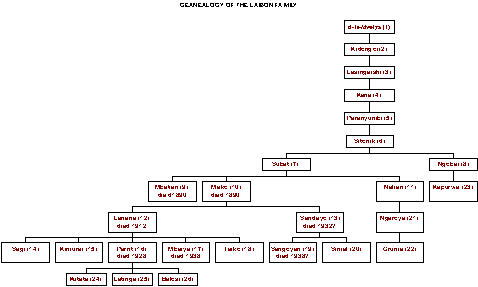
Figure 3 Genealogy of the Laibon Family
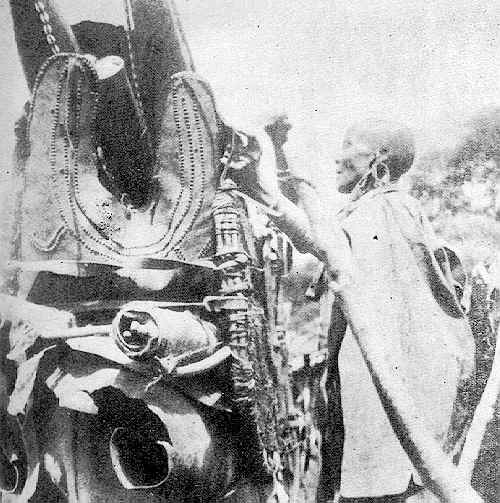
Figure 4 On the Move - An Old Lady Loading Donkey
Figure 5 Masai
Herd Boy NOTE. – Numbers following names refer to Genealogical Chart. The aim of this section is to record the functions of the laibon, or i Medicine Man, and the Masai attitude to him and his work, to study the character of recent laibonok, and the adaptations they have ! under modern conditions, and from an analysis of these factors to der what place the laibon should take in tribal government. One is apt to lose the main thread of such a thesis in a mass of detail, and his reason many incidents will be omitted when they only confirm has already been illustrated by example. Facts which are known n counter to the general argument are, however, recorded. A. History – recent origins – development – the three types of Medicine man – rules of succession. The Masai legend of the origin of the laibon is recorded by Hollis. Briefly, a youth, ol-le-Mweiya by name, was found sitting on the top of Ngong Mountain, was adopted by the Laiser clan, and proved himself a great medicine man. This occurred about ten generations ago. The only difference between this legend and the one generally current in Kissongo is that Kidongoi (2), shown as the son of the original laibon in the Hollis genealogy, is regarded by most elders as the first laibon. One interesting fact arises from the legend, namely that the Masai had penetrated as far as Ngong before they adopted a laibon, thus their original move and occupation of the Kenya Highlands must have been made without the supernatural guidance which the laibon alone can provide. On evidence which need not be recorded here, it seems certain that the Masai, whose age grade custom so closely approaches that of the Galla were possessed of their present military organisation prior to leaving their original home. Thus it appears that the laibon is a later adaptation imposed on a self-sufficient organisation of government through age-grades. Probably much of the confusion of function which exists today, the indefinite division of governmental authority between the laibon and the age-set leaders, is due to the adoption of an institution incompatible with the original culture. It would be wrong to regard the institution as being foreign to Masai nature, but it is probably true that it is a feature which had not found its true level in the tribal structure when European influence intervened. Assuming that the institution is but recently acquired, its development can be deduced from similar occurrences to-day. For there are. generally speaking, three types of laibon to be found at present. First, there is the private practitioner who, for suitable remuneration, will perform such services as curing sickness, removing barrenness and insuring fidelity in wives. He is only consulted by individual patients. The next stage is when a private practitioner has acquired such a reputation that he is consulted by a deputation on behalf of a group of Masai, and provides charms and lays down a ceremonial to be utilised to the advantage of whole group. Such practices are alleged to be efficacious for the above-mentioned complaints, and may also prove useful in procuring success in war, adequate rainfall, or immunity from disease, both human and bovine. Such a laibon of course retains his private practice. The final stage is when a laibon is invited to superintend and bless ceremonial affecting the whole tribe, such as circumcision, promotion of warriors, standing down, etc. Such a one retains the duties of the two previous stages, and is in fact the Chief Medicine Man of the section or tribe. This is the status which the term laibon popularly connotes, and is the sense in which the word is used throughout this paper, otherwise indicated. It is very possible that the office of laibon developed by progression through the three stages outlined above. It may further be assumed that the process took two or three generations to complete, before the laibon was fully installed in a position of power. For this reason the immediately pre-European conception of the office was not as old as the genealogy would at first indicate. It is possible to quote examples of practising laibonok, representing each of the three types of medicine man. Any number of the Engidong clan is credited with a certain amount of supernatural power. Not all exercise their gifts, but as an example of one who did, Kakenya, murdered at Longido in 1939, may be quoted. In addition to the Engidong clan, however, numerous aliens, particularly Kikuyu, often build up reputations as private practitioners. Of the second type, those who cater for various groups, the example of Oruma (22) springs to mind: He probably exercised "group" functions in the supply of charms for cattle raiding, but was brought to book when he tried to usurp the privileges of the elders in the matters of tribal ceremonial. Taiko (18) was doubtless another member of this class, supplying raiding medicine to the moran of the Longido area. Both these people are of the Engidong clan, but as an example of one who is not, one can quote ole Shongo, of the Ngorongoro Highland area. He is a Kikuyu, and his activities are not fully understood. He was believed responsible for a series of raids in 1933, and has still got a reputation, known beyond the bounds of his particular area, as a powerful laibon. The third type, the acknowledged laibon of the tribe or group of sections, must always be a member of the Engidong clan. One frequently hears that in olden times all the Masai acknowledged one laibon, but Mbatian (9) had a fellow practitioner, if not a rival, in his brother Mako (10), and it is more than probable that many other figures, important competitors to the known holders of office, have been lost in the mists of antiquity. The phrase "all Masai acknowledged one laibon" requires also a further qualification, as the rival sub-tribes, Uasingishu, Kwavi, etc., had their own medicine men. The office is hereditary, insofar as the holders must be members of the Engidong clan, and preferably close relations of the deceased laibon. More distant relatives confine themselves to activities of the two inferior laibon types. There are. however, no definite rules of succession, the choice resting on the general consent of the tribe. He whom the previous laibon had held in greatest esteem, and trained and nominated for the office, would normally be chosen. The past reputation of the candidate would, however, be a matter for consideration; if someone, other than the deceased’s choice; had proved himself extremely powerful, it is possible at he would be chosen, for fear of the consequences were he overlooked. The maxim of English law, that none should benefit by his crime, is also applied. For the death of a laibon is as a matter of course attributed to witchcraft by a fellow Engidong, and the first step in choosing a new laibon is to ascertain who killed the old; such person is automatically barred from succession. It has been represented that the above theory of late development of the institution stands or falls on a Masai legend. The answer to that is that very few legends are found without some foundation of fact, and secondly that there are many indications that it is a feature not fully assimilated by the Masai organisation.
Immediately prior to his death in 1890 Mbatian was living at Namanga, but had previously lived, as had his father Subet (8), at Lashaine Hill, immediately below the Mondul District Office. He was nominally the official laibon for the whole of the tribe, though his brother Mako lived and practised as a laibon at Engutoto lol Mako, in Ngorongoro Crater. It is also significant that Thomson refers to "the important Lybons (medicine men) Lengobe, Mbaration, and Lembarsacout," without singling out Mbatian as the leader. If he in fact occupied the position, bordering on chieftainship, that many Masai elders would have us believe, it is improbable that even an early traveller would fail to note and comment on it. There can be little doubt that at this time a laibon’s chief functions were: i. Dispensing charms for raids. It is probable that any acts which he performed in the executive sphere arose from these three main duties, which must now be examined more fully.
In the matter of providing charms for raids, it should be noted that raids are divided by the Masai into two types, major (ol orora), and minor (ol wamba). Both these names also signify a group of moran fitted out for war, the former larger than the latter. A third term, which might well be recorded here is o remore, signifying a fight with spears, more particularly the deliberate killing of an alien for the purpose of acquiring a reputation. Prior to a major raid, but not before a minor expedition, a visit would be paid by the participants to the laibon, who would give charms to ensure success. No payment was made at the time, but a portion of the captured stock was taken to the laibon on return. It was thus to his material advantage, as well as to that of his reputation, that the raid should be successful; it is consequently only natural that he should pass on any bits of intelligence brought in by previous visitors, and any hints which experience had taught him, to reinforce the efficacy of his charms. Thus a proportion of the spoils, lifted by a combined force of Kissongo Dwati and Dareto from the Lumbwa living beyond Kiteto, about 1916, were taken to Laibon Parrit (16), later gazetted Chief of the Tanganyika Masai, but at that time resident in Kenya. The initiative of suggesting such raids seems to have rested with the moran, though the modern technique of an upstart laibon saying "There are plenty of cattle in such-and-such an area, I can’t understand why you fellows don’t go and take some", was doubtless used in the old days to encourage slovenly sections to action. Minor raids, from all accounts, were organised locally and carried out without reference to the laibon, to whom none of the captured cattle were presented. The difference between a major and a minor raid appears to have lain not only in the numbers of Masai involved, but also in the strength and reputation of the proposed enemy.
In the matter of civil war the laibon’s position was rather different, as his own position was at stake. In contrast to the usual "We went and raided such-and-such a tribe", Laimer informants frequently refer to the time "when Mbatian called us up to fight the Laikipiak". In the struggle which followed the death of Mbatian, it is obvious that Lenana and Sendeyo were encouraging war for the purpose of furthering their own personal ambitions. The second main function of the laibon is that of supervising and blessing the age grade ceremonies. It is probable that a laibon at least gives charms, if he does not attend in person the Embolosat ceremony, the commencing ceremony of the age, held by the Kakonyuke section on behalf of the whole tribe. It is certain that he does so both at the Unoto and Ngeherr ceremonies, that is at the promotion and passing out of the warriors. But he is not responsible for the organisation of such matters, nor is it on his initiative that new ages commence or old ones stand down. As this is a matter of prime importance in determining his true position, it deserves full attention. The closing of the present Merisho age was agreed to at an Ol Kiama (or General Meeting) of the tribe in 1937, and not done at the dictation of the laibon. The il Piron elders, i.e. those of the reciprocating age–set next but one above the warrior set – are alone responsible for the initiation, promotion and standing down of the moran. An interesting case occurred in February 1939, after the Endungore, or closing, of the present age, when a Dwati elder at Naibor Murt decided to circumcise his two sons, and brewed beer in preparation for the event. The local Dareto, hearing of this, determined to stop him, marched into his boma, and drank the beer themselves. It is confirmed by numerous reliable elders, that, even if the laibon had given his sanction for the circumcision, the Dareto elders would have been justified in acting as they did. On a safari in June, 1938, laibon Mbeiya laid down a ceremonial for closing the age. It consisted of taking a small bird (dead) and breaking its legs and putting out its eyes. Whitehouse records a similar ritual in the same connection. On further enquiry it appears that this procedure is merely a curse which may be laid on any elder who is determined to circumcise his son during the "closed season" in defiance of warnings. It is generally considered improbable that such a ceremony will actually be performed. The point of recording this case is to illustrate that the laibon’s part in this matter is merely to reinforce by magical means a decision that had already been taken by the elders. It is also of interest to note that Mbeiya was passing off as original a curse which had been used in Kenya for years. Although the supervision of the age grade ceremonies has been recorded as an important function of the laibon, this activity is subject to curious restrictions, the principle of which I have been unable to ascertain. The facts, however, show that the laibon of one section may perform the ceremony for another, or alternatively the assistance of an "unofficial" laibon may be sought; for instance the Ngeherr or passing out ceremony of the Dareto age-set of the Kissongo section was nominally held under Parrit, and the Unoto or promotion ceremony of the Kisale age under Mbeiya, who were respectively the ruling Laibon at the material times. But in fact an old Kikuyu adoptee of the Engidong clan, one Lolkokwa ole Kashungu (now deceased), was called in to assist in both these ceremonies. By agreement the Mondul laibon received the fees in respect of these ceremonies from the Naberera and Kibaya areas, whilst those contributed by the Mondul and Longido Masai went to Lolkokwa at Bisil, Kenya Colony. In another case, Sangoyan, laibon of the Loita section, performed the Unoto or promotion of the Kisale age for the Matapatu and Lodokilani sections, which are nominally under Kimuruai (15). All that can be said, therefore, in our present state of knowledge, is that the ‘official’ laibon to the section does not necessarily play the leading part in the age grade ceremonies of that section. In the choice of Laigwanak or Spokesmen of the Age-grades, Whitehouse records "The medicine man always accepts the spokesman presented to him," a statement for which there is ample confirmation throughout Kissongo. Hollis, it is true, states "If the chief medicine man approves of the selection, a cloth is made for the new chief….", but this is with reference to the launon who is a chief of ceremonies only, and certainly does not apply to the Laigwanak or Spokesmen. It is also noteworthy that the il Piron elders keep in very close touch with the laibon, from the time they take charge of the new age, until their charges stand down. Most of the Laigwanak of the Kisale or Senior Warrior Age of to-day state that they were first taken to Laibon Parrit when he was still resident in Kenya, i.e. prior to 1923: they were of course only boys at the time. The laigwanan of Lossogonoi for instance states that he went eleven times to Parrit before circumcision, numerous times after initiation, when Parrit was resident at Mondul, and six times to laibon Mbeiya. One cannot regard the figures as accurate, but at least they show that the laibon is in close touch with the developing moran and their guardians. It has been recorded above that the third main function of a laibon is to lay down the ritual and to provide charms for local ceremonies, concerned with fertility and disease (both human and bovine) and with rainfall. Whitehouse’s description of visits to the laibon for this purpose is of interest. "Obtaining charms from a medicine man is not a matter to be undertaken lightly. Those who accompany the spokesman are always people of proved intelligence and good memory. Charms are always given with much complicated directions as to their use. If any one of the instructions are overlooked the charm may be rendered useless or may even work evil against its users. The Masai sometimes find that their purchases do not have the effect they desire and report the matter to the medicine man; the latter never fails to point out where an error in the method of its use occurred – and probably effects another sale! Sometimes circumstances prevent the immediate use of medicines obtained, a drought for instance may make it impossible to collect people for the ceremony; or perhaps the objects of its use may be forgotten. If this happens the medicine is conveniently mislaid or is thrown away, but if so a report must be made to the medicine man, for he will have seen what has happened to his medicine and will be angry if its fate is concealed from him." Most of these points are confirmed by Kissongo informants. The organisation of deputations to the laibon is one of the principal duties of the laigwanak. I have heard it explained of various elders – "he always goes on ilamal as he has a good memory." The "complicated directions" usually involve the building of a boma, to which all the participants temporarily remove; the duration of their stay is laid down by the laibon. The charms given may be applied in numberless ways; they may be eaten or drunk, sprinkled or smeared over the bodies of those concerned. They may be mixed with decoctions of tree roots, with the fat of the sacrificial beast, or even with the liquor animi if the slaughtered beast is pregnant This slaughtering of a beast is the most usual ceremonial, its species, sex, colour and condition being laid down by the laibon. Examples of such types are – black bullock, black and white heifer in-calf, brown ram, pregnant ewe, etc., etc. The skin of the beast is usually cut up and divided amongst the participants. Such pieces of skin are termed il keretin, (sing. ol kereti) and may be worn on the finger, (a particular finger being named by the laibon) hung round the neck, or suspended over the door or bed in the house. Other variants concern the situation of the boma, or the phase of the moon, so altogether there are an infinite variety of ceremonies which may be ordered. One is frequently told by elders that in the old days the laibon concerned himself primarily with the moran, giving them war charms, supervising their ceremonies, etc., his payment consisting of a share in the spoils of war. After the Unoto or promotion ceremony it appears that a special raid was undertaken, called enoondorosi, a portion of the produce of this doubtless being handed to the laibon. I should think, however, that the custom of collecting cattle by general levy on the Age, at some time after the ngeherr or "passing-out" ceremony, is old established. When such cattle are presented to the laibon, it appears customary for him to decree a ceremony, and to supply charms for it free of charge. This, according to some elders, was the last official connection between the laibon and the age as a whole, except of course his natural association with the il piron elders concerning the initiation of a new age. Other dealings with him by the elders were in the nature of private practice. Before concluding the reconstruction of a laibon’s functions in the old days, reference may be made to certain administrative actions alleged to have been taken by certain past Laibonok. For instance Subet (7) is alleged to have recalled a section of the Masai who had penetrated far into Gogo country (see Sec. I), and when they refused to obey him, sent body of moran to compel them to return. Again he is credited with transplanting some families of an agricultural tribe, il Kikoin, from Arusha Chini to the slopes of Mount Meru, to grow his tobacco, and to dig water furrows, notably the Engare ol Motonyi and the Engare Nanyuki; these agriculturalists subsequently developed into the Arusha tribe. Mbatian (9), apart from his civil war activities, took such "administrative action" as telling the Masai not to move at the time of the famine – in fact imposing a quarantine – and ordering the tribe not to resist the Europeans. But it frequently happens that past events become linked with the names of important personages of the time, when in fact there was no connection between the two. This may have occurred at least in the case of those actions recorded above attributed to Subet. But even if this is not so, the few instances of executive acts undertaken by the laibon in the past are insufficient evidence on which to base any theory that the institution of the laibon at any time approached the status of chieftainship amongst the Masai. The picture of a pre-European laibon may therefore be reconstructed as follows:- He was primarily the medicine man of the moran, both in respect of war charms and of supervising and blessing their promotion ceremonies. As junior elders, the Masai still maintained contact with the laibon (paying ngeherr fees) and as il piron elders visited him on behalf of the new age. But except as private patients the elders seem to have done less business with the laibon than they do today. Administrative executive or judicial functions were not part of a laibon’s duties, though he could exert a certain amount of control by judicious advice. He was in no sense a paramount chief.
Figure 9 Senior Moran - blowing Kudu horn. C. Modern adaptation of the Laibonate – increase in local ceremonies – payment of fees – right to demand girls – extra-tribal contacts - attitude of Masai to Laibon and spiritual matters in general – conclusions.The main factor altering the position of the laibon is the enforced prohibition of cattle raiding. As pointed out above, the supply of charms for cattle raiding was one of the Laibon s chief functions. The first effect of this change was to reduce the laibon’s status, in addition to cutting off his main source of income. Some continued to draw glory and dividends by continuing the practice in secret, others, more loyal to the new order, sought for something to replace this loss. It is difficult to assess which motive was uppermost, love of power or greed for cattle, but whichever it was, the reaction was the same. It consisted of an intensification of another of their main functions, viz. providing charms for, and prescribing the ritual for, local ceremonies. This is thought to have been less important in the old days, but it is now the laibon’s chief function and principal source of income, and as such merits attention. The nature of the ceremonies has already been briefly described and with regard to their frequency, it is improbable that a year passes without some ceremony or other taking place in every area of the district. An aspect not yet touched upon is that of the method of collecting the fees paid to the Laibon. In respect of the cattle paid for the age grade ceremonies their number seems to be laid down either by custom or by the laibon himself, (I am not sure which). They are collected by general agreement from the members of the age concerned, after long discussion. A point of interest is that members of the Engidong clan are not expected to contribute, but may add a "present" of their own, e.g. in one instance encountered, in the proportion of 8 Engidong cattle to 40 from other clans. But what is very striking about these levies is that the Masai in general are seldom sure for what they are paying. When inquiring about a known mob of cattle, one may be told that they are the fees being paid by the Dwati age in respect of their Ngeherr ceremony, or by others that they represent payment by the Dareto age in respect of their Unoto, or promotion. One can only conclude that the general public do not really know for what they are paying; they have been told to contribute cattle, and do so without further enquiry.
Figure 10 Newly Circumcised Youth. In the matter of local ceremonies the situation is different. The idea of holding such a ceremony frequently arises from an old man having a run of bad luck – his cattle or children dying, or his wives not giving birth. He calls a number of his neighbours together, they discuss the situation and decide that a visit to the laibon is indicated – thus the movement starts. Other local ceremonies may be sought when the area in general is affected by drought or disease, or again the laibon himself may remind an area that he has not heard from them for some time. This may be done, for example, in the following manner: when the laibon is throwing the bones or is in a trance deciding some matter for a Naberera deputation, he will suddenly switch round and say, "I see the Moibo people are in for a bad time." That is sufficient to ensure that a deputation from Moibo will visit him without delay. Apart from specific payments for age grade matters, and the ceremonies obtained thereby, all the elders of an area are supposed to benefit from performance of these local ceremonies, and consequently are expected pay. It is an accepted practice that the Dalala age should not give cattle to be taken to the laibon, but are expected to provide hospitality for the meeting which is called to decide who shall contribute. At the meeting proceedings may begin by a man being denounced for refusing hospitality to an age-mate, and so in effect fined. Otherwise the matter is one for general discussion, X pointing out that he gave a beast last time, Y drawing attention to the fact that Z has not helped for many years and so on. These details have been included under the heading "Modern Adaptations," since one is so frequently assured that in the old days no such levies were made. It is asserted that the only occasions on which boma to boma levies were made was when a party of moran returned from raid empty-handed, and were so ashamed that they collected beasts from amongst themselves to take to the laibon. Another demand which a laibon makes on his followers is that he should be provided with wives. Some elders say that this is an age-old institution, others that it is a recent innovation. Be this as it may, motor transport is an innovation, and by getting round the country more, the laibon sees a greater number of suitable women, and consequently increases his demands. Parrit (15) is credited with collecting five girls as a result of the safari he went round South Masailand when the boundary was demarcated: the Dwati paid the dowry and arranged the weddings. Mbeiya (17), on a safari to Kibaya in 1937, demanded and was giver, the daughter of Lemauna, although she was engaged to another; Kapurwa (23) paid one beast towards the dowry and contributed the ram-skins for the wedding garment. When the girl was brought to Mondul, a number of milch cows were presented to form the nucleus of her herd. On the same trip, Mbeiya demanded and was given one girl from Simanjiro and another from Lossogonoi. Taiko (18) is also alleged to have tried his hand at the same game, demanding the daughter of an old man at Sanya; the father asserted that it was just an ordinary marriage, but local Masai opinion thought otherwise. For when a girl is married to a laibon, she is regarded as lost to her family and clan. The usual relationship which marriage sets up between in-laws does not exist; one cannot approach a laibon for assistance as one can an ordinary son-in-law, nor can one expect a laibon to let either one’s daughter or her children go home on protracted visits. The introduction of Pax Britannia and of motor transport makes contact between the Masai medicine men and alien witch doctors much more possible. There always seems to have been a close association between the Kikuyu and the Engidong clan, so much so that we may reasonably suspect that the heaven-sent child ol-le-Mweiya was merely a Kikuyu impostor. But if, as one gathers, the Masai and Kikuyu were frequently fighting, contact must have been limited. But that is not the case today. When Mbeiya’s boma was infected with measles in 1935 he hired a lorry and himself travelled to Nairobi and beyond, bringing back a Kikuyu medicine man to cleanse his boma for him. Kutata (24) is reputed to have obtained a charm to kill Mbeiya from a Sukuma witch doctor in Pare, and Letinga (25) and Balosi (26) hired a car to go and interview this doctor, in order to verify the rumour and/or to obtain charms stronger than those given to Kutata. The cult of the laibon must therefore have much in common with the beliefs and practices of neighbouring tribes, and I put it forward as a possibility that, with further contacts, the institution may eventually end up merely as an instrument of common witchcraft. In the absence of rational scientific explanations for the many natural phenomena which surround them, – drought and .disease, fecundity and sterility, birth and death, – it is natural that the Masai, in common with all other primitive peoples, should regard the unseen with deep fear and awe, and grasp at any opportunity offered which purports to control these mysterious factors in their lives. They believe the laibon to be capable of controlling these unseen forces; he is the intermediary between themselves and the supernatural. His blessing will assure prosperity, his charms and rituals can alleviate an existing calamity, and his power of foretelling the future enables steps to be taken to ward off an impending catastrophe. It is extremely difficult to ascertain the strength of these beliefs amongst individual Masai, but it is considered that the majority of the Kissongo hold them implicitly. Some areas, eg. Kibaya, have a reputation for consulting the laibon more frequently than others, but none the less the beliefs are general. The practice of the ritual may fall into temporary abeyance in certain areas, but the belief remains, and manifests itself in outward form on the advent of a drought or of a personal reminder from the laibon. Modern contacts have as yet done little to shake these beliefs. A few Christian Masai are completely sceptical; others may have their doubts, but when the occasion arises feel that they had better do what they are told, " to be on the safe side". One of the chief factors which guarantees the maintenance of these beliefs is the age grade system. From early adolescence the future leaders of the tribe, the laigwanak and ingobir, are frequently taken to the laibon by their guardians, the il piron elders. The lengthy discussions beforehand, the actual journey, the reverential attitude of the elders to the laibon, the ritual, the mysterious voice in the darkened hut foretelling the future, all these must make a deep impression on the youths. This in turn is spread to the rest of their age-mates when they return home and perform the ordained ceremony. There seems little doubt therefore that so long as the age-grade system is maintained in its present form these beliefs, and the consequent power they give the laibon, will be perpetuated. True, as education progresses, this power will decrease, but disbelief will dissociate a youth from his age-mates, and consequently his influence on others will be small; on the other hand those brought up in awe of the laibon are in a position to influence large numbers of their fellows. For this reason it is probable that these beliefs will be held for many years to come, although their intensity and their outward manifestations may decrease, as in fact they appear to be doing in Kenya today. The time has now come to summarise this section and to draw our conclusions. In doing so it will be necessary to differentiate between the Masai attitude to the laibon, and the laibon’s attitude to the Masai. The Masai do not regard, nor have they ever in the past regarded the laibon as a chief or lawgiver. They regard him as an intermediary between themselves and the unseen, and in consequence hold him in great respect and awe. Any order that he cared to give, suitably disguised as a prophecy, would therefore be obeyed; the laibon is thus a great potential political leader. But here the attitude of the laibon to the Masai comes in. It may be that in the past a laibon has felt responsibility for the welfare of the tribe, but there are very few instances of this taking practical form. At the present time one can only judge the attitude of the laibon to the Masai on facts, and these reveal that he thinks only of himself and not of the tribe. With the possible exception of Lenana, no laibon has made any effort to assist the tribe to adapt themselves to modern conditions. Rather the reverse; for their own personal profit they have made themselves the focus of the tribe’s intense conservatism. When cut off from one source of income (a share of raided stock), they have used their powers to develop an alternative (extended sale of charms). AGE GRADE SYSTEM.
SECTION III: THE AGE GRADE SYSTEM. The importance of the age grade system to the Masai social organisation cannot be over-estimated. It regulates a man’s conduct in relation his fellow men; it is the basis of such political organisation as the tribe possesses: together with clan and kinship it regulates a man’s sexual life; organised religion certain economic activities, and above all military organisation are dependent on the age grade system for their existence. In this chapter it is necessary to describe the system and thereafter to examine it in relation to the above-mentioned activities; this presentation has the unfortunate effect of appearing to divide up its manifestations 3 water-tight compartments. So it must be stressed at the commencement and borne in mind throughout that there is hardly a phase of male activity which is not subordinate to, regulated by, or interlocked with ! age grades. It, is not proposed to give full particulars of every ceremony: in some cases these are not known, in others they have been recorded elsewhere. Sufficient detail however must be included to emphasise the theme of this chapter, that the system is all-embracing and that in its various aspects it absorbs a considerable amount of the energies of those participating and is a constant theme of thought and conversation throughout the tribe. A brief outline of the system will enable the ceremonies hereafter mentioned to be appreciated at their true value. The accompanying chart, dealing with two generations (olaje: plural. ilajijik) A. and B. each composed of two ages (ol poror: plural. il poror) w x, y, and z, will, it is hoped, make the overlapping clear. Disregarding their relationship with the previous generation, age w is circumcised over period of four years. Being the first age in the generation they are called emurata tatene, the right hand circumcision, but they are none e less junior warriors, i.e. junior to those of the previous generation. After about 7 years they are promoted to senior warriorhood in a ceremony :called eunoto. About this time, preliminary steps are being taken for ,e formation of age x, which will also enter generation A; as the left hand circumcision, emurata kedyenye. About the time when age x is demanding promotion to senior warriorhood, some 5 years after their circumcision, age y of generation B, once again right hand, will be in ^process of formation. When y have been circumcised, x can perform their unoto ceremony, thus becoming senior warriors, but nevertheless remaining left hand. When age y is nearing senior warriorhood, and age z about to be circumcised, ages w and x perform the ol ngeherr ceremony, whereby they become elders. From this it will be seen that the right hand circumcision invariably enjoys a longer period of warriorhood than the left, also that the country ; never without a standing army of at least one complete age of warriors. An attempt is made in the chart to give approximate dates to the various steps, regarding the circumcision of age w as the year one. It should be borne in mind, however, that each period is liable to variation: in the old days famine, civil war, etc., played havoc with the ordered sequence of events; modern conditions are causing certain further modifications in the system. None the less, if the chart be studied vertically the various steps through which any particular age passes become apparent; if it is read horizontally, the position of the ages in relation to each other at any given time can be ascertained. Before embarking on a description of the various ceremonies involved, it may be helpful to tabulate as an example the Kissongo generations and ages and their status as at 1939, so that reference may be made to concrete examples in the succeeding pages. Existing Generations and Ages.
The movement for the formation of a new generation comes from the elders immediately above the existing warrior generation, i.e. at present the Dareto. Such elders are the sponsors of the new age, and their guardians and instructors in all the ceremonies which lead from boyhood to eldership. The reciprocal term il piron is used between guardian and ward, being derived from the firestick which plays a conspicuous part at certain stages. The official closing of one age is performed by the il piron of the succeeding age; i.e. the Dareto closed the Merisho age before commencing to organise the formation of the uncircumcised youths into an age of their own. It is marked by a ceremony called Endungore (the cutting) in the course of which a curse is laid on a circumcision knife, and a fire-stick is ceremoniously broken. The actual ceremony is perhaps worked in conjunction with the engibata (see below), but the knowledge that it is about to take place is a sufficient deterrent to prevent unauthorised circumcision. The example has already been quoted (with reference to the laibon and age-grade ceremonies) of. how, during his tour of Southern Masai in 1938 (June) ,the Laibon, Mbeiya, decreed at Kibaya, Makami and Simanjiro that the endungore ceremony should be performed in a certain manner. in 1939,a certain Dwati elder at Naibormurt had brewed beer in preparation for the circumcision of his son. The Dareto elders, hearing of this, visited his boma in force, with the intention of spilling all the beer. In point of fact they drank it in company with the offending owner, but none the less they prevented the circumcision from taking place; this in spite of the fact that the endungore ceremony had not been actually performed. The ceremony of Engibata appears to be a recruiting campaign for the new age. Bands of youths who are of a suitable age for circumcision wander round the country dressed as moran, but carrying only bows in their hands. They send news to a certain elder, by an olamal (deputation) of nine of their fellows, that they will visit his boma. The elder prepares food, milk and an ox, and any youths of the boma who are ready for circumcision are duly prepared to enter the engibata. The band thus wanders round the countryside adding to its numbers en route. This ceremony is performed four times without further incident, (twice only ‘h the case of a left hand circumcision); on the conclusion of the fifth engibata, by which time all suitable candidates in the area concerned have been enrolled, the youths retire to a secluded spot m the bush, in company with the il piron elders. A beast is slaughtered, blessings invoked on the new age, and each boy given a strip of hide from the ceremonial ox. There is a further pre-circumcision ceremony practised only by certain, sections of the Masai, notably the Kenya Kakonyuke it is said to occur prior to the above two ceremonies. The ceremony appears to be somewhat on the lines of the Unoto (see below): choosing a master of ceremonies from amongst the participants, seizing an ox by the horns, rivalry between sections, are all common features. The Kakonyuke ceremony must be performed before all others, and is-attended by representatives of those sections who do not hold a ceremony of their own. There is, however, no information of representatives of the Kissongo attending this ceremony – in fact in South Masai the elders are extremely vague as to its meaning – but that the new age is formally inaugurated by Embolosat in Kenya is fully confirmed by the elders round Mondul. The choosing of a laigwanan or spokesman for each age and each area normally takes place in the hiatus between the end of one circumcision and the commencement of the next, i.e. at the same time as the above ceremonies. The method of their choice and their presentation to the laibon are dealt with elsewhere. It is sufficient to say here that between one generation and the next there may be a gap of two or three years, so negotiations are not hurried; between the two ages of one generation the gap is probably less, but the ceremonies are likewise less important. As in the case of other ceremonies, it is not the details but the wider significance of the operation which claims our attention. The first most important point is that circumcision is the visible sign of admittance to full membership of the tribe, and that anyone desirous of becoming a "Masai" must be operated upon. After admittance there are many ceremonies of promotion but it is not essential that every member of the tribe should attend; it is essential, however, that he should be circumcised. Prior to circumcision no youth may have intercourse with a circumcised woman. This is a rule most strictly adhered to. Further, the moran, whose perquisite the mature girls are, deny the youths’ access to their girls. Consequently circumcision and its attendant ceremonies admit the youths to a full sex life. Hollis states that circumcision usually takes place between the ages of 13 and 17, though orphans and the- children of poor parents frequently wait until they are twenty. My own observations would indicate that 16 or 17 is the lower limit, except in the case of youths whose fathers have died, who want to be in a position to inherit. The existence of this latter custom, circumcision to permit inheritance, is a good example of the meaning of the ceremony. If it has not been performed, the youth whose father dies cannot inherit; the cattle, wives, etc., must all be taken over by a paternal uncle as guardian pending the circumcision of the eldest male child. But if permission can be obtained for his circumcision a youth of ten or twelve can assume control of a boma, to the exclusion of all other relatives. In other words, as stated above, circumcision is the mark of full membership of the tribe. When the initiation of a new age has been sanctioned circumcision takes place singly or in groups of two or three in the father’s boma. The ceremony is usually performed during or at the end of the rains, a time of plenty amongst the Masai, and is suspended during the dry season. Four successive years are taken up with the circumcision of an age, and it is natural that those circumcised in one season possess a marked feeling of affinity towards one another. This shows itself in the possession of a group name for each batch, the same names being employed from generation to generation. They are, fol the first batch, il Changen opirr or il Kiperen, followed by il Paringotwalang, il Kirimbot and finally il Tareto. The above refers to a right hand age; a left hand age, being fewer in number, possesses only the three last-mentioned divisions. When all of one age have been circumcised they divide themselves into companies (isirit) each of which forms a warrior village or barracks (emanyatta). In Tanganyika the manyattas are usually formed on a territorial or sectional basis, eg. Engasumet, Olmolog, Mferegi (areas) or Selei, Purku, etc. (sections), though Whitehouse describes a ceremony whereby the warriors, presumably of one area, divide themselves up, When the whole of one age has been circumcised, and the endungore ceremony performed, the members of the completed age feel it is about time to claim some privileges from the prior age. Whether the age immediately above is of the same or a different generation does not appear to affect the rule that these privileges are only granted when the senior age begins to doubt its capacity to retain them by force. The chief privileges are (a) the marking on the shield known as oseret onyuki (most important), (b) the spear handle of black wood called enjata narok, and the right to hold a dance without seeking permission from the senior ran. No formal demand is made. The juniors will assume one of the privileges, and when met by a band of seniors will be promptly beaten and retract This process continues till wounds become frequent in se affrays. When the seniors feel that they are on the point of losing their ascendancy they graciously hand over these privileges to the juniors, may then proceed to the Unoto ceremony. In the first few years subsequent to circumcision, the new moran e been kept in a position of subjection by the moran of the preceding or generation But these latter have now handed over the marks of .seniority and entered into elderhood through the ngeherr ceremony. What this change of status mean to the moran concerned ? Fundamentally it means that having shown their worth in the fights the coveted insignia, the junior moran are now deemed capable of guarding the country. Their seniors can retire to the more peaceful occupations of marriage and animal husbandry, in the knowledge that r juniors are worthy successors. But their period of junior service done more than make them efficient warriors; it has moulded-them in ways which are to-day more important than the purely military aspect. as individuals and as a group they have been taught respect for authority. If as individuals they are found associating with the mature who are the perquisite of the seniors, they are beaten; if as individuals quarrel with a member of the senior grade, the wrath of the whole lat age falls upon them. An example of this is the case of a Merisho .Kibaya who at Kibaya quarrelled with a Kisale of Makami. The Kibaya Kisale promptly gave the Merisho a good beating. A few days , having got news of the quarrel, a party of Makami Kisale appeared he scene to beat the Merisho. But having heard that the Kibaya Kisale had done the job for them they went home forthwith. The ceremony of promotion from junior to senior warriorhood, called eunoto to. is probably the best known and most misconstrued ceremony in Masai age grade system. Hollis, Merker and Storrs Fox all regard it le step between warriorhood and eldership, and only Leakey and .Hemsted. (the latter somewhat vaguely) regard it as a ceremony of promotion.
Figure 11 Masai
Warrior on the Alert. It is performed by sections or groups of sections. The Kissongo traditionally perform the ceremony at Mugulat near Musa, i.e. on the !eastern slopes of Mondul mountain, actually in the Arusha district. As many as possible of the age attend, but by no means all. The Arusha tribe also by tradition join in the Kissongo ceremony. The Laitayok of Loliondo are believed to perform the ceremony by themselves. The Loita and Purku of that area do not apparently attend the ceremony performed by the remainder of those sections living in Kenya. They are sent a bit of the hide of the ceremonially slaughtered ox, and certain charms. and hold what one might call a "sub-ceremony" of their own. Not all members of the age attend; some are doubtless detained by family matters; others are perhaps deterred by a magical test designed to discover whether they have had intercourse with a married woman. However, a very large number do attend and perform various ceremonies. They compete in seizing an ox by the horns, ceremonial fire is kindled, pigtails are cut off but are subsequently grown again, the launon or olotuno, the ceremonial and spiritual head of the age. is chosen and installed. (The details of the ceremonial are described b Whitehouse under the term "fire drilling ceremony ", which must in fact be the unoto; the exact procedure is however unimportant). The change in status which the ceremony gives is discussed earlier in this chapter. It is obvious from the chart that the right hand age of any generation must go through: a longer period of senior warriorhood than the left hand age. That moran may not marry is a rule so frequently repeated that one is almost compelled to believe that in pre-European times they did not marry. But there are many indications to the contrary. Aged informants will sometimes admit that they were married whilst still moran, though they often did not set up house on their own, but left the wife with her mother or mother-in-law. Again there is a special ceremony by which a moran is permitted- to drink the milk from his wife’s cattle. He brews beer for his age mates, calls them to his house, and receives the necessary permission and blessing. This does not, however, permit him to drink milk by himself; this must always be done in company with his age mates until such time as all go through the ngeherr ceremony. It is improbable that this ceremony is of recent origin; one therefore feels justified in concluding that towards the end of the period of senior warriorhood the moran were beginning to marry and settle down. The final step between warrior- and elder-hood is taken at the olngeherr or olngesher ceremony. Just a, the Kakonyuke ceremony of embolosat starts off the age for the whole tribe. it appears that the Kissongo ngeherr closes it throughout Masailand. It is traditionally held at Oldonyo loo ‘lmoruak (the hill of the Elders), Upper Sanya, Moshi District. Here again details are only of interest in so far as they show the purpose cf the ceremony. Pigtails are cut off and are not allowed to grow again, showing entrance to elderhood. A single official, ol-loo-surutya, is chosen as the head of the whole generation, thus symbolising the union of the two ages which have up to now been independent, each with its own launon or ceremonial leader. After going through the ceremony, the new elders can drink milk 1e, eat meat that married women have seen, carry about short bladed spears (embere sero) in place of the long polished warrior’s spear; in fact all the customs of warriorhood are abandoned. On return to their homes those who are not yet married do so at earliest opportunity. Those who are married, if their fathers are still re, move off from the paternal boma; for they are now in complete control of their cattle, and if they stayed with their fathers there would be constant bickering on animal husbandry matters. From the foregoing it may be concluded that the average Masai male spends at least 10 years of his life as a moran. What are his economic ties and privileges during this period ? In olden times his primary duty was to defend the country and, by raiding other tribes, to maintain and increase the cattle population. But European intervention has deprived im of his main occupation, and the only duties which the moran by custom seem bound to perform to-day are (a) drawing water from wells for his father’s cattle or superintending their watering at flowing streams, cutting the thorn tree branches which form the fence of the boma, and (c) escorting home night-bound cattle or searching for lost beasts. It was natural that few everyday tasks should be imposed on the standing army, but although the military duties are now in abeyance, the moran have retained the privilege of freedom from responsibility together with many other perquisites. These include access to the unmarried girls and the right to demand milk in any boma. In the matter of bullocks for slaughter in ol pul, the camp at which the moran may alone eat meat, the warriors seem to nave a fairly free hand; if an elder withholds his .consent, his moran son (with friends) will frequently help himself. It is not improbable that with the prohibition of raiding the moran exert these privileges in greater degree than they used to. If the elders are :to be believed they spent a considerable portion of their time as warriors absent from home on raids, living in the bush on stolen cattle preparatory -‘to stealing more. Consequently the time which they spent wandering ‘ round the bomas making their demands must have been considerably curtailed. Another duty, or rather, restriction placed on the moran was abstinence from tobacco and beer. The former is largely breaking down, but fortunately the latter still holds to a considerable extent. This is not so with the Arusha, amongst whom drunken brawls between groups of moran are not infrequent. The above largely refers to the unmarried moran; once they settle down. even before the ngeherr ceremony, their mode of life is practically indistinguishable from that of a newly made elder. Elderhood is in itself marked by different’ stages, each of which has its own privileges and responsibilities. The members of the generation immediately above that of the moran are mostly concerned in family matters, establishing their own gates, marrying and performing ceremonies to ensure the fertility of their wives. The generation next above the most junior elders, as explained earlier in this chapter, is responsible for the moran, acting as their guardians and instructors. But after the period devoted to family matters the newly made elders also start thinking about their proteges. Thus, at the moment, the Dwati are responsible for both ages of moran, Kisale and Merisho, yet the Dareto are already engaged in the preliminary ceremonies, endungore and engibata, of the future moran. This means that under the age grade system, two generations of elders are responsible for two generations of moran for a short time (note overlap on chart). But the elders who shoulder most political responsibility are the il piron or guardians of the main body of moran. The matter is by no means clear, but there exist vestiges of a ceremony now practised in conjunction with fertility rites, etc., whereby the senior elders retire and hand over the government to the junior elders. So it should once more be stressed that after his service as a warrior a Masai does not settle into a dead level of elderhood. The different generations keep themselves aloof in such matters as deputations to the Laibon (though at times they combine) and in the meetings preceding and ceremonies following such deputations. A modern tendency to be noted, is that when camped at cattle auctions each generation will cook and eat by itself. It is natural that men of equal age should associate, but the age grade system provides a clear-cut means of providing for this. The following table, compiled in 1939, gives some examples of the distribution of population amongst the then existing age-grade generations. It is probable that there were a few more Nyangusi and Laimer than the table indicates, but that they had been exempt and omitted from the tax-registers which were used as the basis of enquiry. Distribution of Population by Generations.
The two most striking facts that emerge from this table are that more than half the adult male population were at the time moran, and that the Merisho or left hand age formed only a quarter of the moran population. The basic function of the age grade system is doubtless military, and now that the necessity for maintaining a standing army has been removed it might be thought that the early demise of the system is an object to be desired and encouraged. True, modern conditions make many of its features undesirable. The body of young men is largely relieved of economic duties and might be more fully and profitably employed for the benefit of the tribe and the community in general. Further, the process whereby the juniors have to fight the seniors for notion is wholly bad. Again, the disparity of age between husband wife is a direct result of the system; a large proportion of unmarried l leads to restlessness on their part; a large number of discontented es leads to infidelity (even within the wide bounds of the Masai ;em) on theirs. Thus there is a constant threat to family stability. But the system possesses many features of value, which are worthy of retention. It teaches discipline, manners and respect for one’s seniors, passing of which the elders of so many Bantu tribes deplore. Earlier circumcision, which would be one of the first results of any breakdown the system. would shorten the period now devoted to herding, with sequent upset of the economic system. It would also mean that a sex life could, with traditional approval, be practised earlier, with sequent detriment to the social organisation. Again, abstinence from tobacco and intoxicants during warriorhood are doubtless advantageous. ally, the all embracing nature of the institution was stressed at-the inning of this chapter and was illustrated throughout. Its abandonment would. therefore, remove one of the main interests of a Masai’s life, remove one of his chief topics of conversation and, unless replaced by equal interest, lead to reduced vitality in the tribe generally. What is required, therefore, is obviously adaptation of the system to modern conditions. The most pressing need is fuller occupation for the moran , to replace their previous military exploits. Many ideas, ranging n organised games to road work, have been and are being discussed tried out with varying success. An alternative or complementary solution lies in shortening the period of warriorhood. This should not be done by later circumcision but by earlier standing down. If each age performed a ngeherr (or retirement) ceremony immediately after their to (or promotion) ceremony, they would have served as moran for a period sufficient – perhaps more than sufficient – to gain all the advantages which the age-grade system gives. Such a course would do y with the right and left hand ages in each generation. Each age would be a generation in itself, thus reducing the incidence of inter-age disputes. It would also mean that all moran would serve for an equal period and not involve the right hand age in 15 or more years’ service. The Masai can adapt their organisation when conditions demand. For instance the right and left hand ages of the Dalala generation performed separate ngeherr ceremonies. The Dwati and Dareto generations were composed of right hand ages only. If such changes were possible in the past, they can and must be made at present since the necessity for . adaptation is even more imperative. But retirement to elderhood involves more than the ritual act now practised at the ngeherr ceremony. It means a complete change of outlook brought about by the assumption of responsibility in family and economic matters. In other words it involves a psychological rather than a ceremonial change. To assume elderhood a Masai must have a wife or wives, and cattle. But the majority of both of these are at present under the control of the elders. How this has come about is recorded in the later section on Clan and Family matters. The root difficulty is that neither party, the moran nor the elders desire any change; the former are perfectly happy to be in a more or less irresponsible state, the latter naturally unwilling to give up their matrimonial and economic privileges. But there is little doubt that this difficulty can in course of time be overcome, both by constant propaganda and also by economic methods. Thus, if the principle is accepted of using taxation to achieve desirable social ends a cattle tax might be adapted to ensure a more even distribution of stock among adult males. If such a tax were so graduated that, say, 400 head in a single herd would be taxed at four times the rate applicable when divided into two herds, direct encouragement could be given to an elder to allow his sons to depart with their cattle and to the sons to take over that control, to marry and settle down. Many other methods of tackling the problem may be devised, but whatever the means there is no doubt that the adaptation of the age grade system is the most urgent administrative problem and the key to political development, increased family stability, improved treatment of women and economic progress.
SECTION IV: ‘TRIBAL OFFICIALS. The following are brief definitions of the Masai terms involved:- ol aigwanani, pl. il aigwanak. Hollis translates this word as ‘counsellor or spokesman.’ It is a generic term, and specific appointments bear their own designation, i.e. ol aigwanani loongishu pokin, literally, the laigwanan of all the cattle. The chief laigwanan of the age. ol aigwanani lol kuma orok; a duly appointed laigwanan, to whom a black club has been presented. e murt ol aigwanani; literally, the "neck of the laigwanan," the laigwanan’s right hand man, in whose absence no important decisions are taken. engobiro, pl. ingobir; the leading men of a given age and area. They form an inner council for appointing or degrading the laigwanan, and for the conduct of important public business. The officers of an age are not appointed simultaneously, nor do they immediately attain their full status. Some years prior to circumcision, the il piron elders. i.e. the guardians of the youths, start coaching the senior boys in citizenship, taking them to the laibon. making them sit at their meetings, etc. These senior boys are the ingobir, and it is their duty, under the guidance of the elders, to chose from the laigwanan. At first a laigwanan will be chosen for a large area, eg. Naberera, including Engasumet and Ruvu. But later, as the number of recruits to the age increase, the ingobir of Engasumet and Ruvu will choose laigwanak of their own. These latter will, however, remain in a status of slight inferiority to the laigwanan first appointed. In their own areas they will virtually independent, but at any communal gathering the senior appointment takes precedence. This process of sub-division is important, as it not only gives a key the really influential people, but also accounts for the fact that the areas of laigwanak vary from age to age. For instance when the Dwati was in process of formation, numbers were so few that in the whole Tanganyika there were only ‘three areas, Moibo, Kiteto and Engaruka. the Dareto age, both the divisions and sub-divisions were more numerous, whilst the number of Kisale candidates justified even more appointments. The visits to the laibon of the embryo laigwanak and ingobir appear to form a large part of their training. Even prior to the selection o� a laigwanan, the leading youths are taken by the il piron elders, and the lengthy discussions which precede such visits must give the youths good practice in debate. Of these visits Whitehouse writes, "when the boys ie elected their l’aigwanani the il piron elders take him, together with ew boys, to visit the medicine man. The medicine man always accepts the spokesman presented to him and prepares for him a special medicine called ol oingonimyukia – the red bull. This the spokesman is made to nk; it is said to preserve him from witchcraft of the medicine man. In addition, the spokesman is given various charms for the benefit of the be." It would thus seem, and my informants confirm, that the laibon no power of veto over these appointments. The official installation of the laigwanan may take place :immediately after he is chosen, or it may be delayed. Thus in some cases it occurs before, and in others after, circumcision. An assembly is summoned for the ceremony; the ingobir of the moran and the il piron elders are the chief participants, but others drawn both from these and from the remaining ages are naturally present. A black club is prepared beforehand, which ms the centre of the ceremony. In some accounts a cow with a female f at hoof is brought in, and its milk smeared on the right arm and on ! club of the laigwanan, the divine blessing being invoked, and prayers offered that the new laigwanan may rule his people with strength and justice. Other accounts replace the milk with beer, and state that the milk need not be that of the mother of .he calf, which incidentally the laigwanan keeps, but that it must be such-and-such a coloured cow. Again, others, say that the club must be bound with green grass. The details are immaterial, but the ritualistic nature of the ceremony indicates that the office is regarded as one of permanency and importance. The discussions preceding the choosing of a laigwanan never take place in the presence of possible candidates. For frequently they will use to undertake the work, and will run away if they know beforehand ,t they may be chosen. The chosen one may even throw down the club – a gesture of resignation, – when it is presented to him, but is less likely to do so if taken by surprise. The second favourite in the discussions usually becomes the emurt of the chosen laigwanan, but there is no definite appointment or installation ceremony. It appears that there is no laigwanan of the whole age until all sections and areas meet together for the unoto ceremony. Here one man is singled out to be head laigwanan of the age in respect of all sections attending the ceremony. Thus at the time of writing Lesimbe is nominally the head of all the Kisale of Moibo, Kiteto, Laitokitok, Engaruka, Salei and Serenget sections. But except when all meet together, he carries little weight in any but his own section. He does not appear to keep in touch with his (nominal) subordinates in other sections, nor even with the leading laigwanak of the Moibo of other areas, – Mondul, Ngorongoro and Naberera – which are thus, in respect of the Kisale age, practically separate sections. Lesimbe claims, however, that a deputation from the Laitayok of Laitokitok came to consult him about their standing down, but he took no decision, and referred them to the launon, the ceremonial head of the age, at Mondul. The relations between the senior laigwanan of an area and his juniors are only important when all are concerned in a common matter. In most affairs, once a sub-area has a laigwanan of its own, it acts as an independent unit. It will send its own deputation to the laibon, and perform its own local ceremonies. But when an occasion arises when the Nhill area acts in concert, eg. payment of ngeherr cattle or assembly to greet a visiting laibon, the senior man takes precedence. But the relations between the laigwanan, his emurt, and the ingobir in any particular sub-area are much more close. The laigwanan should take no important decision except in the presence of his emurt, whose duty it is to prevent him from taking any rash step. The ingobir also play a large part in local politics; for it is their duty to depose an unsatisfactory laigwanan, or to choose a .successor to one who has resigned. But there is no definite office of engobiro. As Whitehouse says ". . . they are those who have shown ability and strength of character during the many debates . . . ‘ For this reason they are not necessarily confined to the first batch of initiates in. any age. For amongst those circumcised later, youths of ability and strength of character are bound to emerge who will be taken into the confidence of their seniors, and so come to rank as ingobir.
Figure 13 A
Prominent Laigwanan and Two of His Wives, This process of strong characters emerging after the age has been formed continues during elderhood. In areas recently opened to settlement, as for instance Longido, elders will emerge as leaders who are in effect laigwanak or ingobir, though lacking the title. It appears that once a laigwanan has reached elderhood he cannot thereafter be deposed. But a forceful character who is desirous of undertaking the work may in effect deprive the laigwanan of his position, and the Masai are, in fact, glad to accept anyone who is willing to undertake by no means always popular duties. One method of discovering the duties of the laigwanak is to ask them ; they regard as their task. This method does not necessarily show , they actually do in practice, but it gives a very good idea of their own conception of the office. Placed by different informants in different orders, the following list represents the majority of the answers given: – a) To collect cattle for, and organise deputations to the laibon. b) To represent their age in disputes with other ages and to prevent such disputes from developing into fights. (c) To lead their people in war, or now-a-days, to prevent them going on raids, (probably a sop to the questioner). (d) To settle individual cases – payment of debt, compensation, blood-money, etc. One old gentleman, whose duties as laigwanan take him from his boma perhaps once or twice a year, imagined himself so over-worked he described a laigwanan’s duties as being like those of a houseboy! The above are specific duties, but what may be called the guiding principles were best summed up by the Kisale laigwanan of Lossogonoi – laigwanan does not like to see a poor man robbed by a rich, or an old man oppressed by a young one."
Figure 14
Laigwanan Oltimbau's 'Boma', But how far are these principles lived up to in practice ? How are the ! duties fulfilled ? The organisation of deputations to the laibon, if informants are to be believed, fell in the old days mainly on the laigwanan of moran, as when he went to get charms for war, or to take laibon his share of raided stock. But now-a-days this duty falls on all ages except the very senior, i.e. from Dalala upwards. If one age, areto, thinks it good to send a deputation to the laibon in conjunction the other ages, the Dareto laigwanan will call the Kisale and Dwati laigwanak and ingobir to a meeting. Here it will be decided how many each will contribute, and when the deputation will depart. Thereupon leaders of each age call a separate meeting, and decide who shall the laibon, and who shall contribute cattle. It is the meeting and e laigwanan which decides these points, but the laigwanan, having obtained his position by virtue of his strength of character, probably has say in the matter than the others. Considering that these cattle Eten in the nature of fines, and that a journey to the Laibon at l is frequently unpopular, it is a tribute to the Masai organisation that such meetings pass off peacefully. No instance is on record of a dispute coming to official notice arising from such cause. The laigwanan does not necessarily escort the deputation, but quite frequently he does. On the return of the deputation a meeting is again held to hear a report of the laibon’s message, and, -if a local ceremony has been decreed, ke arrangements for holding it. In any given area it is improbable . single yeah passes without the dispatch of a deputation, or the g of a local ceremony. So, considering the time it takes a Masai g to reach a decision, these duties must occupy a considerable – but not inordinate – proportion of a laigwanan’s time. By the very nature of the Masai organisation, inter-age disputes are bound to crop up periodically (see Age-grades). In the ‘ Promotion dispute between the Kisale and the Merisho of the Mondul area in 1939, the respective laigwanak played a considerable part, not only at their own meetings, but in reporting decisions to the District Office. In the old days it was the duty of the laigwanan to assemble his people for war, and to settle the disputes which inevitably arose when the spoils were divided. But by custom he should not enter into the actual fight, but remain in the rear with a small body-guard. This is probably because the laigwanan wore the charm which had been obtained from the laibon, and its loss could not be risked. It is difficult to say what part the laigwanak play in what they regard as their present-day duty, namely the suppression of raiding. Very probably in respect of large-scale raiding they have considerable influence. If any area were openly considering a major raid, and the laigwanan agreed to it, many would join in against their better judgment; but if the laigwanan discouraged it, the project might well be dropped. Generally speaking it is unusual for a laigwanan to interfere in an individual dispute without invitation. It appears to be the privilege of the aggrieved party to select his judges. He brews beer, perhaps slaughters an ox and calls in neighbouring elders, together with the defendant If a local laigwanan has a reputation for fairness and justice, he will be called even from a distance, but proceedings are not invalidated if no laigwanan is present. If the defendant fails to turn up, the assembled elders will none the less discuss the case, and if the claimant’s suit is well founded, they will tell him so. He in his turn will go and tell the defendant that the elders have given judgment in his (the claimant’s) favour. This may be sufficient to induce the defendant to pay up, but-as often as not he will refuse. The claimant may then muster his moran, and take his claim by force, in which case the defendant will call a meeting and claim the return of property wrongfully removed from his boma. And so the circle starts again. Or the matter may be allowed to drop, to be-re-opened after a year or two, possibly on the appearance of some new witness. To sum up the laigwanan’s position in relation to the dispensation of justice, it cannot be. said that he holds a formal position in the judicial system. He is sought as a judge by virtue of his qualities and not of his position. Nor is this aspect of his duties irksome, since a case means a social gathering, and attendant hospitality. The position is different of course in the case of laigwanak who are at the same time paid ‘ Native Authority’ officials. When the assistance of such people is required, it has become customary to take the case to them in their own boma. The above description is intended to convey some idea of how far the laigwanak do in practice fulfil the duties imposed on them. The duty of helping the poor and oppressed seems to be honoured in the breach. The deputations to the laibon appear to occupy the major portion of the time which a laigwanan devotes to public duty, but even here the time he spends is little more than that spent by the average elder of the area. The organisation of these deputations is actually a magico-religious rather than a political duty – that is, from our point of view – to the Masai it is just one aspect of the general theme of ensuring peace and prosperity he area. It will also be noted that there are very few duties which might be called executive. The laigwanan does not enforce judgments, or visit bomas collecting cattle for the laibon – the matters are discussed in open baraza and the weight of public opinion compels the individual to act as required. When this fails there is nothing to take its place. This explains the laigwanak often make unsatisfactory paid headmen. Frequently action required of a headman has not got: this necessary weight of public opinion behind it, and consequently there is no indigenous method enforcing an order. The relations between senior laigwanak and their juniors are very lax. It is probable that this is due to the prohibition of raiding and consequent reduction of the occasions on which large-scale communal efforts are required. In the old days when large groups of moran got together for raids the senior laigwanak must of necessity have asserted his position, I the others must have obeyed him, to ensure the success of the venture. With decreased opportunities of asserting his position, it is natural that power of the laigwanan should itself decrease. Another tendency to be noted is the manner in which laigwanak move m their areas, more especially during elderhood. A senior laigwanan the Kiteto lives at Naberera, one from Engare Nanyuki at Ngorongoro, another from Engaruka at Piaya ,each at least a hundred miles away m the people they are supposed to lead. This is only another aspect the break-up of the sections previously recorded, but it does illustrate loss of old loyalties. At the unoto, or promotion ceremony, there is chosen an official known the Launon, – ol aunoni pl. il aunok, – or Olotuno. He is acknowledged all the sections which attend the unoto, as their ceremonial or religious Id. The position is not popular, so the candidate has to be installed by compulsion. After appointment the launon takes on the mode of living n elder, being given a wife and cattle by his age-set. The duties of the position are obscure, but as far as is known the non appears to be a sort of scape-goat for the age. If he flourishes and begets many children, and if his cattle prosper and increase, it is a bad en for the rest of the age. But his adversity will indicate the age’s prosperity. He must do everything in advance of his age-mates, marry, settle down, make the final payment that binds the marriage. It is as though moran, standing on the brink of elderhood, send forth the launon as explorer into the unknown country, so that any bad luck which may awaiting them shall be focussed on one individual and not on the whole But the launon is held in great respect by his age-mates, and any demands that he makes on them must be fulfilled. It is stated that he is the only official whose order must be obeyed. In discussing this with an elder, I pointed out that this should give the office great political importance, in reply to which the elder indicated that such did not necessarily follow, as "we can always tell the launon what order to give !" Hollis states that the launon is responsible to the laibon for the appearance of the moran in case of war; this may well have been so in the old days, for it is generally admitted to-day that he is responsible for the smart turn-out of the moran. Thus unless in cases of sickness or mourning, a moran is not supposed to cut off his pig-tail without the launon’s permission. It is alleged, however, that the office is losing its status and authority, for whereas the Dareto age launon is supposed to have ,gone on frequent ‘ tours of inspection ‘ and to have inflicted many fines, nowadays many Kisale shave their heads without consulting their launon. During elderhood, by virtue of his previous position, the launon is still held in respect, though no specific duties seem to attach to him. He may perhaps play some part at the unoto and ngeherr ceremonies of the age next-but-one- below, by virtue of the ol piron relationship. Another official chosen at the unoto is called ol buro engene, who splits the skin of the ceremonially slaughtered ox. He is given four or- . five cattle as a fee, and in after life is held in respect, but appears to have no duties. At the ngeherr ceremony, an official, the Losorutya, is chosen in respect of the whole generation, whose position corresponds to that of the launon at the unoto. As there is only one ngeherr ceremony for all sections of the Masai, so there is only one losurutya. No duties, but considerable respect, appear to attach to the office in after life. CLAN ORGANISATION CHART.
Square brackets indicate exogamous groups; when not shown sub-clans may inter-marry. SECTION V. CLAN AND FAMILY MATTERS The chart reproduced above explains the system more clearly than a lengthy description, but a few explanatory notes are necessary. The true Masai, i.e. those who regard themselves as descendants of Maasinda, divide themselves-es into two main groups (indaloishin, sing. endaloshi), the Laiser or Loorokiteng (black bullock) who are regarded as the right hand of the tribe, and the Molelian or Loodomongi (blood-red bull), the left hand. These main groups are in turn divided into clans and sub-clans, called on the chart engishome and olgilata respectively. Some informants however reverse the terms. The-clans are patrilineal, i.e. a child takes the father’s clan. They are also exogamous, i.e. a man may not marry a woman of his own clan. But in certain cases groups of sub-clans within the clan may inter-marry (as shown on the chart), but when this occurs certain payments called enganyit are made. The true status of the Laitayok is discussed elsewhere (Sect. 1) their clans are shown on the chart separate from the main body of Masai clans. One of the most important aspect of the clan system lies in the ownership of waters. It appears that in the old days, when a new country was conquered, each moran, so far as he was able, claimed a water on behalf of his clan. Thus all the Naberera and other Central Masai wells are in clan ownership, as also are the springs round Lossogonoi, Kibaya, etc. The senior member of the clan resident on the water is in control, and, in consultation with the other local clansmen, determines the order of watering. The main practical application of this knowledge is that in effect the users of the water form a council for-the settlement of disputes, under the ‘chairmanship’ of the owner. For example at Landanai a dispute arose as follows: – A migrating Masai may demand, and must be given, water at any well or spring, when actually on the move, drinking in priority to any local cattle. A moran claimed this privilege at Landanai, the elder who was watering his cattle refused, and a fight ensued. The local users of the water reached one decision in the matter in the absence of the ‘owner’ of the water; when he heard of this- he was furious, called another meeting, and the original decision was reversed. In other words, when waters are in clan ownership, there is a definite system of settling disputes arising from the use thereof; further, as the clansmen frequently meet on the water, other matters – marriage, . debt, etc. – come up for settlement before tribunal. The value of these tribunals should not be overstressed, since in many cases waters are not in clan ownership; where water is abundant, as in a river or furrow, the water is communal, (engare loongishu): in other areas where recent migration has ousted the original owners, the clan system does not apply. In certain areas clan feeling manifests itself in other ways. For instance at Laitokitok in Kenya the Molelian and Laitayok have separate manyattas, and act independently in certain tribal matters. Near Loliondo it was found to be of great political advantage when the Laitayok were given a headman of their own. In the course of this survey, only one other clan concentration was discovered, namely the Laitayok at Engasumet, where this clan forms two-thirds of the total population. Local government can, therefore, be given a strong clan bias in that area, and in other areas which may be found in future to contain large numbers of a single clan. The feeling that the clan owns jointly all cattle in possession of the clansmen manifests itself in numerous ways. For instance, members of the Engidong clan are not supposed to contribute to the cattle taken by deputations to the laibon – himself an Engidong – but may add a present of their own. When blood-money is paid, it is less when the payment is between clansmen. The logical extension of this principle that when cattle are due from one member of the clan they may be taken from any of his clansmen. This is in fact the rule for payment of compensation amongst the Masai, though the offender and his near relatives naturally pay more. In the one case of blood money in which details were obtained, members of sub-clans other than that of the murderer contributed, and it is, therefore, safe to calculate that clan responsibility and cohesion applies to the whole clan in greater degree than it does to the sub-clans. Briefly, the Masai live in groups ol: families usually three, four F five together, in a village comprising a ring of nuts, built immediately inside a circular fence, which thus forms an enclosure for the cattle. Such villages are usually built some two or three miles, frequently more, from the water which the cattle use, so that it is unusual to find more than two or three bomas in close proximity. Frequently a boma is a mile or more from its nearest neighbour. In the village each family possesses a separate gate, engishome, round which its members are grouped. It is difficult to define a typical family or ‘gate’ unit. The ideal of Masai elder is to possess half a dozen wives with many children, ranged n either side of his gate. As he marries ,he places the first on the right of the gate, and the second on the left; when a third wife comes in she builds her hut immediately to the right of the gate, and the fourth immediately to the left, the earlier wives moving round accordingly. :Each wife on arrival is given a number of cattle, which are hers to hold in trust for her children. She is also given, for tending. some of he unallocated cattle which the elder holds in reserve for future marriages; such cattle are termed engishu e boo. Those living to the right and the left of the gate form two distinct groups, indaloishin, and or the purpose of inheritance, should a wife on the left die without male issue, her cattle will be inherited by the senior male on the left If the gate; they may in no circumstances be taken by an heir on the right so long as there is a son on the left to inherit. When the sons are circumcised, they nominally take over the guardianship of their mother, and of the cattle allocated to her. In the old days they would move off with her to the manyatta, warriors’ village, but this is less frequent now. As they approach elderhood, however. in polygamous families the sons at times claim their patrimony and move off with their mothers, to form a separate gate in some other boma. More frequently they show little desire for this responsibility, and spend he greater part of their period of warriorhood wandering round the countryside, or living in meat-camps in the bush (ol pul). Once they become elders it is exceptional for a son to continue to live with his father, except when the latter has reached senility. This is the theory of the gate system, but in practice it varies very considerably from the ideal. Polygamy (see below) is limited by the number of women available; at times a poor relation will join in a gate with a richer one; again, mothers and mothers-in-law and deceased brothers’ wives are frequently included; and nowadays married warriors are found staying on with their fathers. Thus a symmetrically arranged ‘gate’ is seldom found in practice. The practical effect of this system is that a Masai elder attempts to main a constant succession of wives, marrying new ones to replace those who depart with their sons. As there are no unmarried adult women amongst the Masai, this means that senile old men take to wife girls only just past the age of puberty. As such girls have previously been accustomed to the companionship, both sexual and social, of the moran, it is little to be wondered at that they frequently run away, or attempt to run away, with their erstwhile companions. The elders have no idea of preventing this by making the girls’ married life more attractive than their previous one; their only remedy is force. The two primary motives for)r polygamy- are the desire for children, and the necessity to have women to tend the cattle. There is little sexual jealousy amongst the Masai; within the age-set the wives are communal to all age-mates, and an age-mate known to be the father of one’s child is regarded as a special friend. Intercourse between men of one age and the wives of another is nominally prohibited, but its extensive practice is acknowledged by the Masai, and in fact receives general connivance. Concerning the economic motive for polygamy, increasing herds necessitate more women to tend them, and at the same time offer the means of obtaining such women. Not that the actual dowry is heavy – usually three heifers and a bullock – but a man prefers to marry off his daughters to a rich elder, rather than to a poor moran. Thus economics and sociology are closely linked, and action in one sphere will have repercussions in the other. The extent to which polygyny is practised can be judged from the following table: – Distribution of Wives amongst Adult Male Population.
These figures were obtained by reading through tax registers to groups of elders, who supplied the information. The number of wives showing in the registers were not revealed to them, and it was noted that in many cases the numbers given by the elders exceeded those recorded .in the books. The percentages to be drawn from this table are of special interest when compared with another tribe. For this reason they are tabulated below, in conjunction with those of the Hehe, figures from Brown and Hutt’s ‘Anthropology in Action i, page 107. Marriage Statistics.
Two points of interest arise from these figures. The first is the much larger proportion of unmarried men amongst the Masai. These fall mainly in the warrior class, as the following table shows: – Marriage of Moran.
The other interesting point is that one would expect both the percentage of polygamous marriages to total marriages, and the number of married women per 100 men to be much higher in the case of the Masai than the figures actually reveal. The reason for this lies in the number of dependent women not classified by the Masai as wives. The first table shows that for 999 adult males there are only 900 wives. but census figures show a preponderance of females over males, and the 999 males probably represent at least 1,200 adult females; the balance being made up by mothers (with husbands still alive) living with their moran sons, deceased brothers’ wives with male issue, (not therefore taken to wife), etc. In one area the distribution of the women (wives only) amongst e ages was worked out; it was found that there were approximately wives to every Dwati, 1.5 to every Dareto and 0.3 only to every Kisale. Although it was found that on an average each gate pays only four taxes, the probability is that there are usually more than four huts to gate, for those moran who pay tax but do not possess a hut are thought be more than offset by those women who do possess a hut yet pay no x. The number of cattle to each gate were examined in the Longido area, with the results shown in the table below: – Cattle per Gate.
As 156,966 cattle were owned by these 514 gates it follows that the average number per gate is just over three hundred, but this figure-is misleading, for two-third:; of the gates possess less than two hundred head.* [* The mean number of cattle per gate lies between-100 and 200 or between 25 and 50 head per adult male taxpayer - Ed.] The advantages of marriage not only include the acquisition of a woman to bear one’s children and to tend one’s cattle. For marriage sets up a new relationship with one’s wife’s family, whereby each party is expected to help the other. If 2 father-in-law loses his cattle by drought or disease, the son-in-law is expected to contribute towards a new herd; if a son-in-law strikes hard times, the father-in-law – if only for the sake of his daughter – will transfer cattle to him. At times, also, a daughter will, by amicable arrangement with the son-in-law, return to live with her father for considerable periods, being visited from time to time by her husband, or again a grandson will be sent from home to help herd his grandfather’s cattle. The fulfilment of these various obligations leads to much travelling and consequent contact, almost as much as the actual- betrothal and marriage does. This latter is a lengthy process.. Early betrothal is the rule and involves a long engagement. during which the man is expected to maintain contact with his future in-laws. Frequent travelling is also necessary in other connections; for example a man goes himself or sends a son to examine the water and pasture of the area to which he proposes to move, and as we have seen the moran are always on the move, visiting friends? begging bullocks for meat-feasts, etc. So in spite of the size of the area which they inhabit, and of their scattered settlements, the Masai maintain very close contact amongst themselves. Another point of considerable importance in Masai family affairs is the adoption of children, frequently practised both in respect of Masai and alien children; the latter frequently come to be regarded as tribesmen by this. process. First of all a Masai adopts any. child born to his wife by anyone .than himself, including those born prior to marriage: in fact a betrothed girl is frequently left in her father’s boma until she bears a child. The child of one’s own loins is called oiunoto, that of another engera oilaitalak. No distinction is made between the two, and the latter h is generally used playfully. If a man has one wife with a number of children, and another who is , when the former gives birth to another child, there is a ceremony by which the latter may adopt this child. The adopting mother sits on the after-birth, and pays to the true mother a cow and calf called nongeya. She takes over the child as her own, and it is asserted that by stimulation of the breasts and special food, lactation can be artificially induced, even when the foster-mother has never given birth. The fact that a woman has adopted a child in this manner is seldom referred to afterwards – the child is regarded as though she herself had given birth to it. In the olden days children were frequently captured in war and adopted into the tribe: such a child is referred to as ol arnoti lembere. It was, and still is, not uncommon for a Masai to adopt an alien’s child; times this will occur when the Masai marries the alien’s daughter t adopts a younger son; or in time of famine amongst aliens, the Masai may find an abandoned child, or be given one to look after; or he .may give e cattle to the alien for the privilege of adopting the child. The use of the word ‘purchase has been deliberately avoided, for neither party looks on the transaction in this light. A son acquired in this manner is called atabarno. These last two categories of adoptee can inherit the cattle of their foster-mother’s house, whilst their children can inherit the ‘gate’ any other Masai. A peculiar custom of adoption exists amongst the Engidong or laibon’s i.- Any Masai, child or adult, can attach himself to a member of the clan, and such person must treat him as a son, giving him cattle, and. arranging his circumcision and/or marriage. Such a person is called ol onito, as also are the numerous Kikuyu received into the clan. The relationship is terminable at will, the adoptee shaving and departing, but leaving behind everything that he has been given. Though theoretically liable to the whole clan, such adoptions usually only take place in the laibon’s immediate family . These notes on adoption are by no means full: they may, however, be sufficient to emphasise that it is a mistake to regard the Masai as being racially pure. If they come in time to accept new ideas as readily hey accept new blood, their rapid advancement would be assured. It is important for a number of reasons to know who holds the purse strings in a Masai family group, but it is a question to which no definite answer can be given. Rules, where they exist, are seldom followed – in intimate family matters it is personality that counts. The cattle which have been allocated to a woman in trust for her husbandry side, deciding which beasts shall be castrated, etc. He may also take bullocks and exchange them for heifers, or sell them at auctions and buy heifers. He is however expected to use his own reserve (ongishu le boo) for tax payments, and if he uses his wife’s bullock he should later replace it with a heifer. When however the son takes over responsibility for his mother, the tax payable on their hut will be met by a bullock from the mother’s herd. When relations come to beg cattle, if they are clansmen o� the husband, he should try to find cattle for them out of his own reserve, but may beg on their behalf from his wives. If a relation of one of his wives comes begging, the request should be met from that wife’s herd, but the elder may also help from his own cattle. But wife B is not expected to assist the relations of wife A, and would in fact be very insulted if asked. In the matter of milk and beer, the wife is m control. The husband should not go into the partitioned-off, private bed-chamber of the wife, where such drinks are kept. If the wife says the milk or beer is finished, the husband should accept her word, but if it is obviously untrue, he will at times look for himself. If he finds any, the wife is in the wrong; if he does not, he himself is: so in either case a quarrel starts. Concerning cash realised by the sale of bullocks, the husband will grudgingly give it out to his wives for purchase of beads, wire, etc., but one sees no great display of generosity at auctions. When a man pays another’s tax – the most frequent occasion on which one sees cash changing hands – the matter is always remembered and set off later, even in the case of a son. Though these notes are only superficial, certain aspects of them must be regarded as important. In some cases the wives doubtless follow the advice of their husbands concerning the sale of stock but they do possess rights of their own, on which – if strong-minded – they can insist. Thus if, for example, stock limitation were made compulsory, many an elder would be placed in an awkward position; if he refused to cull his stock, he would be prosecuted, if he arbitrarily sold his wives’ beasts, he would have to face their wrath. The introduction of economic schemes should, therefore, be preceded by consideration of their social aspects, so that the co-operation of the right person can be enlisted. It has been mentioned for instance that the women have complete control of the distribution of milk; it would appear, therefore, that the women should be consulted and agree to the establishment of any creamery or ghee manufacturing project, and that they should also directly enjoy its profits. In place of the administrative proposals with which this paper originally concluded, perhaps the writer may be permitted to substitute a few general reflections. These are based on 17 years’ experience of purely District Administration in country ranging from the most unspoilt to the most heavily eroded, from the thickest of fly bush to the broadest of plains, with inhabitants ranging from the purest of Bantu, through various Hamitic strains to the Nilo-Hamitic Masai. Lest my interest in and affection for the Masai may label me in the minds o� my readers as an exponent of the theory that the so-called unspoilt primitive tribes should be preserved as museum specimens, I would here state my belief that, for survival, any culture must adapt itself its environment: and environment includes not only the physical, but the political, social and economic forces with which such culture finds itself in contact. There are numerous features in the Masai mode of life which, relative to these external forces, can only be regarded as undesirable. On the physical side one frequently hears cited the unhygienic state of life in ! bomas and the high incidence of venereal disease brought about, it alleged, by the social system. But is life any more hygienic in the slums of great cities in Europe and America ? On the political side there is much talk of broadening the basis of Native Administrations, of greater democratic representation in the local government machine. How do the Masai compare with their neighbours his respect ? It has been written oi Kenya – and within my knowledge it applies to certain areas of Tanganyika, – that "In districts where hereditary chiefs were unknown the Government-appointed chief or the chief elected without secret ballot from a short list of men presented to people, very often now possesses wealth, lands and power." But is obviously no new tendency in African social development: it is significant that in two cases the word for "Chief" in one dialect of a language group means "rich man" in a neighbouring dialect. (ol-karsis in Masai means a rich man, in Arusha, a chief: msungati in Irangi means a rich man, in Mbugwe a chief). This political nest-feathering is, however, a tendency not to be found in Masailand; the laibons by their magico-religious religious position have waxed and grown fat on the gifts of their followers, the chosen representatives of the people, the laigwanak, never. Once a departure was made from the original misconception that the laibon was a type of chief, the Native Administration of the Masai was set on a y broad-based democratic foundation of African, not European, conception. Of how many neighbouring tribes can the same be said ? On the economic side the Masai are frequently alleged to maintain herds of useless cattle, but to one who has watched the process lop over the last 14 years, the growth of the livestock marketing system and the conception of the economic value of cattle is not the least remarkable feature of Masai development. Is this conception growing at qual rate amongst neighbouring tribes ? Over the last decade has African tribe exported a greater number of cattle than the Masai, out at the same time exporting the stored fertility of its land? It is fair criticism of Masai pastoralism that much forest has been t out and many waters trampled. But the well-managed grass land h replaced the forest at least preserves soil stability, as contrasted forest cut by agricultural tribes who expose the soil to erosion; the trampled out waters can be restored by suitable conservation measures, as contrasted with the devastation which agricultural misuse has caused the drainage systems in the Mbulu, Irangi and Uluguru Highlands; devastation which only vast expenditure or decades of natural healing will restore. So, with all its faults, the Masai social and economic system does at least preserve a tradition of open range animal husbandry which may prove most useful if large areas are cleared for ranching by new insecticides or in rotation or conjunction with major agricultural projects such as the Groundnut Scheme. It has been pertinently stated that the two great evils from which Africa is suffering are Soil erosion and Soul erosion. Concerning the former the Masai must incontrovertibly be classed amongst the lesser offenders: what is their position in relation to the latter? If by soul erosion is meant a deterioration in obedience to existing moral standards, a falling off in observance of organised religion, a lack - of purpose in life, then the Masai are amongst the least affected of peoples. Ever since their original contact with Europeans, more than half a century ago, they have as a people most courteously defined their attitude, more by deeds than words, that they are satisfied with their mode of life and intend to adhere to it. Certain adaptations and concessions they have made but only after critical examination and slow absorption, not by unreasonable apeing. The above points provide an answer to those who maintain, either in despair or in anticipation of acquiring the vacated land, that the Masai are doomed. True, adaptations must be made; undesirable features must be weeded out; some territorial adjustments must be made; but let not the land-hungry expect to be handed well-watered, ‘fly-free’ land – there is a sufficiency of tsetse-infested bush in Masailand awaiting utilisation to provide all the land needed for many a decade. Thus a critical comparative examination shows that there is too much of value in the Masai mode of life for any right-thinking person to regard with equanimity its extinction: it sets a standard of democratic representation, of social behaviour and of land usage, without which East Africa would be Immeasurably the poorer. Reprinted from Tanganyika Notes and Records, December 1948, Number 26, pp., 1-50. |
|||||||||||||||||||||||||||||||||||||||||||||||||||||||||||||||||||||||||||||||||||||||||||||||||||||||||||||||||||||||||||||||||||||||||||||||||||||||||||||||||||||||||||||||||||||||||||||||||||||||||||||||||||||||||||||||||||||||||||||||||||||||||||||||||||||||||||||||||||||||||||||||||||||||||||||||||||||||||||||||||||||||||||||||||||||||||||||||||||||||||||||||||||||||||||||||||||||||||||||||||||||||||||||||||||||||||||||||||||||||||||||||||||||||||||||||||||||||||||||||||||||||||||||||||||||||||||||||||||||||||||||||||||||||||||||||||||||||||||||||||||||||||||||||||||||||||||||||||||||||||||||||||||||||||||||||||||||||||||||||||||||||||||||||||||||||||
Send mail to [email protected] with questions or comments about this web site. |