 |
 |
|
|
|
In the Forest of the Lost Child by Bruce Hampton
To a Western culture that often confuses "courage" with "machismo," the Maasai offer a different reality. Inhabiting a land filled with animals that may prey on both people and cattle, the Maasai value an attitude of bold and valiant defence in its men. They are supposed to be brilliant, fearless, athletic, arrogant, wise, great lovers and above all concerned with the well-being of the Maasai community. As he stepped into the forest that night, Moses was involved in a warrior activity called enkitoongiwong - a defiant exploration of his surroundings to defend against danger. In the past danger was an enemy that stole Moses’s cattle in the night; today the enemy wants his forest. In a voice that echoes the tragic American Indian protestations of the last century, Moses describes his fears. "The government would divide us, parcel up the forest into private ownership, take away our group identity. It will be broken apart, sold, then cleared. Our culture cannot survive if we lose the forest. Without it we will die." Such words are a frequent refrain of many indigenous people in Kenya, a country whose multitribal population of 24 million is one of the fastest growing in the world and is expected to double in the next generation. With only one-fourth of its land considered arable, most of Kenya’s forests have fallen before the plough or axe as the country goes about its modernising task termed "nation-building." In truth, the survival of traditional Maasai culture has ceased to be a question; it is rapidly vanishing. They can no longer resist the pressures of the modern world. And so the pride, beauty and harshness of their lives take on an added poignancy as they face unalterable change. For Moses’s Loita Maasai, one of a multitude of Maasai bands scattered throughout Kenya’s Maasailand, the question is how much change and whether the adjacent 155 square miles of the Nguruman Forest—an area about one-twentieth the size of Yellowstone National Park—will disappear as well. Many consider the Nguruman the only remaining highland forest in Kenya excluding national parks that has not experienced substantial development. Standing outside the forest, it is easy to momentarily forget the threats of an encroaching world. This rare, equatorial cloud forest perched at 8000 feet on the rim of Africa’s Rift Valley at first appears inviting. Grass foothills grade into steep slopes, only slowly revealing two-hundred-foot African Olive trees towering above the savannah. At the forest’s edge are Maasai bomas. It’s difficult to see these thatch-roofed and dung-plastered homes from a distance because they blend into the savannah so well. Easier to see are the kraals where Loita Maasai pen their cattle at night to protect them from prowling leopards and lions. For centuries, the Maasai have lived here at the edge of the Nguruman, but seldom do they venture into its shadows.
Much of the what the Maasai own and much of their culture is cattle, and very little goes to waste. Besides drinking the animal’s milk and blood and eating its meat, the Maasai use its urine for medicines and to wash gourds used to carry yoghurt; its dung to cover and seal their house; its horns for containers; its hoofs for ornaments to adorn their spool-sized earlobes; and its hides for clothing, shoes, house and bed coverings. No ceremony can be performed without including a cow or bull in one way or another. Even the Maasai greeting or blessing shows their respect: "May God give you children, may God give you cattle." Because the Loita Maasai see their past success tied inextricably to the surrounding forest, it is no wonder that they consider its survival crucial to their continued existence. The Maasai call the Nguruman "The Forest of the Lost Child" and it is well-named. Walk into the forest and it swallows you. Walk quietly and it may run over you and crush you into the ground for buffalo haunt the trails that criss-cross the head-high brush, and when startled, they may just as soon run over you as run away. Throughout the world this animal has a reputation of savagery among hunters, charging with lowered head, shoving massive horns beneath an intruder, then a quick toss over the back; to finish the job, it may turn and strike with its sharp hooves. Clapping, singing or yelling—any cacophony of sounds may warn them off, their hearing being better than their sight. The most terrifying sound while hiking in the forest is that frightening crash in the underbrush that signals a buffalo nearby; the most wonderful sound is that noise running away. A more subtle fear but one no less haunting, is to stumble upon a two-foot-wide trail, an inviting path into an otherwise impenetrable forest until one discovers twelve inch footprints and uprooted trees along the path. Elephant. Chances arn't’t good, however, of happening on these rare creatures. Poachers have reduced elephants in Kenya ten fold in the past 15 years and most animals have sought the only nearby protection—the Maasai Mara National Reserve to the southwest. "It’s a nice life," biologist George Schaller once said of the lives of elephants before poaching took its toll, "long and without fear." From the forest edge fear is far away, for it’s difficult to stand on the savannah and not wish to enter under the green canopy. Red and green Hartlaub’s Turacos fly between the limbs of a Podocarpus, a tree with needle-like leaves that once populated nearly all the world’s forests. A black and white tropical bou-bou rings its clear bell-like song of three notes to be answered by its mate, as if one short song was uttered by the same bird. High in an African Olive, black and white Colobus monkeys swing between limbs like flying skunks. Lower in the brush flit speckled mousebirds. Their habit of running and climbing about branches with their long tails pointed downwards gives them a rodent-like appearance. Bongos, dik - diks, duikers, lemurs, bush babies, leopards, giant forest hogs and an occasional eland also call this forest home. But the most apparent life is that of small colourful forest birds: the tiny bee-eaters and sunbirds are everywhere. An iridescent blue head, yellow breast and red tail provide an easy pattern of identification until the bird book reveals a dozen species that seem to match the one in the bush. Moses stops before an ancient tree, motions to its scarred base, and speaks in a matter-of-fact voice that gives everyone pause. "Long ago," he says "some Maasai families would abandon a unmarried daughter who had become pregnant. The girl was tied to this tree along with a calf or goat. The bleating of the animal attracted a leopard or a lion, and after feeding on the animal, it released the daughter from her shame." Then it’s through the forest with its giant hanging lianas and slender cedar trees, through unforgiving underbrush that painfully snags clothing or skin, living up to its nickname "wait-a-bit." Patches of stinging nettles are gingerly moved aside with sticks or long Maasai knives called simis. Olive trees seem to defy gravity as they send massive branches in horizontal directions, inviting resting places for leopards. Do not linger long with eyes upon the trees, say the Maasai, for a leopard will attack if it knows it has been seen. The ecotone between the dense forest and the dry upland grassland on the eastern side of the Nguruman is abrupt. Here in the dry season, thorny acacias punctuate the more open country. The eyes need time to adjust to the bright light after so long in the forest’s subdued shadows. A red-billed hornbill calls wot, wot, wot, wot from the top of an acacia. After mating, the male seals the female in the hollow of a tree with mud and animal droppings, leaving only a narrow slit through which the incubating female is fed by her mate. The excited chatter of a greater honeyguide signals a bee tree nearby. Honeyguides have developed the remarkable habit of guiding Maasai to the nest of wild bees in order to feed upon the honeycomb and larvae when the nest is chopped out.
Distant mountains with names that ring like magic—Kilimanjaro, Meru, Lengai—stand like citadels, defining Maasailand; an intense equatorial light fills the sky. The air is fragrant with acacia flowers; the plains below teem with herds of grazing zebra, gazelle, and wildebeeste; the forest looms silently over all. It is easy to begin to believe as the Maasai believe, that God chose this land over all others. But other people desire it as well. Early in this century, two treaties with the British evicted Maasai from their traditional lands in the rich Rift Valley, relegating all Maasai to a semi-arid southern reserve, an area one fifth its original size. A series of land acts passed by the Kenyan government after independence formally opened Maasailand to land buyers. The Maasai found it difficult to believe that land, which belonged to God, could be sold as a commodity. Vulnerable and unaware of their rights, they were taken advantage of by the buyers. Responding to the loss of the Maasai’s remaining lands, the government passed the Group Representative Act in 1968 establishing "group ranches" for collective cattle breeding. The Maasai initially welcomed the act as a safeguard to their pastoral property rights, but the concept failed to bring economic benefit. Since that time, the government has encouraged agriculture over pastoralism and has even gone so far as to recommend ranch subdivision by issuing individual title deeds. According to the government, subdivision of all group ranches will probably take place within the next few years. Non-traditional Maasai who welcome the coming of agriculture and who favour personal gain over community life, eagerly embrace the government’s policy. Most often these are Maasai who inhabit land closer to population centres, who have had longer contact with proponents of agriculture, and who desire a more affluent lifestyle. But where privatisation has occurred, the results have been disappointing. Those owning forested tracts usually sell the marketable timber, then allow the land to remain fallow or convert it into cropland. Less than enthusiastic as agriculturalists, Maasai often lease or sell their land to non-Maasai farmers at bargain prices. Failing to develop a sustained economy, without either their animals or grazing land, many now face a poverty worse than before. Loita elder Ole Porkiswaa echoes the fears of traditional Maasai who see private ownership as a threat to cultural survival. "There will be big fights and no relationship anymore," says Porkiswaa, "no unity and nothing to do as a community. There will be no place for animals if the land is cut up and cleared for crops or lumber."
With unemployment rates in Kenya as high as 20 percent and domestic stock near or at carrying capacity of the land, many Maasai are looking to tourism for relief. Tourists provide nearly half of Kenya’s foreign exchange earning, having superseded coffee and tea as Kenya’s primary income. In recent years, record numbers of international tourists have flocked to the Maasai Mara National Reserve. Although revenue sharing with the Reserve has provided some money to the local government district that includes much of Maasailand, less than one percent has returned to benefit local group ranches. Some Maasai, like Moses, criticise the government for neglecting the people who originally inhabited the Maasai Mara Reserve, who now populate its boundaries, and who share the land with its migratory animals. "They are ignoring our needs for education, health care, water storage, and veterinary care," says Moses. "They are not winning our trust by being responsive to our needs. The government doesn’t accept the fact that we are people who want these things but also want to retain as much of our traditional lives as we can. They think they know what is good for us without even asking how we feel or what we want." There may be some relief on the horizon. Kenya’s new Director of Wildlife Services and NOLS ex-officio Board Member, Richard Leakey, recently raised the entrance fees to the Maasai Mara in order to return more money to the group ranches. In this regard, Leakey is trying to juggle the present threat of poaching with the need to foster an attitude of acceptance of wildlife among the Maasai people. Says Leakey, "It is not just because we love elephants that we need to save them. It is because we love Kenya. If the elephants go, the tourist industry goes. If the tourists go, then we lose Kenya’s biggest industry." A new tax on entrance fees proposed by Leakey would pay for community projects in the districts where parks are located. Responding to critics favouring development who claim that he is trying to bribe the Maasai into an atavistic retreat from modern life, Leakey says, "I hope to make it clear to the Maasai that they have a far better chance of sending their kids to universities by keeping wildlife on their land than by raising crops on it." Supporters of Leakey’s proposal see this plan as a vital answer to increasing conflict between animals and humanity throughout the world. Says David Western, director of Wildlife Conservation International, "The argument that wildlife cannot coexist with high human populations is being tested here and now." Another possible protection for the Nguruman is the Narok District Council’s recent proposal to make the forest a national reserve. In Kenya, national reserves such as the Maasai Mara make up much of the eight percent of the country’s protected areas and are mostly managed by local district government. Under this proposal 35 square miles—about one-fourth of the present forest—would be protected. Moses resoundly rejects this idea fearing that the Maasai will lose control over administration of the reserve. "We do not want them turning us into another Maasai Mara," says Moses. "It is nothing but a city down there and we Maasai have lost any say in what happens with it." In the end, designation as a national reserve may provide the only safeguard for a forest faced with private ownership and the threat of agricultural development. For such a plan to succeed, however, the Maasai must be allowed to play a more significant role than in the past. In the soft evening light, scattered herds of wildebeest roam below over the Rift Valley. It is difficult to view this land and not recall that the abundant life that now fills these mountains and plains has been fertilised by the bones and blood of countless animals that have gone before, as well as the tears of its people. Looking across at the holy mountain of Lengai where God is supposed to reside, Moses begins singing. Deep bass sounds of Hunnnh! Hunnnh! alternate with a high falsetto melody. It is a beautiful rhythmic song about Maasai clans, about drought and famine, about having always acted bravely and feeling good about it before God. "I only hope," says Moses at the end of the song, "that my children will have as good a life as mine."
By permision, from: The Leader, Volume 6, Number 3, May 1990. Pp. 4-6. Publication of the National Outdoor Leadership School, 288 Main Street, Lander, WY 82520-3140, USA
|
Send mail to [email protected] with questions or comments about this web site. |
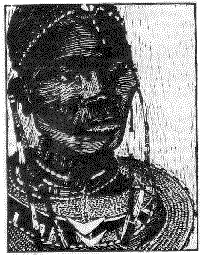 Dusk fell quickly
and silently as it does every evening of the year at the edge of Kenya’s Nguruman
Forest. Nearby trees grew taller and more imposing as the soft equatorial fight faded into
night-time shadows. Beyond our campfire, just inside the forest, a lion roared and
everyone moved closer together, anxious eyes looking into the growing darkness. Moses Ole
Kipelian rose, gathered his colourful shuka about his shoulders, slipped into the night,
and from deep inside the forest promptly roared back. "I am insulted by your
boldness. At daybreak I will go in search of you, hunt you, and teach you a lesson that we
Maasai warriors, not you, rule this land." By dawn the lion had disappeared, and as
we broke camp to begin our hike into the forest, no one doubted that our guide Moses, who
claims to have killed many lions in his life, meant every word he had said.
Dusk fell quickly
and silently as it does every evening of the year at the edge of Kenya’s Nguruman
Forest. Nearby trees grew taller and more imposing as the soft equatorial fight faded into
night-time shadows. Beyond our campfire, just inside the forest, a lion roared and
everyone moved closer together, anxious eyes looking into the growing darkness. Moses Ole
Kipelian rose, gathered his colourful shuka about his shoulders, slipped into the night,
and from deep inside the forest promptly roared back. "I am insulted by your
boldness. At daybreak I will go in search of you, hunt you, and teach you a lesson that we
Maasai warriors, not you, rule this land." By dawn the lion had disappeared, and as
we broke camp to begin our hike into the forest, no one doubted that our guide Moses, who
claims to have killed many lions in his life, meant every word he had said.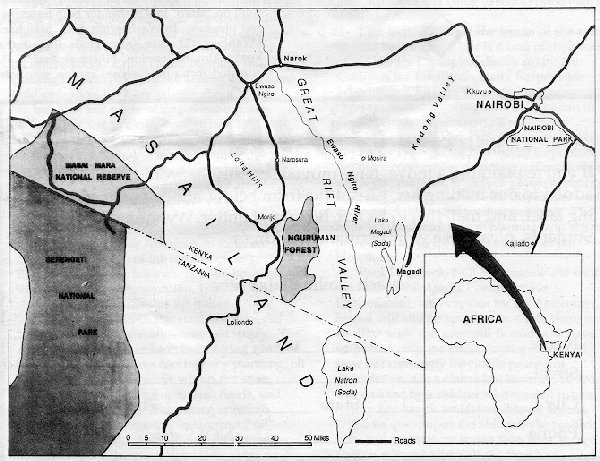 "Our cattle use only the edge of
the forest," says Moses, referring to the fact that the Loita Maasai are pastoralists
who inhabit the surrounding savannah, a reason why the Nguruman has maintained such a rich
abundance of plants and animals. "But that does not mean we do not need it. The
forest takes care of us. Without the forest there will be no water for our cattle, no wild
animals. The reason the rains come each year is because of the forest. In times of
drought, it provides the only water. The forest is the one thing that we have always owned
together as a people. Everything we have, everything we are depends upon it."
"Our cattle use only the edge of
the forest," says Moses, referring to the fact that the Loita Maasai are pastoralists
who inhabit the surrounding savannah, a reason why the Nguruman has maintained such a rich
abundance of plants and animals. "But that does not mean we do not need it. The
forest takes care of us. Without the forest there will be no water for our cattle, no wild
animals. The reason the rains come each year is because of the forest. In times of
drought, it provides the only water. The forest is the one thing that we have always owned
together as a people. Everything we have, everything we are depends upon it." Acacia grow sparse in the wheat-coloured
grassland at the edge of the immense Rift Valley. High above the uplands flies a Bateleur,
a giant bird of prey with white underwings bordered by a leading edge of black, followed
by a bright red tail. The only dense vegetation occurs along the few small streams coming
from the cloud forest. Lava rock worn smooth by periodic flooding provides a streambed for
the Oloibortoto River cascading to the parched land below. And here, a thousand feet below
is the land that has produced the most abundant biomass ever known; the land of the
ancestors of all humankind. Looking east across the valley, it is sobering to realise that
this huge rift in the earth’s surface was caused by the separation of continents.
Indeed, the giant saline lake of Natron and Magadi below are actually the early stages of
a future ocean. In 20 or 30 million years, geologists say, Kenya and Tanzania will
separate from the rest of Africa as the rift slowly pulls apart at the rate of one inch
per year.
Acacia grow sparse in the wheat-coloured
grassland at the edge of the immense Rift Valley. High above the uplands flies a Bateleur,
a giant bird of prey with white underwings bordered by a leading edge of black, followed
by a bright red tail. The only dense vegetation occurs along the few small streams coming
from the cloud forest. Lava rock worn smooth by periodic flooding provides a streambed for
the Oloibortoto River cascading to the parched land below. And here, a thousand feet below
is the land that has produced the most abundant biomass ever known; the land of the
ancestors of all humankind. Looking east across the valley, it is sobering to realise that
this huge rift in the earth’s surface was caused by the separation of continents.
Indeed, the giant saline lake of Natron and Magadi below are actually the early stages of
a future ocean. In 20 or 30 million years, geologists say, Kenya and Tanzania will
separate from the rest of Africa as the rift slowly pulls apart at the rate of one inch
per year.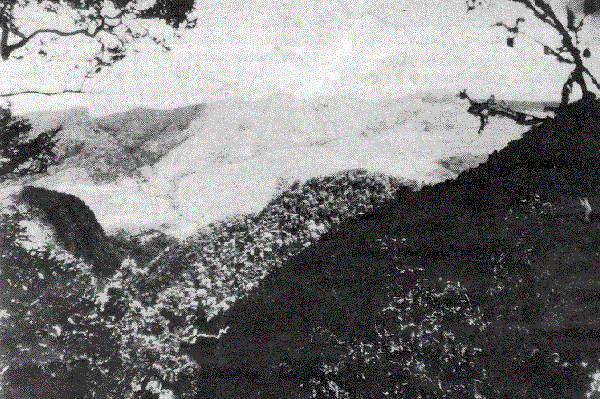 Porkiswaa’s words suggest that
agriculture and private ownership may pose severe ecological consequences for the
Nguruman. The area surrounding the forest is a traditional migration destination of vast
herds of animals. Pouring over the Maasai Mara National Reserve boundary from the south
over three million wild animals compete seasonally for water and forage with an equal
number of domestic stock and a growing number of Maasai people. In a land that is prone to
wet and dry cycles that may last decades, the recent moist years have given rise to more
people, stock and wildlife than Maasailand has ever known before.
Porkiswaa’s words suggest that
agriculture and private ownership may pose severe ecological consequences for the
Nguruman. The area surrounding the forest is a traditional migration destination of vast
herds of animals. Pouring over the Maasai Mara National Reserve boundary from the south
over three million wild animals compete seasonally for water and forage with an equal
number of domestic stock and a growing number of Maasai people. In a land that is prone to
wet and dry cycles that may last decades, the recent moist years have given rise to more
people, stock and wildlife than Maasailand has ever known before.
