

We were not allowed to ride with TJ in the helicopter so we rushed home, called our family, collected some personals, and headed for Ann Arbor. When we arrived, TJ was already hooked up to the dialysis machine that was exchanging the poisoned blood for clean. We were encouranged to spend as much time with TJ as we wanted in ICU and chairs were pulled up for us next to TJ where we were to spend hours and hours over the next 7 days. Finally, after true hell of ups and downs, on the 4th day, TJ began to improve. On the 7th day, he was moved to Mott Children's Hospital at U of M where we spent 5 more days for observation and to work at getting his weight back up and teaching him how to eat again...but this time with special low protein formula.
Over the next couple of years, TJ was slow to reach his milestones. It became more and more apparent just how delayed he was as time passed. Certainly, any parent would hope for some special miracle in that maybe our baby would have been spared extensive damage to his brain from the high ammonia. TJ's ammonia level remained within the normal range. He never had another hyper-ammonia episode since the initial onset at 3 days of age. (the maimum level was 680).
At around the age of 9 months, TJ pretty much stopped eating. He seemed to be weaning himself from the bottle (which was our only method of administering arginine). Introducing solids started out normally but soon disinterest developed there too. Once in a while something would flip his hunger switch on and he ate for a week or so. Then, just as fast as it turned on, it turned off. No matter what food, how it was presented or when it was offered, this child refused to eat. Finally, after TJ was labeled "failure to thrive" by his doctor, in spite of trying everything under the sun, we made arrangements to have a G-Tube put in at 13 months.
Liver function tests showed fluctuating numbers between 80 and 300. Buphenyl was prescribed but after about 4 months we saw no change. As many ASA kids have liver problems at some point in time, our Genetics doctors decided it was time to have TJ's liver status looked at. We knew it was enlarged but it seemed as though we were far from needing a transplant. The appointment with the transplant team at The University of Michigan was scheduled a couple of weeks later. I thought they would tell us that he would be monitored closely. Imagine our surprise when it was decided that he would be listed as a 2B that day (TJ was 23 months old). A transplant would halt hyper-ammonia because a healthy liver would be able to produce enough of the missing enzyme to metabolize protein (no longer requiring protein restrictions). Listing TJ now, while he was strong and healthy, allowed time to wait for the "perfect match" and certainly lessened probable complications. If were were to wait until we began to see signs of a troubled liver, we could end up having to accept a less than perfect match and more complications may arise from an ill child suffering from liver failure. TJ would require medications and avoidance of illness for the rest of his life...that was his future anyway, but without the looming threats of brain damage from another hyper-ammonia episode. We agreed with listing.
February 12, 2002 TJ was granted The Gift. His time on the waiting list lasted only 3 1/2 months. The surgery was 8 hours long, 3 days in PICU and 5 days on the floor, then home. Pathology reported his old liver was 2 1/2 times the size it should have been and was already cirrhotic. Arginine was stopped 2 days post-transplant and normal baby formula was give through his G-Tube. TJ was approximately 1 year to 6 months behind in development. He began walking at 27 months (4 days before he got his call), speech had not been achieved at 3 years old, although he was pretty good at communicating with gestures and sounds. He was shy around other people but around his family, he was a rambunctious and happy little boy.
In March 2002 there was a run to the ER with a high fever that came on suddenly. The central line had become infected so we had it removed after being told that these infections are tough to kick and they could certainly reoccur. TJ was so sick from this that I'd rather him endure a needle poke at lab time than to go through this again. This hopital stay came to a close and we were geting ready to go home when I noticed his belly was distended and tender. I hailed the resident doctor; he took a peak and ordered an ultra sound right away. The T-Tube had become dislodged and leaked 20oz of bile into his abdomen. A drainage tube was put in and immediately relieved his pain. Later, the T-Tube was pulled out and the leak sealed on it's own.
April of 2002, LFTs showed a steady rise over the last couple of weeks so a biopsy was done. No rejection but the test showed a bile flow problem. A stricture had developed. The following month, a PTC tube was inserted through his side, through the liver and into the main bile duct. This tube had to be changed monthly under anesthesia and was used to hold the stricture open between the ballooning treatments that would stretch the stricture open. The first 3 months of tube changes, TJ developed violent infections but, after getting the right antibiotic for the job, these infections were avoided for the next 5 tube changes.
All was quite for the next 4 months. TJ began to excel in every area except eating and talking. His understanding of his world and non-verbal communication improved and he began to go to school three days a week. In October of 2002, it was decided that the PTC tube and ballooning treatments were not working so, surgery was scheduled for Nov. 4, 2002. This surgery was 4 hours long and 6 days were spent in the hospital. This surgery left a scar that runs parallel to his transplant scar and stops just an inch shorter in length. Once out of the hospital, it was not long before TJ was off and running around the house again.
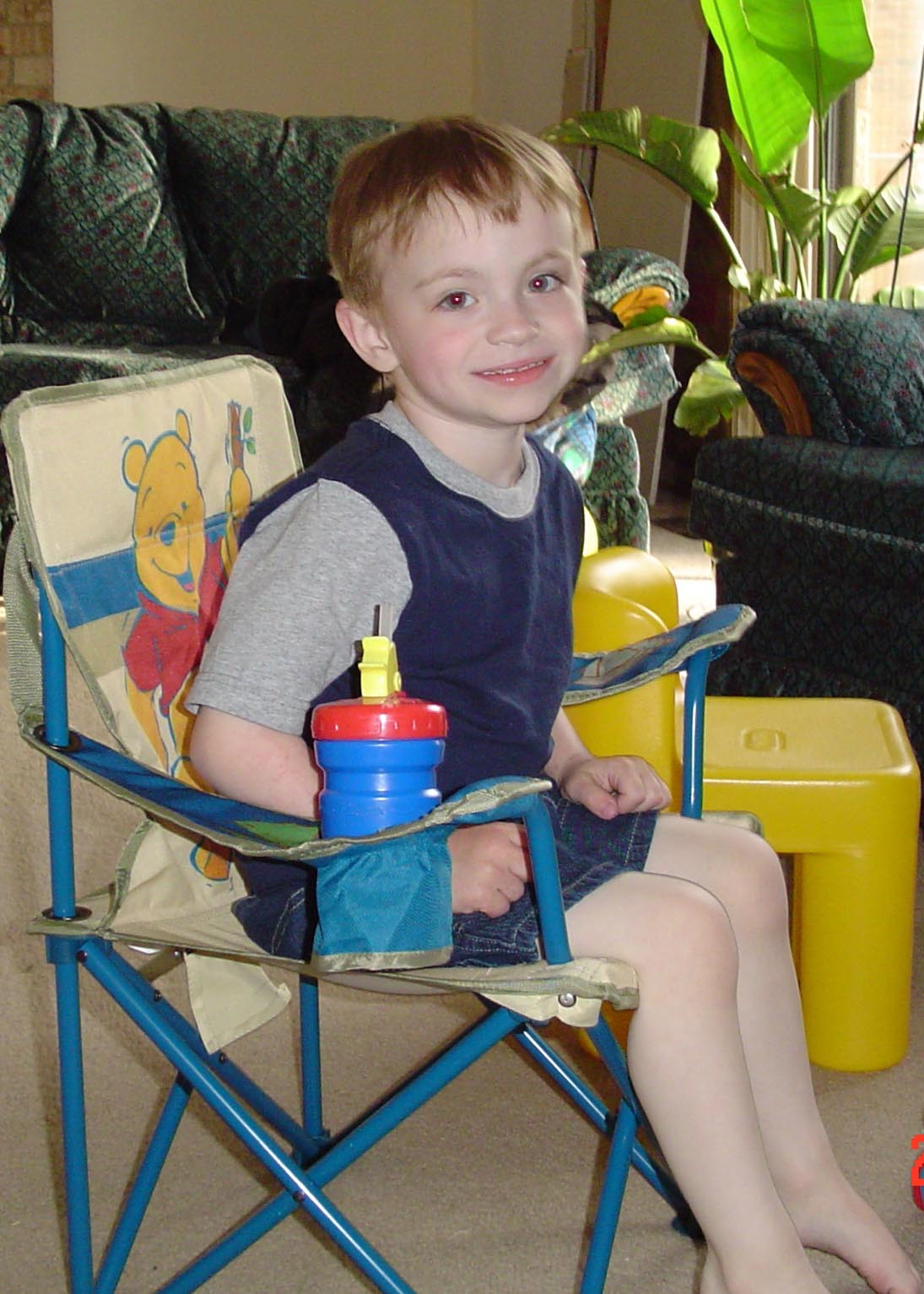
May of 2004 .. During this school year, TJ has made incredable improvements mentally and physically. He's almost a different kid. Verbal communication is blossoming, fine and large motor skills have improved three fold, and he's a regular social butterfly and loves attention. A neurophych test placed him at around 2-3 year old level and is borderline EMI/TMI. It is believed if we push him hard, we may be able to pull him farther into the EMI side. During this month, we spent 5 days at Columbus Children's Hospital. They have an intensive, inpatient feeding program that teaches kids, like TJ, to eat. After ONLY 5 days in, we were out, no longer needing the G-Tube for nutrition. He's taking in all food and drink by mouth. As soon as we can master taking his meds by mouth, that tube will be removed ASAP. He certainly realizes that he has done something pretty fantastic.
Having a child with medical issues AND develpmental AND physical issues is certainly challenging to say the least. There are days that I don't know how much longer I can keep the pace. But when I see TJ doing the things he likes to do and how happy he is...worries fade and I just love him for being TJ.

Age at Diagnosis: 4 days old Other diagnoses: None
Home town: Farmington Hills, Michigan Siblings: 11 y/o, not affected (previous marriage)
Developmental Status: Delayed, 2-3 year level Liver: Transplanted February 12, 2002
