Karnaugh maps provide an alternative technique for representing Boolean functions. For example, consider the Karnaugh map for a 2-input AND gate (Figure 1).
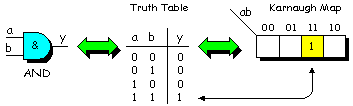
Figure 1: Karnaugh map for a 2-input AND gate.
The Karnaugh map comprises a box for every line in the truth table; the binary values above the boxes are those associated with the a and b inputs. Unlike a truth table, in which the input values typically follow a standard binary sequence (00, 01, 10, 11), the Karnaugh map's input values must be ordered such that the values for adjacent columns vary by only a single bit, for example, 00, 01, 11, and 10. This ordering is known as a gray code, and it is a key factor in the way in which Karnaugh maps work.
