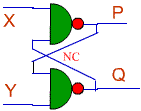
Basic Circuit
Here's a basic circuit that involves just two NAND gates. There are two inputs to this circuit, X and Y. Can you generate a truth table for this circuit?
Let's address that issue of the truth table. Here is a truth table for you to fill in. (Print this web page if you want to work on it.)
|
X |
Y |
P |
Q |
|
0 |
0 |
|
|
|
0 |
1 |
|
|
|
1 |
0 |
|
|
|
1 |
1 |
|
|
Let's review what you know about this circuit. We can focus on what happens when X= 0, and Y = 0, the first entry in the truth table above.
|
X |
Y |
P |
Q |
|
0 |
0 |
1 |
1 |
|
0 |
1 |
|
|
|
1 |
0 |
|
|
|
1 |
1 |
|
|
Now, let's address the second entry in the truth table. In that situation, X = 0, and Y = 1.
|
X |
Y |
P |
Q |
|
0 |
0 |
1 |
1 |
|
0 |
1 |
1 |
0 |
|
1 |
0 |
|
|
|
1 |
1 |
|
|
Now, let's address the second entry in the truth table. In that situation, X = 0, and Y = 1.
|
X |
Y |
P |
Q |
|
0 |
0 |
1 |
1 |
|
0 |
1 |
1 |
0 |
|
1 |
0 |
|
|
|
1 |
1 |
|
|
Next, let's address the third entry in the truth table. In that situation, X = 1, and Y = 0.
|
X |
Y |
P |
Q |
|
0 |
0 |
1 |
1 |
|
0 |
1 |
1 |
0 |
|
1 |
0 |
0 |
1 |
|
1 |
1 |
|
|
Finally, we have the case where X = 1 and Y = 1.
There is one way to proceed. We could just assume that P = 1, for example. Let's try that.
|
X |
Y |
P |
Q |
|
0 |
0 |
1 |
1 |
|
0 |
1 |
1 |
0 |
|
1 |
0 |
0 |
1 |
|
1 |
1 |
1 |
0 |
This is interesting, but we need to note the following.
What if we made the opposite assumption? Let's assume P = 0.
|
X |
Y |
P |
Q |
|
0 |
0 |
1 |
1 |
|
0 |
1 |
1 |
0 |
|
1 |
0 |
0 |
1 |
|
1 |
1 |
0 |
1 |
Now, we can't
have it both ways. This truth table summarizes what we have found.
|
X |
Y |
P |
Q |
|
0 |
0 |
1 |
1 |
|
0 |
1 |
1 |
0 |
|
1 |
0 |
0 |
1 |
|
1 |
1 |
|
|
There's something decidedly peculiar here. The output has to be one or the other of these two cases. Which is it?
But, there's a related question.
Now, let's imagine that we do the following.
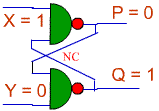
We can reverse the initial inputs.
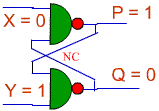
Some observations: