|
For the white settlers of South Australia, it's remoteness meant that many of their essentials of life had to be shipped from as far as 12,000 miles away. These imported goods frequently did not arrive when expected, if at all, often because cargoes were diverted to the larger and more profitable markets on the eastern seaboard. A few enterprising local men seized the opportunity provided by this unreliability, and embarked on the lucrative business of wholesale supply.
Entrepreneurs like Faulding, Fowler, and Simpson, whose company names became known internationally, appointed their own overseas agents. Their duties included not only the purchase of goods but also chartering ships to ensure efficient delivery. Others like Bickford, Burford, Wilkinson, and Wood whose reputation were Australia-wide rather than international, pursued similar policies. |
|
 |
|
|
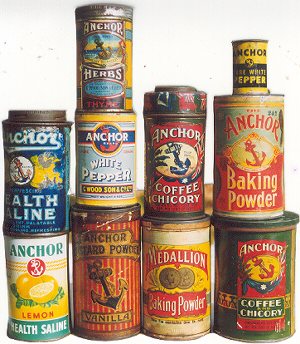
Despite the wide variety of their products, these companies had one neen in common: packaging. The containers could be made of tin, glass, cardboard, stoneware, paper, hessian, or wood and contain spices, herbs, coffee, biscuits, confectionery or health salts to name but a few possibilities. Whatever the contents, the packaging was often brightly coloured and featured attractive logos and trademarks.
Among the most durable containers were the tins. These colourful links with our past have survived because of their secondary use as storage for nails, screws, cup-hooks, safety pins and a myriad of other objects. Some confectioners and biscuit makers were well aware of this recycling and offered large tins of uniform size for use as kitchen canisters for bulk items such as tea, flour, cocoa, sugar, etc. |
|


