Onion
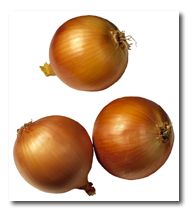 Onion
is a cool-season vegetable that can be grown successfully throughout most of
temperate
Onion
is a cool-season vegetable that can be grown successfully throughout most of
temperate
Onions start bulb formation when the day length is of the proper duration
and different varieties of onions require different day lengths to initiate bulbing. In general, most common varieties fall into one of
two classes, long-day (for northern latitudes) and short-day (for southern
latitudes). For this reason, onion varieties that are grown in the South are
not adaptable to the North and vice versa. Late plantings of the suggested
varieties also result in small bulbs or lack of bulbing
altogether in any location.
High temperatures and low humidity are advantageous during bulbing and curing. Onions have shallow roots and compete
poorly with weeds and grasses. Timely shallow hoeing and cultivation are
important, especially when the onions are small.
Onions may be eaten raw, broiled, boiled, baked, creamed, steamed, fried, french fried and pickled. They are used in soups and stews
and combination with vegetables and meats.
Onions from Sets
Growing green onions from sets is probably the simplest method for the home
gardener. The plants are quickly established and become vigorous and strong.
Onion sets may be used to produce both green onions and dry onion bulbs, though
production of really premium dry onions requires methods described in the
following section.
Onions from Transplants
Transplanting young onion seedlings is the method of growing that most
regularly produces large, dry, attractive onions for slicing (as shown in
catalog pictures). Transplants are purchased in bundles (usually 60 to 80
plants) from garden stores and through seed and nursery catalogs (though
mail-order onion plants often cost as much as buying the 60 to 80 full-size
mature bulbs they may produce).

Several varieties are used for onion sets. All of these varieties are widely
adaptable. The home gardener has little choice of varieties at the store,
however, because sets are seldom sold under varietal
names, merely by color: yellow, white or red. Yellow sets are sometimes sold as
the varieties Ebenezer or Stuttgarter.
Purchase firm, dormant sets early - before they begin growth in heated
salesrooms. Store sets in a cool, dry, dark environment if planting must be
delayed after purchase. Divide the sets into two sizes before planting. Large
sets (larger than a dime in diameter) are best used for green onions. If
allowed to grow, these sets may "bolt" and form flower stalks. The
small sets (smaller than a dime in diameter) produce the best bulbs for large,
dry onions; and they usually do not "bolt." Extremely cold weather
during early season growth also may condition onions from sets to flower.
Round onion sets produce flat onions; elongated or torpedo-shaped sets
mature into round onions. Most gardeners prefer white sets for green onions,
although red or yellow sets are also acceptable.
Onions from Transplants
Gardeners should try to match varieties to their location. Long-day onions
are bred for best performance in the North and short-day varieties perform best
in southern locations. Short-day varieties may perform acceptably in the North
if the plants can be set out very early in the season. Long-day types may not
get the bulbing signal in the
The normal garden center may offer Yellow and White Sweet Spanish
(long-day varieties), Yellow and White Bermuda (short-day varieties
and a red variety that may or may not be named (Southport Red Globe,
perhaps; a long-day variety). Catalog shoppers may choose from a slightly wider
variety selection, which may include Texas Grano (short-
day), Vidalia Sweet (really a Granex hybrid,
short-day), Red Hamburger (short-day),

Onions can be planted as soon as the garden can be tilled in the spring,
usually late March or early April in prime regions for producing onions. Good
fertility, adequate soil moisture and cool temperatures aid development.

To produce green onions, plant the larger sets 1 _ inches deep and close
enough to touch one another (green onions are harvested before crowding becomes
a problem). To produce dry onions, plant the smaller sets 1 inch deep, with 2
to 4 inches between sets. Allow 12 to 18 inches between rows. If sets are 2
inches apart, harvest every other plant as green onions so that bulb
development of the remaining sets is not impeded by neighboring plants.
Onions from Transplants
Plant in fertile soil in early spring. Space the
plants 4 to 5 inches apart in the row to produce large-sized bulbs (closer
spacing significantly decreases bulb size) or space 2 to 2 _ inches apart and
harvest every other plant as a green onion. Allow 12 to 18 inches between rows
or space onions 6 to 8 inches apart in all directions in beds. Set the
transplants 1 to 1 _ inches deep and apply 1 cup per plant of a
starter-fertilizer solution.

Keep onions free from weeds by shallow cultivation and hoeing. To develop
long, white stems for green onions, slightly hill the row by pulling the loose
soil toward the onions with a hoe when the tops are 4 inches tall. Do not hill
onions that are to be used as dry onions. Hilling may cause the necks of the
stored bulb to rot.
Onions from Transplants
Weeds and grass compete with the onion plants for nutrients and moisture
during the growing season. Remove all weeds and grass by diligent and repeated
shallow cultivation and hoeing. Side-dressing with fertilizer may be necessary.

Pull green onions anytime after the tops are 6 inches tall. Green onions
become stronger in flavor with age and increasing size. They may be used for
cooking when they are too strong to eat raw. Though leaves are traditionally
discarded, all parts above the roots are edible.
Remove any plants that have formed flower stalks and use immediately. They
do not produce good bulbs for dry storage. Harvest in late July or early
August, when most of the tops have fallen over. Allow the plants to mature and
the tops to fall over naturally. Breaking over the tops early interrupts
growth, causing smaller bulbs that do not keep as well in storage.
Pull the mature onions in the morning and allow the bulbs to air dry in the
garden until late afternoon. On especially hot, bright, sunny days, the bulb
may sunburn. On days when this is likely, remove onions to a shaded location
and allow them to dry thoroughly. Then, before evening dew falls, place them
under dry shelter on elevated slats or screens or hang them in small bunches.
Tops may be braided or tied with string before hanging. Full air circulation
for 2 to 3 weeks is necessary for complete drying and curing. Keep the dry
wrapper scales as intact as possible on the bulbs, as they enhance the keeping
ability.
After the bulbs dry, cut the tops 1 _ to 2 inches long (at or above the
narrow spot where the stem bent over), and place the bulb in dry storage with
good air circulation. Do not try to store bulbs that are bruised, cut or
diseased, or those with green tops or thick necks. Store
under cool, dry conditions. Dry onions may keep until late winter, but
check them regularly and use or discard those that begin to soften or rot.
Onions from Transplants
The earlier varieties are usually ready to harvest in July, with later
varieties maturing into August. When most of the tops have fallen over, the
onions may be pulled and dried (refer back to Harvesting under "Onions from
Sets"). The length of storage time varies with the variety, with the
sweeter varieties usually being the poorer keepers.