Asparagus
|
Asparagus is a hardy perennial. It is the only common vegetable that grows
wild along roadsides and railroad tracks over a large part of the country.
Although establishing a good asparagus bed requires considerable work, your efforts
will be rewarded. A well-planned bed can last from 20 to 30 years. For this
reason, asparagus should be planted at the side or end of the garden, where
it will not be disturbed by normal garden cultivation. Asparagus is one of
the first vegetables ready to harvest in the spring. Asparagus is native to
the |
|
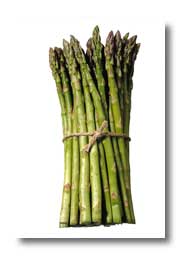

The list of commonly available varieties has significantly changed in recent
years. Standard varieties like Mary Washington, Martha Washington and

Asparagus should be planted as soon as the ground can be worked in the
spring. One-year-old crowns or plants are preferred. Seeds are sown in a
production bed and allowed to grow for a year. The young plants have compact
buds in the center (crown), with numerous dangling, pencil-sized roots.
Adventurous gardeners can start their own plants from seed. Although this adds
a year to the process of establishing the bed, it does ensure fresh plants and
the widest possible variety selection.

Place the plants in a trench 12 to 18 inches wide and a full six inches
deep. The crowns should be spaced 9 to 12 inches apart. Spread the roots out
uniformly, with the crown bud side up, in an upright, centered position,
slightly higher than the roots.
Cover the crown with two inches of soil. Gradually fill the remaining
portion of the trench during the first summer as the plants grow taller.
Asparagus has a tendency to "rise" as the plants mature, the crowns
gradually growing closer to the soil surface. Many gardeners apply an
additional 1 to 2 inches of soil from between the rows in later years.

As asparagus plants grow, they produce a mat of roots that spreads
horizontally rather than vertically. In the first year, the top growth is
spindly. As the plants become older, the stems become larger in diameter.
As noted, asparagus plants are dioecious (either
solely male or solely female). The female plants develop more spears or stems
than the male plants, but the stems are smaller in diameter. With normal
open-pollinated varieties, gardeners plant both male and female plants in an
approximate ration of 1:1. After the first year, small red berries form on the
female plants in late summer. These then fall to the ground, sprouting plants
that essentially become perennial weeds in the asparagus bed.
Following freezing weather in the fall, the asparagus tops should be removed
to decrease the chances of rust disease over wintering on the foliage.
Because asparagus remain in place for years, advance soil preparation helps
future production greatly. Working green manure crops, compost, manure, or
other organic materials into the proposed bed well in advance of planting is a
good approach. Asparagus should be fertilized in the same way as the rest of
the garden the first 3 years. In the spring, apply 10-10-10, 12-12-12 or
15-15-15 fertilizer at the rate of 20 to 25 pounds per 1,000 square feet of
area or 2 pounds per 100 square feet and incorporate with soil tillage.
Starting in the fourth year, apply the same amount of fertilizer but delay
application until June or July (immediately after the final harvest). This
approach encourages vigorous growth of the "fern," which produces and
stores nutrients in the roots for next year’s production season.
Weeds and grasses are the worse problems with asparagus. They compete with
the developing spears, make an unsightly area in the garden and significantly
decrease yield and quality. Start frequent, light, shallow cultivation early in
the spring in both young plantings and mature patches that are being harvested.

Asparagus can be harvested the third year after planting crowns, but for no
more than one month the first season. The plant is still expanding its root
storage system and excessive removal of spears weakens the plants. During the
fourth year and thereafter, the spears may be harvested from their first
appearance in the spring through May or June (as long as 8 to 10 weeks).
Harvest spears 5 to 8 inches in length by cutting or snapping. To cut a
spear, run a knife into the soil at the base of the spear and carefully sever
it. Because the spear is cut below the point where fiber develops, it becomes
necessary to remove the fibrous base from the tender stalk. Cutting may damage
some spear tips that have not yet emerged from the ground. To snap a spear,
grasp it near the base and bend it toward the ground. The spear breaks at the
lowest point where it is free of fiber.
Either method is acceptable. Cutting is often preferred by commercial
growers and snapping by home gardeners. Asparagus deteriorates rapidly after
harvest. If it is not eaten immediately, it should be processed or refrigerated.