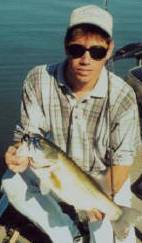
| Brian Waldman (team9) |
| Long before I ever got a boat, I bank fished. I loved to fish, and this was my only option. I chased after anything and everything, whatever would bite. But the bass fishing bug quickly bit me, and it wasn�t long after that that I contracted �bass tournament fever�. While I could count on being paired with a boater in my club, and could occasionally hook a ride on the off weekend, most of my trips were spent at the local ponds and reservoirs walking the shoreline trying to learn to catch bass. Some of the easiest to fish and most accessible banks were riprap covered, and I coined the name �rock hopper� to refer to myself and this style of fishing. Even now I refer to bank fishermen as �rock hoppers� after those early days. I literally put in hundreds of bank trips to those waters, and still to this day I spend lots of time fishing from the bank. Due to time constraints and convenience, I probably logged 75-100 bank days each of the past couple years and more when I didn�t have a boat. I have probably caught thousands of bass from the bank and would like to pass on some of the observations and conclusions I have made during these endeavors. NOT CASTING TO OR ALONG THE BANK � This is far and away the biggest mistake I see most bank bound bassers make. The old observation about noticing bank fishermen cast out towards the boats and why boat fishermen cast in toward the shore is really true. Bass, by nature, are largely shallow water fish. They are also very cover oriented. When you combine these two concepts you have the basis for the start of an approach. In most of the lakes I fish, the best cover is along the bank. And the best way to fish that cover is to cast parallel, or nearly so, down a bank. Sometimes, just short pitches are all it takes. Why waste your time throwing out into the middle of the lake when so many fish are at your feet? The only time I throw out into deeper water (say >45 degrees off bank) is if I�m fishing a point or a known piece of structure. Other than that, all casts are within 10� of the shoreline. The clearer the water or the more open the shoreline, the longer and more parallel the casts. In heavy cover or small openings, small pitches and flips will suffice. Any piece of cover, no matter how insignificant gets a cast. Rocks, drains, washed in logs, weeds, lay downs, docks, you name it. Just be quiet and still and you�ll be surprised how many fish you�ll catch within 10� of yourself. COVER WATER � Mistake number two is standing in one spot for half and hour or more and making cast after cast. Have you ever noticed how most bass boaters are always on the trolling motor covering water? If you accept the fact that most fish you�re chasing are shallow water object oriented, then probability says that the more water and spots you can cover the greater your odds of running into an aggressive (read biting) fish. This is especially important when first learning a body of water. The more water you cover the more spots (holding areas) you�ll discover. I will typically make 3-5 casts from a given area on the bank and then move 20-40� down the bank for the next 3-5 casts. On and on it goes. You can easily cover a couple miles of bank in just a few hours. Remember, you're trying to find as many spots and as many bass as you can. Don�t wait for them to come to you, go to them. USE ONLY ONE LURE (but carry backups) � How many times have you seen this mistake made? Someone bass fishing from shore with a big tackle box, casting a lure for 20-30 minutes then digging into his box and changing to another lure, only to repeat the process. At this rate you might only fish 2 or 3 spots in a day. This usually won�t work. The largest tackle box I ever carry with me is a tiny, flat drop-down that goes around your waste and attaches to your belt. Often times it is only an old lure box with a couple extra baits or a Ziploc bag stuffed into a pocket. There are several advantages to this. One, it lets you cover water by not wasting time changing baits, thinking they�ll hit something else better. Another is that it makes you more mobile. Anymore, I�ll frequently fish an entire trip without a lure change. As long as you pay attention to retying when appropriate, you�ll rarely lose too many baits. Remember, you�re fishing shallow cover close to the bank. Most times, even if you do hang, you can reach out and unsnag lures that get stuck. As a side note here for those of you fishing small ponds regularly, use a different lure each trip. I have the good fortune of having 5 ponds located within my subdivision. The theory of fish becoming conditioned is definitely true, especially in these smaller bodies of water. I can�t count the number of times I�ve proven this to myself. Day one I�ll go out and catch 30 bass. If I go back out the next day with the same lure, my results will be cut in half. By the time I try this a third or fourth day, I might only catch a few. These fish get used to seeing the same bait day after day, so change up! Try a crankbait one trip, a topwater the next. Jigs on the third trip and maybe worms after that. After a week or two of not seeing the same bait twice you can usually go back in with the original bait and they�ll bite it well. |
 |
| Rock Hopping 101 |
| page 1 of 2 |