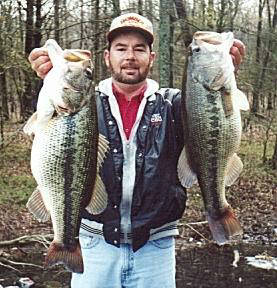
First and foremost, you must be fishing where there are big bass. Not all bodies of water hold big bass. Good info can be obtained from your State fish agency's electro-shocking surveys, and if you are lucky enough to become friends with your region's biologists, they can be a great source of information. Also, local tackle stores can be a good source of information on lakes that regularly produce big bass. I don't put a lot of stock in just one or two reports of good catches, but when a body of water produces big bass for 3 or 4 years, or lots of big bass in one year, that means I will be investigating it. And new lakes, from about age 5 to age 15 are in their prime for producing lots of big bass, if properly managed and water quality is good. Also, don't overlook older lakes that don't have a lot of bass, or fishing pressure. These old lakes, when not overpopulated with small bass, can produce some great catches of huge bass under the right conditions. The main thing on these type lakes is to find one that is close to your home so you can fish it frequently and figure out when the times and conditions are that turn the big bass on and make them easier to catch. One thing I have found on public lakes is if the lake is loaded with 1 and 2 lb bass, there may not be many huge bass in that lake. A lake can only support so many pounds of predator fish, and if that number is 100 pounds per acre, and you have 100 one pound bass per acre in that lake, then you can see that the carrying capacity is maxed out and the chances of growing a giant bass is unlikely. One big reason why the smaller bass must be thinned out in such lakes, and our state biologists are trying to get us to keep smaller bass in some lakes.
Second, you must be QUIET!!! Big bass are not so hard to catch, but it is nearly impossible to get close to one without spooking it. A spooked bass, especially a big one, is not catchable. So your main objective is to try to keep the area you are fishing as natural feeling to the fish as possible. Turn off your depthfinders in most cases, and use your trolling motor sparingly or not at all, but if you do use it, put it on the lowest possible setting. Better to take 5 minutes to get your boat into position quietly than to push right in there and spook the fish. Tying up to brush, anchoring, and drifting are all great ways to spook as few big bass as possible. Also, wind is your friend when it comes to not spooking big bass. Wind creates a lot of underwater noise, that covers your boat noises. In 2 foot waves, you can run your trolling motor on high, bang the boat, run all your depthfinders at once, make loud splashy casts, and still not spook bass sometimes. When it is calm, it is a very different story.
Third, big bass are not chasers, and they are on the move when they feed, so fish slow, with baits that will stay in the big bass' feeding area a long time. This can be done with many baits if you set everything up correctly. A big crankbait can be slowly walked, or slowrolled through stump fields on the edge of channel drop-offs, or along points, or in vegetation. Spinnerbaits are most often used for this tactic, but the crankbait will work better in some instances, especially if lots of folks are using spinnerbaits. And vice versa. My favorite big bass bait is a jig. If you get this bait in cover, you can keep it there as long as you like, and still give it action by just shaking the rod, or pulling it up into a tree and letting it fall back repeatedly. Soft plastics allow you to do the same. Since big bass are almost always moving when feeding, a great tactic is to anchor or tie up a short cast away from where you think a good big bass feeding area is, and fish the whole area, over and over, for 1 or 2 hours. If you are quiet, big bass may begin to feed as normal. This is what you want. Have you ever heard of a guy casting over and over to the same stump, and on his 30th cast he hooks a giant bass? Well, the angler usually thinks he made enough casts to make the bass mad enough to hit. It is a rare occurrence indeed when a big bass makes the mistake of getting "mad" enough to hit a lure. Maybe smaller bass, but not big ones. What really happened is the big bass was not there the first 29 casts. On the 30th cast, the big bass was close enough to notice the lure, the presentation was good enough, and it swam over for a meal.
Fourth, if you are catching a lot of small bass in the area, you are messing up, at least if you want giants. You either need to change locations, or change baits so as to not catch so many small bass. If you keep catching and releasing small bass in one area, it will eventually key the other fish in the area that something is wrong, due to several factors, and your chances of catching big bass go down. You may only need to move to the edge of the area where all the smaller bass are. I have caught giant bass by moving only about 20 yards from a school of small bass.
Fifth, use tackle appropriate to the size fish and type of cover you are fishing. Ten lb mono on light tackle, while fishing for monster bass in the middle of cedar trees will only break your heart. You don't hunt grizzly bears with a bean flip. When fishing this type of cover, for huge bass, you need at LEAST 25 lb mono or a 50 lb braid. A very stout rod and quality reel are absolute MUSTS for fishing in thick cover for monster size bass. Even in open water, I would not want to go to less than 10 lb test. The teeth of a big bass are very abrasive, and can weaken your line quickly. I will go down to 8 lb test in COLD winter open water conditions. The point is, use the strongest, heaviest tackle you think you can use in the circumstances you face.
The weather and moon phases play a big part in your chances of catching a giant bass. I will not get into it too much here, just go fishing when you can and watch the weather and moon phases and see if a pattern develops. In my experience, the 3 days (or nights) before a full or new moon, and the day (or night) of the quarter phases are the best. And most folks know that when it is cloudy and a front is coming in, the fish will bite better. That is true, but I have had some great days when all the signs didn't add up. So experiment.
And I must say that I firmly believe you have a much better chance at really big bass if your boat is not all shiny and glittery, and you are not wearing bright colored clothes and hats. I prefer drab boats, and drab clothing while fishing for big bass. I know that a shallow fish can see quite well above the water, and if you don't blend in, well, then you stick out like a sore thumb. Remember the part above about keeping the area as natural feeling to the bass as possible?
. |