


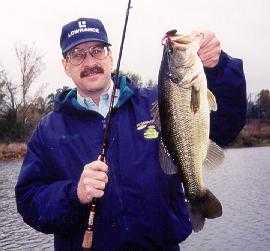
last year at Broken Bow Lake. Fourteen pounds, eleven and a half ounces. What a fish!
That fish must be the result of good fishery management, right? A carefully thought-out
plan to produce trophy bass. Stocking Florida bass at just the right rate, the right size, the
right time. Scientifically evaluated regulations that encourage the harvest of some fish, the
protection of others. And a thoroughly tested and refined habitat enhancement plan that
maximizes the potential for the survival and growth of big bass.
I only wish it were that easy!
No, despite our years of schooling and even more years of experience, mother nature still
has more control over what happens in our lakes than we would like to admit. True, Florida
bass stockings have paid off handsomely in the production of trophy bass. Catch and
release has slowed the harvest of five, six, or eight pounders that have the potential of
growing up to be records. But in reality, nature controls much more of the situation than
we care to admit. Let me explain.
The ODWC stocked Florida bass in Broken Bow every few years beginning in the early
1970's with from 20,000 to 200,000 fingerlings annually. What happens to those fish on
their way to state record size? Assume we stocked 100,000 fingerlings. If water levels
were good and they had plenty of cover to hide in so they were not lunch for other bass,
crappie, walleye or catfish, they survive into the first winter. Now they are driven from the
protective shallows by the cold water. If they have learned to eat fish, they may have
grown to a size that can avoid being eaten themselves as they head for deeper winter
sanctuary. Comes spring we get a pretty good idea of the survival rate of our year class.
Genetic studies we have done over the past 15 years indicates that the over-winter survival
of Florida bass fingerlings averages less than 25%. The 100,000 we started with is now
down to 25,000 fish in one year!
Some of our little Florida made it however and are growing well. But the road to trophy
size is a long and treacherous one. Because of a multitude or causes, some natural and
some man-made, the mortality that our year class of bass experiences is about 35% each
year. The 25,000 that survived the first winter is reduced to 16,250 at age two. 10,560
reach age three. 6,860 at age four. 4,462 make it to age five and so on until we have only
17 of the original 100,000 that survive to age ten. I picked age ten because, on average,
it takes ten years to grow a ten pound bass in Oklahoma and the maximum age we have
seen is only thirteen years old.
Now think about the nature of animal growth. In any given stock of animals, whether its
cattle, pigs, dogs or fish, some are runts and never grow very large, most are average in
their growth and only a few grow exceptionally fast and get a lot larger than their brothers
and sisters. In fish this fast growing group amounts to only about 3.5% of the year class.
Multiply the 517 ten-year old survivors by 3.5% and we have 18 fish that have the growth
potential to become true trophies. But wait, we're not through. We know that the females
that are the ones that get big - not the males. Assume that we have a 50:50 sex ratio, now
we're down to nine bass out of 100,000 that have the potential to become a record-class
individual. Spread those nine fish over the 14,100 acres of water at Broken Bow...are you
getting picture why a trophy bass is such a rare critter? Why a state record is even more
rare? And why duplicating that feat is so difficult for fishery managers.
Why do you think the is only one Lake Fork? Texas Parks and Wildlife has not been able
to duplicate the combination of factors that have turned Fork into such a big-fish factory.
Other lakes may come close in time (Rayburn, Roberts, Cooper) but it is doubtful they will
equal Fork's output of true trophy fish. Our biologist are constantly confronted with
questions from anglers of "why can't my lake be like Fork?" Many Oklahomans just don't
understand how different our water quality, lake fertility, and water level fluctuations are
from those in east Texas. No amount of study or money will be able to turn our lakes into
Lake Forks. Nature dealt us a different set of cards and we can't ask for a new deal. We
have to do the best we can with the hand we've got.
While on the subject of this record fish, several people have asked if the angler released
his fish. They were angered when we told them no, he is letting Bass Pro Shops display
it in an aquarium in their new store in Grapevine, Texas. "Well, he should have turned it
loose" most bass fishermen say. "It needed to be put back so it could spawn and have a
chance to be caught again."
Let's look at the biology at work here. First, that fish was probably ten to twelve years old
and remember I said earlier that they only live to twelve or thirteen years of age in
Oklahoma anyway. If the fish was released, the odds of it ever being caught again before
it died are slim and none. What about the spawning argument? Big bass are old bass,
and just like other animals their reproductive capabilities decline with age. That fish had
already made its contributions to the gene pool when it was younger and in its prime.
Biologically there were no compelling reasons to release the fish. By donating it to Bass
Pro Shops in Dallas the fish is really serving a much larger purpose than it would if it were
returned to the lake. It will focus attention on Broken Bow and Oklahoma, giving local
economies a much needed boost. It will help increase awareness of the natural resources
and fishing opportunities that this state has to offer and maybe it will get more people
interested in fishing.