America Takes Over
1965-67
Boston Publishing Company
Westmoreland: more troops......The American troops in their enclave bases had been spared the brunt of the enemy offensive which was concentrated around Saigon and in the central highlands. But shortly after midnight on July 1 the marines guarding the air base at Da Nang got their first taste of heavy Vietcong firepower. Late on the night before, a heavily armed VC attack force consisting of a special operations company and motor company crossed the Cau Do River south of Da Nang. By midnight they reached the southeastern perimeter of the air base, knowing that the outer portion of the southern perimeter was guarded by ARVN troops rather than U.S. Marines. Digging under the outer perimeter fence, a thirteen-man demolition team then crossed an open area and cut a hole in the inner perimeter fence. A single marine sentry, hearing something in the dark, threw an illumination grenade.
At that moment the enemy opened fire and ten demolition's experts raced onto the airfield. They destroyed an F-102 Corvair and two C-130 transport planes and damaged another F-102 and C-130. Lieutenant Colonel Verle E. Ludwig immediately sent a reinforcing squad from Company C of his 1st Battalion, 9th Marines. But in those few minutes the enemy withdrew from the field. By 7:AM Company B from 1/9 was searching the area for the sappers. Fourteen suspects were rounded up, but none was connected to the attack. ARVN soldiers did find a wounded North Vietnamese intelligence officer who told them that the attack had been planned and rehearsed for over a month.
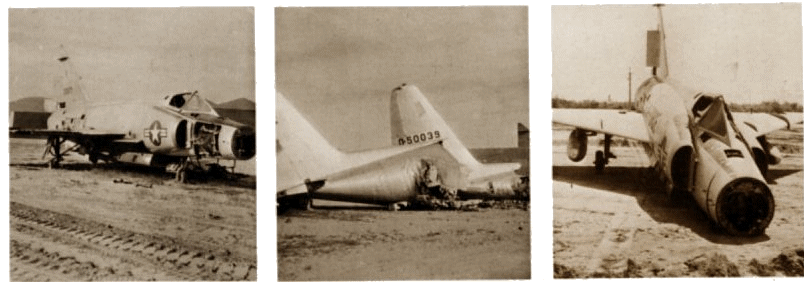
On July 2, one day after the attack, General Walt sought authorization form the ARVN I Corps commander, General Thi, to extend the marine TAOR ( tactical area of responsibility) south of the air base to include the area five miles south of the Cau Do River, the direction from which the attack came. On July 20 General Thi reluctantly agreed, acknowledging that his men could not guarantee the security of the air base. But the extension of the TAOR presented the marines with a new problem. The area south of the Cau Do was densely populated and sympathetic to the VC. Contact between marines and Vietnamese civilians was bound to increase as the marines attempted to secure the area. Within two weeks a Zippo cigarette lighter would ignite the tense situation on the ground and on the American television screen.
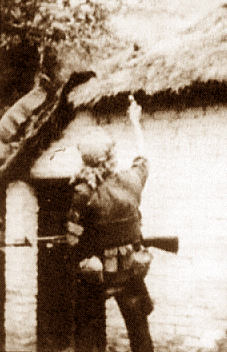
A War Remembered
Boston Publishing Company
William R. Melton Squad Leader, Company D
1st Battalion, 9th Marines 1965
America Takes Over
1965-67
Boston Publishing Company
Perhaps the most important outcome of Operation Starlite was its psychological lift. In the first major engagement between American troops and Main Force Vietcong soldiers the Americans has been victorious. Had the American forces lost - a real possibility given their inexperience - the effects might have been severe indeed. The old tactics of the VC, which had worked so well against ARVN (Army of the Republic of Vietnam), failed to rout the marines. So the enemy learned a lesson as well; it would be many months before they would again stand to fight against the marines.
For the marines, Starlite, or the Battle of Chu Lai as it became known in their lore, took on an almost mythical importance. For those marines who came later and for whom the landings at Iwo Jima and Inchon Beach were the glory of another generation, the Battle of Chu Lai remained for many months the only evidence of what the marines could do if the enemy stood and engaged. Now, in late August 1965 the number of marines - and soldiers, airmen, and sailors - arriving in Vietnam was no longer a trickle, but a torrent. Fateful decisions had been made in Washington, by one man, sitting alone in his office: the president of the United States.
A Contagion of War
Boston Publishing Company
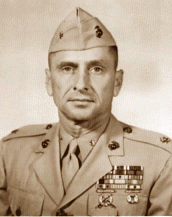
Lieutenant Colonel Verle Ludwig, commander of the 1/9 Marines, agreed to ward off the Vietcong and devised a project called Golden Fleece. When the rice harvest began on September 10, companies from the 1/9 saturated the area around Hoi Hai Village, conducted night ambushes, and set up cordons around the harvesters working in the fields. After a major unsuccessful fight with the marines on September 12, most of the VC left. The marines met only sporadic resistance during the rest of the harvest. Golden Fleece was an economic success because it preserved the harvest and it was also a psychological success. The marines proved they could defend the villagers, and they forced the Vietcong to increase their rice levy in other areas, thereby diminishing their popular support there.
Control over rice had been an important element of the war in Vietnam, and the success of Golden Fleece reinforced this fact among the marines. Soon other marine units, often working together with ARVN troops, took up rice protection at harvest time. Emphasis on the technique also spread south among U.S. Army units. Not all subsequent Golden Fleece operations proved successful, in part because sometimes ARVN troops pilfered from the harvests they were assigned to protect. But the technique became a standard component of military operations conducted at harvest time.
The Masher plan
In planning the operation, the 1st Cavalry coordinated with the ARVN 22nd Division as well as the Republic of Korea Capital Division, which had been stationed near Qui Nhon since October. In addition, the marines were organizing an operation to the North called Double Eagle, which was poised to sweep across the Quang Ngai-Binh Dinh provincial boundary to snare enemy units retreating from the advance of Operation Masher............ D-day for Operation Masher arrived on January 28, 1966 a dreary, wet Friday. The ARVN 22nd and Korean Capital divisions tightened their holds over Highways 1 and 19 and the ARVN Airborne Brigade set out on search and destroy patrols in villages between Highway 1 and the coast northeast of Bong Son. Meanwhile, in the coordinated Double Eagle action, 4,000 marines stormed the beaches of southern Quang Ngai Province, just north of the Binh Dinh line. The marines were to link up with the Cav in two weeks for Phase 2- the thrust into the An Loa Valley. Although Masher was to last for nearly six weeks and fall into four phases, it was Phase1, the few days during which the 3rd Brigade encountered a North Vietnamese regiment and inflicted nearly half of the total U.S.-caused enemy casualties for the whole operation, that set the pattern, in tactics and the nature of the fighting, for the other phases.............On February 7 four battalions landed on high elevations above the An Lao Valley and began to march down the mountain slopes to the valley floor. U.S. Marine units from Double Eagle and ARVN troops operated at the northern end of the valley, and an ARVN battalion blocked the southern exits. The three-day sweep was, in infantry jargon, a "walk in the sun." The enemy had evaporated. Their absence mystified the Americans, who discovered an extraordinary system of trenches and fortifications, along with elaborate traps and fields of punji-stakes............
The Marines Story
Video Treasures, Inc.
Batavia, Ohio
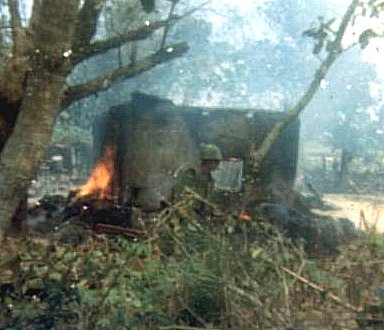
On July 1st 1965 Vietcong sappers attack the heart of the Marine presence in Vietnam - the Air Base at Da Nang. Although the losses are of minor significance, the propaganda value to the VC is incalculable, and pressure builds to allow the Marines a more aggressive posture.
Marine Patrols ordered to secure Vietnamese villages face problems none have before encountered. Marine training, the toughest in the United States armed forces, has not prepared men for an enemy hidden amongst the civilian population.
This is a new world, a world in which villagers are fearful, hostile by turn. A community of apparently peaceful farmers could harbour a deadly guerilla army.
For the Marines in Vietnam the nightmare is beginning - a hell of snipers and of booby traps, of ceaseless fear and suspicion............
Taylor Publishing Company, Dallas
A History Of Our Battalion
1 Nov 63 - 12 Apr 66
From fireteam tactics to the battalion FEX many days and nights were spent in classrooms and in the field.
While becoming acquainted with Case Springs, the firing ranges and the hills around the San Mateo area, we watched the situation in Southeast Asia develop, wondering how long it would be before we would put this training to practical use.
After a well earned 'ninety-six' we began preparing for our overseas tour.
We shipped from San Diego March 14 aboard the USS General J. C. Breckinridge.
Aboard ship we attended lectures, stood inspections and continued training, even though some of us suffered seasickness.
We got liberty in Hawaii and Yokohama and on April 2 off-loaded at Naha Port, Okinawa.
That same day we officially became 1st Battalion, 9th Marines when we traded colors with the old 1/9. We were now a unit of the 3rd Marine Division.
The 'like new' barracks at Camp Hansen were quite an improvement over the living quarters at Pendleton.
Almost immediately Bravo Company set out for the Northern Training Area for a lengthy stay as host company. Delta Company went to Raid School and was soon followed by Alpha Company.
All of the line companies spent a very wet ten days at NTA for jungle warfare training. Not many of us realized at that time how valuable that training would be.
We weather a couple typhoon warnings with no more than heavy rain and a bit of wind. We even weathered a few weekends in such unlikely spots as Kin Village, Koza, Kadena, Naha and Four Corners.
In the field we worked with many of the units that were to join us when we became a Battalion Landing Team.
When we got the word: "pack your gear and be ready to board ship by June 12, you're going to Vietnam as BLT 1/9," it came as no great surprise.
We suspected something like this would happen, but we had had our hopes set for Fuji.
A hectic two days and nights of loading and we were under way.
Remember how happy those "salts" in 3/9 were when we "walked" ashore at Da Nang. They sure were glad to see us. In fact, they started loading even before we were all ashore.
Bravo moved out immediately to participate in an operation in the western TAOR while the rest of us moved to Da Nang airfield and began to improve the positions.
Then the word was passed that most of the CP would be moved to the base of Hill 268 within 24 hours to make room for the Force Logistics Support Group (FLSG).
Every now and then a Viet Cong sniper would try his luck at us, but usually nothing came of it Except once in a while one of them would get lucky and get close enough to make the dirt fly.
On July 1 the VC sent a suicide squad equipped with 81 mm mortars and 57 mm recoilless rifles to the airfield. Before it was over three Air Force jets were destroyed and three were damaged. Later on we captured one of the VC who participated in the attack and from him learned that thanks to our alertness they didn't fully accomplish their mission.
Shortly after this we moved back to the airfield. By now we were beginning to feel like Ringling Brothers with all that moving around.
We stayed at the airstrip for a short time before we got word that we were to move again.
We got pretty comfortable down by the Cau Do River, but it wasn't long until we moved to Marble Mountain.
When we were instructed in the finer points of the inter-Division Transfer System that was being initiated so that the rotation tour dates would be mixed in each unit, we lost a lot of friends and comrades to other outfits.
That night the VC hit Da Nang East, Da Nang Main and Chu Lai was a real thriller. With Da Nang East just a mile down that bumpy road we saw some action. We lost a lot of choppers that night and MCB-9 got it pretty bad but we got about 20 of them.
Life at Marble Mountain was a steady stream of sweeps, village searches and perimeter security, but we soon got strong back tents to live in and life wasn't so bad after all.
We may have moved again before this book is off the presses but we'll do our best wherever we are because we're an organization rich in the spirit and pride that makes the Marine Corps the best fighting force of its kind in the world today.
Before they left Vietnam the 1st. Battalion 9th Marines had earned the nick name "The Walking Dead."