this is a repost of an article I wrote for the Japan Times in 2003
DECREASE IN HUMAN RIGHTS SUPPORT FOR FOREIGNERS IN JAPAN
By Olaf Karthaus, April 14, 2003
Freely forwardable
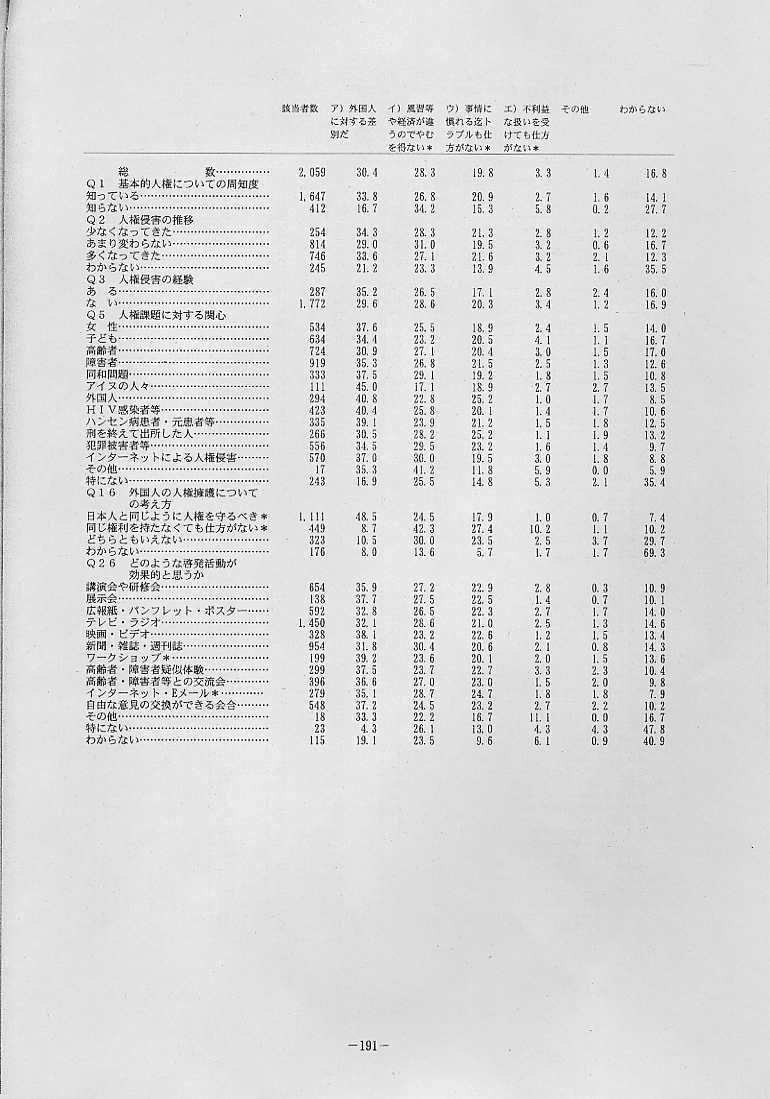
On April 12, 2003 the Japanese government published a report on human rights of foreigners in Japan.
The scanned report (10 pages) can be seen at
http://www.geocities.com/okarthaus/jinken1.jpg
http://www.geocities.com/okarthaus/jinken2.jpg
http://www.geocities.com/okarthaus/jinken3.jpg
http://www.geocities.com/okarthaus/jinken4.jpg
http://www.geocities.com/okarthaus/jinken5.jpg
http://www.geocities.com/okarthaus/jinken6.jpg
http://www.geocities.com/okarthaus/jinken7.jpg
http://www.geocities.com/okarthaus/jinken8.jpg
http://www.geocities.com/okarthaus/jinken9.jpg
http://www.geocities.com/okarthaus/jinken10.jpg
3000 Japanese citizens were asked if they think that foreigners should enjoy protection of human rights to the extend of Japanese.
In the following I will give my analysis of part of the data. The poll is a whole bonanza of information.
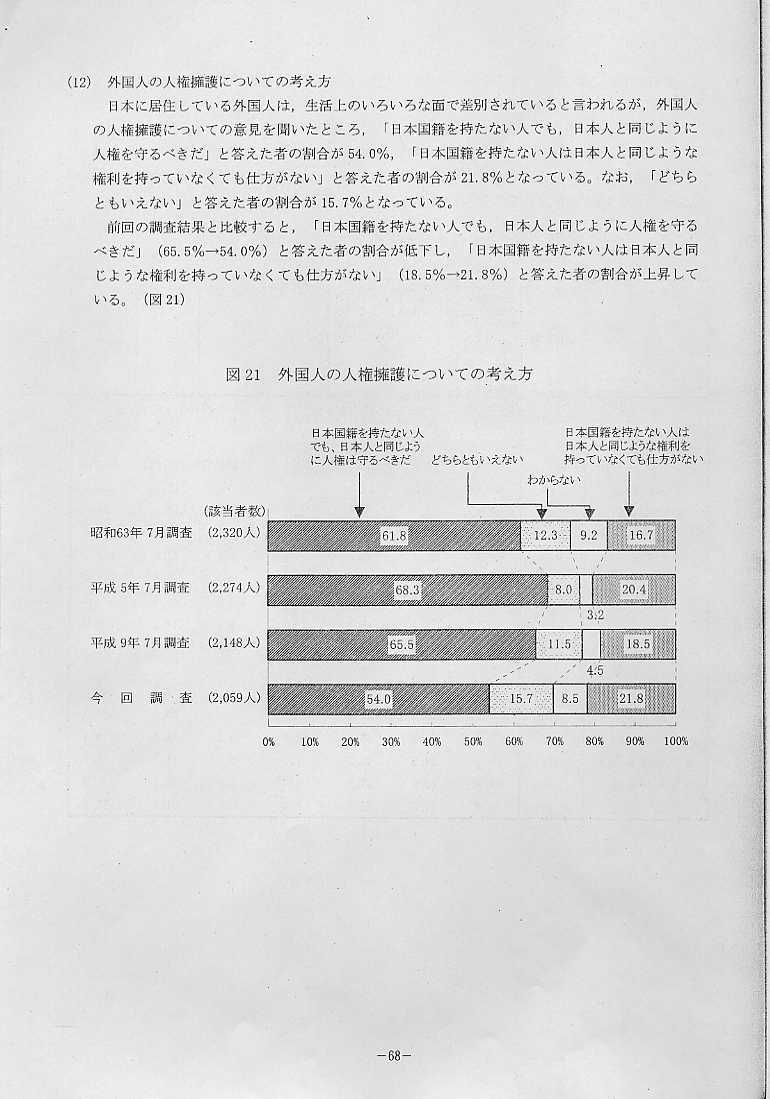
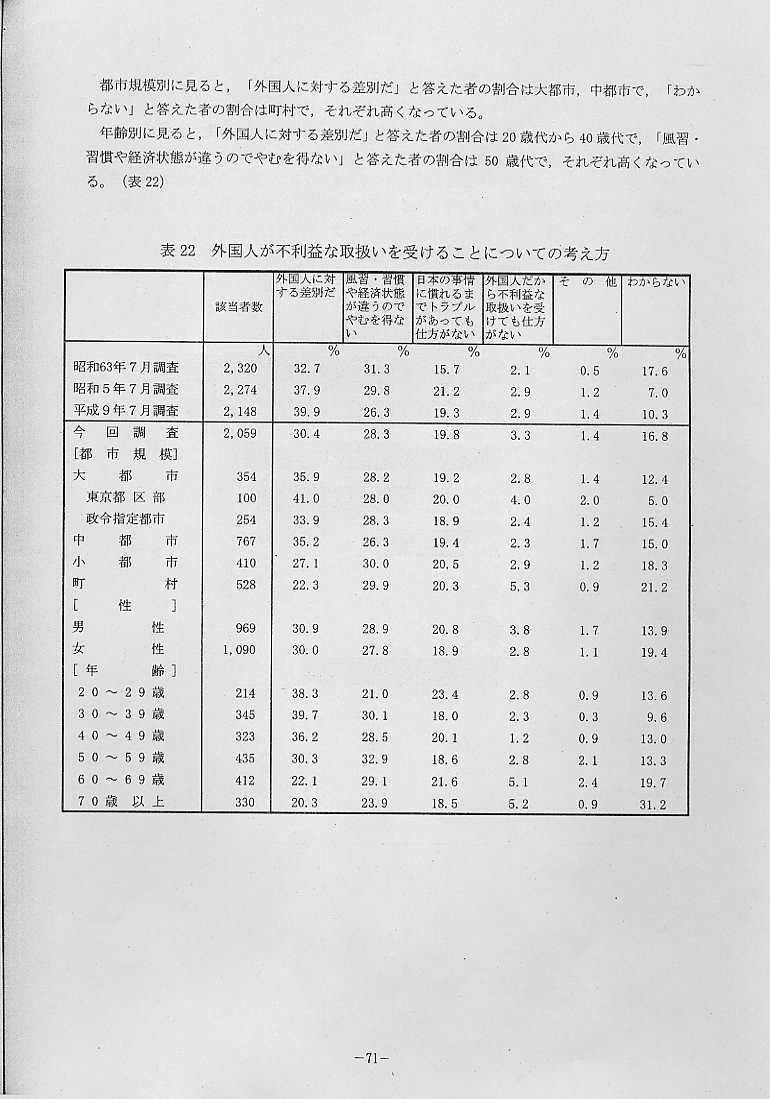
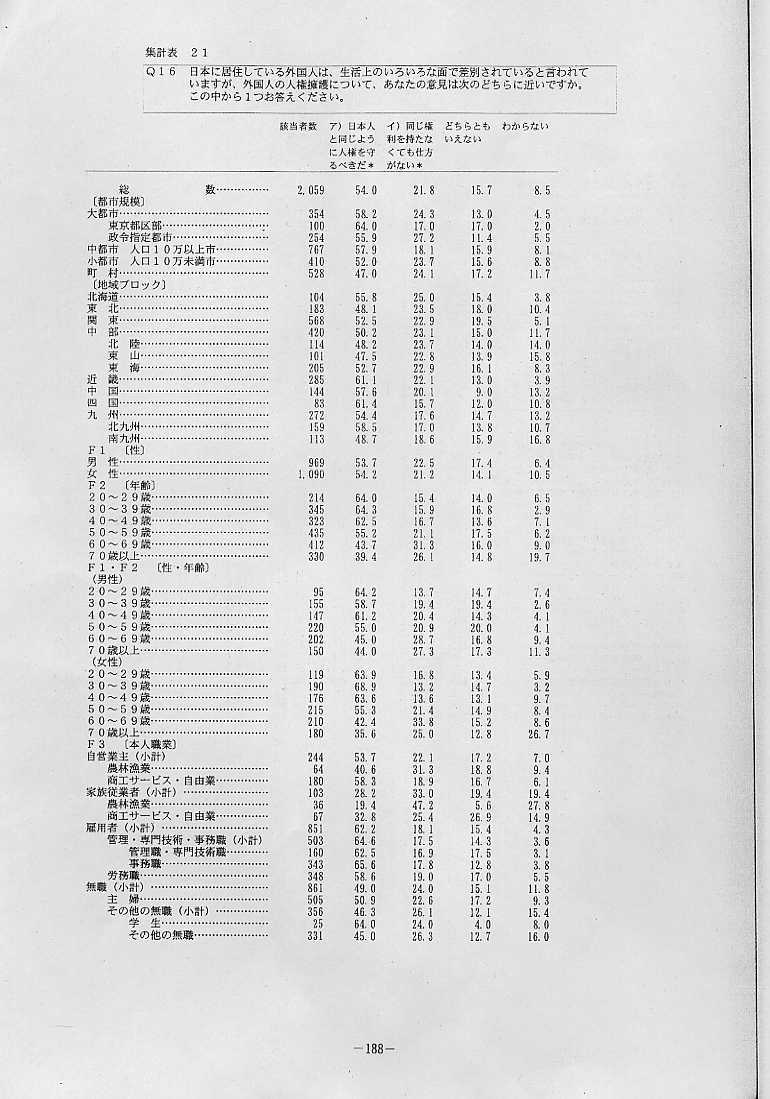
Overall 54% said that foreigners should have the same protection of human rights as Japanese (nihon kokuseki wo motanai hito demo, nihonjin to onaji you ni jinken ha mamorubeki da). This is a steady decline from 68.3% 10 years ago, and 65.5% 5 years ago.
On the reason it can only be speculated, but newspaper articles quote from the Justice Ministry that maybe the sudden rise in crime by foreigners may have affected the outcome of the poll.
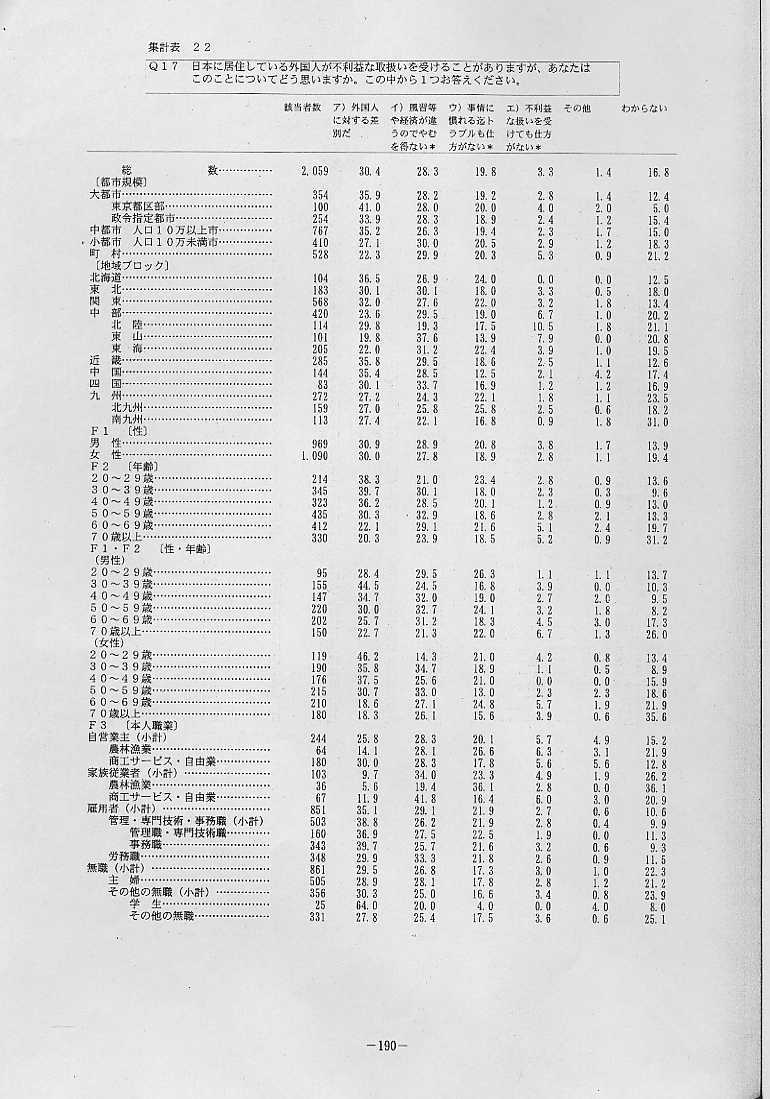
In the same period, the percentage of people who answered that it canÕt be helped that foreigners have not the same rights (nihon kokuseki wo motanai hito ha nihonjin to onaji you na kenri wo motte inakutemo shikatta ga nai) first fell from 20.4 to 18.5% and then rose to 21.8%, and thus is more or less unchanged.
Interestingly, the percentage of people answering "I don't know" or "neither of both" more than doubled from 11.2% to 24.3%.
Japanese people do not know what they should make of the "problem" of human rights. This is due to the lack of decisive political action to clearly establish that human rights have to be protected, no matter for which nationality. The lack of clear legislation and court decisions create a vacuum which leaves lots of space for ambiguity.
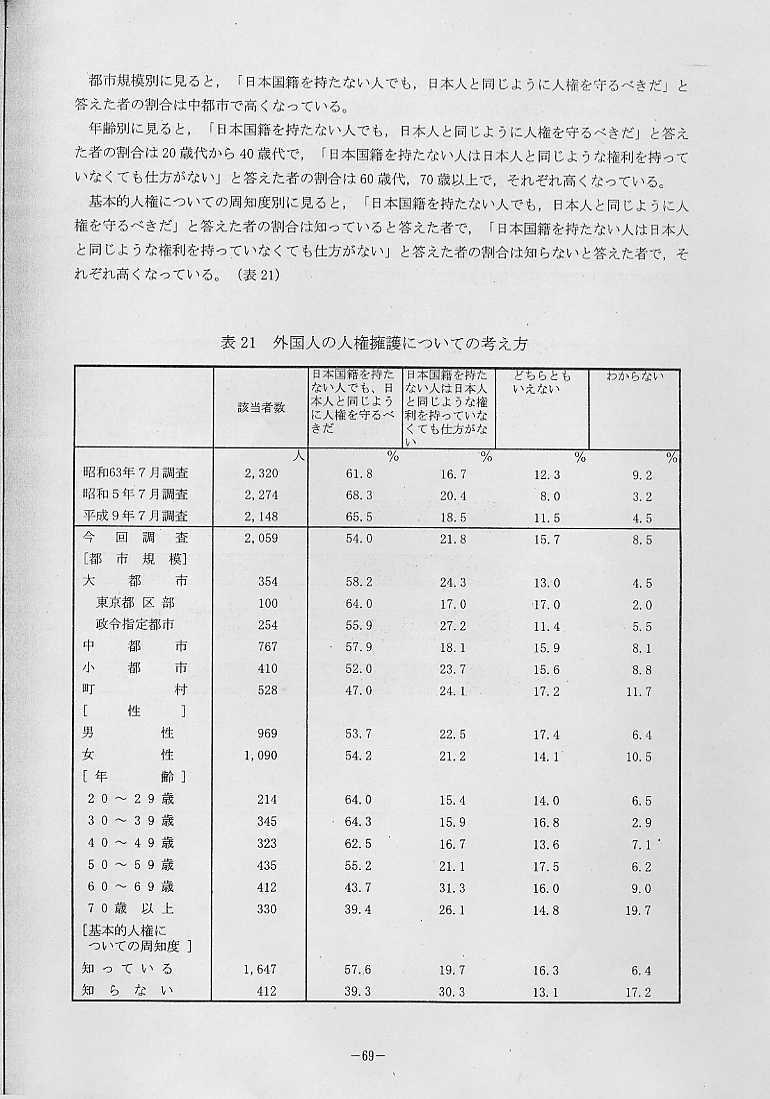
There is also a clear trend concerning the age, education level and living conditions of the polled persons. The older the person, the less supportive he/she is for protection of foreigners (more than 64% in the 20-39 age bracket, but only 39.4% in the above 70 years bracket. 64% among people who live in a megapolis but only 47% who live in rural areas. More than 64% among students and office clerks, but an alarming low number of 19.4% among farmers and fishermen in family businesses)
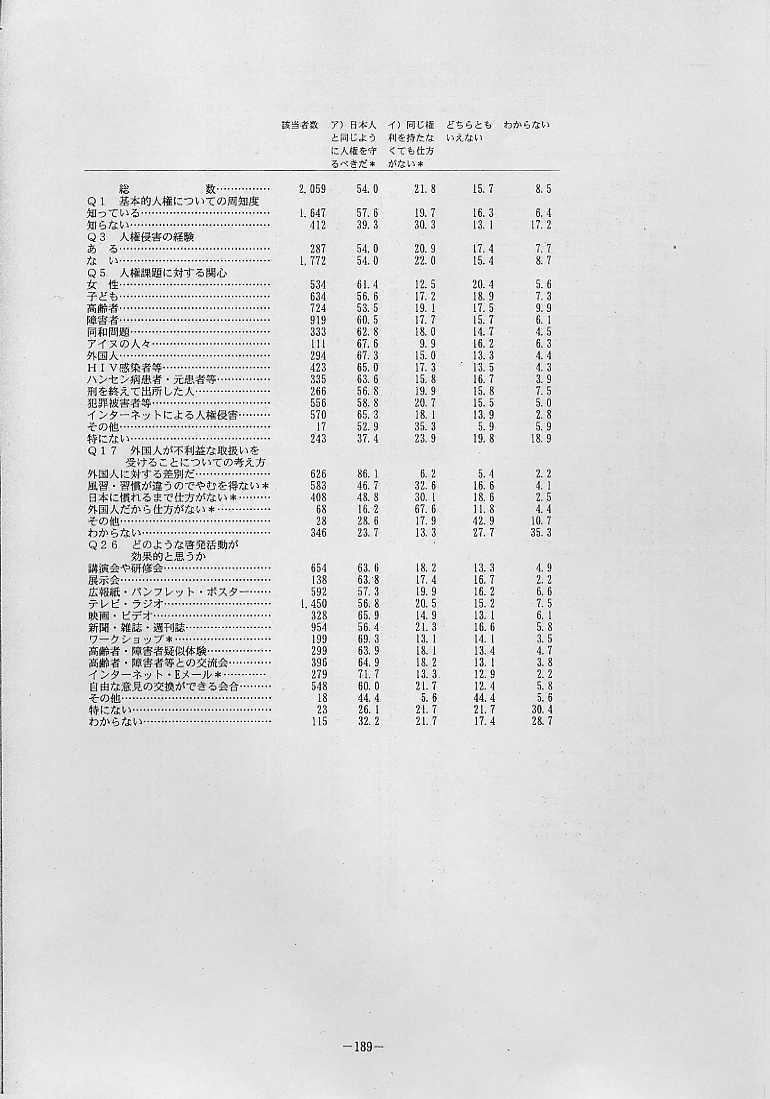
Very interesting differences also exist if the polled person knows about basic human rights.
57.6% of the people who knew basics about human rights (kihonteki jinken ni tsuite no shuuchido shitteiru) support same human rights for foreigners, and only 19.7% said "shikata ga nai".
This clearly shows that the better the general education and the knowledge of the basics of human rights is, the higher is the acceptance that foreigners should enjoy the same protection as Japanese.
CONCLUSION
It seems that the lack of proper information of the Japanese people is one of the reasons why the support for the protection of foreigners in Japan is dwindeling.
Moreover, the most unsupportive people are those, who barely have any contact with foreigners (rural people in farming and fishing business). This also proves the lack of information on the issue. Lack of information is by the way the best breeding ground to built up prejudice.
If the Japanese government, especially the Human Rights Bureau of the Justice Department (Jinken yougobu) would intensify their efforts in educating the unknowing, the result of the polls would be better. The poll itself gives enough suggestions how to increase awareness: via internet (71.7%), in workshops (69.3%), in meetings with the elderly (64.9%), and so on. It has to be noticed that the favorite way of educating people of the Human Rights Bureau is to issue posters, but this way of advertising human rights was ranked second to last (only 57.3% thought this would be effective) among the polled people.
Furthermore would the society profit from a clear-cut legislation on the issue. Away from the present ambiguity to a clear framework of the dos and donÕts of human rights in Japan
Here is the final and even more basic question: why is such a poll necessary anyway? ShouldnÕt it be clear and common sense that people should enjoy the same level of human rights, regardless of nationality?
Not so in Japan, it seems.