O.R.--SERIES I--VOLUME LI/1 [S# 107]
JULY 11, 1861.--Engagement at Rich Mountain, W. Va.
Reports of Lieut. Orlando M. Poe, U.S. Topographical Engineers. [ar107_11 con't] WASHINGTON, D. C., August 18, 1861.
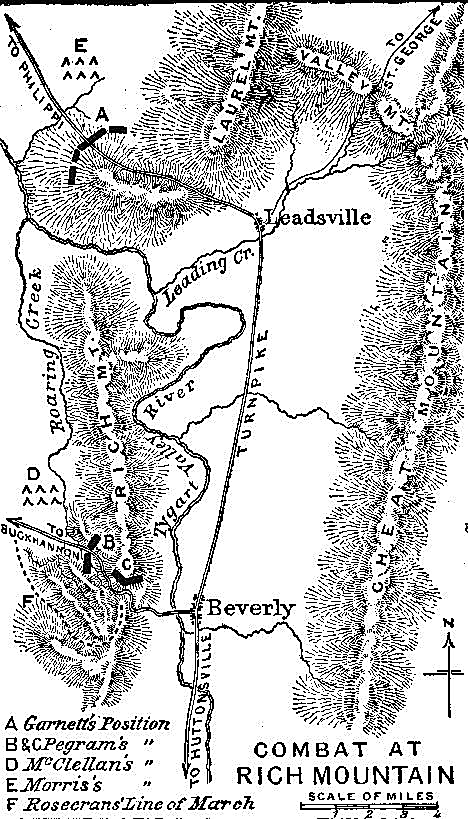
SIR: In accordance with your directions I have the honor to submit the following report upon the operations of the Topographical Department in front of the enemy's position at Rich Mountain and in explanation of the sketch forwarded to the Bureau of Topographical Engineers under date of August 6, 1861:
The fight at Rich Mountain took place at the crest, where the Parkersburg and Staunton turnpike crosses, at which point the enemy had After marching about six miles, I left my position near the commanding general and rode to the front, taking my position in the advanced guard. As we debouched from the woods about half a mile west of the Roaring Run bridge we saw, a few hundred yards in front of us, a cavalry vedette, which exchanged shots with us and then fled, pursued by a detachment of our cavalry, but without catching them, the enemy having destroyed the bridge, a fact not known to us until our cavalry were upon its site and found it gone, while the enemy had crossed by a ford a few hundred yards below the bridge, and were already beyond our reach. From a knoll just in front of the woods alluded to the enemy could be plainly seen in his intrenchments some two miles to the eastward and on the line of the road. I at once rode back and informed General McClellan of the condition of affairs and the necessity for rebuilding the bridge over Roaring Run before we could cross it with our artillery and baggage. He rode forward himself to examine it, and, concurring in my opinion, ordered a halt, and afterward that tents be pitched. The next morning (it being too late to do so the evening before) he directed me to make a reconnaissance in force. For this purpose the brigade then under command of Col. R. L. McCook was detailed. This brigade consisted of the Ninth Ohio and Fourth Ohio Regiments, commanded by Colonels McCook and Lorin Andrews, and the Coldwater (Michigan) Artillery, Captain Loomis. All were three years' volunteers and formed the advanced guard of the army. Upon reaching the ground where the brigade was to form I found the two regiments mentioned and four field pieces without caissons; also Colonels Lander (now brigadier-general) and Key, both of the general's staff, who accompanied me as volunteers. We moved forward at once until we reached our outer picket, when we halted and threw out our flankers, composed of six companies of the Ninth Ohio Regiment. And here I must allude to the admirable manner in which these troops performed their duty. I was totally without experience, yet it seemed to me that these men, under the immediate direction of Lieutenant-Colonel Sondershoff and Major Willich, of the Ninth, did their duty in the most perfect manner. The accompanying sketch will show the manner in which the flankers were disposed. In a few minutes we came upon the enemy's pickets and were fired upon, the field pieces in the intrenchments throwing canister and spherical case-shot to dislodge us from the woods, but our march never faltered until we reached a position some 200 yards in front of the enemy's works, where the troops were halted and remained quietly under cover of the woods while I obtained such information as was deemed necessary.
The works of the enemy were plainly seen, together with the obstructions in front (we were at the outer edge of them) and the whole disposition for defense. The troops were then recalled, and we returned to camp with a loss of 1 man killed and 2 wounded. We captured two From the reconnaissance I saw that we could probably carry the work by storm, but it would be with heavy loss, as the enemy's position was naturally a strong one. There appeared to be no other road leading to it but the turnpike, which it completely commanded. I. however, noticed a low ridge bordering a small brook which crossed the road a short distance (within canister range) of the works, and which appeared to run parallel with the direction of the enemy's lines and to increase in altitude as it extended from the road. Its front toward the enemy was a bold escarpment, and I was of the opinion that it preserved this character for some distance. The next morning, some hours after the departure of General Rosecrans with his brigade, intended to turn the enemy's flank and attack the redoubt of which information had been given by the prisoners alluded to, I was directed to move forward, under escort of eight companies of the Third and all of the Fourth Regiment Ohio Volunteers, Colonels Marrow and Lorin Andrews, until the ridge spoken of above was reached, and then to move up this ridge, to ascertain whether a position could be found from which the works could be either enfiladed or taken in reverse by a battery of 6-pounders to be placed there; this reconnaissance to be made provided it could be done without alarming the enemy. I found, upon reaching the head of the escort, that through some misunderstanding upon the part of brigade commanders, our pickets had been withdrawn from the advanced positions we had reached the day before, and that we had all the ground to go over again. However, our flanking dispositions were made and we moved forward. We had gone but a short distance when a patrol of the enemy was seen in the road some 250 yards beyond us. They perceived us, and, of course, rendered it impossible to advance without giving the alarm. Under these circumstances I ordered a halt and sent to General McClellan, by the hands of Colonel Key (again a volunteer), the following dispatch: "The enemy's patrol in sight. Probably cannot occupy the position indicated without driving in his pickets. Shall we do so?" After an absence of an hour, during which we stood exposed to a pelting rain, Colonel Key returned with an affirmative answer, when we at once advanced, expecting momentarily to encounter their pickets, but for some reason not known they never fired upon us, but fell back to their works and we quietly occupied the desired position. I then placed the Fourth Regiment in reserve, put four companies of the Third in ambush by the side of the brook, and moved up the crest of the ridge with two companies deployed as skirmishers along the crest, one company deployed at right angles to the crest, and connecting with head of the other line, and one company inside of the angle thus formed, which was intended to act as a support to either line, if attacked. We advanced with the greatest care, knowing that we might be attacked at any moment, but the enemy made no demonstration whatever, and after some three hours of severe labor in crawling through laurel and over rocks we reached what seemed to me to be the proper site for a battery to accomplish the desired purpose.
I sent a man to the top of a tree, and his report fully confirmed me in my opinion. I then returned to the main road as rapidly as possible. Meanwhile General Rosecrans had gained the enemy's rear, and after a sharp fight carried the redoubt already described, and when I reached the road I found General McClellan with his available force drawn up All of which is respectfully submitted by your obedient servant,
ORLANDO M. POE, Lieut. Col. HARTMAN BACHE,
First Lieutenant, Topographical Engineers.
Commanding Topographical Engineers.