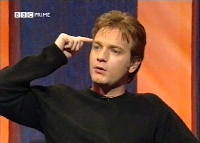
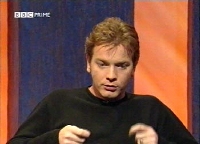
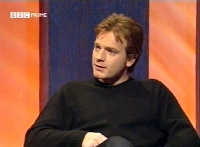
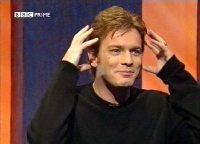
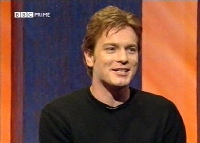
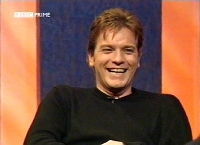
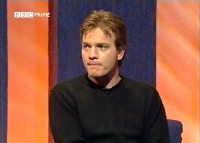
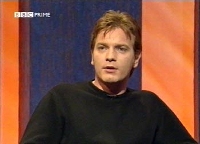
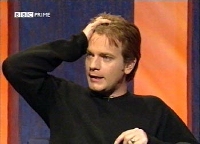
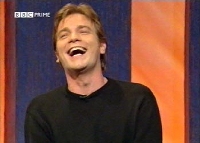
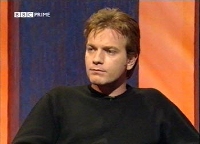
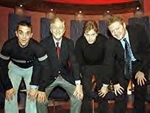
Ewan turns to first guest, Rory Bremner:
Ewan: You were very very good. I thought you were terribly good.
Bremner:You enjoyed that, did you?
Ewan: Yeah. I was thinking, Oh my God!
I just don't have so much to say myself, that's all.
Parkinson:In ten years you've gone from being a drama student to being in the new star wars. You couldn't have known, at sixteen that this would happen to you, could you?
Ewan: No, no. I didn't know where...cause it's a funny thing when you want to become an actor, you don't know quite where it's gonna go, and I wanted to get into drama school and I put everything into getting there, and then you get there and you don't know what that's going to be like for three years, and then when you get out you don't know where you're going to end up, you know, I was driven always, always driven to go as far as I could but you don't know if it's going to be the theater or here or whatever. But it's kind of a fairy tale where I've got to.
However, I was always very arrogant about it and I never ever imagined it any other way at the same time, you know. I never considered the alternative. So, I'm here and I'm, of course I'm here. (laughs) But it is cause you know the way you're going.
Parkinson: But in your job, the first thing they say you have to learn is rejection. But apart from one which we'll talk about in just a moment, you've never been rejected. It's been smooth all the way. The rejection, of course, which I now want you to tell me about, because whoever rejected you must be now looking for other work, was when you went to RADA.
Ewan: They're sorry now! RADA! (laughs) and v-signs as the audience. Well, this is the thing, I was sixteen as you say and I didn't have any money and I was living in Scotland. I was in a one year drama course up there and I came down to audition in London for drama schools. So my first one was RADA and they charge you thirty quid or something and I didn't have any money and then sixty quid for the train or whatever, you come down and you've spent about five hundred quid and you're skint and I walked into the room and there was one guy... Oh, this is great! This is the first time I've got my own back at RADA (laughs). So there was one guy behind... one guy! And surely if you're going to test people whether they're talented and interesting to become actors or not maybe you should have a couple of people, maybe three or four! And there there was one man behind a desk, I forget his name unfortunately cause I'd love to mention it right now (laughs) but I don't know who he was. And he was sitting there and I walked in, I was seventeen. I was going to be eighteen by the time the year started and I was going to get in, you know. And he went 'so Ewan, come and sit and have a chat' and I went, well, surely you'd like to see my speeches first. Had them all under my belt, Shakespeare and everything, and he said, 'no, no, come and sit down and we'll have a wee chat. How old are you?' I said seventeen. He went 'oh, you've got a good few years of auditioning yet'. I just went, excuse me? I just paid... wedged down a hundred quid to get down here, you know, and you've written me off already! So. That was RADA. And I hope that f... I hope they're very sorry now.
Parkinson: But you used an interesting word when....
Ewan: I almost used a more interesting word a minute ago. (laughs)
Parkinson: I'm glad you didn't.
Ewan: Yes, thank you.
Parkinson: But, you used that word driven and it's a strange word for you reflecting on being sixteen years of age. It's a strange word for a 16 year old to use. What drove you?
Ewan: I don't know, I mean, I was going to be an actor since I was nine. My uncle is an actor called Dennis Lawson.
Parkinson: Good actor.
Ewan: Top actor. And so he'd come up to Scotland when I was a kid, y'know, and he was an extraordinary character for... I was brought up in a small place called Crieff which is a lovely place and you should all go there on holiday! However, it was a place that maybe when you're sixteen you want to get out of to go and do other things. And my uncle would come up. There was a lot of tweedy people in Crieff, y'know, a lot of tweedy farmers and stuff, which is nice, but my uncle would come up with long hair, sheepskin waistcoat and beads and no shoes and give people flowers and stuff. And I'd go, 'who's this man?' And so it fascinated me, and I guess when I was at that age, nine, you don't know what being an actor is going to... what that will be. But I wanted to be different like him, I think. So I decided by then and... I went through school and progressively got worse through school as I was just dying to get away and do other things, y'know. So I was always driven
Parkinson: I mean, that must have been worrying to you, I mean, your dad was a teacher at the school and so your parents must have had an academic plot laid out for you, and there you are at sixteen saying I don't want school at all, I mean the only thing that interested you at school was music, wasn't it?
Ewan: That's right. I had a great love for music and art as well. They don't let you do that, though. They think you're coppin' out which was a shame cause when you get to an age when you got to choose your subjects I always wanted to do art and music and they were like, no! And I was going, why? And they said, well, because that's not very serious, is it? And I was going, no, I'm very serious about it. I'm very serious about art and music. 'I'm sorry, you've got to do chemistry and maths and...'
Parkinson: That's very foolish, isn't it?
Ewan: It's silly cause basically you're just knocked on the head from then on and I became less and less interested.
Parkinson: But you did learn to play the French horn.
Ewan: I did, yes.
Parkinson: And you made your television debut...
Ewan: A clip, I know you've got a clip! (covers his face with his hands)
Parkinson: You're going to see Ewan McGregor's debut on television playing the French horn.
Ewan: (commenting on the clip) Oh my God!
I could play, though, you see... a bit.
Finger close-up.
All right, thank you very much.
Parkinson: So then you went to drama school and then on to make Shallow Grave and Trainspotting, the movie which really sort of made you famous. Extraordinary, extraordinary powerful film. How did you approach the business of the drug addiction, of being a heroin addict. What kind of research did you do?
Ewan: Well, I mean, it started the day I read the script. Andrew and Danny gave me the script when we were publicizing Shallow Grave in America and they had just got the go-ahead from channel 4 to make the film and they gave it to me and as usual were very cagey and said well, you know, we're not offering it to you but see what you think. And that was, from that moment, you know it was like a million birthday presents, it was quite an amazing script to read as you can imagine and it started then, that's the way I work anyway. I don't necessarily do a great deal of research or a lot of library work but I do a lot of thinking and working with my gut, and my instinct I think, so I was thinking about it from that moment. And then when they said I could do it, I started to read an awful lot about hard drugs and addiction and crack and smack and all the different... cause, you know, addictions are a problem of its own, regardless of the drug, I think. And then, we went up to Glasgow and met... we went to a group of people called the Carlton Athletic club who are all ex-users and who don't use any methadone or any substitute drug but they use each other to help each other off and they have things like football teams and, you know, a kind of weekly program. And they're most incredible people, inspirational people. And meeting them was.... cause I think when I got on the plane, when I went up there with Danny, I still had a wee element of the glamorous... the heroin addict and the glamour of that. Of course there is none but even in the plane on the way up I still had a wee bit of that till I met these people and listened to their stories and saw people who had just come off heroin and that immediately disappeared, you know, cause there's no place for it. It's a nightmare, it's a nightmare of a drug and it's a living hell these people... that they live.
But I'm so proud of the film still cause I think we told the truth, I think we showed it the way it is. And of course, to begin with, there's got to be some upside to it cause otherwise why are people doing it? I think we were quite brave with that, we showed that. But then, of course, is a very quick downward spiral.
Parkinson: Now you're appearing in every other film that's being made. Slight exaggeration but I think there are four waiting in the wings,aren't there?
Ewan: There's a few, yeah. There's a lot of British films waiting in the wings in general. I mean, it's fantastic at the moment cause we're making so many more films than we used to, which is great.
Parkinson: Can I ask you a cheeky question?
Ewan: (Smirking) Go on.
Parkinson: In these four movies, how many times do you take your kit off?
Ewan: In these four movies?
Parkinson: Cause in many movies you've...
Ewan: I like to get it off. I was watching Billy Connoly on the show the other day and he likes it and so do I. (laughs)
Parkinson: What about Hollywood? You've been there, you've done that. Did you enjoy it? Is there when the future lies for you?
Ewan: I don't know, hmm... be polite, hmm... I don't like it so much. I made one movie there. I made the film with Danny Boyle there, A life Less Ordinary, but we made that in Utah, which is a whole other experience all together, but L.A., I don't know, I had a good time making a film there because that's all it's about that town, it's only for making movies and there's nothing else there and I think to stay there, you just dry up. I mean, in London, we have so much stuff around us, I mean there's art, there's music, there's theater, you know there's beautiful buildings and great people around the place. But in L.A. there's only the movie industry, it seems. And, you know, big Jeeps and big roads.
Parkinson: But that's what they've got that we haven't - the movie industry.
Ewan: Yes, well, we're getting it back, we're not doing too bad.
Parkinson: Let's talk about the movie industry. Are we ever going to be able to match Hollywood, or at least compete properly? I mean, we make little movies now and some become successful like Trainspotting and Shallow Grave or whatever, but we don't make the substantial diet...
Ewan: We make terribly good movies though.
Parkinson: We do because we've got good writers and good actors...
Ewan: It depends on how you compare it, I mean, I think, you know there's a great many good independent small movies come out of America. And I'm more interested in making movies like that than making the big... I don't want to name any names! (laughs)
Parkinson: So you don't want to do Titanic, you don't want to do Independence Day, you don't want to do any of those things.
Ewan: I don't want to do Independence Day, that's for sure, no. But... I don't know, we've got really good writers, I think, here, we've got incredible facilities in Britain, all the studios are brilliant, the best technicians in the world and we make really really good movies. Now, they're not gonna make 400 million dollars. But then they're not gonna cost 400 million dollars either.
Parkinson: You think it's obscene what they cost.
Ewan: I think that it is, yeah. I think that it's very difficult, hmmm, I had this argument with my wife or someone. Because what do you say if a movie costs 250 million dollars? I immediately go, that's disgusting, you could feed Africa, it's appalling. And it is. But then, the next thing is well, it made it's money back and that money is played back into the movie industry in America, so what's your point? And then I have to go, oh...I don't know! I don't know but I don't like it. I don't know if we'll ever compete with them but I think the quality of our work is far superior.
Parkinson: Just one final question. Now that you're working on this new trilogy of star wars, cause you play the young Alec Guinness part, don't you?
Ewan: I do, yeah.
Bremner: Was he advising you?
Ewan: No, I didn't go meet him. I didn't know quite what to say. Hi, how did you do it? (laughs)
Ewan and the audience laugh
Bremner: (doing Guinness's voice) Do you play the French horn?
Ewan: Only naked, dear boy.
The audience go mad :)
Parkinson: About the trilogy, the last one should be around 2001, by which time do you know what will happen to Harrison Ford?
Ewan: Luke will happen to him. Luke will happen to Mark Hammil, though hey? Uff!
I would like to be Carrie Fisher the most. I always wanted to be Princess Leia, the buns thing, I love that. She was probably my first crush, you see. I had a serious crush on her, cause she looked great with those Danish things and I would have liked to play her. But it's interesting cause I don't know when we'll finish, I don't know when we'll do the next one - you seem to know more about it than I! (laughs) The next one I think is made in the year 2000 and then we'll see.
Parkinson: By which time you will have 125 films under your belt, at your present rate.
Ewan: Well, we'll see what happens.
Parkinson: Thank you very much. Ewan McGregor!
Next guest comes in, Robbie Williams after singine Angels and half way through the interview he tells a story about being in a bar with Max Beesley and being asked to be in a movie about drugs. Turns to Ewan and says: I don't think it was his (turning to Ewan), I think it was someone else's
Ewan: (leaning back in chair) I should imagine it wasn't mine, no. (laughs)
Ewan then asks Robbie a question:
Ewan: What was it like to stand in front of 20.000 people and probably more. Because I can't... all actors want to be rock stars and all rock stars want to be actors I think. Cause I'd love to know what that was like.
Robbie: Sometimes there are so many people watching that there is no one there.
After another while Robbie Williams touches Parkinson's knee:
Ewan: I'm annoyed you touched his knee cause I always wanted to do that.
They exchange seats so that Ewan can touch Parkinson's knee and the whole audience cracks out laughing, then they change back.
Parkinson: Would you like to send a message to your mom as well.
Robbie had started his interview off saying how he'd only been allowed to stay up past his bed-time to watch Parkinson and said to the cameras, "Mum, look - Parky!" He also persuaded Parky to pose for a 'photo' with him as his mum has "one of those video players that can print stuff out"!
Ewan: Oh, yeah... hello... (looking very shy)
At the end of the show, Parkinson thanked all his guests and their mums.
Classic :)