|
|
Why do so many grownups like WTP so much? |
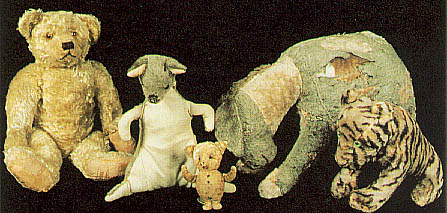
I had heard or read somewhere that Milne's stories and verses about Christopher Robin and his collection of stuffed animals weren't really written for children at all, but for the child in all of us. This conjecture was recently confirmed at a performance by Peter Dennis, one of my favorite Poohologists and the creator of "Bother!", a delightful one-man show made up of readings from the stories and verses of Winnie-the-Pooh.
But even without Dennis' validation, one need only read a few chapters aloud to a child to realize that most kids just don't "get" the subtle humor and sophisticated sarcasm in Milne's hysterical dialogue between characters.
Heck, I didn't get it myself until I was in high school. It was at that time that I stumbled upon The Pooh Perplex by Frederick C. Crews. Being a teen of very little brain, I never occurred to me that all of the "critics" in Crews' work (Smedley Force, Duns C. Penwiper, Simon Lacerous and P.R. Honeycomb among them) were make believe. No, all I saw in this humble little paperback was an opportunity to chuck the satire of Gulliver's Travels for a term paper on Winnie the Pooh.
Creative use of Crews' work (which I later decided was pretty much bordering on plagiarism) as well as a few other sources led to what my English teacher (who knitted her brow in doubt when I proposed the topic) dubbed "...a fine and mature effort. One of the best I've seen in high school." It's the only time I got a whole A and not an A- for my horrible typing and even horribler spelling (My spelling's wobbly...).
Anyway, if you're interested, here's my absurd term paper, A Critical Study of Winnie-the-Pooh In Which We Discover the Lost Paradise of Childhood, written for English 189, 7th hour, May 14, 1982. I've since corrected the spelling errors. At least most of them.
In Which We Discover the Lost Paradise of Childhood
by
Paula Rumple
A Research Paper
Prepared for Mrs. Schiller
English 189
7th hour
© Copyright Paula Rumple, May 14, 1982
Thesis: This paper will demonstrate that with an elementary understanding of the Winnie-The-Pooh stories, one can see the lost paradise of childhood represented by the world of Pooh.
(Here is where the required outline goes, but you'll have to do without, because I don't feel like typing it, and besides, who looks at outlines anyway?)
A.A. Milne's stories about Winnie-The-Pooh and his friends were some of the greatest stories ever written for children. However, one might be surprised to learn that "Milne himself insisted that he wrote ... 'for grownups, and more particularly for two grownups. My wife and myself.'"1 What then, was the purpose or inner necessity of Winnie-The-Pooh? It was obviously not to recount little episodes that would engage the attention of small children,
... for the stories as stories are ... notably lacking in elements of the violent, the fabulous, the quickly thrilling. A precis of any chapter might cause us to wonder whether the book has any appeal whatsoever: a toy bear and a toy pig follow their own tracks around a tree until they are told by a small boy that this is pointless, and all retire for lunch.2
The stories achieved their effects through sly manipulation and secret implication, not through what they directly narrated. This paper will demonstrate that with an elementary understanding of the Winnie-The-Pooh stories, one can see the lost paradise of childhood represented by the world of Pooh.
A mistake that has been made by many previous "Poohologists" is the confusion of Milne the writer with Milne the narrator, and of Christopher Robin the listener with Christopher Robin the character. These are not two personages, but four, and no elementary understanding of the stories is possible without this realization.3 The real A.A. Milne was writing a book in which he, translated into the Milnean voice, was to narrate stories for the teaching and amusement of his son in the role of listener. These stories had to do with various characters, among whom were "Christopher Robin." The character of "Christopher Robin was not Milne's actual son, but a character who was treated partly in a manner meant to teach Milne's son, as the Christophoric ear, and partly in a manner demanded by the ear to flatter its own egotistical conception of itself.4
...the beauty of childhood seems in some way to transcend the body. ...with this outstanding physical quality there is a natural lack of moral quality, which expresses itself, ... in an egotism entirely ruthless. ...In "Buckingham Palace" Christopher Robin is taken by his nurse to see the changing of the guard ... at the end of it all he had only one question to ask: 'Do you think the king knows all about me?' Could egotism be more gross?5
"Armed with our interpretive key -- the knowledge that all the 'harmless,' 'happy-go-lucky' stories in the book are really dictated by compromises between the edificatory wishes of the Milnean voice and the self-indulging wishes of the Christophoric ear..."6, one can begin to recognize the second principle that knitted the stories together; the principle being the Hierarchy of Heroism. A.A. Milne ruled the Hierarchy, however, a certain amount of power was granted to the Milnean voice, which in turn granted privilege to the Christophoric ear. The chain continued downward to Christopher Robin (the character) and then to Pooh, Christopher's favorite animal, Piglet, as Pooh's best friend, comes next, and so on down the line. "...Pooh remains triumphantly and uproariously the hero of Winnie-The-Pooh, ... But a clown, even an accidental one like Pooh, requires an audience to evoke his buffooneries; to inspire, reflect, and amplify; to act as foils, Pooh has a host of friends who are jesters in their own right and foils to the jests of the master..."7 Other characters such as Owl and Rabbit tried vainly to dominate the action, but more often than not failed because of low rating in the Hierarchy. At the bottom of the order of main characters was Eeyore; and below him was a long string of characters, concluding with Rabbit's friends and relations, Small, and Alexander Beetle.
The Hierarchy reflected what one might call a marriage of interests between the Milnean voice and the Christophoric ear. The animals near the top were the Christophoric ear's favorites, but the Milnean voice gave them traits which it (the voice) hoped that the ear would use as examples in its own life. When Pooh turned out to be more successful in one particular episode than Rabbit was, the Milnean voice may have been transmitting the message, "Look, Christophoric ear, the meek shall inherit the earth,"8 "A little didacticism, a little egoism; that is the rational of Winnie-The-Pooh's plot."9
The Hierarchy of Heroism was seen in a very complete from in "The Expotition to the North Pole." The Expotition chapter began with Pooh feeling neglected and probably asking himself whether his priority in Christopher Robin's Hierarchy had slipped. "One fine day Pooh had stumped up to the top of the Forest to see if his friend Christopher Robin was interested in Bears at all."10 Christopher Robin described the expedition as "A long line of everybody."11 "This, Milne implicitly informs us, is to be a tale which really has to do not with finding [the North Pole], but with a more or less savage emotional free-for-all over Hierarchical rank."12 "...in Milne, the essential action is to construct a hierarchy, to calculate one's superiority to someone else..."13 This idea was illustrated through the sarcasm with which Rabbit, who was somewhat of a power seeker, greeted Pooh.
'Hallo, Rabbit,' he said, 'is that you?''Let's pretend it isn't,' said Rabbit, 'and see what happens.'
'I've got a message for you.'
'I'll give it to him.'
'We're all going on an Expotition with Christopher Robin.'...
'We are, are we?' said Rabbit...14
"This impression is [also] heightened ... by the pell-mell confusion of all the animals gathered together; it is evident that no one intends to take a servile role in the Expotition."15 One should not be misled by such sentences as, "First came Christopher Robin and Rabbit, then Piglet and Pooh; then Kanga, with Roo in her pocket, and Owl; then Eeyore; and, at the end, in a long line, all Rabbit's friends-and-relations."16 "The true order is of course distorted here by Rabbit's ambition and Pooh's modesty..."17 A few moments later, in the "hushing" that was passed back from Christopher Robin to Pooh, Piglet, Kanga, and so forth, the order was accurately restored.
'Hush!' said Christopher Robin...'Hush!' said Pooh to Piglet.
'Hush!' said Piglet to Kanga.
'Hush!' said Kanga to Owl.
'Hush!' said Owl to Eeyore.
'Hush!' said Eeyore in a terrible voice to all Rabbit's friends-and-relations, and 'Hush!' they said hastily to each other all down the line, until it got to the last one of them all. And the last and smallest friend-and-relation was so upset to find that the whole Expotition was saying 'Hush!' to him, that he buried himself head downwards in a crack in the ground and stayed there for two days until the danger was over, and then went home in a great hurry, and lived quietly with is Aunt ever-afterwards. His name was Alexander Beetle.18
Pooh and his friends constituted what one might refer to as "humor" characters.19 In each of them, one characteristic was exaggerated for humorous effect. They were "...laughable and, at the same time lovable. They are laughable because they miniaturize our human eccentricities. Who has not met an over-indulgent Pooh among his acquaintances? Or a fearful Piglet? Or a pessimistic nay-sayer like Eeyore?"20 although Eeyore had a low rank in the Hierarchy, he was one of the wittiest of all the characters. "Part of the pleasure we get from Eeyore's retorts is that their sarcastic drollness always hits the mark..."21 He was at his best in Chapter VI of The House at Pooh Corner, "In Which Pooh Invents a New Game and Eeyore Joins In." Pooh, Piglet, Rabbit, and Roo were playing Poohsticks. The game of Poohsticks involved throwing sticks off of a bridge and seeing whose would float out from under the bridge first. Pooh thought he spotted Piglet's stick but it turned out to be Eeyore.
'Eeyore!' cried everybody. Looking very calm, very dignified, with his legs in the air, came Eeyore...'It's Eeyore!' cried Roo, terribly excited.
'Is that so?' said Eeyore, getting caught up in a little eddy, and turning slowly around three times. 'I wondered.'...
'Eeyore, what are you doing there?' said Rabbit.
'I'll give you three guess, Rabbit. Digging holes in the ground? Wrong. Leaping from branch to branch of a young oak tree? Wrong. Waiting for somebody to help me out of the river? Right. Give Rabbit time and he'll always get the answer...22
Milne was quite successful in capturing "...incomparably and enduringly, the frolic and indolence, the sweetness and foolishness, of animals which are also people."23 "Milne's other achievement [was] to have created, out of a few acres of Sussex countryside, a world that has the qualities both of the Golden age of history and legend, and the lost paradise of childhood -- two areas which, according to psychologiists, are often one in the unconscious mind."24 "...these books deal fundamentally, with a debate over true wisdom and an attempt to arrest the clock at the wisdom of childhood ... [the wisdom of childhood being] the mystic capacity to live only in the present moment."25 In the closing chapters of The House at Pooh Corner, Christopher Robin still affirmed his belief in doing nothing. "'...what I like doing the best is Nothing. ...It means just going along, listening to all the things you can't hear, and not bothering.'"26 Milne was aware that Christopher Robin must soon abandon his world for a more practical outlook.
Then, suddenly again, Christopher Robin, who was still looking at the world with his chin in his hands, called out, 'Pooh!''Yes, Christopher Robin?'
'I'm not going to do Nothing anymore.'
'Never again?'
'Well, not so much. They don't let you.'27
Christopher Robin, like every other child was destined to loose his innocence of intention. This was best represented through Pooh. He neither could, nor wished to think ahead more than a few minutes. "In contrast to the relatively 'adult' and repellent Rabbit, ... Pooh is essentially passive, a recipient ... of inspiration ... Pooh symbolizes this idea for Christopher Robin, while Rabbit and Owl stand for the opposite: self-important 'maturity,' nervous busyness."28
In spite of the stories' superficial simplicity, they have a universal appeal to any child anywhere who finds himself, like most children, at a social disadvantage in the adult world. What Milne has done is turn this adult world upside down, so that Christopher Robin "...is given a world over which he has complete power..."29 It is "...essentially a modern version of an archetypal legend, ... the story of a peaceful animal kingdom ruled by a single benevolent being. ...It seems no accident, therefore, that this Eden is in the shape of knowledge."30 "...implications of programmatic study, looking to the future, choosing a career, and therefore plunging toward final annihilation."31
The last chapter of The House at Pooh Corner was Christopher Robin's farewell, not only to childhood, but to the wisdom of the mystic present. It had come time for Christopher Robin to say goodbye to the Forest forever. He took Pooh up to the top of the Forest and dubbed him Sir Pooh de Bear. "...They went off together. But wherever they go, and whatever happens to them on the way, in that enchanted place on the top of the Forest, a little boy and his Bear will always be playing."32
One can extend the metaphor of the loss of Eden by considering it from a more positive view; that is, viewing it as some theologians have, as "the fortunate fall." With a knowledge of what one might have missed in childhood through ignorance and inexperience, and what one would miss in reading the Pooh books as a child, one cannot regret one's banishment from Paradise.33 "Milne offers assurance that we are growing toward something as well as growing away from something else."34 Appreciation of Eeyore's wit and Pooh's "artless artfulness" -- appreciation that comes only through knowledge, is the prize A.A. Milne awards for having left "our happy seat, to find the world was all before us."35
BIBLIOGRAPHY
Crews, Frederick C. The Pooh Perplex: A Freshman Casebook. N.Y.: E.P. Dutton and Co., Inc., 1965.
Lurie, Alison. "Now We are Fifty," The New York Times Book Review. (November 14, 1976), P. 27.
Milne, A.A. A.A. Milne, N.Y.: E.P. Dutton and Co., Inc., 1939.
Milne, A.A. The House at Pooh Corner. N.Y.: E.P. Dutton and Co., Inc., 1928
Milne, A.A., Winnie-The-Pooh. N.Y.: E.P. Dutton and Co., Inc., 1926
Sale, Roger. "Introduction: Child Reading and Man Reading," Fairy Tales and After: From Snow White to E.B. White. Cambridge, Mass.: Harvard University Press. 1978, pp. 16-18.
Swann, Thomas Burnett. A.A. Milne. Boston: Twayne Publishers, 1971.
Tremper, Ellen. "Instigorating 'Winnie-the-Pooh," The Lion and the Unicorn. Vol. 1. (Summer), 1977.
ENDNOTES
1 Thomas Burnett Swann, A.A. Milne, (Boston: Twayne Publishers Inc., 1971), p. 66.
2 Frederick C. Crews, The Pooh Perplex: A Freshman Casebook, (N.Y.: E.P. Dutton and Co., Inc., 1965), p. 5.
3 Ibid., pp. 5-6.
4 Ibid., p. 6.
5 A.A. Milne, A.A. Milne, (N.Y.: E.P. Dutton and Co., Inc., 1939), pp. 283-85.
6 Crews, p. 8.
7 Swann, pp. 90-91.
8 Crews, p.8.
9 Ibid.
10 A.A. Milne, Winnie-The-Pooh, (N.Y.: E.P. Dutton and Co., Inc., 1926), p. 110.
11 Ibid., p. 113
12 Crews, p. 10.
13 Roger Sale, "Introduction: Child Reading and Man Reading," Fairy Tales and After: From Snow White to E.B. White, (Cambridge, Mass.: Harvard University Press. 1978), p. 16.
14 A.A. Milne, Winnie-The-Pooh, p. 114.
15 Crews, p. 10.
16 A.A. Milne, Winnie-The-Pooh, p. 115.
17 Crews, p. 11.
18 A.A. Milne, Winnie-The-Pooh, pp. 118-119.
19 Swann, p. 91.
20 Ibid.
21 Ellen Tremper, "Instigorating 'Winnie-the-Pooh," The Lion and the Unicorn. Vol. 1. (Summer), 1977.
22 A.A. Milne, The House at Pooh Corner. (N.Y.: E.P. Dutton and Co., Inc., 1928), pp. 97-8.
23 Swann, p. 94.
24 Alison Lurie, "Now We are Fifty," The New York Times Book Review. November 14, 1976, P. 27.
25 Crews, p. 79.
26 A.A. Milne, The House at Pooh Corner, pp. 122-23
27 Ibid., p. 178.
28 Crews, p. 81.
29 Sale, p. 17.
30 Lurie, p. 27.
31 Crews, p. 82.
32 A.A. Milne, The House at Pooh Corner, pp. 179-80.
33 Tremper, pp. 43-44.
34 Sale, p. 17.
35 Tremper, pp. 43-4.
![[Up]](uparrw.gif)