In which we explore Ashdown Forest and experience the enchanted places of A.A. Milne’s Winnie the Pooh
|
|
In which we explore Ashdown Forest and experience the enchanted places of A.A. Milne’s Winnie the Pooh |
|
|
The lady behind the desk nodded knowingly when I mentioned casually, so as not to seem too anxious, why I was there.
I was standing before the Tourist Information Desk located in the public library in East Grinstead, England. After an eight hour flight and an hours’ drive south out of London to the East Sussex countryside, I was a little bleary-eyed, but optimistic. She knew all about the area I was headed, and didn’t bat an eye when I mentioned I also needed a place to stay.
Yes, after convincing a dubious husband that this would indeed be a trip of excitement and intrigue, we had traveled "across the pond" as they say, to visit the birthplace of Pooh. To tromp through the very heather, streams and glades where Pooh and Piglet tracked a Heffalump. To wander through the woods where Christopher Robin plotted his own Expotition to the North Pole. To glimpse the boggy place where Eeyore lived, the sandy pit where Roo played and the hiding places of Rabbit and his friends and relations.
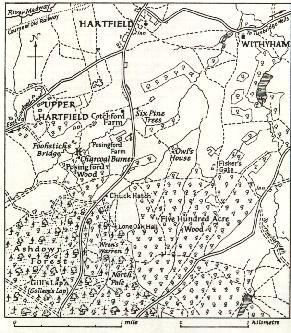
"Well, you’ll want a map then, won’t you...here you are," she said efficiently, adding a list of B&Bs and pointing across the street to a pay phone. "Do you have the proper coins?" she asked helpfully.
I did, and we called and made a reservation, sight unseen, at The Stairs Inn Farmhouse in Hartfield.
The Expotition, as it were, had officially begun.
It was back in 1926 that Alan Alexander Milne and his illustrator Ernest Shepard created Winnie the Pooh, followed two years later by The House at Pooh Corner. The stories came into my life in the late 1960s, though it wasn’t until recently that I learned of Ashdown Forest, a place tucked away in the English countryside that Pooh fans the world over made pilgrimages to for the sole purpose of seeing for themselves where it all began.
And now I was there. Driving into Hartfield (population about 1,000), there was no indication that this tiny village is the hub of Pooh country. Pretty cottages, quaint buildings, a 15th century farmhouse (The Stairs Inn, also a nice spot for breakfast, lunch and tea), and...wait! What was this? A little shop on the left called Pooh Corner!
A veritable gold mine of Pooh merchandise, you can lose a lot of pounds in this shop -- the monetary kind -- so beware. Owner Mike Ridley (whom we didn’t actually meet) offers a slick little brochure called "The Official Pooh Corner Guide" which includes a nice map for a pound fifty, though we got it free from the information lady in East Grinstead.
The shop itself dates back to the 1690s, and has been a Pooh shrine since the late 1970s. According to store literature, it was once a candy shop where Christopher Robin and his nanny traveled weekly for a treat. Since it’s about a mile from Cotchford Farm, Christopher rode on the back of a donkey (though he notes in his book, The Enchanted Places, that the animal was not the inspiration for Eeyore).
As for the shop today, it’s still a quaint place, although the help, I have to say, was a bit grumpy (especially for someone working in a teddy bear shop) and seemed not the type that’s friendly with bears. I wasn’t expecting more than a smile and a friendly hello, but neither was offered in the three visits we made to the store. Maybe you’ll have a better experience.
Anyway, after a quick freshening up and a snack (I decided right then and there that afternoon tea is a nicety we Americans ought to emulate), we headed down the narrow road into the forest. A slight drizzle seemed to be keeping any other tourists at bay, so we had the pathways to ourselves. The first stop: Poohsticks Bridge.
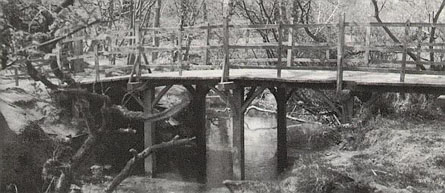 A wooden structure rebuilt in 1979, Poohsticks Bridge
looks a lot like Shepard’s illustration. To get to it you can take a 2.5-mile
footpath through meadows lined with split rail fences, or drive up B2026 to Maresfield.
About 2 miles up, pass a sign Chuck Hatch and after another 500 yards turn right SP March
Green and Newbridge,.you’ll find the Pooh Car Park (there’s also one for Piglet
further up the road) and you can follow the arrow sign pointing down a shady path through
the woods. The walk is lovely and takes about 20 minutes each way.
A wooden structure rebuilt in 1979, Poohsticks Bridge
looks a lot like Shepard’s illustration. To get to it you can take a 2.5-mile
footpath through meadows lined with split rail fences, or drive up B2026 to Maresfield.
About 2 miles up, pass a sign Chuck Hatch and after another 500 yards turn right SP March
Green and Newbridge,.you’ll find the Pooh Car Park (there’s also one for Piglet
further up the road) and you can follow the arrow sign pointing down a shady path through
the woods. The walk is lovely and takes about 20 minutes each way.
Heeding the advice of travelers before us, we picked up suitable twigs at the car park for a game of Poohsticks, because there are none to be found around the bridge. Since we had the place to ourselves, we enjoyed the tranquillity; though the stream itself wasn’t much more than a trickle, it wasn’t hard to imagine a small boy and his bear hanging over the rail, "just doing nothing" as they watched the stream slip by below.
Crossing the bridge, the path is said to eventually fork left (southwest for those with a sense of direction) to Ashdown Forest and right (northeast) to Cotchford Farm (private property), which we never did find.
From there, we headed to "the enchanted place at the very top of the forest," Gill’s Lap. Though it’s called Galleon’s Lap in the stories, there’s no doubt that this wooded area at the intersection of the B2026 and the road from Forest Row is the spot where Christopher Robin and Pooh went in the last chapter of The House at Pooh Corner to say good-bye.
If you go, plan to spend a day hiking about the area surrounding Gill’s Lap (bring a "piknick"). The fire roads make the going easy, but wear sturdy shoes.
More heathery and gorse bushy than foresty, it’s a pleasant walk on a nice day, and you can see for yourself the lone pine tree (called six pine trees in the story), the sandy pit where Roo plays (actually an old quarry), Eeyore’s gloomy place, and where the woozle wasn’t. You can also retrace the steps to the North Pole, and, with a little imagination, locate a Pooh Trap for Heffalumps near the lone pine.
As for the true enchanted place, a ring of trees numbering 63 or 64 (no one really knows, which, according to the stories, is what makes it enchanted), that’s there too, and you can spot it for miles around because of its unique profile against the sky. You can also, as noted by CR, sit down in its midst carelessly without getting prickled, which you can’t do in the rest of the forest.
Speaking of the forest, there are about 14,000 acres of it total, over half of which is accessible to the public (though no camping allowed), so if you’ve a penchant for exploring, it’s a good place to go.
A truly ancient forest, evidence of early habitation includes flint arrowheads and tools from before the Romans. During the Dark Ages, it was called Andreds Weald and described as "thick and inaccessible, with numbers of deer, swine, wolves and wild boar." Later, in 1268, it was vested in the crown and became the Royal Hunting Forest. The hilltop clumps were as good a lookouts for hunting wild creatures back then as they are for hunting heffalumps and woozles today.
Designated an area of outstanding natural beauty it’s protected today by a trust and an act of parliament designating a board of conservators whose duties, among others, are "To protect the forest from encroachment and to conserve the Forest as a quiet area of outstanding natural beauty."
Of course, the term "forest" is somewhat misleading in around the enchanted places. There are actually few trees, and lots of heather and gorse. At any rate, from the aforementioned ring of trees, walking around to your right, around the top of this hill, you’ll come to an area enclosed by a short post-rail fence. Toward the front lies a memorial plaque to A.A. Milne and Ernest Shepard. If you look across the valley to the right, you can see the 500-acre woods (called the 100-aker wood in the stories). The mound just below is where Rabbit’s friends and relations lived.
All of these areas are described and mapped out in "Two Pooh Walks," a handy little brochure put out by the Conservators of Ashdown Forest. Stop by the Ashdown Forest Centre at Wych Cross, Forest Row, where you’ll find all sorts of other interesting maps and guides to the forest. Of particular interest is a full scale map and guide to the forest -- handy if you plan to venture further afield, and a lovely, suitable-for-framing souvenir even if you don’t.
Getting There
You can take the train from London to Tunbridge Wells or East Grinstead and rent a car. Or you can rent a car at the Airport. From the airports (either Gatwick or Heathrow), take the M25 south to Exit 6, which is the A22. Continue south on the A22 to East Grinstead, where you can get maps and information at Tourist Information, not to mention some snacks at the Safeway. From there, head east on the A264 to the B2026, and then south on the B2026 to Hartfield.
For More Information:
Ashdown Forest Centre
Wych Cross
Forest Row
East Sussex RH18 5JP
Phone: (dialing from the U.S.) 011-44-01342 823583
British Tourist Authority
551 Fifth Ave., Suite 701
New York, NY 10176
800/462-2748
![[Up]](uparrw.gif)