Physical Characteristics

Zebras, horses and wild asses are all equids, long-lived animals that move quickly for their large size and have teeth built for grinding and cropping grass. Zebras have bodies like those of horses, but their manes are made of short, erect hair, their tails are tufted at the tip and their coats are striped.

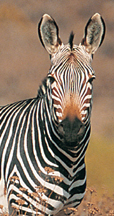
Three species of zebra still live in Africa, two of them are found in East Africa. The most widespread species in the east is Burchell's, also known as the common or plains zebra. The other is the Grevy's Zebra, named for Jules Grevy, a president of France in the 1880s who received one from Abyssinia as a gift. The Grevy's Zebra is now found mostly in northern Kenya. The third species, Equus Zebra , is the mountain zebra, found in southern and southwestern Africa.

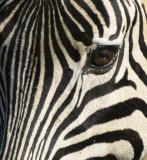
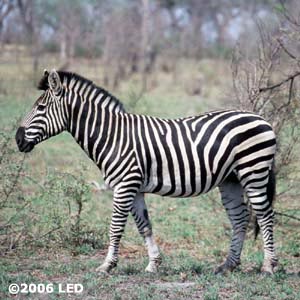
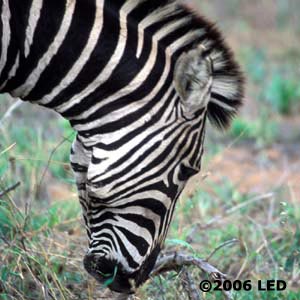
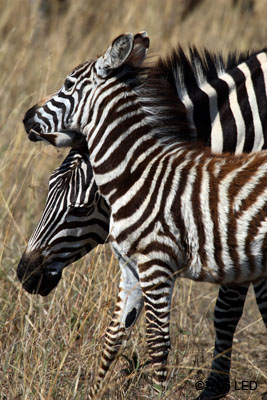
The Burchell's zebra is built like a stocky pony. Its coat pattern can vary in number and width of stripes. The stripes form disruptive coloration which breaks up the outline of the body. At dawn or in the evening, when their predators are most active, zebras look indistinct and may confuse predators by distorting distance. Their shiny coats block over 70% of incoming heat.
Diet

Although they are water dependent, the zebra is a very adaptable grazer, able to eat both short shoots and long flowering grasses. The zebra is often a pioneer, the first to enter, in a grassland community (tall or wet pastures). Wildebeests and gazelle follow once the zebras have cleared a path in the vegetation by trampeling and clipping.


Reproduction

Like most animal species, female zebras mature earlier than males. A mare may have her first foal at the age of three. Males are not able to breed until they are five or six years old. Mares may take twelve months to birth one foal. She nurses the foal for up to a year. Like horses, zebra are able to stand and walk shortly after they are born. Plains and Mountain zebra foals are protected by their mother as well as the head stallion and the other mares in their group. Grevy's zebra foals have only their mother for protection. Even with parental protection up to 50% of zebra foals are taken by predators, disease and starvation each year.


Eyesight

Zebra have excellent eyesight with binocular-like vision. It is believed that they can see in color. Like most ungulates the zebra has its eyes on the sides of its head, giving it a wide field of view. Zebras also have night vision although it's not as advanced as that of most of their predators.


Ears and Hearing

Zebra also have great hearing. Zebras tend to have larger and rounder ears than horses. Like horses and other ungulates, zebra can turn their ears in almost any direction to listen for sounds. Zebra ear movement can also signify a zebra's mood. When a zebra is in a calm or friendly mood, its ears stand erect. When it is frightened, its ears are pulled forward. When angry, the ears are pulled backward.


Resources


top

Hosted by www.Geocities.ws

1